

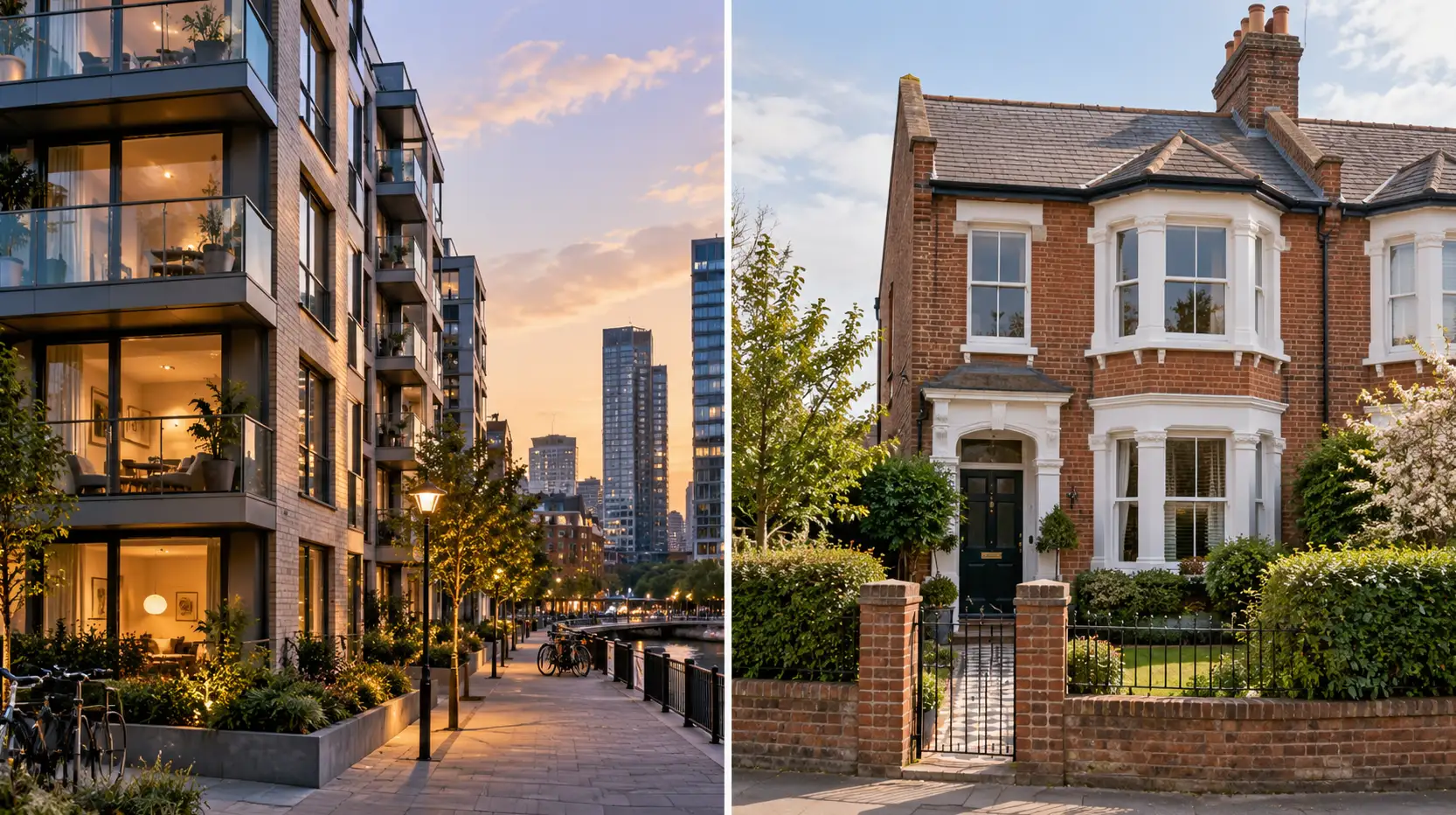
The choice rarely arrives as a clean either/or. It arrives as a specific pair of listings: a two-bed flat in the postcode you actually want, or a three-bed house twenty minutes further out at roughly the same price. Both are real options for the same budget, and the decision between them is less about which property type is objectively better and more about which specific things you’re willing to give up to get the other.
That matters particularly in the current market, because flats and houses have moved further apart on price. But a cheaper purchase price does not automatically make the flat the cheaper home to own, just as buying the house does not automatically make it the better long-term purchase. Location, tenure, ongoing costs, flexibility and the individual building can overturn the obvious answer surprisingly quickly.
The market figures below are UK data. The detailed leasehold discussion applies principally to England and Wales, where the ownership system for flats differs substantially from Scotland. Northern Ireland also has its own property law and conveyancing system, so buyers there should check the specific tenure and legal arrangements attached to the property.
The price gap has rarely made the trade-off this stark
Zoopla’s June 2026 analysis put the average UK flat at about £193,000 and the average house at £327,000 — a difference of £134,000. On its measure, a house now costs around 1.7 times as much as a flat, the widest ratio in its 30-year series. Zoopla’s 2026 house-versus-flat analysis
The gap varies enormously around the country. Outside London, the house-to-flat ratio rises to around 2.3 times. In the West Midlands, Zoopla puts a typical flat at £120,000 and a house at £296,000, giving the highest ratio of any English region at roughly 2.5 times.
London looks different. A typical house costs around 1.9 times a typical flat, but that apparently narrower ratio should not be confused with a small cash difference: Zoopla’s averages were £809,000 for a house and £416,000 for a flat, a gap of £393,000.
Affordability is shaping what buyers look for too. Zoopla reports that more than half of first-time buyers outside London are looking for a three-bedroom house, while seven in ten London first-time buyers are looking for a flat. Where houses remain within reach, some buyers can bypass the traditional starter-flat stage altogether. In London and other high-cost urban markets, flats continue to open locations and price points where comparable houses are simply beyond many buyers’ budgets.
None of that tells you which property is better. It tells you how much more — or less — you may have to compromise elsewhere to buy one.
What you’re actually trading, property type for property type
A flat can buy you access to a neighbourhood where the equivalent house is unaffordable. That can mean a shorter commute, better access to public transport or simply living in the part of a town or city you actually want rather than buying additional bedrooms somewhere you do not.
A house often buys something different: more separation from neighbours, more potential external space and greater scope to control the building as a whole. But none of those should be assumed from the word “house”. An urban terrace may have no off-street parking and a tiny garden; a modern flat may have a terrace, secure underground parking and excellent storage. The actual properties matter more than the stereotypes attached to them.
Maintenance works differently as well. In a leasehold flat, responsibility for the roof, structure, communal entrance, building insurance and shared areas will usually be allocated through the lease, with the cost recovered from leaseholders through service charges. A landlord or managing agent may organise the work, saving you from arranging every communal repair yourself, but that does not remove the cost or give you complete control over when expenditure occurs.
Before buying a leasehold flat, the Leasehold Advisory Service recommends checking not only the current service charge but what it pays for, whether there is a reserve or sinking fund and whether major works are planned. A reserve fund can spread the cost of expensive work such as roof replacement or external repairs, but not every building has one or has enough set aside for what is coming. LEASE: things to know before buying a leasehold flat
With a typical freehold house, you have much more direct responsibility for the building. A failed roof, drainage problem or exterior repair generally lands with you rather than being divided among leaseholders. That gives you control over maintenance decisions but also leaves you carrying the full financial exposure. Some modern freehold estates also have estate-management charges, so “freehold house” should not automatically be read as “no shared charges”.
This is why purchase price alone can be a poor comparison. A £250,000 flat with a substantial annual service charge and a £280,000 house whose owner must fund every repair personally are not meaningfully compared simply by looking at the £30,000 difference between the listings. Some flat charges pay for costs the house owner would incur separately anyway; others fund facilities and management the house does not have.
Service charges can also matter before you get to the question of whether you personally think they represent good value. MoneyHelper explains that mortgage lenders can take property outgoings including service charges, ground rent and estate charges into account when assessing affordability. A flat with unusually high recurring charges may therefore affect how much some buyers can borrow, which matters again when you eventually sell because future purchasers will be looking at the same regular expense alongside their mortgage. MoneyHelper: how lenders assess mortgage affordability
The better comparison is therefore the cost and responsibility of owning each particular property, not simply the price required to acquire it.
Flexibility for the future
A house often gives its owner more opportunity to adapt the property as circumstances change, but the word “house” does not guarantee planning potential.
A loft conversion, extension or garage conversion can depend on the building, planning rules, building regulations, title restrictions and sometimes other consents. There may simply be no physical room to do what you have in mind.
Flats normally have another layer to consider because the lease determines what alterations are permitted and which require the landlord’s consent. Structural work, changes affecting the exterior and some apparently modest internal alterations may require formal approval depending on the particular lease.
That can matter enormously if your next five to ten years might involve working permanently from home, starting a family, accommodating an older relative or simply needing another bedroom. A property you can grow into may save a move later. But future flexibility is valuable only if you are likely to use it; if you expect to move again regardless, paying more today for hypothetical extension potential may make less sense than buying the better-located property that suits you now.
The leasehold question sits underneath many flat purchases
Leasehold remains central to buying flats in England and Wales, which introduces due diligence that a straightforward freehold house does not normally require.
The number of years remaining on the lease matters. So do the current service charge, its history, any reserve fund, planned major works, ground rent where one remains payable, restrictions within the lease and the way the building is managed. LEASE’s specialist buying guidance is particularly useful here because it deals with those questions as part of the specific decision to buy a leasehold flat rather than as generic property-buying advice. LEASE: leasehold buying and selling guidance
A well-run flat with a long lease, stable charges, sensible reserves and transparent management can be a very different purchase from another flat at the same asking price in a building facing major expenditure and poor administration. A low service charge is not automatically evidence of good management either: it can mean costs are genuinely modest, or it can mean insufficient money is being collected for work that will eventually have to be funded.
“Share of freehold” does not make those questions disappear. In a typical arrangement, the flat still has its own lease even though the flat owners collectively own the freehold, often through a company. LEASE specifically warns that owners with a share of the freehold must still comply with the terms of their leases. It can give residents more influence over how the building is run, but it is not a substitute for reading the lease or understanding the building’s finances.
Ground rent also needs to be understood in its current legal context. The Leasehold Reform (Ground Rent) Act 2022 restricts ground rent on most qualifying new long residential leases in England and Wales to a peppercorn — effectively zero — but buying an older lease from an existing owner does not automatically remove whatever contractual ground rent lawfully applies to that lease. GOV.UK: Leasehold Reform (Ground Rent) Act 2022 guidance
For some flats in England, building safety adds another layer. Government protections under the Building Safety Act apply in relevant circumstances to historical safety defects in buildings above 11 metres or at least five storeys, but eligibility and liability depend on the building, defect and leaseholder circumstances. A buyer considering an affected building should establish the remediation position and what protections attach to the flat rather than relying on a general assurance that the issue is “covered”. GOV.UK: building safety leaseholder protections
Leasehold reform is moving quickly, but future policy should not be treated as though it has already rewritten the lease you are buying. The government published the draft Commonhold and Leasehold Reform Bill in January 2026. Among other measures, it proposes a £250 annual cap on qualifying existing ground rents before reducing them to a peppercorn after 40 years, wider use of commonhold and an end to leasehold for most new flats. As at September 2026, it remains draft legislation rather than a set of rules buyers can assume already applies to their purchase. GOV.UK: Draft Commonhold and Leasehold Reform Bill
That is why “flat versus house” eventually becomes “this flat versus this house”. The legal and financial quality of the particular flat matters at least as much as the category it belongs to.
Selling speed tells us something — but not everything
Zoopla’s 2026 analysis also found a difference in how quickly houses and flats were finding buyers.
Outside London in England and Wales, flats took a median 42 days to sell compared with 33 days for houses. In London, the figures were 45 days for flats and 37 for houses. Scotland showed a markedly different result: around 15 days for both property types.
These are marketing periods rather than the time from offer to legal completion, and they should not be treated as a guarantee about the resale prospects of an individual property.
Zoopla links some of the England-and-Wales difference to the greater complexity and uncertainty surrounding leasehold flats. Scotland, where the long-leasehold system does not apply, is an interesting comparison, but it does not prove that leasehold alone causes the whole gap. Local market conditions, property mix and Scotland’s different sales system can all matter.
The useful conclusion is narrower: flats in much of England and Wales are currently taking somewhat longer to find buyers than houses on Zoopla’s measure. If you expect to sell again relatively soon, the marketability of the individual flat — its lease, recurring costs, building condition, management and location — deserves particular attention.
A desirable flat in a strong location with straightforward tenure can still be considerably easier to sell than the wrong house in a weaker market.
Making the actual decision
The clearest way through this isn’t to ask which property type is generally better, because the honest answer is that neither is. Ask what you’re optimising for with this particular purchase.
If location, transport and access to a particular neighbourhood matter more to you than additional space, and the flat’s lease, building and recurring costs withstand proper scrutiny, it can be the stronger purchase even when a house is available for similar money further out.
If privacy, space, control and the ability to stay in the property as your circumstances change matter more, the house may be worth the location or price compromise — provided buying it does not leave your finances too stretched to maintain it.
The most useful comparison is often between the compromises you cannot easily undo.
You can redecorate either property. You may be able to replace a kitchen or change a bathroom. What you cannot cheaply change is the flat’s location, the way its building is managed, the financial structure written into its lease, the house’s commute, the absence of outside space or the fact that an extra bedroom you expect to need simply is not there.
The choice is genuinely a trade, not a hierarchy.
The useful question is which side of that trade you would resent more five years from now: compromising on the place you wanted to live, or giving up the space, privacy, control or financial simplicity you thought you wanted in order to live there.
This article provides general property information and does not constitute financial, legal or conveyancing advice. Lease terms, service charges, reserve funds, building-safety arrangements, estate charges and ownership structures vary substantially between individual properties and across the UK. Any flat or house you are seriously considering should be assessed on its own title, condition, ongoing costs and legal arrangements.

