

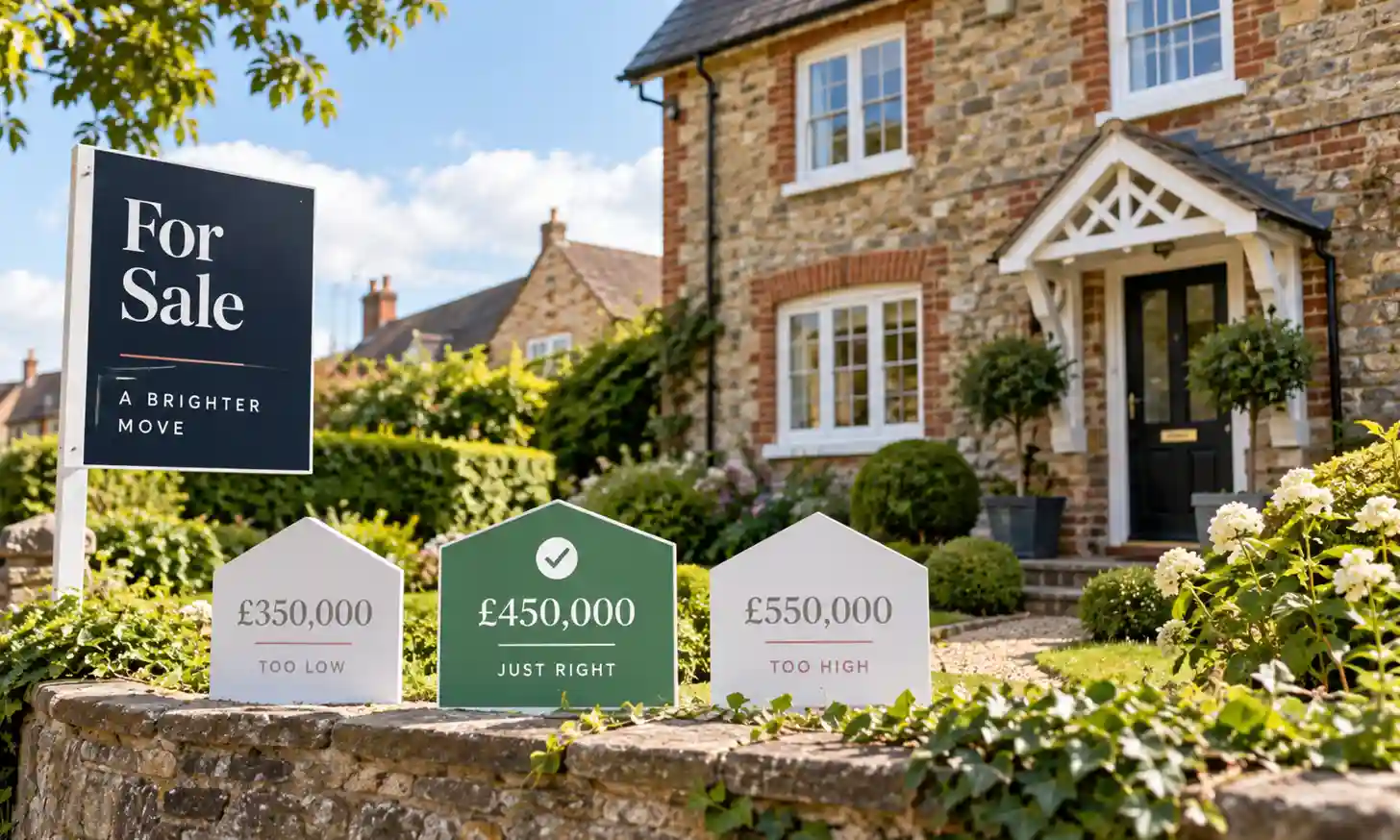
An asking price isn’t a valuation. It’s a decision — one influenced by evidence, but shaped just as much by strategy, timing and what a seller actually wants from the sale. Two homes on the same street, in near-identical condition, can reasonably carry different asking prices depending on whether the seller wants a quick, certain sale or is prepared to wait and test what the market will bear.
Treating the number an agent first suggests as an objective fact, rather than the opening move in a marketing strategy, is where a lot of sellers go wrong before the board even goes up.
What the price is actually measuring
Market value and asking price are related but not identical. Market value is an estimate of what a property should reasonably achieve in the current market, with recent completed sales of genuinely comparable homes providing some of the strongest evidence. Asking price is what a seller chooses to market at, informed by that evidence but adjusted for strategy — a figure designed to attract interest, encourage offers or, sometimes, test the upper edge of what buyers might pay.
Confusing the two leads to two common and opposite mistakes: sellers who assume the highest suggested figure must be correct because an agent said so, and sellers who assume any price below their own emotional sense of the home’s worth must be an insult.
There is another figure worth separating from both: what the seller needs from the sale.
If the mortgage, onward purchase and moving costs mean you need £450,000 to make the move work, that matters enormously to whether selling is financially viable. It doesn’t make the property worth £450,000. If the evidence says buyers are likely to value it closer to £425,000, the problem is with the economics of the move rather than the valuation of the house.
The place to start is genuine evidence, not opinion.
In England and Wales, HM Land Registry’s Price Paid Data records completed residential transactions. It shows what properties actually sold for rather than what neighbouring sellers originally hoped to achieve, which is all an asking price can tell you.
The figures still need interpreting. A house recorded as a three-bedroom semi may have a substantially larger plot, an extension or much better condition than yours, and completed-sale data inevitably looks backwards at transactions agreed some time earlier.
Current listings are useful for a different reason: they show what buyers will actually be choosing between now.
The two therefore belong together. Sold prices tell you what buyers have paid; current listings tell you what you’re competing with.
Scotland works differently enough to deserve a qualification. Most homes marketed there require a Home Report, whose Single Survey contains a surveyor’s valuation, while properties are commonly advertised as “offers over”, “offers around” or at a fixed price. The marketing figure and the surveyor’s valuation therefore shouldn’t automatically be treated as the same thing. Northern Ireland also has its own property data and selling process, so UK sellers should use evidence appropriate to the jurisdiction in which the property is actually being sold.
Online valuation estimates can be useful as another reference point, but they belong in the evidence pile rather than sitting above it. An automated estimate may draw on previous sales, property characteristics and local market data; it cannot necessarily see that one house has been comprehensively renovated while another hasn’t, that a rear garden backs onto a busy road, or that an extension has transformed how the house works.
If an online estimate differs sharply from several local agents who can support their figures with genuinely comparable sales, the useful question is why — not which number you prefer.
Why agents’ suggested valuations can vary so much
It’s common for three agents to value the same property three noticeably different ways, and this deserves a straightforward explanation rather than suspicion by default.
An agent’s suggested asking price is partly evidence-based and partly judgement. Different agents can reasonably read the same local market differently, particularly where the property is unusual or comparable sales are thin.
There is also a commercial reality: the agent carrying out the appraisal would generally like to win the instruction. A higher suggested figure can therefore be attractive to a seller choosing between firms, even when the evidence supporting it is less convincing.
That doesn’t mean agents are routinely dishonest. Government guidance for home sellers recommends obtaining several agent valuations and asking for evidence such as similar properties they have recently sold. It also makes the useful point that a high valuation does not guarantee that the price will actually be achieved.
The sensible response isn’t to pick the agent who names the biggest number. It’s to ask what sold evidence supports it.
If three agents independently arrive around £420,000–£430,000 and a fourth suggests £475,000, the fourth isn’t automatically wrong. But the difference needs explaining. What comparable sale supports it? How similar was that property? When did it sell? What is currently competing at that price?
A valuation backed by recent, genuinely comparable transactions is worth more than one backed by confidence alone.
And the lowest valuation isn’t automatically the least ambitious one. Sometimes it is simply the most realistic assessment of where buyers are.
The cost of pricing too high
An overpriced property doesn’t sit quietly waiting for the right buyer to come along — it changes how the property competes from the moment it appears.
Serious buyers tend to notice new listings quickly through portal alerts, saved searches and agents’ applicant databases. If the house enters the market substantially above where those buyers perceive its value, that first exposure has still happened; it has simply happened at the wrong price.
Overpricing can also put the property in front of the wrong competition. A house that looks compelling at £425,000 may look ordinary at £465,000 because buyers with £465,000 to spend are comparing it with larger, better-located or more comprehensively renovated alternatives.
The seller hasn’t merely asked for another £40,000. They’ve moved the property into another competitive set.
Starting high and reducing later isn’t necessarily a cost-free way of “seeing what happens”, either. Rightmove’s May 2026 market analysis found that properties which needed a price reduction were taking an average of 127 days to secure a buyer, compared with 36 days for those which had not needed one — a 91-day difference. That doesn’t prove the original price caused every delay, but it illustrates why initial positioning matters.
And even a buyer agreeing to an ambitious figure doesn’t necessarily settle the question.
Where the purchase depends on a mortgage, the lender may value the property below the agreed price. MoneyHelper notes that a buyer may then seek to change their offer. They may also need to find additional cash if the lender bases its lending on the lower valuation.
An accepted offer is therefore encouraging evidence of demand, but it isn’t always the final verdict on price.
The cost of pricing too low
The opposite mistake is less common but real.
Pricing below the evidence in the hope of generating competing offers can work, particularly where the property has broad appeal and the local buyer pool is deep enough to create genuine competition.
But competition cannot be manufactured simply by setting a low asking price.
In a slower market, or for an unusual property with a smaller pool of likely buyers, the result may simply be that the seller starts negotiating from a lower figure than was necessary.
This deliberately ambitious-low strategy therefore makes more sense where strong demand already exists than where the seller is hoping the price itself will somehow create it.
Again, Scotland needs to be read differently. An “offers over” figure below the Home Report valuation can be part of the normal marketing convention, particularly where several buyers may compete through a closing date. It isn’t necessarily the equivalent of deliberately underpricing an English or Welsh listing.
Factors that genuinely move the number
Beyond the headline comparables, several things reasonably adjust where a seller should sit within a sensible range.
Condition and presentation. A well-maintained, well-presented home can reasonably command a figure towards the top of the evidenced range; a property needing obvious work should have that reflected rather than being priced as though buyers simply won’t notice.
Presentation can help buyers recognise value. It doesn’t erase expensive maintenance.
Micro-location. Two houses on the same road can differ meaningfully because of traffic, outlook, parking, plot, orientation, school catchment or proximity to a busy junction. Broad-area averages miss this; good comparable evidence shouldn’t.
Genuine improvements. An extension, loft conversion or well-executed renovation can justify a premium over unmodified comparables — but only where buyers value what has been added.
The fact that £80,000 was spent on an extension does not mean the house is automatically worth £80,000 more. Cost and value aren’t the same measurement.
Usable accommodation. Bedroom count alone can conceal substantial differences. Two four-bedroom houses aren’t equivalent if one has four genuinely useful rooms and the other has gained the fourth at the expense of storage or sensible living space. Floor area, layout and plot all matter.
How the price sits against search bands. Buyers commonly use portal filters with round-number ceilings — £300,000, £400,000, £500,000 and so on. A property priced just beyond one of those thresholds may disappear from searches being carried out by otherwise plausible buyers.
That doesn’t mean every £505,000 house should automatically be marketed at £500,000 or below. But where the evidence already places a property close to a common search threshold, the effect on visibility is worth discussing with the agent rather than treating a few thousand pounds as meaningless.
When to change the price, and how
A price review makes sense when the evidence changes, not simply when the seller becomes impatient.
A quiet fortnight could be worrying in one market and entirely normal in another. What matters is how the property is performing compared with the homes competing for the same buyers.
The pattern of interest can be particularly useful:
| What is happening? | What it may be telling you |
|---|---|
| Very little interest and few viewing enquiries | Price may be outside buyers’ expectations, although the photography, particulars and marketing exposure should also be checked |
| Plenty of online interest but few viewings | Buyers may like the basic proposition but see something in the price, presentation or location that stops them taking the next step |
| Viewings are happening but nobody offers | The property is reaching plausible buyers, but what they see in person may not support the asking price |
| Several offers cluster around a similar lower figure | That cluster is useful market evidence, even if it is below what the seller hoped to achieve |
| Comparable nearby homes sell while yours remains available | Price, condition, position and marketing all deserve an honest comparison |
None of those patterns proves the price is wrong on its own. But it gives the seller something more useful than simply counting the weeks.
Buyer feedback matters too. Government selling guidance recommends asking the agent for viewing feedback and reconsidering price, condition and marketing where a property isn’t generating offers.
New comparable evidence can change the position as well. If a genuinely similar property comes to market below yours or another completes at less than expected, that is new information whether or not it supports the figure you originally hoped for.
If a reduction is needed, it should be meaningful enough to change something.
A series of small cuts can make the property look as though the seller is slowly being forced towards a figure buyers reached weeks earlier, while failing to move it into a new portal search band or give fresh buyers a reason to reconsider it.
One considered repricing, supported by new evidence, is generally easier to explain than a trail of nervous adjustments.
There is no universal formula
“Price 10% above what you’ll accept, because buyers always negotiate” is one of the most common pieces of advice sellers receive, and it’s a poor substitute for genuine analysis.
Some buyers negotiate. Some well-priced properties sell at or close to the asking price. Some generate competition. Others need adjustment before the market responds.
The percentage tells you nothing about the underlying value.
Nor should the asking price simply be reverse-engineered from the seller’s private minimum. If you would accept £400,000, that doesn’t automatically make £440,000 a sensible asking price. The market has no obligation to begin ten per cent above the number you secretly want.
The better approach is to establish a realistic range from recent comparable evidence, understand the properties competing for the same buyers, and then decide deliberately where within or around that range the marketing price should sit.
A seller prioritising speed and certainty may sensibly choose a different position from one with no onward deadline who is prepared to test demand. Neither approach is inherently wrong if the trade-off is understood.
The right asking price is the one grounded in genuine comparable evidence, adjusted honestly for the property’s condition, location and competition, and chosen deliberately for the outcome the seller actually wants — not a fixed percentage bolted onto a number that was never properly evidenced in the first place.
Set it that way and the asking price starts doing the job it was supposed to do: bringing the right buyers into the conversation.
Important: This article provides general property information, not a formal property valuation, financial, legal or estate-agency advice for your individual circumstances. Property values, evidence and selling practices vary by location, market conditions and jurisdiction. Where an accurate valuation is particularly important, consider appropriate professional advice based on the specific property and current local evidence.

