

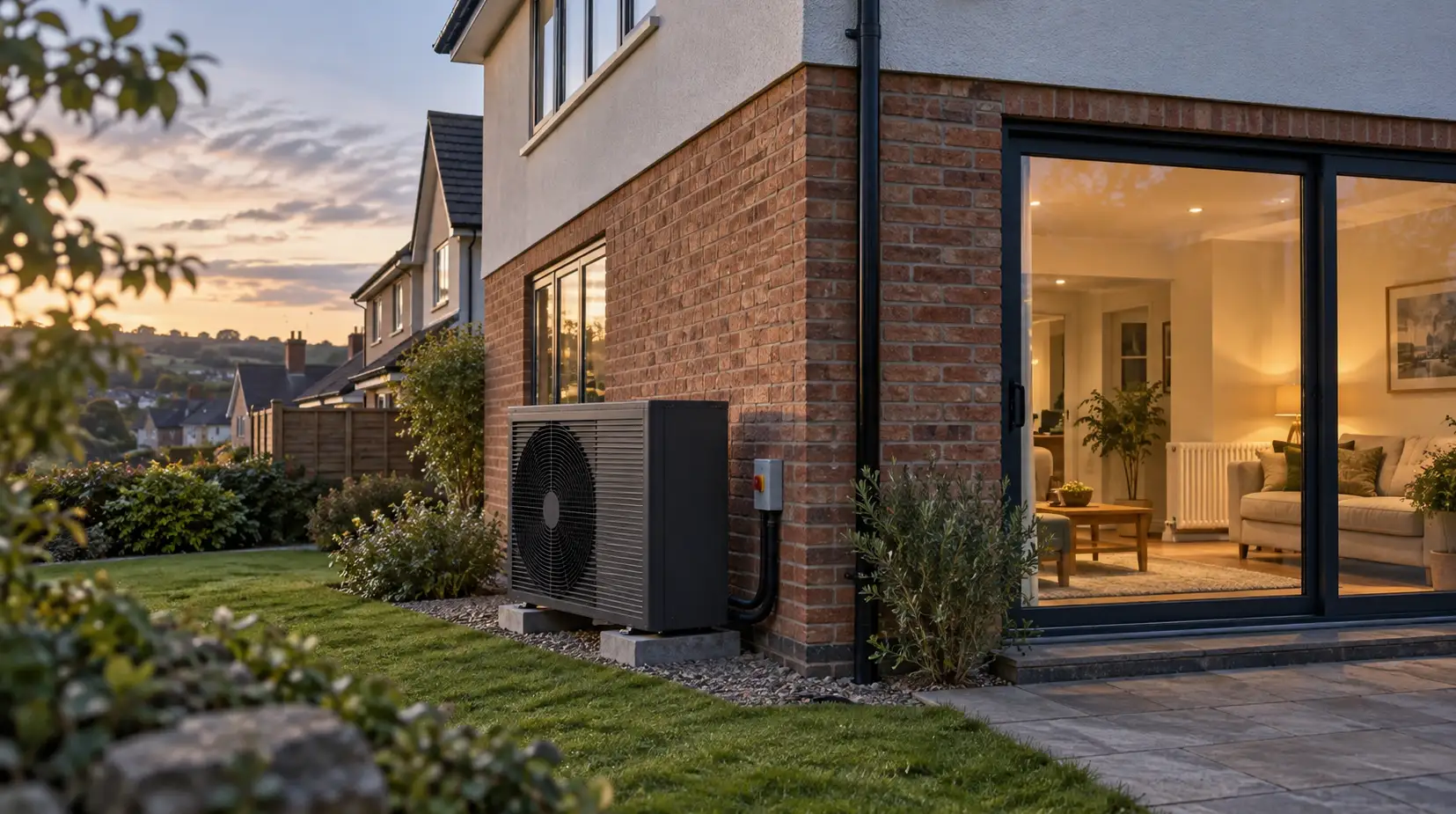
“Will it actually heat my house?” is the question underneath almost every heat pump conversation, and it’s a fair one, because the honest answer is: it depends far more on how the system is designed for the specific property than on the underlying technology itself. Heat pump technology works, reliably, across a huge range of UK housing, including plenty of older homes. Whether a specific installation heats a specific house properly is a separate question, and it’s the one this article is actually about.
Enough technology to make sense of the decision
An air source heat pump extracts heat from the outside air, even in cold weather, and uses it to heat water for radiators, underfloor heating, or a hot water cylinder. A ground source heat pump does the same thing using pipework buried in the garden, generally at higher upfront cost but with steadier source temperatures, and needs meaningful outdoor space for a ground array or suitable access for boreholes.
Both run at their most efficient producing water at lower temperatures than a traditional gas boiler — air-to-water heat pumps commonly operate heating circuits around 35–45°C, although the actual design temperature depends on the system and property — and efficiency is generally described using a seasonal performance figure, often called SCOP.
A SCOP of 3, for instance, means roughly three units of heat delivered for every unit of electricity consumed across the defined seasonal test conditions. Real household performance can differ from the product figure because system design, weather, controls and how the home is used all matter.
This lower flow temperature is the single fact that explains almost every other consideration in this article. Energy Saving Trust’s heat pump installation guide gives a useful overview of how radiators, hot-water storage, plumbing and electrical work fit together.
Whether the property suits it: a real question, not a formality
Suitability isn’t primarily about whether a house is old or new, though age and construction genuinely feed into the picture. What actually matters is the home’s heat loss — how much heat escapes and needs replacing to keep it warm — since a heat pump has to be sized to that specific demand.
This connects directly to insulation and draught levels, covered in our companion articles on insulation priority, and to more specific factors: whether existing radiators are adequately sized for lower-temperature heating or underfloor heating is already in place, whether there’s a suitable location outside for the outdoor unit with appropriate airflow and an acceptable noise impact, whether the property has, or has room for, suitable hot-water storage where the chosen system requires it, and whether the existing electrical supply and consumer unit can accommodate the installation.
For an air-to-water system replacing a combi boiler, the hot-water question can be particularly significant because the property may currently have no cylinder at all. A conventional cylinder is common, but other storage arrangements can sometimes be designed where space is difficult.
A proper room-by-room heat-loss calculation, carried out by a competent installer before any commitment, is what actually answers these questions for a specific property — not a general assumption based on the house’s age or type.
What makes a heat-pump installation easier — and what needs closer investigation?
| Factor | More straightforward when… | Needs closer design when… |
|---|---|---|
| Heat loss | The home has moderate heat demand and obvious fabric weaknesses have been addressed | Heat loss is high or poorly understood |
| Radiators | Existing emitters are already generously sized | Several rooms rely on small radiators designed around high boiler temperatures |
| Hot water | Suitable cylinder/storage space already exists | A combi boiler currently supplies hot water and internal space is tight |
| Outdoor unit | There’s a sensible position with good airflow | Space, appearance or proximity to neighbours creates constraints |
| Electrical supply | Existing supply can readily accommodate the system | Additional electrical work or network involvement may be required |
| Controls and habits | The household is comfortable with steady, lower-temperature heating | Occupants expect rapid bursts of heat for short periods |
None of the right-hand column automatically means “no heat pump”. It means the design work matters more and the total project may become more involved.
In England, many domestic air source heat pumps can be installed under permitted development rights if the relevant conditions are met, including the applicable MCS noise standard, but restrictions remain for situations including listed buildings and certain protected locations. The Planning Portal heat-pump guidance is worth checking before assuming planning permission is either definitely required or definitely unnecessary.
Radiators: a real concern, not automatically a total re-plumb
This is usually the first worry homeowners raise, and it deserves a straight answer. Because a heat pump runs most efficiently at lower flow temperatures than a boiler, radiators originally sized for a hot, high-temperature system can sometimes struggle to deliver the same warmth at the heat pump’s lower operating temperature — which is why radiator upgrades, or additional radiators, commonly feature in heat pump installation quotes.
But it’s inaccurate, and unnecessarily alarming, to claim every heat pump installation requires replacing every radiator in the house.
A proper heat-loss and emitter calculation, room by room, determines which radiators are genuinely undersized for the proposed system and which are already adequate. In a reasonably well-insulated home, this can be a fairly modest number, while in a leakier, larger property, it can be a more substantial part of the project.
And a larger radiator doesn’t necessarily mean sacrificing considerably more wall space: replacing a single-panel radiator with a double- or triple-panel version can substantially increase heat output from a similar footprint.
Some heat pump models are also capable of operating at higher flow temperatures, which can make harder-to-adapt properties easier to accommodate, although running a heat pump hotter will generally reduce its efficiency compared with operating at lower temperatures.
Comfort: genuinely different, not automatically worse
A heat pump-heated home tends to feel different from a boiler-heated one, and it’s worth understanding this honestly rather than glossing over it. Rather than short bursts of intense heat from a boiler firing up and cooling down, heat pumps generally run for longer periods at a steadier, lower output, aiming to maintain a more consistent internal temperature rather than large swings between hot and cold.
Many people who make the switch describe this as more comfortable once they’ve adjusted their expectations and habits, particularly around allowing the system to maintain temperature rather than repeatedly switching it completely off and expecting a rapid recovery.
It’s a genuine adjustment, not simply an inferior version of boiler heating, and it’s worth going in with a realistic sense of what to expect rather than either an overly promotional picture or an assumption that it will feel identical to what came before.
Government evaluation of Boiler Upgrade Scheme installations has also found high overall satisfaction among participating property owners after living with their systems, although individual experience still depends heavily on the quality of the particular installation and home.
Running costs: it depends, and anyone promising otherwise is oversimplifying
This is the area where the most misleading claims circulate in both directions. Whether a heat pump reduces your bills depends on several things acting together: the system’s actual achieved efficiency, which depends heavily on design and installation quality as well as the equipment; the property’s heat demand; the electricity tariff in use; and — critically — what fuel is being replaced.
Electricity currently costs considerably more per unit than mains gas in Great Britain, but a heat pump delivers several units of heat from each unit of electricity it buys. That means the relevant comparison isn’t simply the electricity price against the gas price.
A useful approximation is:
Heat-pump cost per unit of useful heat = electricity unit price ÷ achieved SCOP
For a boiler:
Gas cost per unit of useful heat = gas unit price ÷ boiler efficiency
At Ofgem’s 1 July to 30 September 2026 average Direct Debit price-cap rates, electricity is 26.11p/kWh and gas is 7.33p/kWh. If, purely for illustration, a gas boiler delivers 90% seasonal efficiency, its fuel cost works out at roughly 8.1p for each useful kWh of heat.
That gives this simplified comparison:
| Example | Approximate fuel cost per useful kWh of heat |
|---|---|
| Gas boiler at 90% efficiency | 8.1p |
| Heat pump at SCOP 2.5 | 10.4p |
| Heat pump at SCOP 3.0 | 8.7p |
| Heat pump at SCOP 3.2 | 8.2p |
| Heat pump at SCOP 3.5 | 7.5p |
So, at those particular unit rates, heat-pump/gas fuel-cost parity lands at roughly a SCOP of 3.2, before considering standing charges, specialist heat-pump tariffs, solar generation or the possibility of removing the gas supply altogether.
But this is deliberately a snapshot, not a permanent break-even rule. Ofgem has already announced different gas and electricity rates from October 2026, and specialist tariffs can change the calculation considerably. The current figures can be checked through Ofgem’s energy price-cap unit rates.
That is why a claim such as “a heat pump needs SCOP X to beat gas” is only meaningful once the tariff assumptions and boiler efficiency behind it are stated.
Where a heat pump replaces direct electric heating, the running-cost case can be particularly strong because resistance heating typically produces roughly one unit of heat from each unit of electricity bought. Replacing oil or LPG can also produce attractive economics in many homes, but prices for those fuels vary and shouldn’t be treated as fixed in the same way as the regulated default-tariff comparison above.
Anyone claiming heat pumps universally and automatically cut bills for every household, regardless of what they’re replacing, is oversimplifying; so is anyone claiming they never do.
What installation actually costs, before support
A fully installed air source heat pump remains a significant capital purchase. Recent Boiler Upgrade Scheme installations have typically been around the low-£13,000s before grant, although the actual figure varies widely with property size, heat demand, system specification and the additional work the house needs. The government’s Boiler Upgrade Scheme statistics publish current installation-cost data alongside scheme uptake.
The crucial budgeting point is to compare whole-project quotes, not simply the price of the heat-pump unit.
A quotation may need to include some combination of a suitable hot-water cylinder or alternative storage, radiator upgrades, pipework changes, electrical work, controls, groundwork and making good. Some homes need relatively little beyond the core installation; others need substantially more.
Ground source systems generally cost more upfront than air source, reflecting the additional ground array, trenching or borehole work involved.
For a homeowner comparing quotations, the meaningful number is therefore:
total installation cost – grant = what you actually have to fund
rather than the advertised price of the heat pump itself.
Current government support — check this before relying on it
At the time of writing, the Boiler Upgrade Scheme provides grants towards qualifying installations in England and Wales.
The current rates are:
| Qualifying installation | Current BUS support |
|---|---|
| Air-to-water heat pump | £7,500 |
| Ground or water source heat pump | £7,500 |
| Eligible off-gas air-to-water or ground source system replacing oil or LPG | £9,000 until 31 March 2027 |
| Qualifying residential air-to-air heat pump | £2,500 |
The higher £9,000 rate applies to qualifying properties with no mains gas connection that are replacing oil or LPG heating; it is not a blanket £9,000 grant for every off-grid home.
The government’s current Boiler Upgrade Scheme grant rates should be checked before relying on any figure in a real budget.
The scheme is installer-led: for a BUS-funded installation, the installer must be MCS certified, applies for the voucher on the property owner’s behalf and deducts the grant from the amount the owner pays. Government guidance also recommends getting quotes from more than one installer.
Scotland runs its own support arrangements through Home Energy Scotland, while the former Boiler Replacement Scheme in Northern Ireland is closed and support there should be checked separately.
Qualifying installations of heat pumps in Great Britain also currently benefit from 0% VAT until 31 March 2027. The government’s VAT guidance for energy-saving products explains the current relief.
Grant levels, VAT treatment and eligibility are exactly the sort of things that change, so verify all three at the point you’re actually obtaining quotations rather than building a long-term budget around an article written today.
Old homes: challenging two opposite myths at once
“Heat pumps can’t work in old homes” isn’t accurate — plenty of period properties, including some with solid walls and modest insulation, run heat pumps successfully, particularly where the fabric has had appropriate improvement and the system has been properly designed around the property’s actual heat demand rather than a generic assumption.
But the opposite claim — that any old home is automatically ready for a heat pump without further thought — isn’t accurate either.
A poorly insulated, draughty older property with undersized radiators and no fabric improvement planned is a genuinely harder, sometimes more expensive proposition, and skipping a proper heat-loss assessment on this kind of property in favour of just fitting the unit is a common route to disappointing results and inflated running costs.
It’s also worth separating “the home must be completely insulated first” from “reducing sensible heat loss improves the proposition.” A house doesn’t need to meet a particular age or EPC stereotype before heat-pump technology can work, but unnecessary heat loss has to be supplied by the heating system somehow. Reducing it can lower the required output, ease the job of the emitters and improve comfort regardless of which heating technology is ultimately chosen.
The honest position sits between the two myths: an older home’s suitability depends on its actual condition and on the quality of the design work behind the installation, not simply on its age.
Heat pumps and solar together, briefly
A heat pump meaningfully increases a home’s electricity consumption, which can improve the opportunity to use more solar generation within the property rather than exporting it.
There is an important seasonal limitation, though: heat demand is highest during winter, while solar generation is lowest. Solar panels therefore don’t simply make heat-pump electricity free throughout the heating season.
The interaction becomes more interesting when the household can use generation intelligently — for example heating hot water during productive daylight hours, combining solar with suitable battery storage, or taking advantage of time-of-use tariffs and controls.
This interaction is worth being aware of when planning either investment, though the detailed economics of solar and battery storage are covered properly in our dedicated article on that decision.
Why installer quality matters as much as the equipment
A heat pump’s real-world performance depends heavily on the quality of the design work behind it: an accurate room-by-room heat-loss calculation, correctly sized emitters, an appropriate design flow temperature, proper commissioning once installed, and sensibly configured controls afterwards.
Two identical heat pump units, installed to different standards of design and commissioning, can perform very differently in practice — one running efficiently and keeping the house comfortable, the other working harder than it should and delivering disappointing bills.
This is exactly why the choice of installer, and the thoroughness of the survey and design process they carry out before installation, matters at least as much as the specific brand or model chosen.
Questions worth asking before you accept a heat-pump quote
Don’t just ask “what make of heat pump is it?” Ask:
- Can I see the room-by-room heat-loss calculation?
- What outside design temperature have you used?
- What flow temperature is the system being designed around?
- Which radiators need replacing, and why?
- What seasonal efficiency are you predicting for this installation?
- What is the hot-water solution, and where will it go?
- Does the outdoor-unit position satisfy the relevant planning and noise requirements?
- Does the quote include all electrical, plumbing, cylinder and making-good work?
- What controls will I have, and how should I actually operate them?
- What happens after commissioning if individual rooms don’t reach the designed temperature?
For a BUS-supported installation, using an MCS-certified installer is mandatory. Even where a grant isn’t involved, the government’s heat-pump installer service provides a useful starting point and explicitly recommends obtaining more than one quote.
The cheapest quote isn’t automatically poor and the highest isn’t automatically good. What matters is whether the design assumptions behind the number are visible and make sense.
The question actually worth asking
Not “does heat pump technology work,” which is well-established, but “has this specific system been properly designed for this specific house, this household’s actual heat demand, and the fuel it’s replacing.”
Get that design work right, and a heat pump can be a genuinely comfortable, often lower-carbon, sometimes lower-cost way to heat a home. Skip it in favour of simply swapping in the equipment, and the same underlying technology can leave a household disappointed regardless of how well it would have performed with proper design behind it.
This article provides general guidance on domestic heat pumps and does not constitute engineering, financial or investment advice. Installation costs, performance and running costs depend on the individual property, system design, household behaviour and energy tariff. Boiler Upgrade Scheme rates and tax treatment are correct at the time of writing but should be checked again before committing to expenditure.

