

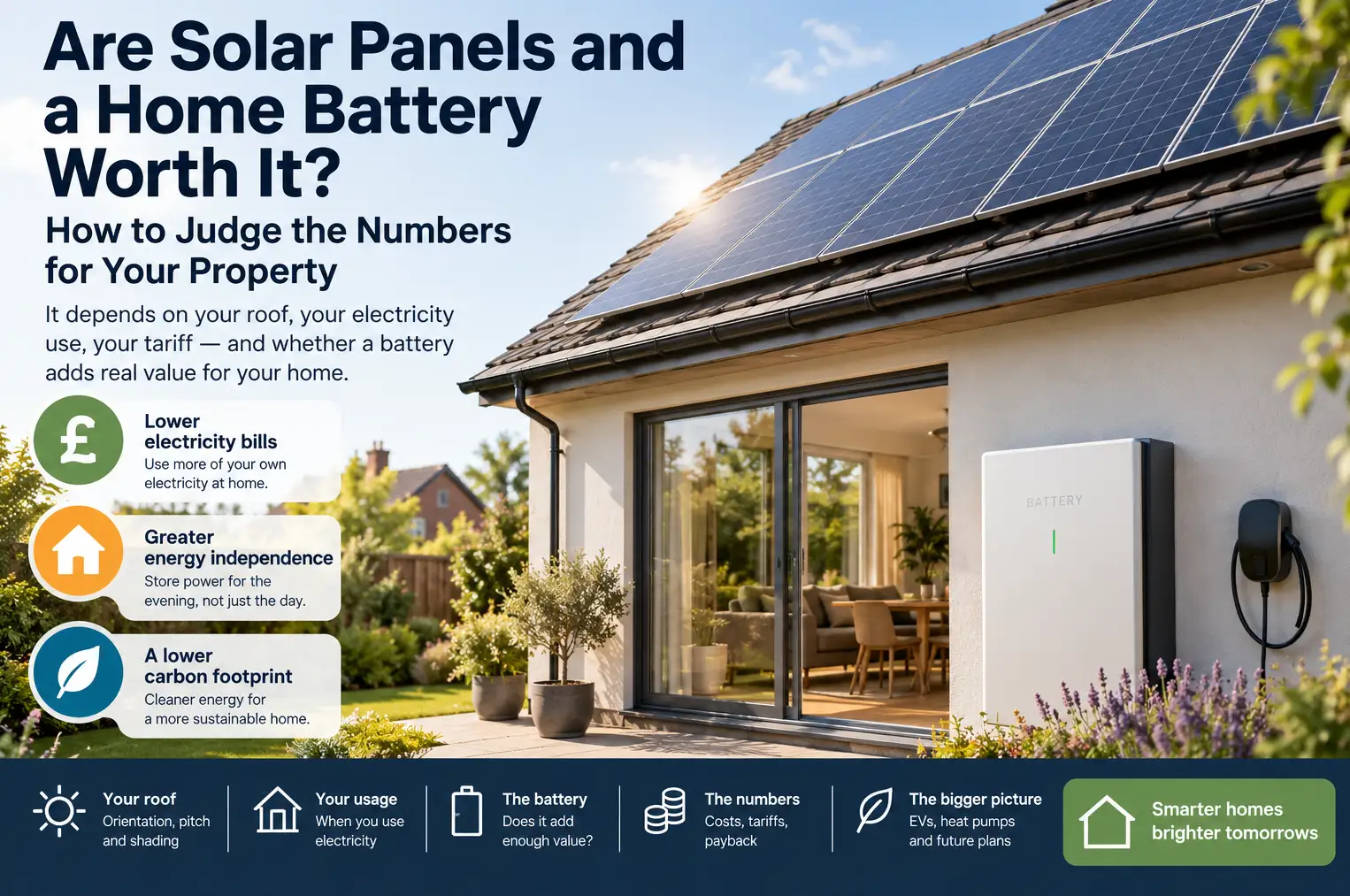
Two neighbouring houses, similar size, similar roofs, get quoted for the same solar and battery system. One family will genuinely benefit financially within a reasonable number of years. The other, working from home with heavy daytime electricity use and a south-facing roof with no shading, might see a payback timeline meaningfully shorter still — or, on a shaded, poorly oriented roof with low daytime consumption, considerably longer than either. “Is solar worth it” doesn’t have one national answer, because the honest answer depends on a specific set of facts about a specific property and a specific household, not on solar technology in general.
What actually drives the economics
The genuine determinants of whether solar and battery storage make financial sense for a particular home include: roof orientation and pitch, how much shading affects the available roof area through the day and across seasons, how much usable roof space actually exists, the size of system that space and budget allow, broad location within the UK (affecting how much sunlight the panels receive over a year), current electricity consumption, and — this is often underweighted — when through the day that electricity is actually used, since a household mostly out at work during daylight hours gets a very different result from one working from home with the kettle, the washing machine and the laptop running while the sun’s out.
The export rate available, any battery’s size and cost, the household’s current and likely future electricity tariff, and whether a heat pump or electric vehicle is on the horizon all factor in too. Any single, universal payback figure quoted without reference to these specifics should be treated as a rough illustration, not a genuine forecast for a particular roof.
Solar only, solar plus battery, or battery without solar?
These are actually three different financial decisions:
| Option | Where the value mainly comes from | Most attractive when… | Main thing to test |
|---|---|---|---|
| Solar without battery | Avoiding imported electricity and receiving export payments | You can use a meaningful amount of solar generation while it’s being produced | How much generation will you use directly versus export? |
| Solar + battery | Using more of your own generation later, plus possible tariff flexibility | Daytime generation and evening demand don’t naturally coincide | Does the extra saving justify the battery’s extra cost? |
| Battery without solar | Buying electricity cheaply and using it during dearer periods | There’s a worthwhile time-of-use tariff spread and enough consumption can be shifted | Is the tariff difference large enough after battery losses and degradation? |
The useful question isn’t therefore simply “should I buy solar and a battery?” It’s whether each component earns its place in the system you’re actually being quoted.
Energy Saving Trust’s solar panel calculator is useful at this early stage because it estimates suitability, likely system size, generation, costs and savings from the property’s location and household circumstances rather than relying on one national figure.
Solar without a battery: still a genuinely rational choice
Installing solar panels without a battery is a lower upfront cost, and it can still make good financial sense, particularly for a household with meaningful daytime electricity use that can directly consume a decent share of what the panels generate as it’s produced — self-consumption, in the jargon.
Electricity used directly from the panels as it’s generated effectively displaces electricity that would otherwise be bought at the full import rate, which is usually a highly valuable use of solar generation.
Surplus generation beyond what the household uses at that moment is exported to the grid and can be paid for separately where the installation qualifies and the owner signs up to an appropriate export tariff, covered below.
For a household with modest daytime usage, solar without a battery can still be worthwhile — it simply exports more of its generation and self-consumes less, which changes the numbers rather than ruling the investment out.
That also means a battery isn’t automatically necessary to make solar financially sensible. It needs to justify its own additional cost rather than being treated as an inseparable part of buying panels.
Solar plus battery: what storage actually buys
A battery lets a household store daytime solar generation that isn’t used immediately, and draw on it later in the evening rather than exporting it first and then buying electricity later.
Where the export rate is lower than the electricity price that would otherwise be paid after dark, this can meaningfully increase the financial value of the solar generation kept within the home. A battery can also allow a household on a time-of-use tariff to charge from cheap off-peak grid electricity and use it later, independent of solar generation entirely.
Against this, a battery adds real cost on top of the solar system itself, and it’s worth going in with realistic expectations about the technology: no battery converts stored energy back to usable electricity with perfect efficiency, some energy is lost in charging and discharging, the usable capacity can be lower than the headline nominal capacity, performance gradually degrades over years of use, and warranty terms and expected lifespan vary meaningfully between products and are worth comparing carefully rather than assumed to be equivalent across quotes.
Energy Saving Trust’s current battery storage guidance makes the same fundamental point: batteries can produce significant savings, but those savings aren’t automatically enough on their own to justify the additional cost.
This is why a quote for solar plus battery is worth asking to see with the battery economics separated out:
- expected annual saving from solar without the battery;
- additional expected saving created by adding the battery;
- additional battery cost; and
- assumptions about electricity tariffs and battery use behind that calculation.
Otherwise a strong financial case for the panels can easily disguise a much weaker — or occasionally stronger — case for the battery itself.
Battery storage without solar: a genuine, separate option
It’s worth knowing this exists as its own decision, distinct from solar. A battery can be charged from the grid during cheap off-peak periods, on tariffs designed for exactly this pattern, and then used to cover the household’s consumption during more expensive peak periods — effectively arbitraging the price difference between cheap and expensive electricity through the day, with no solar generation involved at all.
Whether this makes financial sense depends heavily on how large the gap is between the specific tariff’s cheap and expensive rates, and on how much of the household’s consumption can realistically shift to draw from the battery during peak hours rather than directly from the grid.
Battery round-trip losses need to be included in that calculation as well: buying 1kWh cheaply does not mean the full 1kWh will later emerge from the battery for use in the home.
It’s a genuinely useful option for some households, but it isn’t automatically worthwhile for everyone on every tariff — the maths needs running against the household’s actual usage pattern and the specific tariff being considered.
Export payments: understand what’s actually on offer
Surplus solar generation not used by the household, and not stored in a battery, can be exported to the grid.
In Great Britain, eligible small-scale generators can apply for payment through the Smart Export Guarantee (SEG), which replaced the export-support route available to new installations after the older Feed-in Tariff scheme closed to new applicants.
It’s worth being clear about how SEG actually works, since it’s often confused with its predecessor: payments are not automatic. The homeowner needs to apply to a SEG licensee, and the installation has to meet the eligibility requirements.
Mandatory SEG suppliers must offer at least one qualifying tariff, but the government doesn’t set one national export rate. Suppliers decide their own rates, contract terms and tariff structures, with a SEG tariff required to remain above zero.
You can also choose a SEG provider different from the company supplying the electricity you buy from the grid.
Ofgem maintains the current Smart Export Guarantee guidance for generators and recommends shopping around rather than assuming your existing electricity supplier offers the best export arrangement.
That shopping-around point has become increasingly important because the difference between export tariffs can materially affect the value of adding a battery. If an attractive export tariff pays well for surplus solar, storing every spare unit at home may be less valuable than a sales quotation assumes. If the export rate is poor relative to the later import price, increasing self-consumption can become considerably more valuable.
Northern Ireland is different: the statutory Smart Export Guarantee does not operate there. Microgenerators should instead check the export arrangements available from relevant electricity suppliers.
If an existing installation predates the closure of the Feed-in Tariff scheme, don’t assume it should simply be “switched to SEG”. A FiT-accredited system can continue receiving its generation payment and, if eligible, the owner can opt out of the FiT export payment and instead receive SEG payments for exported electricity.
You cannot receive both FiT export payments and SEG payments for the same exported electricity.
Whether changing the export arrangement is worthwhile therefore depends on the particular FiT export payment, whether export is currently deemed or metered, the SEG tariff available and any metering requirements. Ofgem’s Feed-in Tariff guidance explains the interaction.
Why payback estimates deserve real scepticism
Any solar or battery payback figure rests on assumptions about the future — future electricity prices, future export rates, how the household’s usage pattern might change, and the system’s actual output over its lifetime, none of which can be forecast with genuine precision.
A payback calculation is only ever as good as the assumptions feeding it, and a quote showing an unusually short, confident payback period is worth interrogating rather than simply accepted at face value — ask specifically what assumptions about future prices and usage the figure rests on.
This isn’t a reason to dismiss solar economics altogether; it’s a reason to treat any single number as an illustration of the shape of the investment rather than a guarantee.
What current national figures can — and can’t — tell you
Some current figures are still useful as a sense-check.
Energy Saving Trust currently puts the cost of a typical domestic solar PV system at around £7,600, while its recent battery guidance gives around £4,600 as an indicative cost for a 5kWh battery system. Both are broad averages, not quotations for a particular home.
Its current solar modelling, using July 2026 energy prices and including export payments, produces illustrative payback periods of roughly 9 to 12 years across several example Great Britain locations and household occupancy patterns. Its solar panels guidance publishes the assumptions and examples.
That is useful context, but not a promise that your £7,600 system pays for itself in nine years.
A homeowner should still ask the installer to show at least these five numbers:
- Predicted annual generation in kWh
- Assumed percentage used directly in the home
- Assumed export volume and export tariff
- Assumed import electricity price
- Total installed cost, including any battery
For a battery quote, add a sixth:
- How much extra annual saving the battery itself is expected to create
If the payback calculation can’t be reconstructed from those assumptions, it’s difficult to judge how meaningful the headline result really is.
Heat pumps and EVs change the picture, but don’t automatically justify a bigger battery
Plans for a heat pump or an electric vehicle in the coming years meaningfully increase a household’s future electricity consumption, which can improve the case for solar and storage by giving the household more of its own demand to offset with self-generated or stored power.
But it’s worth resisting the leap from “we’ll use more electricity in future” straight to “therefore a larger battery is automatically worthwhile” — the sizing decision still depends on when that future demand will actually occur.
An EV charging overnight on a particularly cheap tariff, for instance, doesn’t necessarily benefit from storing large amounts of daytime solar in a domestic battery simply to transfer that electricity into another battery later.
A heat pump presents a different challenge: it can increase daytime electricity demand, but its largest seasonal demand tends to arrive in winter, exactly when solar generation is much lower than in summer.
Energy Saving Trust’s battery guidance notes that homes with heat pumps can need larger batteries than otherwise similar homes, but that’s a sizing observation rather than proof that the larger battery automatically produces a better financial return.
The specific economics still need running.
Buying, selling and ownership details worth checking
Whether panels and any battery are owned outright, financed, or leased affects both ongoing costs and how the system needs to be handled during a future sale — a leased system, in particular, is worth understanding fully before installation, since the lease and roof-space arrangements can matter to a future buyer and lender.
For a typical domestic installation seeking SEG payments, the generating technology and installer will normally need certification through the Microgeneration Certification Scheme (MCS) or an equivalent recognised certification scheme. A meter capable of recording half-hourly exported electricity is also required.
The government’s SEG application guidance explains those eligibility requirements.
It’s worth confirming the installer’s certification and exactly what paperwork will be supplied rather than assuming it.
Keeping warranty documentation, certification, invoices, system specification details, electrical paperwork and any finance or lease documents together with other property records makes life considerably easier at the point of a future sale, when the buyer’s solicitor is likely to ask for information about the installation.
VAT: currently favourable, worth checking the current position
At the time of writing, qualifying installations of solar panels and electrical battery storage in residential accommodation currently benefit from a 0% VAT rate until 31 March 2027.
Importantly, this relief now includes qualifying standalone battery installations as well as batteries installed alongside solar.
And the current zero rate isn’t limited to Great Britain. The temporary energy-saving-materials relief currently extends to Northern Ireland as well, although the commencement dates differed when the regime was introduced.
From 1 April 2027, qualifying installations are scheduled to revert to the reduced 5% VAT rate unless the rules change again before then.
The government’s VAT guidance for energy-saving products gives the current consumer-facing position.
Because this is a time-limited relief with a defined end date, it’s worth checking the position again when comparing real quotations rather than assuming the rate in an older article still applies.
Comparing quotes properly
When comparing solar and battery quotations, it’s worth looking beyond the headline price to: the actual panel capacity being proposed (measured in kWp) and the inverter specification, the battery’s capacity and, separately, its usable capacity, the predicted annual generation figure and what shading assumptions it’s based on, the warranty terms on panels, inverter and battery separately (these commonly differ from each other), and precisely what’s included in the installation scope — scaffolding, any roof work needed, electrical work, monitoring equipment and commissioning.
Two quotes with similar headline prices can represent meaningfully different systems once these details are compared properly.
A particularly useful comparison is to ask each installer for the same three scenarios if they’re quoting a battery:
- solar alone;
- solar plus the proposed battery; and
- solar plus a smaller or larger battery where appropriate.
For each, ask for total installed cost, estimated annual generation, expected self-consumption, expected export and estimated annual financial benefit.
That makes it much easier to see whether the battery is actually improving the return or simply increasing the amount being spent.
Also look at what happens when individual components reach the end of their warranty. Solar panels commonly have much longer performance warranties than inverters or batteries, so a 20- or 25-year solar calculation that assumes no inverter or battery replacement expenditure is worth questioning.
The question this article set out to answer
Not “is solar good,” which is close to a meaningless question asked in the abstract, but whether the installation cost, likely generation, realistic self-consumption, and available export or tariff arrangements add up for this specific roof, this specific household’s electricity use, and this specific budget.
Get a proper, property-specific assessment — genuine generation estimates for the actual roof, an honest look at when electricity is actually used through the day — rather than relying on a generic sales calculation, and the answer becomes considerably clearer than any single national claim about solar payback could ever make it.
This article provides general guidance on domestic solar PV and battery storage and does not constitute electrical, financial or investment advice. Costs, generation, savings and payback periods depend on the individual property, household electricity use, equipment, tariffs and export arrangements. SEG tariffs, VAT rates and other policy arrangements can change and should be checked again before committing to expenditure.

