

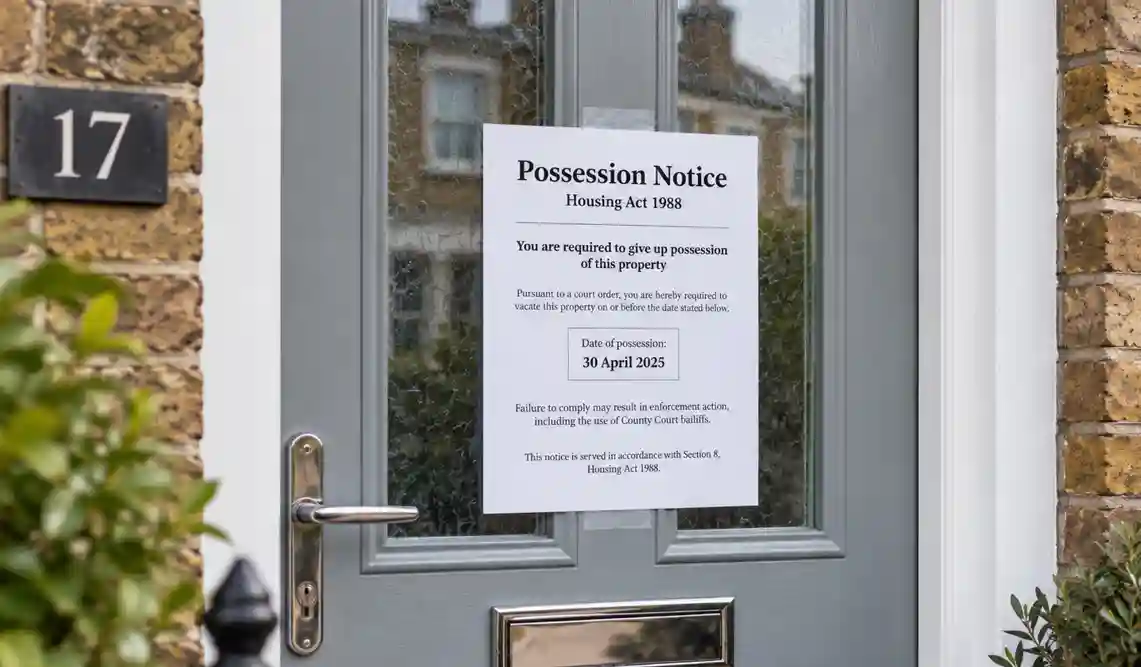
A possession notice lands with a specific date printed on it, and the instinctive reading is that the date is the deadline — that whatever happens, the tenant needs to be gone by then. It’s a reasonable assumption, and it’s usually wrong. For most tenancies, that date marks the point a legal process is allowed to begin, not the day physical eviction happens. The gap between the two can run to months, and understanding the stages in between is the difference between panic and knowing exactly where you actually stand.
Four dates that mean very different things
| Date or stage | What it actually means |
|---|---|
| Notice expiry date | The landlord can normally move to the next legal stage if the tenant remains |
| Court hearing / decision | The court decides whether possession should be granted |
| Possession-order date | The date an outright order says the tenant should leave |
| Bailiff appointment | The point at which court-authorised physical eviction can actually take place |
Confusing the first of those dates with the last is what causes a great deal of unnecessary panic.
Stage one: a valid ground and a valid notice
Since Section 21 no longer exists in England, every possession process now starts with a landlord identifying a specific statutory ground under Section 8 of the Housing Act 1988 and serving a notice that correctly states it, using the right form and the notice period that particular ground requires — from four weeks for serious rent arrears under Ground 8 to four months where the ground relates to sale or landlord occupation, with different rules again for some anti-social behaviour grounds.
The government’s grounds for possession guidance sets out the current grounds and notice periods.
If the notice is wrong — the wrong ground, the wrong form, an incorrect notice period, or another requirement attached to that ground hasn’t been met — it can undermine the possession claim and may mean the landlord has to correct the problem before proceeding.
Stage two: the notice expires
The date on the notice is when it expires, not an automatic eviction date. If a tenant leaves voluntarily by that point, the process ends there. If the tenant doesn’t leave, the tenancy doesn’t just evaporate on that date; rent generally remains payable, and the tenant remains lawfully in occupation while the legal process continues.
The notice expiring is what allows the landlord to take the next step — it isn’t the next step happening automatically.
Stage three: the possession claim
If the tenant hasn’t left once notice expires, the landlord’s next move is applying to the county court for a possession order. This involves filing a claim, along with evidence supporting the specific ground relied on — evidence of the arrears for a rent-based ground, for example, or material supporting a genuine intention to sell for Ground 1A.
The tenant is notified of the claim and has the opportunity to respond, including disputing the ground itself, raising a defence, or pointing to procedural errors in how the notice was served.
Free legal help may be available before the hearing through the government’s Housing Loss Prevention Advice Service, so receiving court papers is a point to seek advice rather than simply waiting to see what happens.
Stage four: the court’s decision
What happens at this stage depends heavily on whether the ground relied on is mandatory or discretionary. For a mandatory ground genuinely proven — serious rent arrears above the statutory threshold, or a genuinely established sale or occupation ground, for example — the court must normally grant possession if the legal requirements are met. For a discretionary ground, the court weighs the wider circumstances and can decide whether possession is reasonable.
It’s worth knowing that deposit protection can matter at this stage under the 2026 rules. For most Section 8 grounds, a court cannot make a possession order while the landlord remains non-compliant with the relevant tenancy-deposit requirements. There are exceptions, including Grounds 7A and 14 relating to anti-social behaviour, and in some circumstances a landlord may be able to remedy the position before the court makes the order.
This is covered in full in our Rent, Deposits & Fees section, but it’s directly relevant here because an otherwise viable possession claim can be affected by a compliance failure that has nothing to do with the underlying ground itself.
Stage five: the possession order
If the court grants possession, it sets out what happens next.
An outright possession order gives a date by which the tenant must leave. A suspended possession order, where appropriate, can allow the tenant to remain provided specified conditions are met — for example making agreed payments towards arrears.
Where an outright possession order is made and the tenant remains beyond the date stated, that is what allows the process to move towards enforcement.
The order itself still does not authorise the landlord personally to remove the tenant.
Stage six: warrant, and only then, bailiffs
If a tenant remains beyond the date in an outright possession order, the landlord normally has to apply separately for a warrant of possession — this isn’t automatic, and it’s another formal step.
Once the warrant is issued, a county court bailiff can be authorised to attend the property and carry out the physical eviction on a scheduled date. The tenant will normally receive advance notice of that appointment.
A landlord can also seek permission for enforcement through the High Court in appropriate cases, where a High Court Enforcement Officer acts under a writ of possession rather than a county court bailiff.
This is the single most important thing to understand about the process: the landlord or letting agent doesn’t personally carry out the physical eviction. Court-authorised enforcement does.
A landlord turning up with a locksmith and changing the locks simply because a notice or possession-order date has passed is not the normal lawful enforcement route.
When this crosses into illegal eviction
Physically excluding a protected tenant from their home without following the required legal process — changing locks, removing belongings, cutting off utilities to force someone out, or simply refusing to let them back in — can amount to illegal eviction or harassment under the Protection from Eviction Act 1977.
The government’s guidance on illegal eviction and harassment explains the basic protections.
Not every occupier has identical protection — certain excluded occupiers, including some lodgers living with their landlord, can fall under different rules — but for the ordinary assured tenancy process described here, self-help eviction isn’t a lawful substitute for court enforcement.
If you’re genuinely at risk of losing your home
You don’t need to wait until a bailiff is at the door to get help.
In England, someone can be treated as threatened with homelessness if they’re likely to become homeless within 56 days. A qualifying private tenant with a valid possession notice expiring within that period may therefore be able to approach the council’s housing options or homelessness team before the possession process reaches its final stages.
The government’s homelessness guidance explains the 56-day test.
Approaching the council early, notice in hand, genuinely changes what they’re able to do; leaving it until enforcement is imminent narrows the options considerably.
When it’s a matter for the police
An ordinary possession process, however stressful, generally isn’t a police matter.
But violence, threats, or an attempted illegal eviction happening in real time are different. Locks being changed or belongings being removed while a protected tenant is still lawfully occupying the property can justify contacting the police alongside the council or a housing adviser.
Different processes, different nations
This staged structure — Section 8 notice, court, order, warrant, bailiff — is specifically the English system.
Scotland routes possession disputes through the First-tier Tribunal for Scotland (Housing and Property Chamber), with its own notices, grounds and enforcement process.
Wales follows its own possession framework under the Renting Homes (Wales) Act 2016, with different notices, terminology and timelines.
Northern Ireland operates a separate notice and court framework again.
If you’re facing possession proceedings outside England, don’t assume the English forms or deadlines apply.
This article provides general information about the possession process in England as it stood at the time of writing and does not constitute legal advice. If you’ve received a possession notice or believe you’re being unlawfully evicted, consider contacting your local council’s housing options team, a housing advice service or a solicitor promptly.

