

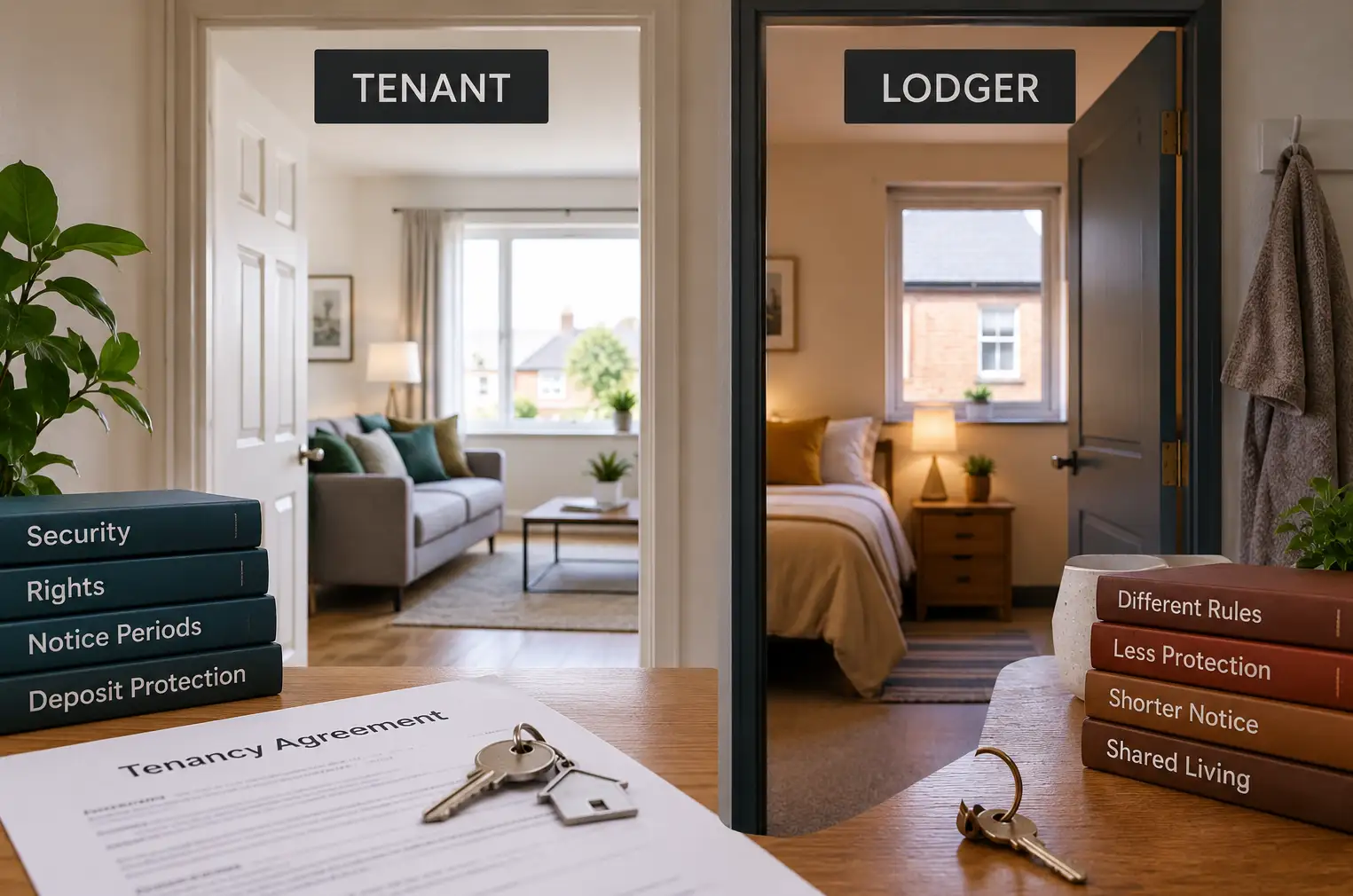
“I pay rent every month, so I’m a tenant.” It’s a reasonable assumption, and it’s often wrong.
Two people can pay near-identical monthly amounts for somewhere to live and hold entirely different legal positions — one protected by mainstream tenancy law with genuine security, the other able to be asked to leave with comparatively little notice and no court order. The difference isn’t the money. It’s the legal nature of the arrangement itself, and it’s decided by facts most renters have never thought to check.
What actually decides the answer
English law recognises several distinct categories of occupier, and the label on your paperwork is only one factor.
The main ones an ordinary renter is likely to encounter are: a tenant with an assured tenancy — now usually an assured periodic tenancy in the mainstream private rented sector; a lodger, usually someone renting a room from a resident landlord and often treated in law as an excluded occupier; a licensee more broadly, meaning someone who has permission to occupy without the legal status of a tenant; a joint tenant, named alongside others on a single tenancy; and a permitted occupier — commonly a partner or family member living with the tenant but without a tenancy in their own name.
There are other, less common categories too — including subtenants and service occupiers whose accommodation comes with a job — but for most renters, the practical question is simpler: am I a tenant, or am I something with considerably fewer protections?
The resident landlord test
The category that catches people out most often is the resident-landlord arrangement — what most people would call being a lodger.
The starting questions are straightforward. Does the landlord actually live in the property as their main home? And do you share genuine living accommodation with them, such as a kitchen, bathroom or living room?
If both of those things are true, you will usually be treated as an excluded occupier. GOV.UK’s guidance on lodger tenancy types describes this as the usual position where the lodger lives in the landlord’s home and shares a kitchen, bathroom or living room with them.
In practice, that means much thinner protection. The landlord will usually only need to give reasonable notice — often the length of the rent-payment period — and will not normally need a court order before recovering possession.
But it is not always as simple as “resident landlord equals lodger equals no rights”. If the landlord lives in the home but you do not share living accommodation with them, you may instead be an occupier with basic protection. That is still a weaker position than being an assured tenant, but it is materially different from being an excluded occupier because the landlord normally needs written notice and, if you do not leave, a court order. GOV.UK explains the different procedures for ending excluded and non-excluded lettings.
And if the supposed resident landlord does not in fact live there as their home, the arrangement may well need to be looked at very differently regardless of what anyone has called it.
The label on the agreement isn’t the final word
This is worth taking seriously: a document headed “Licence Agreement” does not automatically make someone a licensee if the real arrangement points the other way.
The leading case is Street v Mountford, decided by the House of Lords in 1985. The court looked at the substance of the arrangement rather than simply accepting the language chosen by the landlord. Where an occupier has exclusive possession for a term, typically in return for rent, the arrangement may amount to a tenancy even if the agreement describes itself as a licence. The judgment in Street v Mountford remains a fundamental authority on the distinction.
That matters because a landlord cannot simply remove statutory tenancy protections by putting a different heading at the top of the contract.
The reverse is also true, and worth saying plainly: not every lodger arrangement is secretly a disguised tenancy. Where a landlord genuinely lives in the property and genuinely shares living space, the lodger or excluded-occupier position is usually real, not a loophole.
Why the distinction actually matters
The practical consequences are substantial, not academic.
A tenant in England’s mainstream private rented sector will usually now have an assured periodic tenancy. That brings significantly stronger protection. In most cases, a landlord who wants possession must rely on a recognised legal ground and, if the tenant does not leave, obtain a court order. That detailed process belongs in our Tenancies, Notices & Evictions section, but the broad point matters here: an assured tenant’s position is far more secure than a typical lodger’s.
An occupier with basic protection sits somewhere in the middle. They do not have the full protection of an assured tenant, but the landlord usually still needs proper written notice and a court order if the occupier stays put.
An excluded occupier — the classic lodger sharing a home with a resident landlord — is in the weakest position of the three. Reasonable notice is normally enough, and the landlord does not usually have to go to court before taking back possession.
Deposit protection can differ significantly too. In England, the statutory tenancy-deposit scheme applies where the relevant conditions for an assured periodic tenancy are met. A lodger living with a resident landlord should therefore not assume that their deposit has to be placed into one of the government-backed schemes simply because someone elsewhere renting a whole property would expect theirs to be. GOV.UK sets out when tenancy deposit protection applies.
The same caution matters with the Renters’ Rights reforms introduced in 2026. The headline new rights for mainstream private renters are centred on assured periodic tenancies. Government guidance specifically tells lodgers that different rules apply, so a lodger should not assume that every new protection — from possession rules to the new tenancy framework — applies to them in exactly the same way.
None of this means lodgers have no rights at all. Violence, harassment and other unlawful conduct do not become acceptable simply because someone is an excluded occupier. But the gap between an assured tenant’s position and a lodger’s is real, and it is worth knowing which side of it you are on before a disagreement starts, not during one.
England is not the rest of the UK on this
This article is about England.
The broad lesson — that your legal status matters more than the casual label people use — applies across the UK. But the detailed categories and rules do not travel neatly across national borders.
Wales has its own wider system of occupation contracts under the Renting Homes (Wales) Act. Scotland has its own private-tenancy framework, and the rules are different where a landlord lives with the occupier. Northern Ireland’s private tenancy law is separate again.
So if your home is outside England, do not assume the detail here carries across unchanged. Use guidance for the nation you actually live in.
The questions worth answering about your own situation
Before assuming your status either way, it’s worth working through:
- Does the landlord actually live in the property as their main home?
- Which rooms, if any, do you share with them?
- Are you sharing genuine living accommodation, such as a kitchen, bathroom or living room, or only access areas such as a hallway or staircase?
- Do you have exclusive use of your own room or space?
- What does your written agreement actually say — and does day-to-day reality match it?
- Has the situation changed since you moved in — for example, has a previously resident landlord moved out?
Answering those honestly will not resolve every borderline case, but it gives you a far better steer than simply asking, “Do I pay rent?”
Where a lot turns on the answer — especially if notice has been given or an eviction dispute has started — specialist housing advice is worth getting rather than guessing.
Because in housing law, the name people casually use for the arrangement is not the thing that decides your protection. The facts do.
This article provides general information about occupancy status in England and does not constitute legal advice. Legal status can be genuinely uncertain in borderline cases. If a significant right or a possible eviction depends on the answer, consider seeking advice from a housing advice service or solicitor before relying on this guide alone.

