

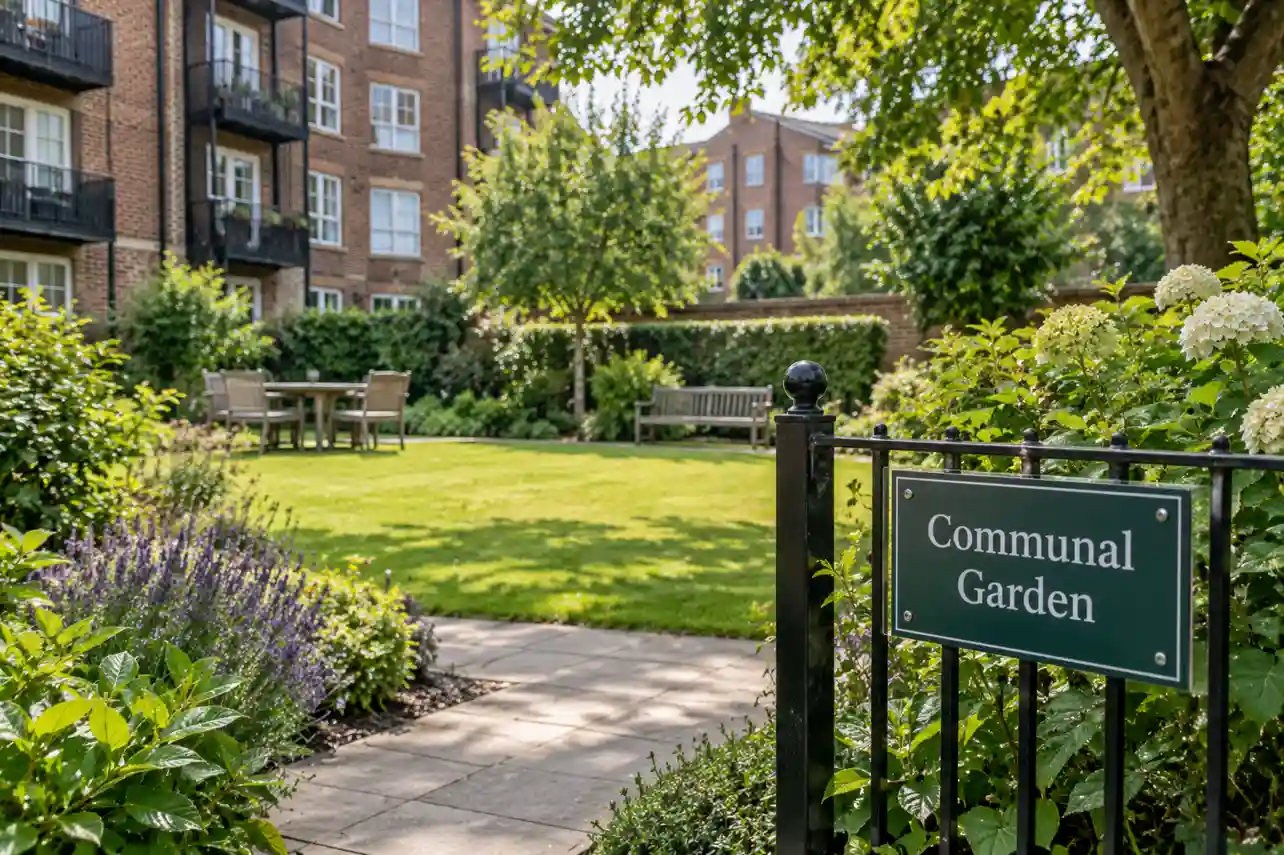
A flat is advertised with “access to communal gardens.” Six months into ownership, a resident on the ground floor has quietly put up a low fence around a section, a managing agent has sent a notice about acceptable furniture, and nobody can quite agree on whether children are allowed to play there or whether the whole garden is even communal in the first place.
Almost none of this is decided by common sense or convention. It’s decided by the lease.
That can come as a surprise when the garden looks, for all practical purposes, like everybody’s. There may be a lawn in the middle, flowerbeds maintained by a contractor and a path leading from the shared entrance. Every flat contributes towards the gardening bill, and generations of residents may have treated the space as somewhere to sit on a summer evening. Then one neighbour fences off a corner, or a managing agent announces a new restriction, and suddenly nobody is quite sure what anyone is entitled to do.
The difficulty is that a garden can be communal in everyday language without every resident having the same legal rights over it. Equally, a garden owned by the freeholder may be subject to rights that the managing agent cannot simply take away.
“Communal” doesn’t mean what it sounds like
For leasehold flats and maisonettes in England and Wales, the description “communal garden” can cover several quite different arrangements.
The land might belong to the freeholder, with each flat granted a right to use it alongside other residents. That is what most people imagine when they buy a property advertised as having shared gardens. But one ground-floor flat might instead have a particular section included within its lease, or an exclusive right to use a defined patio or lawn even though the freeholder retains ownership of the land.
Those distinctions matter because two gardens that look identical can carry different legal rights. A fenced garden outside a ground-floor flat may genuinely belong to the space that flat is entitled to occupy, while an apparently open lawn behind another building may be shared only by certain residents. It is even possible for flats in the same converted house to have different garden rights, particularly where their leases were created at different times.
The Leasehold Advisory Service’s guidance on lease-based rights explains that shared gardens are among the facilities a lease may grant residents a right to use. It is that legal grant, rather than the appearance of the garden or the wording of an estate agent’s brochure, which normally establishes the position.
The same applies where flat owners have a share of the freehold. Owning shares in a company that holds the freehold doesn’t ordinarily mean owning an equivalent physical proportion of the garden. A leaseholder with a quarter of the shares cannot simply decide that a quarter of the lawn is theirs to enclose. Their rights to use particular areas will still usually be determined by the leases and other relevant property arrangements.
This is where the plan attached to the lease becomes as important as the wording. A lease may grant shared use of an area marked in one colour while reserving a terrace or garden strip for a particular flat. It might give residents permission to cross an area without giving them the right to occupy it for recreation. A boundary that seems perfectly obvious when standing in the garden can turn out to be rather less obvious on paper.
If you don’t have a complete copy of your lease and its plan, start with the documents supplied when you bought the flat or ask your conveyancing solicitor for a copy. The freeholder or managing agent may also be able to provide it. Otherwise, HM Land Registry holds registered property information in England and Wales and may have a filed copy of the lease available to order.
Its guidance on obtaining filed property documents explains how to request copies of leases and other deeds, including through form OC2 where the relevant document has been retained. Don’t confuse the general title plan, which normally shows the extent and boundaries of registered property, with the detailed lease plan that may define rights over individual sections of the garden.
And where the dispute concerns another flat’s supposedly exclusive garden, looking at your own lease may not be enough. The neighbouring flat’s lease may contain the reservation or right that explains why its occupier believes that particular corner is theirs.
When one resident — or the managing agent — goes too far
Return to the ground-floor resident and the new fence. Perhaps they began by putting a couple of chairs outside their patio doors. A few flowerpots followed, then a border of shrubs, and eventually a low fence that made the whole corner look like a private garden.
It’s easy to understand why other residents might object, particularly if they have always been able to use that part of the lawn. It’s also possible that the ground-floor owner has an exclusive right that nobody else has bothered to examine.
If the area is included in that flat’s lease or reserved for its exclusive use, enclosing it may be entirely legitimate, subject to any restrictions on alterations. But if several flats have enforceable rights to use the same space, one resident cannot ordinarily deprive the others of those rights merely by treating the land as their own.
Years of informal use do not automatically rewrite a lease, although very longstanding arrangements may raise additional legal questions. Residents should not assume that they can remove a fence or reclaim the space themselves simply because they believe it belongs to everyone. Establishing the rights from the documents, and raising the matter with whoever manages or owns the relevant land, is a much safer starting point.
The managing agent’s notice about furniture and children’s games presents a closely related problem. Instead of one resident apparently claiming more rights than they possess, the management company may be attempting to restrict rights that residents already have.
Many leases permit the freeholder or management company to make reasonable regulations governing shared areas. Depending on the wording, those powers may cover garden furniture, barbecues, pets, noise, ball games or keeping pathways clear. Rules intended to protect the garden from damage or prevent one household monopolising it may be entirely compatible with the leases.
But a managing agent doesn’t have an independent, unlimited power to decide how residents may use the garden. It acts for the freeholder or management body, and its authority must be supported by the relevant legal arrangements.
There is a meaningful difference between regulating a shared garden and taking away a right to use it. A rule requiring residents to remove furniture after use is one thing. A notice permanently closing a garden to residents whose leases expressly give them access is quite another.
The Leasehold Advisory Service makes the underlying position clear: a landlord cannot ordinarily withdraw rights already granted under a lease. Restrictions may sometimes be justified for safety, repairs or proper management, but an existing legal right cannot simply be erased because an agent has changed its policy.
For residents faced with a disputed notice, the useful question is therefore not whether the agent considers the rule sensible. It’s which lease provision gives the landlord or management body the power to impose it.
The same caution applies to demands for a new fee simply to enter a garden that residents already have a contractual right to use. A separate charge needs a proper legal basis; announcing one does not establish that leaseholders must pay it.
If the managing agent refuses to explain an apparent restriction, the next step depends on who granted the right and who is responsible for respecting or enforcing it. The freeholder, residents’ management company and managing agent may have different roles, and an agent may not be the party against whom a legal claim should ultimately be made. That distinction is worth establishing before threatening proceedings.
Who pays to keep the garden looking presentable?
Garden maintenance creates a different kind of argument, although it often involves the same residents.
A top-floor leaseholder might complain that they never use the lawn yet still contribute towards mowing it. Someone whose flat faces an exclusively occupied garden may wonder why the service charge includes work there. Others might be happy to pay for routine gardening but question an unexpectedly large bill for new planting or landscaping.
In many developments, the freeholder or management company arranges the upkeep of communal grounds and recovers the expense through service charges. Grass cutting, hedge trimming, maintaining shared planting and looking after paths can sit alongside cleaning, lighting, insurance and the building’s other common costs.
Whether a particular leaseholder must contribute, and in what proportion, normally depends on the lease. It isn’t determined by how often they personally use the garden. In some cases, residents may contribute towards maintaining landscaped grounds that provide an outlook or form part of the development without having a separate right to sit or play on them.
That can feel counterintuitive, but the right to use the garden and the obligation to pay towards maintaining it are separate matters.
The Leasehold Advisory Service’s guidance on what service charges can include specifically identifies maintenance of outside spaces such as gardens. The important qualification is that the lease must provide a basis for recovering the relevant costs, and applicable law places requirements on the reasonableness of variable residential service charges.
An unexpectedly high bill is therefore worth questioning, although the amount alone doesn’t prove anything improper. A substantial garden with mature trees and formal planting may legitimately cost more to maintain than a small lawn. What residents should be able to establish is what work has been charged for, whether the lease permits the expenditure to be recovered and whether the costs are reasonable.
Leaseholders in England and Wales have statutory rights, in relevant circumstances, to request a summary of service-charge expenditure and inspect supporting documents. The Leasehold Advisory Service explains those information rights, including the procedures for requesting accounts and receipts.
That gives residents a more useful starting point than arguing about the total on a service-charge demand. If gardening expenditure has doubled, ask what changed. Was additional work necessary? Was a new contractor appointed? Does the invoice concern routine maintenance or an improvement that requires different consideration under the lease?
Where a dispute remains unresolved, qualifying questions about the payability or reasonableness of service charges can be taken to the relevant tribunal. In England this is generally the First-tier Tribunal (Property Chamber); Wales has a separate Leasehold Valuation Tribunal, whose official guidance on service-charge disputes explains its application process.
Simply withholding a service charge because the gardening bill looks excessive can create further contractual problems. Obtaining the accounts, checking the lease and challenging the charge through the appropriate process is usually a more sensible approach.
There’s also a distinction between maintaining what residents already have and paying for something new. A leaseholder’s right to enjoy a communal garden doesn’t necessarily entitle them to demand new seating, more elaborate planting or a complete redesign at everybody else’s expense. As with restrictions on garden use, the relevant powers and obligations have to be found in the legal documents.
The position isn’t identical for every flat owner or tenant
Much of this discussion concerns long leasehold flats in England and Wales, but not everyone occupying a communal garden is a long leaseholder.
Someone privately renting a flat may have garden access included in their tenancy agreement. That right will ordinarily depend on what the landlord has agreed to provide and the rights the landlord itself holds. A landlord cannot normally promise a tenant unrestricted use of a garden if the landlord’s own lease gives them only limited access.
This matters particularly in mixed buildings, where some occupiers own their flats and others rent. Everybody may use the same lawn in practice, but their rights can arise from different agreements. A tenant faced with a new restriction should check their tenancy and raise any apparent conflict with their landlord rather than assume the managing agent’s relationship with leaseholders is the same as its relationship with tenants.
Scotland has a different framework altogether. Flats are generally owned outright rather than held under the long residential leasehold arrangements familiar in England and Wales. Rights over shared gardens and obligations to maintain them are normally found in title deeds and title conditions, sometimes alongside the default management arrangements provided by Scottish tenement legislation. Registers of Scotland explains that title burdens can govern the use and maintenance of common areas.
Northern Ireland also has its own property-law and land-registration system. Existing leasehold apartment arrangements may contain rights and obligations concerning shared areas, but English and Welsh leasehold procedures should not simply be assumed to apply there. The Northern Ireland Department of Finance’s leasehold registration guidance explains the significance of apartment leases, plans and covenants relating to common areas.
The documents and dispute procedures differ, but the practical point remains much the same: garden rights cannot reliably be inferred from how the grounds look, how residents happen to use them or who receives the gardening bill.
When the garden becomes everybody’s argument
Communal-garden disputes have an awkward habit of turning neighbours against one another. The ground-floor resident thinks they’ve simply made a neglected corner more attractive. The families upstairs believe a valuable part of their shared space has disappeared. The managing agent wants to keep the garden orderly, while other residents feel that every new notice makes it less welcoming.
Then the annual service-charge statement arrives, and everybody discovers they’re paying for a garden they can’t agree how to use.
The temptation is to settle matters by appealing to fairness or longstanding custom. Those things may help people reach a compromise, but they aren’t reliable substitutes for establishing what the legal documents actually provide.
If a section has been fenced off, the leases and their plans need examining. If garden rules seem excessive, ask what authorises them. If maintenance costs are disputed, request the relevant accounts and examine what the lease allows to be charged. And if the freeholder or managing body won’t address an apparent breach of garden rights, obtain advice on who has the power or obligation to act before attempting to enforce those rights yourself.
Where the wording is genuinely ambiguous, the Leasehold Advisory Service can provide initial information, and a solicitor experienced in residential leasehold may be needed to interpret the documents and advise on the available remedies.
Back at the flat advertised with communal gardens, the little fence may be entirely lawful. It may also be depriving other residents of space they have a legal right to enjoy. The managing agent’s furniture rules might fall comfortably within its authority, while a blanket prohibition on using the garden could go too far.
And the gardening bill may still be payable regardless of which resident spends the most time outside.
The difficulty is that all three arguments can look like questions of fairness, while each turns on rights and obligations that may have been set down decades earlier.
A garden can be shared in appearance without being shared in law. Before deciding who gets to sit in it, fence it off or send the bill for maintaining it, the important thing is to find out what each flat was actually promised.
Important: This article provides general property information and is not legal, financial or other professional advice. Communal-garden rights, management powers and maintenance costs depend on individual leases, title documents, plans and the applicable law. Different rules and procedures apply across the UK. Where access is being restricted, shared land has been enclosed, substantial service charges are disputed or formal proceedings are being considered, obtain appropriate specialist advice before taking action.

