

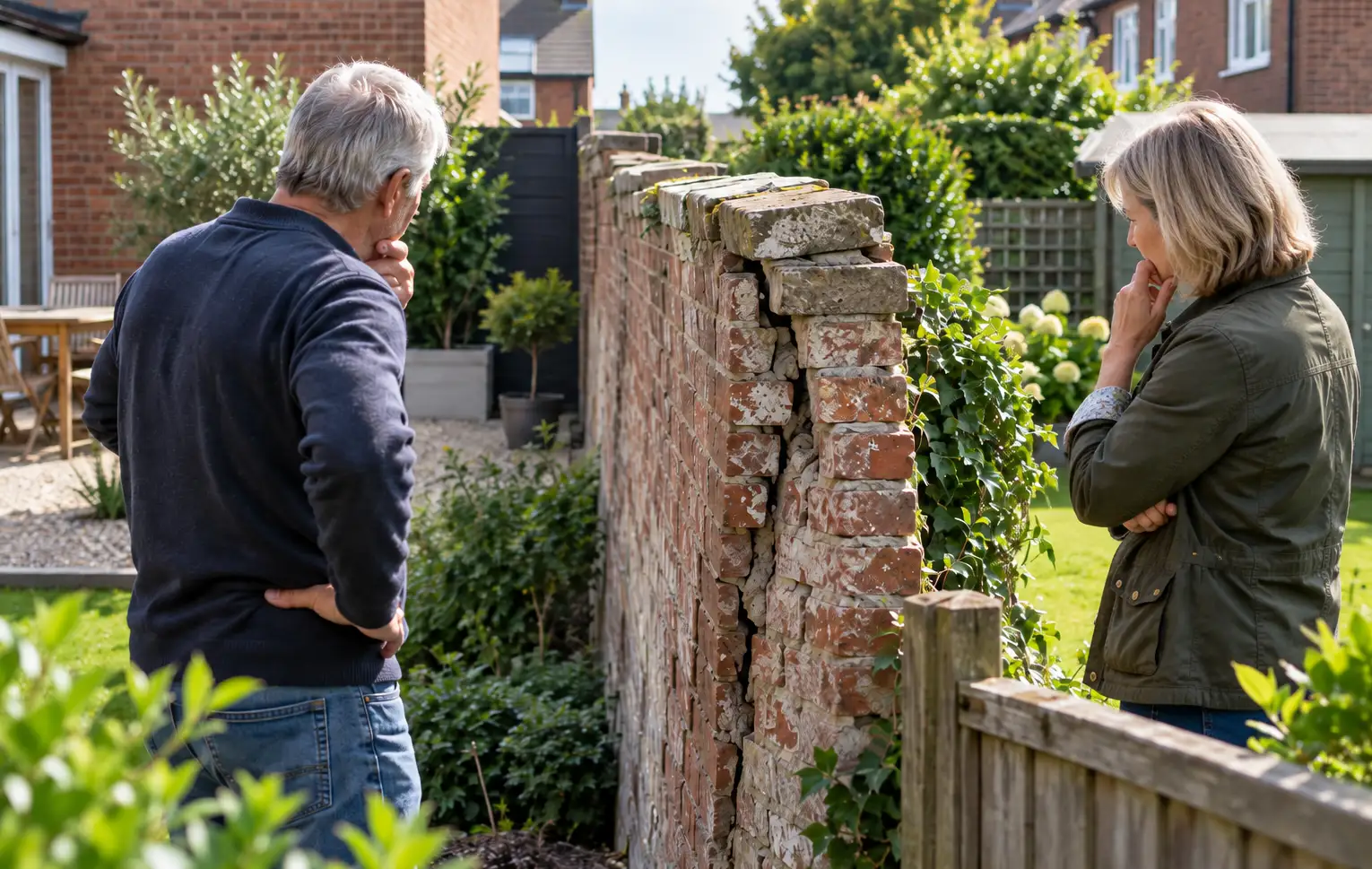
A leaning brick wall between two gardens raises the fence-ownership question’s more expensive cousin. The mechanics for working out who owns it are broadly similar to a fence, but the stakes are usually higher, the presumption that it’s automatically shared is weaker than people assume, and the cost of getting it wrong runs into thousands rather than the price of a few fence panels. This article covers England and Wales, where the Party Wall etc. Act 1996 and the Building Act 1984 are particularly relevant; Scotland and Northern Ireland have their own separate property-law and building-control systems, without the same Party Wall Act procedure.
There’s a distinction worth making at the outset. Establishing who owns a wall doesn’t necessarily answer who must maintain it, and neither question automatically establishes who pays when something goes wrong. An old conveyance may place maintenance obligations on one property, a wall may qualify as a party structure for certain statutory purposes, or the need for repair may have arisen because of something one neighbour has done. Those possibilities can produce quite different answers to what initially looks like a straightforward ownership dispute.
Start where you’d start with a fence, because the same gap in the paperwork is common
Government guidance is candid about this: in England and Wales, there is often simply no definitive record establishing who owns a wall — or a hedge, tree or fence, for that matter — sitting between two properties. The starting points are the same ones covered in our fence-ownership article: the title deeds, any T marks on the relevant deed plan, and, where the paperwork is silent, the original conveyance if it can be traced. For older brick and stone walls in particular, that paperwork trail is frequently thinner than for a fence that’s been replaced more recently, simply because the wall has often outlived several changes of ownership on both sides without anyone formally recording anything about it.
HM Land Registry’s guidance on boundary ownership and maintenance makes an important point about the evidence people tend to rely on. There is no general legal rule that a wall belongs to the owner whose garden faces its better-looking side, whose coping stones slope towards them or who has historically painted or maintained it. T marks can help establish responsibilities where the deed expressly explains what they mean, but an unexplained T mark on a plan has no automatic legal force merely because it looks official. Even an express obligation to maintain a wall doesn’t, by itself, necessarily establish ownership.
That’s why the title register and title plan should be read alongside any transfers, conveyances or other documents referred to in the register. The original wording may distinguish between ownership of a boundary feature, responsibility for maintaining it and rights enjoyed by the neighbouring property. A modern title plan may help establish the general position of the boundary without answering any of those questions conclusively.
Where the documents are genuinely silent, the difficulty isn’t always that somebody has lost a crucial piece of paperwork. Sometimes the responsibility was never expressly recorded in the first place. The wall may have been there before either house was sold separately, or its original construction may have been understood by the owners at the time without anybody considering the need to record a permanent maintenance arrangement. That makes ownership harder to establish, but it doesn’t justify inventing a rule that the bill must automatically be shared.
Three categories of wall, three different starting positions
A wall standing entirely on one owner’s land will ordinarily belong to that owner, subject to whatever the title documents and other rights establish. In principle, they may maintain, alter or remove their own structure, although planning restrictions, contractual obligations and rights benefiting neighbouring property can limit what they’re entitled to do. There’s also an important Party Wall Act exception: a wall wholly on one owner’s land can still qualify as a party wall where it forms part of the division between two buildings. That is different from an ordinary freestanding garden wall which happens to mark the visual boundary between two properties.
A wall built genuinely astride the boundary may be a party fence wall under the Party Wall etc. Act 1996, provided it is a freestanding masonry wall separating the adjoining properties. A timber fence or hedge doesn’t qualify as a party fence wall merely because it occupies the same position. The Act regulates certain work to party walls and party fence walls, including repairs and structural alterations, through its notice and dispute-resolution procedures. It’s common to describe these structures as shared, which is a useful practical way of understanding the relationship, but their classification under the Act shouldn’t be mistaken for a definitive ruling on the underlying legal ownership of every part of the wall.
Where ownership genuinely can’t be established — no useful deed reference, no clear physical evidence and no reliable agreement between previous owners — the wall is generally best approached as a party boundary for practical purposes, with alterations or replacement discussed and agreed between the neighbours. That’s consistent with HM Land Registry’s guidance, but it is a sensible working position rather than a declaration that an uncertain wall has somehow become legally jointly owned. Treating it cautiously can prevent one homeowner from demolishing a structure that the other may have a legitimate interest in preserving.
This distinction becomes particularly important when the wall is old and needs substantial work. A freestanding masonry wall astride the boundary, an external wall belonging to one house but separating two buildings, and a garden wall standing wholly within one property’s land may look similar from a neighbouring garden. Legally, however, the work permitted under the Party Wall Act and the obligations attaching to each can be quite different.
Before deciding who should pay, it’s therefore worth establishing what kind of wall is actually involved. The answer may depend on where the legal boundary runs, how the wall was constructed and whether it performs a function that brings it within the statutory definition of a party structure. Those are questions worth resolving before either neighbour commissions an expensive rebuilding project on the assumption that ownership is obvious.
Costs are not automatically split 50/50, even for a genuinely shared wall
This is the point that catches people out most. Even where a wall is unambiguously a party fence wall, the Party Wall Act doesn’t default to an even split whenever repairs are needed. For qualifying work to a party structure because of defect or want of repair, Sections 11(4) and 11(5) provide for costs to be apportioned by reference to matters including the use each owner makes, or may make, of the structure and responsibility for its defective condition. Section 11(5)(a) specifically refers to the use each owner makes, or may make, of the structure, rather than simply requiring every invoice to be divided down the middle.
In practice, where both properties use an existing shared wall in broadly the same way and neither owner has caused the problem, an equal contribution may be a reasonable outcome. But that doesn’t make it an automatic legal entitlement. If one neighbour has carried out work that damaged the wall, increased the loads acting upon it or removed ground that previously supported it, the cause of the defect may alter the allocation of responsibility. Equally, where one owner wants additional work or an improvement solely for their own benefit, there may be good reason for that owner to bear the extra expense rather than expecting an equal contribution.
There’s also an important limit to the statutory cost-sharing rules: Section 11 isn’t a general law requiring neighbours to divide the cost of every boundary wall. Its provisions apply in the context of work falling within the Party Wall Act. If a freestanding wall stands wholly on one owner’s property and doesn’t qualify as a party structure, the Act doesn’t automatically require the other neighbour to contribute merely because they enjoy having a boundary wall there. The answer may instead depend on the deeds, a covenant, responsibility for damage or an agreement between the owners.
The cause of the problem is therefore worth establishing before the argument over percentages begins. A century-old wall with deteriorating mortar raises a different question from one that was sound until a neighbour excavated beside its foundations or attached something that overloaded it. Water penetration, ground movement, damaged brickwork and tree roots can also affect whether local repairs will be sufficient or a substantial rebuild is necessary. For an expensive project, a building surveyor or structural engineer may be able to explain what’s actually wrong and whether the proposed work will solve it.
That’s a worthwhile investment before either side starts arguing about the bill. It makes little sense for neighbours to agree to divide the cost of rebuilding a wall only to discover that the real problem — perhaps foundation movement or accumulated water behind it — hasn’t been addressed. Establishing the proper repair and establishing responsibility for paying for it are separate exercises, but they need to inform one another.
Can one neighbour just knock it down?
Not simply because they’ve decided the wall needs replacing, particularly where ownership is uncertain or the structure is genuinely shared. But there’s a legal distinction between constructing a new wall across a boundary and carrying out statutory work to an existing party wall, and it’s one that matters when neighbours disagree about repairs.
For a new wall built astride the boundary, the adjoining owner’s express written consent is required. A building owner cannot simply decide that a new masonry wall should straddle both properties and use the Party Wall surveyor procedure to override a refusal. If the necessary consent isn’t given, the proposed new wall must generally be built wholly on the building owner’s side.
For an existing party wall or party fence wall, the position is different. The Party Wall Act gives building owners rights to undertake specified work, including repairs and, in appropriate circumstances, demolition and rebuilding of structurally defective party structures. Those rights are subject to the relevant notice requirements and, where a dispute arises, the Act’s surveyor procedure. It isn’t necessarily the case that one neighbour can veto essential statutory work simply by withholding agreement, provided the proposed work falls within the Act and the required procedure is followed.
This doesn’t mean someone can demolish a shared wall first and sort the legalities out afterwards. Starting notifiable work without following the required procedure can expose the person carrying it out to an injunction or other civil remedies. Nor can a Party Wall Award be used to decide an underlying dispute about who owns the land or where the legal boundary actually runs. Those questions may need resolving separately before substantial work can safely proceed.
The practical point is that permission, notice and ownership aren’t interchangeable concepts. Where the wall is shared or its status is uncertain, establish what the deeds say, whether the Party Wall Act applies and whether the proposed project is a repair, a replacement under an existing statutory right or an entirely new structure. Getting that right before the first bricks are removed is considerably easier than trying to resolve an ownership dispute after the wall has disappeared.
If it’s actually dangerous
A structurally unsafe wall is a distinct problem from the ownership question, and it’s worth treating it as one. A badly leaning masonry wall, one that has started separating into sections or one showing signs of imminent collapse can present a serious risk to people and property, particularly where it borders a public footpath, driveway or neighbouring garden. The first priority in that situation is to keep people clear of the danger and obtain an appropriate professional assessment, not to wait until the neighbours have agreed whose responsibility the structure is.
Under the Building Act 1984, local authorities have powers to intervene where buildings or structures appear dangerous. Section 77 allows a council to seek an order requiring danger to be removed, while Section 78 permits emergency action where immediate steps are necessary. A dangerous garden wall doesn’t have to form part of a house before those powers may become relevant. Reporting a genuinely unsafe structure to the local authority’s building-control or dangerous-structures service can therefore be appropriate, and an immediate threat to life should be treated as an emergency.
That intervention addresses the safety risk. It doesn’t, on its own, establish which neighbour ultimately pays for making the wall safe or rebuilding it. Ownership, repair covenants, the cause of the defect and any relevant Party Wall Act obligations may still need examining after the immediate danger has been dealt with.
For a substantial but non-emergency repair, it’s often worth obtaining a jointly commissioned professional assessment and agreeing the proposed work before either side commits to expenditure. A written agreement can establish the contractor, the scope of repairs, the allocation of costs and how unexpected additional work will be handled. Where the ownership position is genuinely uncertain, the neighbours may also want to record their understanding of who will maintain the rebuilt structure, rather than leaving the next disagreement for whoever owns the houses in twenty years.
A leaning wall is expensive enough without turning it into an avoidable legal battle. Sometimes one neighbour will be responsible, sometimes both will contribute, and sometimes an equal split will be the most sensible arrangement. What matters is establishing where the wall stands, what obligations attach to it, why it needs repairing and which legal rules apply to the work. Only then can either homeowner sensibly answer the question they probably asked when they first noticed the crack: who has to pay?
Important: This article provides general property information, not legal, financial, surveying or other professional advice for individual circumstances. Boundary ownership, repair obligations and Party Wall rights can depend on title documents, the wall’s position and construction, the cause of any defect and the work proposed. If a substantial repair, dangerous structure or active neighbour dispute is involved, obtain appropriate professional advice before carrying out irreversible work.

