

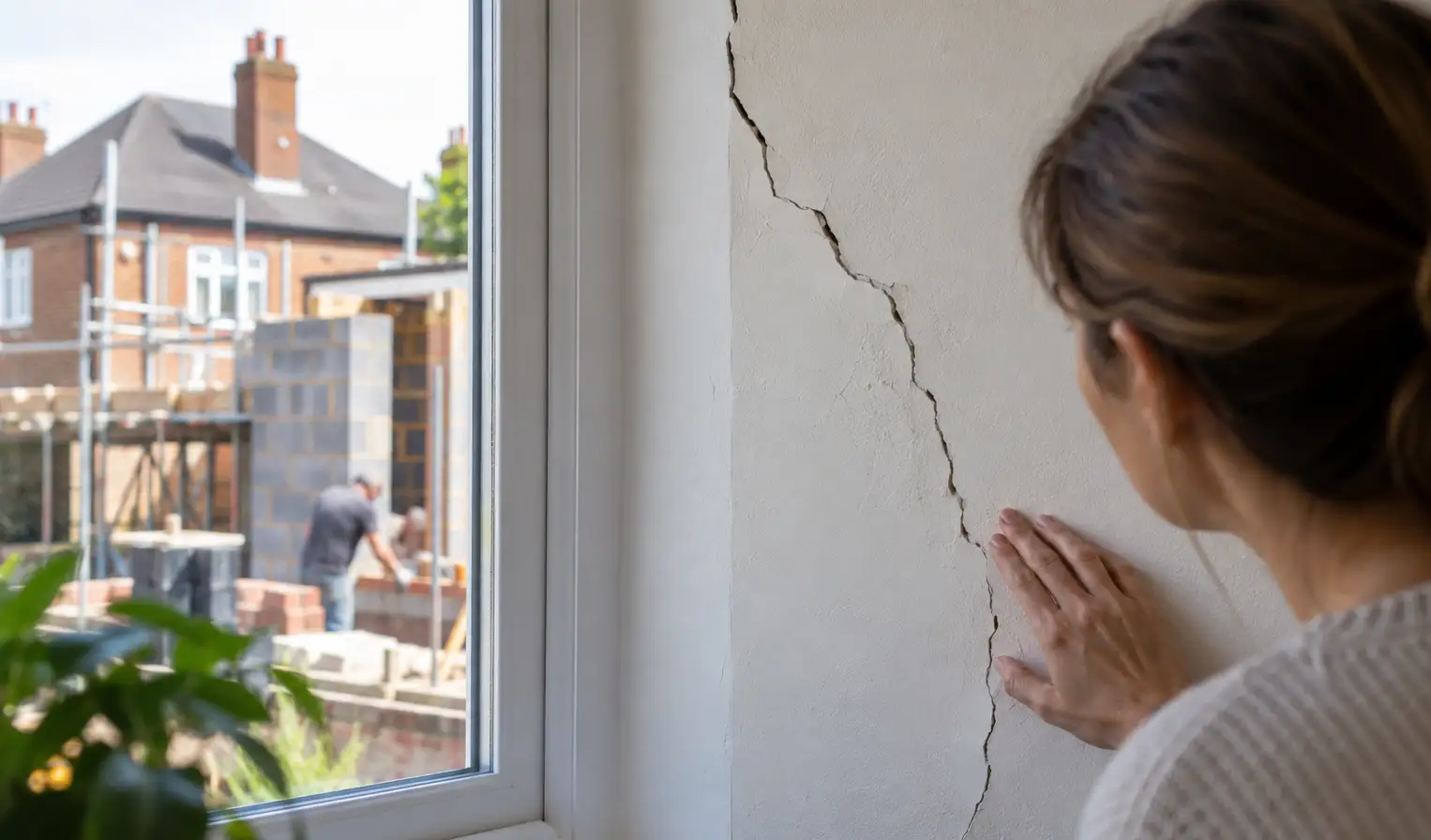
New hairline cracks appearing across a bedroom ceiling a few weeks into next door’s extension are worth investigating properly rather than dismissing as coincidence — but timing alone doesn’t prove the two are connected, and treating it as obvious before checking is exactly how these disputes go wrong. What happens next depends heavily on the evidence, particularly one document that either does or doesn’t exist: a schedule of condition, recorded before the work began. This article covers the position in England and Wales, where the Party Wall etc. Act 1996 applies; Scotland and Northern Ireland have no equivalent statute, and damage disputes there are resolved through their own separate legal systems.
The building owner’s obligation is clear, in principle
Under Section 7(2) of the Party Wall etc. Act 1996, a building owner carrying out work under the Act is required to compensate an adjoining owner or occupier for loss or damage resulting from that work. That’s the baseline principle, and it’s not optional — it’s a statutory obligation attached to exercising rights under the Act, not a favour extended if the neighbour happens to ask nicely. It can apply to damage elsewhere in the adjoining property, not just to the shared wall itself, provided the damage was caused by the relevant work.
There’s an important distinction between compensating someone for damage and physically making good the damage, because the Act deals with both in different ways. Certain rights exercised under Section 2 carry obligations to make good, while Section 11(8) allows an adjoining owner, in circumstances where making good is required, to have the expense of doing so determined and paid instead. This matters if the neighbour insists their original builder should return to repair your house, when you’d understandably prefer to appoint someone independent. The appropriate remedy depends on the work involved, the statutory provisions and any Party Wall Award already in place; there isn’t a universal rule that the building owner can insist on carrying out every repair themselves.
Nor can the building owner necessarily escape their statutory responsibility by pointing towards the contractor who physically caused the problem. Where the loss results from work carried out under the Act, the obligation under Section 7(2) rests on the building owner, regardless of whatever separate contractual or insurance arrangements they may have with the builder. A negligent contractor may have liability of their own, but the neighbour’s answer of “you’ll need to take that up with my builder” doesn’t automatically dispose of the statutory obligation.
The practical difficulty is almost never the principle. It’s proving what actually changed, when it changed and whether the neighbouring work caused it. Houses develop cracks for all sorts of reasons — settlement, thermal movement, drying shrinkage and existing structural defects among them — and a crack appearing during construction doesn’t necessarily mean construction caused the crack. That’s why the evidence gathered before work starts can become considerably more important than the strength of either neighbour’s conviction once damage appears.
Why a schedule of condition changes everything
Where a Party Wall notice was served and the proper process followed, good practice — and something experienced party wall surveyors commonly arrange — is to prepare a schedule of condition of the neighbouring property before work starts. This is a detailed, dated record of its existing state, normally supported by photographs showing cracks, distortions, previous repairs and other defects. Its value cuts both ways. For the adjoining owner, it provides a clear “before” against which alleged new damage can be compared. For the building owner, it protects against being blamed for deterioration that was already present, which becomes a genuinely common source of disagreement once everyone’s memory of “how bad that crack always was” has conveniently shifted.
There’s one qualification worth making because it frequently gets lost in discussions about Party Wall disputes: a schedule of condition is not itself a statutory requirement. The Government’s Party Wall Act explanatory booklet describes the exercise as prudent and highly advisable rather than compulsory. A neighbour hasn’t necessarily broken the Act simply because no schedule was prepared, just as the existence of a schedule doesn’t automatically prove that every crack discovered afterwards resulted from their work.
Its importance is evidential. A photograph taken before excavation began may show that a particular crack was absent, or that an existing crack was considerably smaller than it is now. That’s much more useful than two homeowners arguing about what they remember, particularly where damage has developed gradually. Even then, identifying a new crack and proving what caused it are different questions. A structural engineer may still need to consider whether excavation, vibration, foundation movement or another mechanism could reasonably explain the damage.
Without a schedule, the position becomes more difficult, but not hopeless. Earlier photographs of the room, previous survey reports, dated renovation records and other evidence can help establish its original condition. In disputes following work undertaken without proper notice, the absence of an opportunity for the normal pre-work inspection may also be relevant when the evidence is assessed. It doesn’t remove the need to establish causation, however, or create an automatic right to compensation for every defect discovered while the neighbour’s builders are on site.
If the Party Wall process was followed properly
Where notice was served and a surveyor process is already in place, damage disputes can generally be addressed within that same framework. The surveyor, or surveyors, can assess what has changed against the schedule of condition, consider whether the work caused it and determine matters within their statutory jurisdiction. Depending on the circumstances, that may result in an arrangement for the building owner to make good the damage or an award addressing the compensation payable instead. Where a valid award requires payment, there are legal means of enforcement if the building owner fails to comply.
It’s worth understanding that consenting to a Party Wall notice doesn’t mean accepting responsibility for whatever damage follows. Homeowners sometimes agree to proposed work because they don’t want to delay an extension or sour relations with their neighbours, then worry that their consent prevents them raising a claim later. It doesn’t. The building owner’s continuing obligations under the Act remain relevant, and a dispute about damage can arise after consent was originally given. The absence of a surveyor appointment before construction began doesn’t, by itself, mean an adjoining owner has waived their rights.
The amount payable can create its own disagreement, particularly where serious damage has occurred. In Lea Valley Developments Ltd v Derbyshire, the Technology and Construction Court considered how compensation under Section 7(2) should be assessed following substantial damage to neighbouring property. The judgment illustrates why there isn’t a single calculation that suits every case: the reasonable cost of reinstatement and any reduction in property value can be relevant, depending on the circumstances. For an ordinary domestic crack, a properly established repair cost will often be central to the discussion, but that doesn’t mean an adjoining owner can commission whatever work they choose and automatically recover the bill.
For the homeowner, the practical point is to involve the appointed surveyor or surveyors as soon as damage appears, rather than allowing the contractor to fill the cracks and paint over them before the cause has been investigated. An apparently straightforward cosmetic repair may be appropriate once the problem is understood, but making the evidence disappear before the responsible parties have examined it can leave both neighbours arguing about the same defect months later. A schedule of condition is valuable precisely because it reduces the amount of reconstruction needed afterwards.
If no notice was served at all
Where a neighbour simply started notifiable work without going through the Party Wall process, the position is different, but you’re not left without legal protection. Ordinary civil claims remain available, potentially including negligence, private nuisance or trespass, depending on what happened and who was responsible. Skipping the statutory notice procedure can also matter when the evidence is assessed, particularly where proper notification would have given the adjoining owner an opportunity to arrange an inspection and document the property’s condition before the work began.
What you can’t necessarily do is recreate the Party Wall surveyor procedure after the event by appointing surveyors yourself. In Power v Shah [2023] EWCA Civ 239, the Court of Appeal confirmed that where the building owner hadn’t served the notice required to invoke the statutory machinery, the adjoining owner couldn’t unilaterally appoint surveyors and obtain a valid retrospective Party Wall Award. That’s a significant distinction, because homeowners are sometimes told that the solution to unnotified work is simply to appoint their own party wall surveyor and have an award issued afterwards. A surveyor may still provide useful technical advice, but the statutory dispute-resolution process cannot necessarily be brought into existence that way.
The absence of notice doesn’t make the building owner automatically liable for every crack, either. The person claiming compensation still needs an appropriate legal basis for the claim and evidence connecting the work to the damage. A failure to follow the Act may be important, but it doesn’t dispense with the need to investigate whether excavation, structural alterations or other building activity actually caused the problem. Equally, the builder’s suggestion that no Party Wall Award exists and therefore nobody owes compensation is plainly too simple. The lack of an award does not extinguish otherwise available civil remedies.
The position can become more complicated where the homeowner, building contractor and other professionals disagree about who caused the damage or who owed which duty. This is one reason significant claims arising from unnotified work may require a solicitor as well as a technical expert. A party wall surveyor can explain the requirements that should have applied, while a structural engineer can investigate the cause and extent of the movement. A solicitor can then advise on the legal route for recovering the loss, rather than trying to force a dispute into a statutory process that was never properly engaged.
Should you claim on your own home insurance instead?
It’s tempting to claim on your own buildings insurance and let the insurer sort out who’s ultimately responsible. This can sometimes get repairs moving sooner than waiting for a neighbour dispute to resolve, particularly where the damage falls within the policy and the insurer agrees to deal with it. But it isn’t necessarily the cheapest route for you personally, since excesses, future premiums and any no-claims arrangements may be affected, depending on the insurer and the policy. If the insurer pays for covered damage and somebody else is legally responsible, it may seek to recover the payment from that party through a process known as subrogation.
Where the cause is clearly the neighbouring work and liability is accepted, approaching the building owner or the relevant insurer may offer a more direct route to resolving the problem. The difficulty is that liability isn’t always accepted immediately, even where the damage appears closely connected to construction next door. Contractors may refer a homeowner to the building owner’s insurer, the neighbour may insist the contractor caused the problem, and an insurer may decline to agree a settlement until technical evidence establishes what actually happened. None of those positions should be mistaken for a final determination of responsibility.
There is also a reason not to avoid your own insurer simply because you’d prefer the neighbour to pay. Buildings policies can contain conditions requiring prompt notification of damage or circumstances that may give rise to a claim, and insurers may want an opportunity to inspect before substantial repairs are commissioned. Cover varies, particularly for structural movement, subsidence, gradual deterioration and defective construction, so it’s worth checking the wording and speaking to the insurer early where the damage may be covered. Notification isn’t necessarily the same as making a claim, and understanding the policy requirements first may protect your position if the dispute becomes prolonged.
For a straightforward cosmetic repair where the building owner accepts responsibility, matters may never need to involve your insurer beyond any notification your policy requires. For more serious damage, however, it can be unwise to assume that a neighbour’s promise to put things right will necessarily be honoured or that their contractor’s insurance will cover the loss. The more expensive the repair, the more important it becomes to establish the available insurance arrangements alongside the evidence of who caused the damage.
What to do the moment you spot damage
Photograph everything immediately, with the original files and their dates preserved, before anyone has a chance to suggest the damage was already there. Take close-ups of the cracks, but also wider photographs showing exactly where they are on the ceiling, wall or external elevation. If you have photographs taken before the building work began, keep those too, even if they were originally intended to record decorating or a family occasion rather than the condition of the property. An existing crack that has widened can be just as relevant as one that has appeared for the first time, provided there’s reliable evidence showing how its condition has changed.
Don’t let a contractor’s reassurance that “it’s just settlement” substitute for your own record. Minor cracking can be cosmetic, but new movement around openings, doors or windows suddenly sticking, displaced masonry or cracks continuing to widen may justify an independent professional inspection. For anything suggesting structural movement, a structural engineer’s opinion — independent specifically meaning not appointed solely by the building owner or their contractor — can be worth the cost, particularly where the question of who pays is likely to become contentious. If a wall is visibly unstable or there appears to be an immediate risk to people, the priority is safety, not preserving the Party Wall procedure; urgent professional help or emergency assistance may be necessary.
Raise the matter in writing with your neighbour promptly, explaining where the damage has appeared, when you first noticed it and what work was taking place at the time. If a Party Wall surveyor is already appointed, notify them as well and ask how the damage should be inspected and addressed. Where there is no statutory process in place, a factual written account supported by photographs gives any subsequent solicitor or engineer a clearer starting point. Avoid allowing cracks to be filled, plastered or painted over before they’ve been properly recorded and, where appropriate, inspected. Cosmetic repairs can wait until the cause and significance of the damage are understood.
There is no need to assume that every new hairline crack signals a major structural problem, just as there is no reason to ignore a significant change because the neighbour insists their building work had nothing to do with it. The important thing is to establish the condition before the work, record what has changed and obtain a reliable opinion on what caused it. That evidence will determine whether the statutory compensation provisions apply, whether another legal claim is available and what the reasonable cost of putting matters right is likely to be.
For homeowners in Scotland and Northern Ireland, the practical need to preserve evidence, establish causation and raise concerns promptly is much the same. The legal route is different, however, because neither jurisdiction operates under the Party Wall etc. Act 1996. Compensation for neighbouring construction damage has to be considered under the law applicable there, with professional advice suited to the local property and legal system rather than the England-and-Wales surveyor procedure.
The clearest lesson is that the appearance of damage and proof of responsibility are not quite the same thing. Where properly conducted Party Wall work causes loss or damage, the building owner has a statutory obligation to compensate for it. Where the statutory procedure was never invoked, other legal remedies may still be available. In both situations, a schedule of condition can make the difference between a claim supported by a clear record and an expensive argument about whose memory is more reliable. And if cracks are appearing while the builders are still next door, investigating them now is considerably easier than trying to reconstruct the evidence months later, after everything has been plastered, painted and forgotten.
Important: This article provides general property information, not legal, financial, surveying or other professional advice for individual circumstances. Building damage and Party Wall claims can depend on the work undertaken, its cause, the evidence available, insurance terms and the statutory procedure followed. If significant structural damage, substantial money or legal rights are at risk, obtain appropriate professional advice before agreeing repairs or settlement.

