

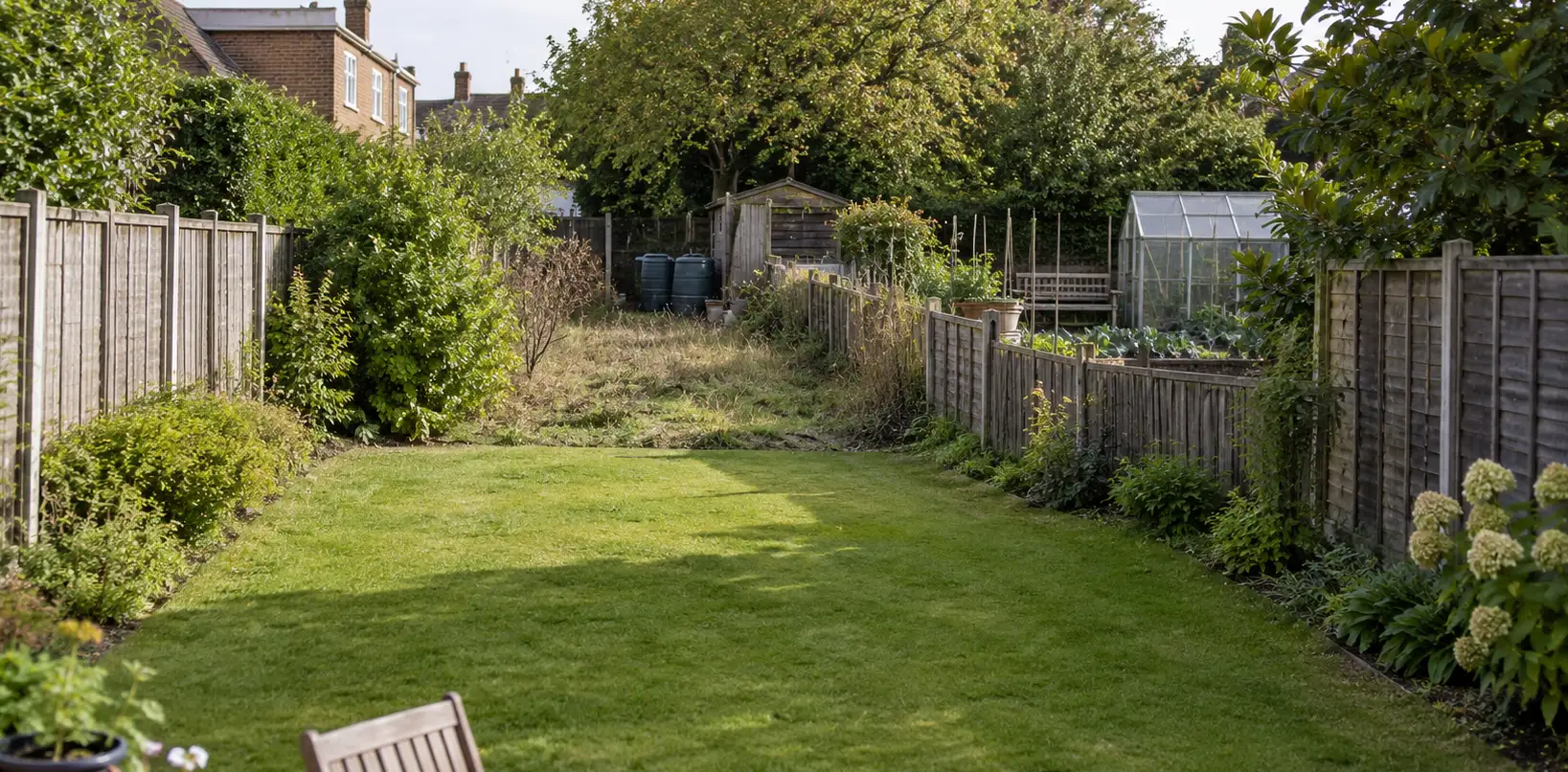
There’s a piece of folklore that circulates in almost every UK neighbourhood in some form: leave a strip of land unchallenged long enough, and it quietly becomes the other person’s. Like most folklore, it’s built on something real — but the real version is considerably narrower, considerably harder to actually achieve, and works differently depending on which part of the UK the garden happens to be in.
The distinction matters most where a fence has stood in the wrong place for years, or a neighbour has gradually treated a strip of adjoining land as part of their own garden. Long occupation can sometimes create a legal claim, but maintaining someone else’s lawn and possessing it as though you own it are very different things. In England and Wales, the registration system also gives a registered owner an important opportunity to resist an adverse-possession claim, although that protection depends on understanding what the paperwork requires and acting when the opportunity arises.
England and Wales: ten years, and a registered owner who gets to fight back
The relevant law is adverse possession, governed for registered land by Schedule 6 of the Land Registration Act 2002. After ten years of adverse possession, an occupier can apply to HM Land Registry to be registered as the new owner. That’s the part most people have heard. What’s much less widely understood is that the application doesn’t automatically succeed, and simply having used somebody else’s land for ten years isn’t necessarily adverse possession in the legal sense.
The neighbour must demonstrate factual possession, an intention to possess and occupation without the true owner’s consent. As HM Land Registry’s guidance on adverse possession explains, factual possession involves exercising an appropriate degree of physical control over the land, judged against its nature and ordinary use. Fencing a strip into your garden and excluding others from it may provide considerably stronger evidence than occasionally mowing the grass or walking across it. The intention that matters is an intention to possess the land as your own, so far as reasonably practicable excluding others, rather than necessarily knowing or believing you have legal title.
Permission changes the picture again. If an owner has allowed a neighbour to use part of the garden, whether under a formal licence or another genuine arrangement, that use isn’t adverse while the permission continues. This is why the circumstances behind an old boundary arrangement can matter as much as the number of years it has existed. A neighbour who’s been permitted to maintain a strip beside the fence isn’t in the same legal position as one who’s enclosed it, excluded the owner and treated it exclusively as their own.
Where the necessary ten years have been established, the occupier can make an application. HM Land Registry then notifies the registered proprietor and certain other interested parties, giving them 65 working days to respond. This is where the 2002 Act provides the protection that much of the neighbourhood folklore leaves out, because a registered owner can prevent many claims from succeeding. There is, however, a procedural distinction that genuinely matters: objecting to an application and serving a statutory counter-notice are not the same thing.
An objection may challenge whether the neighbour has established adverse possession at all. A counter-notice, by contrast, invokes the protection under paragraph 5 of Schedule 6, requiring the application to be rejected unless the applicant can satisfy one of three narrow statutory conditions. An owner who merely sends an objection and fails to serve the necessary counter-notice within the response period can find themselves in a much weaker position if the objection is unsuccessful. In other words, receiving a formal application from HM Land Registry is not the moment to rely on a strongly worded letter saying the land belongs to you. The distinction between the available responses is sufficiently important to justify obtaining legal advice promptly.
The exception most likely to arise in an ordinary garden dispute concerns a reasonable but mistaken belief about the boundary. The familiar example is a fence erected in the wrong position decades ago, leaving a strip of land enclosed within the adjoining garden while the people living there genuinely believed the fence marked the legal boundary. Under the statutory conditions, an applicant may be able to succeed despite the registered owner’s counter-notice if they can demonstrate a qualifying period of reasonable belief, alongside the other requirements concerning adjoining land, registration history and the absence of a previously determined boundary. It’s not enough simply to announce, after being challenged, that the land was always thought to belong to them. The belief must have been reasonable and the statutory conditions must actually be satisfied.
A significant clarification came from the Supreme Court in Brown v Ridley [2025] UKSC 7, which addressed how the ten-year reasonable-belief requirement should be measured. The Court confirmed that the necessary period of reasonable belief doesn’t have to continue right up to the date of the application; a qualifying ten-year period within the relevant period of adverse possession can satisfy that part of the test. That matters where someone occupied land for years believing a fence marked the correct boundary, then discovered the mistake before making an application. The decision doesn’t make every misplaced fence a successful claim, but it does show why a homeowner shouldn’t assume that the neighbour’s eventual discovery of the true boundary necessarily defeats an otherwise qualifying claim.
Even where a registered owner successfully resists the first application, that isn’t necessarily the end of the story. If the application is rejected following a counter-notice because none of the three statutory exceptions applies, the occupier may be able to apply again after a further two years of adverse possession. The owner has that period to take effective steps to recover possession, begin possession proceedings or otherwise regularise the occupation. If they simply win the first round and then leave the neighbour occupying the same land, a second application can be much harder to resist. In effect, the 2002 Act gives a registered owner a substantial chance to stop a claim, but it expects them to do something with that opportunity.
This is also why writing to a neighbour every couple of years to say “that’s my land” shouldn’t be treated as a guaranteed way to stop adverse possession. Such correspondence may be useful evidence, but it doesn’t necessarily end the physical possession itself. Depending on the circumstances, recovering the strip or making its occupation genuinely consensual may require further action. That isn’t an invitation to dismantle a disputed fence yourself — particularly where the legal boundary hasn’t been established — but it is a reason to treat a longstanding encroachment as something that may need resolving rather than merely protesting about.
Unregistered land works differently again, under the older Limitation Act 1980. For ordinary privately owned land, twelve years of qualifying adverse possession can extinguish the previous owner’s title under the applicable limitation rules, without the same notice-and-counter-notice safeguard introduced for registered land. HM Land Registry’s Practice Guide 5 explains this older regime and the transitional position for certain claims predating the 2002 Act. There are exceptions and special situations, but the important point for homeowners is that the powerful procedural protection available to a registered owner cannot simply be assumed to apply to every piece of land.
Scotland: a genuinely different legal mechanism, not just a different number
This is a case where the same everyday question needs a completely separate answer depending on which side of the border the garden sits. Scots law doesn’t use adverse possession in the English sense; the relevant mechanism is positive prescription, principally governed by the Prescription and Limitation (Scotland) Act 1973. The headline period may sound familiar — ten years of open, peaceable possession without judicial interruption — but the legal foundation is materially different. Positive prescription of ownership generally requires an appropriate recorded or registered deed capable of covering the land in question. Simply occupying and maintaining a strip of somebody else’s garden for a decade, without the necessary title basis, doesn’t produce the same result as a qualifying adverse-possession claim in England and Wales.
That difference becomes particularly important where a neighbour has fenced off a piece of land without having any deed that purports to convey it. Scots law has a specific prescriptive-claimant process, sometimes involving a disposition a non domino — broadly, a deed granted by someone who isn’t actually the owner. Registers of Scotland’s guidance on prescriptive claimants explains the evidence and notification requirements that must be satisfied before such a deed can be accepted for registration, and how the resulting registration remains provisional while the relevant prescriptive period runs.
There’s a timing distinction here that can easily be missed. Under that process, a claimant will normally need to demonstrate an initial period of possession before applying for registration, but that preliminary period doesn’t itself count towards the subsequent ten-year positive-prescription period. The relevant possession following registration of the prescriptive-claimant deed is what matters for that stage, subject to the particular title history and legal requirements. Scotland is therefore not simply operating an English-style adverse-possession system with a different application form.
For a homeowner in Scotland, the practical conclusion is that a neighbour’s long use of land shouldn’t be dismissed as irrelevant, but neither should it be assumed that ten years of mowing, planting or enclosing a disputed strip has automatically transferred ownership. The deed history and the basis on which the land has been possessed are fundamental. Anyone dealing with a longstanding boundary encroachment there is better served obtaining advice from a Scottish property solicitor than attempting to apply the English rules to a Scottish title.
Northern Ireland: a single 12-year period, without the England and Wales near-veto
Northern Ireland operates a third system again, under the Limitation (Northern Ireland) Order 1989 and the Land Registration Act (Northern Ireland) 1970. Unlike the modern England-and-Wales system, it doesn’t provide the same separate Schedule 6 route under which a registered proprietor can require most applications to be rejected by serving a counter-notice. The ordinary limitation period relevant to many private-land adverse-possession claims is twelve years, and the framework extends to registered as well as unregistered land.
That doesn’t mean the land automatically belongs to whoever has been using it for twelve years. The claimant still needs to establish the necessary adverse possession, and the question of whether someone has genuinely occupied the land without permission can be disputed. Land & Property Services operates a formal procedure for adverse-possession applications, with evidence requirements and opportunities for interested parties to object. What differs from England and Wales is the underlying legal framework and the absence of the same statutory counter-notice protection for registered owners.
In practical terms, a Northern Ireland homeowner who’s allowed an obvious encroachment to continue for many years may face a more difficult position than someone dealing with a newly moved fence. The fact that the neighbouring land is registered doesn’t provide the same procedural safeguard available under Schedule 6 in England and Wales. As in the other jurisdictions, however, it remains necessary to establish what the occupier actually did, whether permission existed and which legal requirements have been met. A twelve-year period of casual use isn’t necessarily twelve years of adverse possession.
What this actually means for an ordinary garden dispute
None of this means a neighbour who’s been mowing a strip of your lawn for eight years is about to become its legal owner — the bar, correctly understood, is genuinely difficult to clear, and a registered owner in England or Wales who responds properly to HM Land Registry’s notice retains substantial protection. But it does mean that letting an obviously wrong boundary sit unchallenged for years isn’t a neutral choice. Longstanding possession can become legally significant, particularly where a fence has enclosed land into the neighbouring garden and successive occupiers have treated it exclusively as their own.
The first thing to establish is where the legal boundary actually lies. A fence may have been in the wrong position for decades without anyone realising, and an ordinary Land Registry title plan in England and Wales generally shows only the boundary’s approximate position. The original conveyance, historic plans and the physical features existing when the land was divided may therefore be more useful than attempting to measure a narrow strip from the modern red line. Before treating the neighbour’s use as trespass or adverse possession, it’s worth being confident that the land actually belongs to you.
The next question is what use the neighbour has made of it. Has the strip been enclosed within their garden, with the owner effectively excluded, or have they simply maintained an area that’s remained accessible to both properties? Was permission given by you or a previous owner? How long has the relevant occupation continued, and has anybody formally claimed ownership? Those details matter more than an isolated statement that the neighbour has “used it for years”, because the law is concerned with the nature of possession as well as its duration.
Where the evidence suggests the neighbour really has been treating part of your land as their own, a calm written approach may resolve the matter before it becomes a formal dispute. But it’s worth making sure that whatever is agreed actually addresses the occupation, rather than leaving the physical arrangement unchanged while both parties continue to disagree over ownership. A properly documented agreement, consent to use the land or other appropriate legal arrangement may be useful, depending on the circumstances. Where the boundary is contested or possession has been longstanding, specialist advice is more reliable than assuming an exchange of letters will necessarily stop the legal position developing.
And if you receive an actual adverse-possession application from HM Land Registry, treat it very differently from an informal neighbour complaint. The 65-working-day response period matters, and the distinction between objecting to a claim and serving the statutory counter-notice can be decisive. Getting that procedure wrong can be considerably more expensive than obtaining advice when the notice first arrives.
Adverse possession is therefore neither the myth that “use it long enough and it’s automatically yours” nor the opposite myth that registered ownership makes a successful claim impossible. The law provides different protections and requirements across the UK, and the particular history of the land can make an enormous difference. The earlier a genuine encroachment is raised, recorded and properly resolved, the less likely either household is to discover years later that a misplaced fence has become a far more complicated property dispute than anyone intended.
Important: This article provides general property information, not legal, financial, surveying or other professional advice for individual circumstances. Adverse possession and prescription depend on the nature and duration of possession, consent, registration history, jurisdiction and other facts. If significant property rights or money are at risk, or you receive a formal adverse-possession application or notice, obtain appropriate professional advice promptly.

