

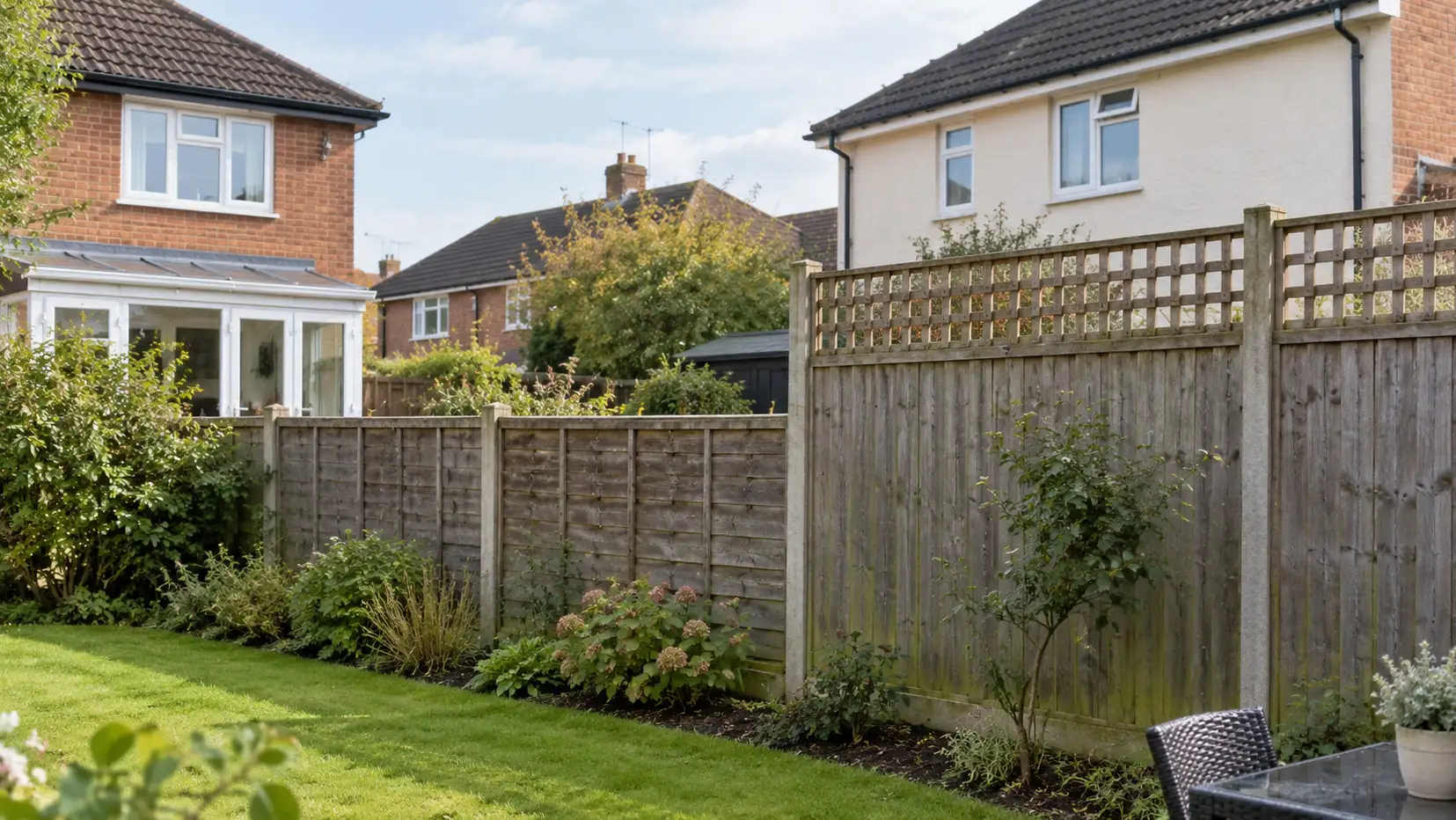
Two metres is the number most people have half-heard somewhere, and as a rule of thumb for an ordinary back garden in England, it’s roughly right. As a complete answer, it isn’t — the permitted height drops to one metre in certain positions beside roads, adding trellis can take an otherwise lawful fence above the limit, and the rules change depending on which part of the UK the property is in. Even a fence that looks too high from your garden may be perfectly lawful once the relevant measurements and planning restrictions are understood.
There’s another distinction worth making before going further. The familiar one-metre and two-metre figures are generally limits for building or altering a fence without applying for planning permission, not absolute maximum heights that no fence can ever exceed. A taller enclosure may be permitted following a successful planning application. Whether you need one depends on the fence’s position, the property and the particular planning rules that apply.
The baseline: 2 metres, or 1 metre near a road
Under Part 2, Class A of the Town and Country Planning (General Permitted Development) (England) Order 2015, a fence, wall, gate or other means of enclosure can generally be erected without planning permission provided it doesn’t exceed two metres above ground level. Where it is adjacent to a highway used by vehicular traffic, the permitted-development limit falls to one metre. This includes situations where a boundary runs alongside the pavement forming part of such a highway, rather than requiring the fence to stand immediately beside the carriageway itself. The distinction matters particularly for front gardens, corner plots and boundaries close to junctions, where high solid enclosures can also obstruct visibility.
Two details catch people out more than any others.
Trellis counts. A two-metre fence with another 30 centimetres of trellis fixed permanently to the top isn’t a two-metre fence with decoration — it’s a 2.3-metre enclosure. The fact that the upper section is open rather than solid doesn’t provide an additional permitted-development allowance, and the same overall-height consideration applies to other permanent additions that increase the height of the enclosure. What matters is the finished structure, not simply the height of the fence panels you bought.
Ground levels matter, but aren’t always straightforward. A fence between gardens at different heights can appear considerably taller from the lower property. The English legislation measures height above ground level, but it isn’t safe to turn that into a universal rule that every fence must always be measured from whichever neighbour has the higher garden. Sloping boundaries, raised ground and alterations to site levels can make the correct measurement less obvious. Where a difference in levels determines whether permission is needed, checking the proposed measurement with the local planning authority before construction is much safer than relying on a general rule found online.
There’s also a useful provision for existing higher boundaries. Under the English permitted-development rules, an existing fence, wall or gate can generally be maintained, improved or altered up to whichever is greater: its former height or the normal limit applying in that position. So a boundary fence already standing at 2.3 metres doesn’t necessarily need to be reduced to two metres simply because it requires repairs. The complication arises when maintenance becomes something closer to complete demolition and replacement. Removing a structure entirely and building a new one can raise a different planning question, so an unusually high fence shouldn’t be taken down on the assumption that its previous height can automatically be recreated.
None of this overrides other restrictions that may apply to the property. Listed buildings and their curtilage can be subject to additional controls, while an Article 4 direction or planning condition may remove or restrict the usual permitted-development rights. Conservation areas deserve checking too, although being in a conservation area in England doesn’t, by itself, mean every replacement garden fence needs planning permission. The position depends on the particular controls in force. If you’re dealing with an older property, a listed building or a boundary in a sensitive location, a quick check with the council before ordering materials can save a considerably more expensive problem afterwards.
How the rest of the UK compares
This is a genuinely UK-wide question with different regional legislation behind what initially looks like the same answer. The headline figures are remarkably consistent — two metres in ordinary situations and one metre in certain positions near roads — but the conditions that trigger those limits aren’t identical.
| Nation | General permitted height | When the lower limit applies |
|---|---|---|
| England | 2 metres | 1 metre adjacent to a highway used by vehicular traffic |
| Wales | 2 metres | 1 metre next to a highway used by vehicles, including its footpath |
| Scotland — houses | 2 metres | 1 metre where the enclosure fronts a road or extends beyond the relevant principal or side elevation nearest a road |
| Scotland — flats | 2 metres | Generally 1 metre for a new enclosure within 20 metres of a road |
| Northern Ireland | 2 metres | 1 metre adjacent to a road used or designed to be used by vehicular traffic |
In Wales, the Welsh Government’s guidance on fences, gates and garden walls confirms that planning permission is normally required where a new or increased enclosure would exceed one metre next to a highway used by vehicles, including the footpath of that highway, or two metres elsewhere. The guidance also explains the position for existing fences, which can generally be maintained, altered or improved without increasing their height. As in England, listed-building considerations, planning conditions and Article 4 directions can affect whether the ordinary rules are available.
Scotland is where treating ‘two metres everywhere except beside a road’ as a universal UK rule becomes particularly misleading. The Scottish Government’s householder permitted-development guidance generally allows a fence, gate, wall or other enclosure up to two metres, but the one-metre restriction is linked to whether the enclosure fronts a road or extends beyond the relevant principal or side elevation of the house nearest a road. That’s a different test from simply asking how close the boundary is to a highway, and it can produce a different result on an unusually shaped plot.
Scotland also has a particularly important distinction concerning ground levels. For the relevant permitted-development class around a dwellinghouse, height on sloping or uneven ground is measured from the lowest point immediately adjacent to the enclosure. Flats are treated separately, and the Scottish Government’s permitted-development guidance for flats applies a different road-distance test, with new enclosures within 20 metres of a road generally limited to one metre. For that class, height on uneven ground is measured from the highest point immediately adjacent. Even within Scotland, therefore, two neighbours living in different types of property may need to approach the same fencing question differently.
The Scottish rules also contain additional restrictions concerning conservation areas and listed buildings. The fact that an ordinary domestic fence would fall beneath the headline height limit doesn’t mean those restrictions can be ignored, particularly where the property has historic significance or is subject to specific planning controls.
Northern Ireland operates under its own legislation. Part 3, Class A of the Planning (General Permitted Development) Order (Northern Ireland) 2015 provides the familiar two-metre limit away from roads and one metre where a new enclosure is adjacent to a road used or designed to be used by vehicular traffic, subject to the Order’s other conditions and restrictions. As elsewhere in the UK, listed-building considerations can change the position.
The useful lesson isn’t that the four planning systems produce wildly different answers. It’s that the same number can rest on a different legal test, and that matters when a fence stands near a road, on sloping land or beside a property with unusual planning restrictions. A rule confirmed for a garden in Cardiff or Belfast shouldn’t automatically be applied to a house in Edinburgh simply because the headline height looks identical.
“Can my neighbour just make theirs taller?”
If your neighbour owns the fence, it stands entirely on their land and the proposed increase falls within the permitted-development rules applying to the property, then yes, generally they can. They don’t usually need your permission simply because you preferred the old height, although the finished structure must still comply with any other relevant planning restrictions. If they want to go above the permitted-development limit, they can apply for planning permission, and the local planning authority will decide whether the proposal is acceptable.
That isn’t quite the same as saying your neighbour has unrestricted control over every fence between the two properties. Ownership and planning permission are separate questions. If the structure is jointly owned, forms part of a shared boundary arrangement or an alteration would interfere with something belonging to you, the fact that it stays below two metres doesn’t automatically entitle one person to change it. Restrictive covenants and other provisions in the title documents may also limit the height or type of boundary treatment independently of the planning rules.
Where planning permission is required, neighbouring homeowners can normally make representations about the proposal. The council may consider the appearance of the enclosure, highway safety and its effect on neighbouring living conditions, depending on the circumstances and relevant planning policies. But being the adjoining owner doesn’t give you an automatic veto, just as planning permission granted to your neighbour doesn’t give them ownership of your land or a right to alter something that legally belongs to you.
For a fence already standing between two gardens, the sensible first question is therefore whether the neighbour is proposing something they own and are entitled to alter. The second is whether the finished height and position fall within the applicable planning rules. Mixing those two questions together is one of the reasons apparently simple fencing disagreements become more complicated than they need to be.
“What if it blocks my light?”
This one surprises people: there is no general legal right in England and Wales to preserve the same amount of sunshine across an open garden. A higher fence can make a patio noticeably darker or leave a flowerbed in shade for much of the afternoon, but that inconvenience doesn’t automatically establish a legal claim against your neighbour.
A legal right to light is a more specific property right, generally concerned with light reaching openings in buildings rather than sunlight falling across lawns and gardens. The Law Commission’s work on rights to light examines the law governing these rights and the circumstances in which they may arise. In England and Wales, long-established rights to light can exist through prescription, including under the Prescription Act 1832, but that is not the same as a general entitlement to retain an unobstructed sunny garden. Scotland and Northern Ireland have their own property-law arrangements, so the English statutory position shouldn’t simply be assumed to apply there.
That doesn’t mean a loss of light is irrelevant whenever a neighbour proposes a taller fence. If the enclosure requires planning permission, its effect on neighbouring amenity may be a consideration in the council’s decision. The distinction is between asking a planning authority to consider the impact of a proposed development and asserting an independently enforceable property right to sunlight. The first may be available where an application is required; the second is much narrower than most homeowners assume.
It’s also worth distinguishing fences from hedges, because the two can cause similar problems without being governed by the same rules. A timber fence or garden wall is assessed under the planning provisions for enclosures, while certain tall evergreen or semi-evergreen hedges can fall within separate high-hedge legislation once the relevant conditions are met. A neighbour can’t necessarily answer a complaint about an excessively high hedge by pointing to the permitted height for a fence, because those are different legal questions altogether.
What to actually check before you build, or complain
If you’re planning a taller boundary, start by measuring the complete finished enclosure rather than just the fence panels, including any trellis or permanent additions. Establish whether its position brings the lower one-metre limit into play, and, where the ground slopes or neighbouring gardens stand at different levels, check how height should be measured under the rules that apply to your particular property. Don’t assume that permission to maintain an existing higher fence necessarily means you can demolish it and construct an entirely new one at the same height.
It’s also worth checking the property’s planning history before spending money. A listed building, an Article 4 direction, an earlier planning condition or another local restriction can change what would otherwise be permitted development. And if you’re altering a boundary shared with somebody else, establish who owns the structure and what the title documents allow rather than treating the planning height limit as permission to make whatever changes you choose.
If your neighbour’s new fence looks too tall, the same checks apply before raising it with them. A fence that appears imposing from your lower garden may still fall within the relevant rules once its position and measurement are properly considered. Equally, an ordinary-looking fence can require planning permission because it stands beside a road or on a property where permitted-development rights have been restricted. Where there is genuine uncertainty, asking the local planning authority about the applicable rules is more productive than beginning with an accusation that the neighbour has broken them.
The important number, then, isn’t always ‘two metres’. It’s the permitted height for that particular enclosure, in that particular position, under the planning system that applies to the property. Understanding that distinction before building — or before turning an unwelcome change next door into a neighbour dispute — is considerably more useful than relying on a rule of thumb that only tells half the story.
Important: This article provides general property and planning information, not legal, financial, surveying or other professional advice for individual circumstances. Fence-height rules and property disputes can depend on the applicable UK jurisdiction, the position and construction of the enclosure, ground levels, planning restrictions and title documents. Where significant property rights, costs or disputes are involved, obtain appropriate professional advice before proceeding.

