

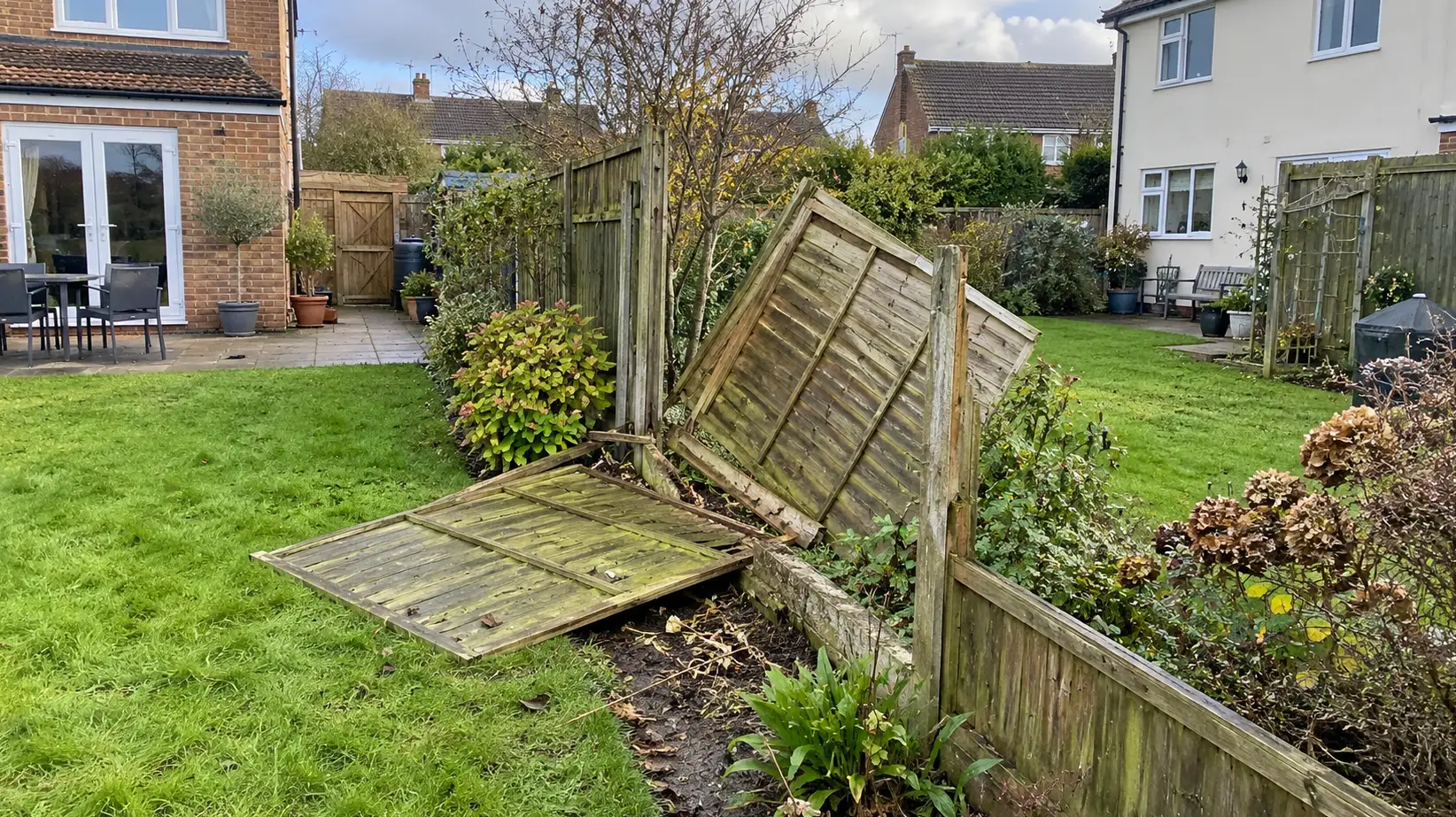
A storm goes through overnight, and by morning the fence panel that used to separate your garden from next door is lying flat across your flowerbeds, or leaning at an angle that suggests it’ll finish the job in the next stiff breeze. Your neighbour, it turns out, owns that fence. Surely that means they have to fix it?
Not necessarily — and this is one of the more counter-intuitive points in boundary law, in every part of the UK. Ownership and obligation are two different things, and conflating them is where a lot of neighbour disputes start. A homeowner can own a boundary fence without being legally required to replace it when it deteriorates, although the deeds, the cause of any damage and whether the fence has become dangerous can all change what happens next.
Owning a fence doesn’t mean you’re legally required to keep it standing
In England and Wales, there is generally no statutory duty to erect or maintain an ordinary residential boundary fence at all. Unless something in the title documents creates an enforceable obligation to maintain it, a homeowner can, in principle, leave a broken fence where it fell. It’s an unhelpful answer if you’re the one staring at the gap, but it’s an important starting point. The fact that somebody owns a fence doesn’t automatically mean the law requires them to keep it standing, attractive or capable of providing the privacy it once offered.
The first place to look is the property paperwork. HM Land Registry’s guidance on boundary ownership and maintenance explains that deeds may contain obligations concerning fences and walls, but also makes clear that ownership and maintenance responsibility aren’t necessarily the same thing. A covenant might require an owner to maintain a particular boundary, even though the physical feature’s ownership isn’t established by that obligation alone. Equally, a title might identify who owns the fence without imposing any requirement to repair it.
There’s a complication here that matters if you’re thinking about forcing a neighbour to spend money. An old covenant saying that a boundary fence must be maintained doesn’t necessarily bind every subsequent freehold owner automatically. Positive covenants — obligations requiring someone to do something or incur expenditure — can be difficult to enforce against successors in title under English and Welsh property law, depending on the wording and legal arrangements involved. It’s therefore worth distinguishing between finding a maintenance obligation in an old conveyance and establishing that it can actually be enforced against the person who owns the property today.
If the current title register refers to an earlier transfer or conveyance, that document may contain the relevant wording. You can request copies of deeds and other property documents from HM Land Registry where they’re held, although a solicitor may be needed to interpret what an old covenant means and whether it remains enforceable. For a routine fence repair, that level of investigation may be unnecessary. For a neighbour dispute involving an expensive replacement or threatened legal proceedings, assuming that an old covenant automatically settles the issue can be a costly mistake.
The broad distinction between ownership and repair obligations also matters elsewhere in the UK, although the legal systems are different. Citizens Advice Scotland’s guidance on boundary and garden disputes confirms that a property owner in Scotland doesn’t generally have to repair a fence or wall unless the title deeds impose that obligation. Northern Ireland has its own land-registration and property-law system, so the effect of any maintenance obligation there needs to be considered under Northern Irish law rather than simply applying the English rules about covenants.
In other words, discovering that your neighbour owns the fence is useful, but it isn’t the end of the investigation. The more important question is whether anything legally requires them to repair it.
What you can actually do if they won’t fix it
If there’s no enforceable obligation and your neighbour genuinely doesn’t want to repair or replace their fence, you may have little ability to compel them simply because you want the boundary reinstated. But you’re not stuck looking at the wreckage either. The straightforward option is to put up your own fence entirely within your property, a short distance onto your side of the legal boundary. It costs you money for something that arguably wasn’t your job, which understandably grates, but it sidesteps the impasse and gives you control over the replacement, provided the proposed fence complies with the applicable planning rules and any restrictions in your title.
There are a couple of practical precautions worth taking before doing that. Make sure you’re reasonably confident where the legal boundary runs rather than treating the old fence as conclusive evidence of its position. And don’t assume that because the neighbour has allowed their fence to collapse, you’re entitled to dismantle it, throw the materials away or attach your replacement to their posts without permission. A broken fence remains somebody’s property, and interfering with it can create another disagreement on top of the original one.
It’s also worth asking whether you actually need a replacement. If the missing panel presents no significant privacy, security or safety problem, spending your own money may not be worthwhile. If you have children or pets that need a secure garden, or the gap leaves your property unusually exposed, the calculation changes. A fence you own and maintain yourself may be a more practical solution than spending months trying to persuade an unwilling neighbour to repair theirs.
There are, however, situations where the legal position becomes more complicated.
Safety is the first. A rotten panel lying harmlessly on the grass is one thing; a substantial boundary structure that could collapse onto a pavement, road or somebody using the adjoining garden is another. The absence of a general obligation to maintain a fence doesn’t mean an owner can necessarily ignore a known danger without consequences. If a deteriorating structure causes injury or damage, questions of civil liability may arise depending on what the owner knew, how foreseeable the risk was and what reasonable precautions could have been taken.
In England and Wales, local authorities also have powers concerning dangerous buildings and structures under sections 77 and 78 of the Building Act 1984, including emergency intervention where the statutory conditions are met. Those powers won’t necessarily apply to every leaning timber fence, and an unsightly panel isn’t automatically a dangerous structure. But where a substantial boundary structure appears genuinely unsafe, contacting the council’s building-control or dangerous-structures service may be appropriate rather than treating it as an ordinary maintenance disagreement. Scotland and Northern Ireland have their own separate building-safety regimes.
The second exception concerns boundaries subject to particular statutory requirements. Fencing alongside certain railway land, or fencing used to contain livestock, can involve obligations that have little to do with the ordinary rules for a suburban garden. Those are specialist circumstances rather than a general reason to assume every homeowner must maintain the fence around their property.
For the typical garden boundary, though, the distinction remains: a neighbour may have no enforceable obligation to replace a damaged fence, even where leaving it unrepaired is inconvenient for everyone around them.
The insurance question people forget to ask
If the fence belongs to you and a storm took it down, your home insurance might seem the obvious answer. Unfortunately, this is another area where the outcome is often less helpful than homeowners expect. The Association of British Insurers’ guidance on storm damage explains that damage to fences, hedges and gates is generally excluded from standard buildings insurance, reflecting how exposed these structures are to strong winds.
That doesn’t mean every policy is identical. Some insurers offer different levels of protection or additional cover, and the wording of your own policy determines whether a particular loss is insured. But it does mean that discovering the fence has been blown down isn’t, by itself, a good reason to assume an insurer will pay for a new one. Checking the exclusions, any applicable excess and the scope of cover before arranging replacement is considerably more useful than finding out afterwards that the claim falls outside the policy.
The fence’s condition before the storm can matter as well. A sound structure suddenly damaged by exceptional weather presents a different insurance question from one that has been deteriorating for years and finally collapsed during an ordinary period of strong wind. Wear and tear, rot and gradual deterioration are generally treated differently from sudden insured damage, so a storm being the final event in a fence’s collapse doesn’t necessarily make the replacement cost recoverable.
If the fallen fence belongs to your neighbour, don’t assume their insurance will pay either, or that their insurer’s refusal somehow establishes your legal right to require replacement. Insurance cover and a homeowner’s responsibility to maintain a boundary feature are separate questions. The policy may explain how an owner intends to fund repairs, but it doesn’t create a maintenance obligation where none otherwise exists.
Not an obligation, but often still worth a conversation
None of this means a neighbour with a collapsed fence is necessarily being unreasonable by legal standards — but it also doesn’t mean you have to live indefinitely with a gap in your garden. A calm conversation, ideally before assuming the worst, resolves many of these situations more easily than either household immediately resorting to solicitors or arguing about title deeds. Your neighbour may not have noticed how badly the fence has deteriorated, may have been intending to repair it anyway, or may simply have different priorities about privacy and security.
Even where there’s no legal obligation, there may be room for a practical agreement. One neighbour might offer to pay for replacement panels if the other contributes towards the posts, or both might agree on a new fence that suits their gardens better than the original. Where one household particularly wants greater privacy, that owner may choose to contribute more rather than insist on a legal entitlement that doesn’t exist. An agreement of that kind needn’t become complicated, although recording what has been decided in writing is sensible where significant money is involved or future maintenance responsibilities might otherwise be disputed.
If your neighbour still doesn’t want to act, the sensible next step depends on what the fence is actually doing — or failing to do. A purely unattractive boundary is different from one that leaves your garden insecure, and both are different from a structure that presents a genuine safety risk. Establishing who owns the fence, whether an enforceable maintenance covenant exists and whether there’s any immediate danger will usually reveal whether you have a legal problem or simply an awkward maintenance disagreement.
The most important point is not to start from the assumption that ‘your fence’ automatically means ‘your legal duty to replace it’. In boundary matters, ownership and maintenance responsibility are separate questions, and even a damaged fence can remain somebody else’s property without creating an obligation to rebuild it.
Sometimes the answer will be in the deeds. Sometimes a genuine safety concern changes what can reasonably be expected. But in many ordinary gardens, the quickest solution is also the least satisfying in principle: accept that your neighbour isn’t legally required to give you the fence you’d prefer, leave their property alone and put up your own suitable boundary on your side. It’s not always the answer anyone wants, but it can be considerably cheaper than turning a fallen panel into a lasting neighbour dispute.
Important: This article provides general property information, not legal, financial, surveying or other professional advice for individual circumstances. Boundary ownership, maintenance covenants, liability for dangerous structures and insurance cover depend on the relevant documents, jurisdiction, condition of the fence and particular facts. If substantial costs, safety concerns or disputed legal obligations are involved, obtain appropriate professional advice before carrying out irreversible work.

