

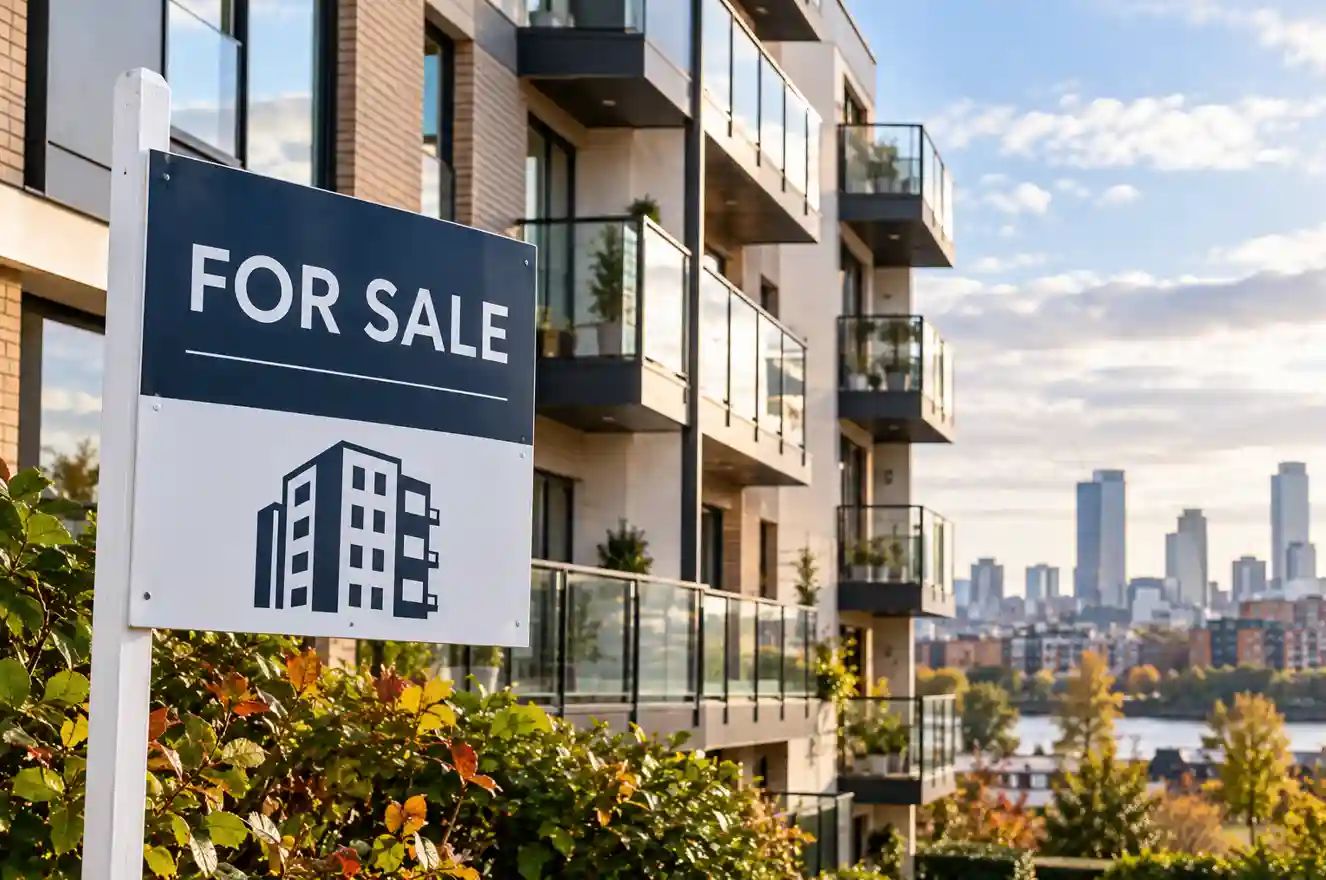
New property market figures show flats struggling to attract buyers, with slower sales and more price reductions than other types of home. But the national picture hides important differences — and for some owners, the greatest difficulty is not finding a buyer, but finding one at a price that allows them to move.
Selling a flat has become an uncomfortable business for some homeowners. A property that once looked like an affordable first step onto the housing ladder can prove surprisingly difficult to sell when the time comes to move on. Buyers may like the location and the accommodation, only to hesitate over the service charge, the remaining lease or the possibility of expensive building works. Others simply decide that, for a little more money, they would rather have a house.
The latest figures suggest those difficulties are becoming more widespread. Property data company TwentyCi reported on 14 October that flats are less likely to sell, more likely to undergo a price reduction and generally taking longer to find buyers. Its Property & Homemover Report for the third quarter of 2026 also describes a subdued wider market, with the number of properties reaching sale agreed down 6% compared with the same quarter last year, despite a small increase in new listings.
For flat owners, the consequences can go beyond a disappointing valuation. Someone who bought an apartment five or six years ago may find that its value has barely moved while the house they hoped to purchase next has become considerably more expensive. Even if a buyer can be found, accepting the available price might leave too little equity to fund the next deposit and moving costs. Staying put becomes less a choice than a financial necessity.
That is an important part of the story behind the latest figures. Flats are performing less strongly as a group, but their prospects vary enormously according to location, price, ownership costs and the condition of the building. Declaring that flats have become unsellable confuses a difficult market with one that has stopped functioning.
What the figures reveal — and what they don’t
TwentyCi’s latest report identifies flats as a particularly weak segment of the housing market, but its publicly accessible summary does not fully explain the methodology behind the percentages used in trade reporting to describe their likelihood of selling. Without knowing precisely which listings were counted, the observation period and how withdrawn or relisted properties were treated, those figures should not be mistaken for the probability of an individual flat finding a buyer.
Other research supports the broader conclusion. Zoopla’s June 2026 House Price Index found that more than two-thirds of one- and two-bedroom flats listed during the first 20 weeks of the year had not reached sold or sold-subject-to-contract status within its observation period. Its figures also showed average flat and maisonette prices falling 0.6% annually to May, while terraced and semi-detached house prices rose by 2.6% and 2.9% respectively.
The difference in selling times is equally revealing. Analysis by agency software company Alto, drawing on more than 70,000 agreed offers between January and June 2026, found that flats took a median 39 days to reach an agreed offer. That compares with 26 days for terraced and semi-detached houses. Two years earlier, flats had taken a median 29 days, suggesting that finding a buyer has become noticeably harder.
Not every type of house was quicker to sell. Detached properties took a median 41 days to attract an agreed offer, reflecting the smaller pool of purchasers for more expensive homes. Alto’s figures also describe properties that reached an agreed offer, rather than every home placed on the market. They are therefore a measure of selling speed among successful listings, not proof that every flat will find a buyer within 39 days.
The sources measure different things, but together they describe a market in which flats face weaker demand, slower negotiations and less favourable price growth than many houses. What they cannot establish is how much of that weakness comes from mortgage affordability, leasehold costs, building safety concerns or changing buyer preferences.
There is also an important difference between a flat that attracts no offers and one that attracts buyers but cannot complete a sale. The first may be struggling with price, presentation or local demand. The second may encounter problems when a solicitor or mortgage lender examines the lease, service charge accounts or building safety documentation. Both contribute to a difficult market, but the underlying obstacles are not necessarily the same.
Why buyers are becoming more cautious
Affordability is an obvious starting point. Flats are an important entry into homeownership for first-time buyers, particularly in expensive towns and cities where houses may be beyond their reach. But that group is especially sensitive to borrowing costs, and the mortgage market has become less forgiving during 2026.
Moneyfacts reported in early October that the average advertised five-year fixed mortgage rate had reached 6% for the first time in around three years. Not every borrower will pay that rate, but higher financing costs affect the amount buyers can borrow and what they are comfortable spending each month. Someone comparing a flat with a small terraced house may decide that the additional space, garden or freedom from certain communal costs makes stretching their budget worthwhile.
The comparison becomes more complicated once the full cost of owning a flat is considered. Service charges, building insurance contributions, ground rent where applicable and potential major works bills can make a seemingly affordable property considerably more expensive than its asking price suggests. Lease length and uncertainty over future expenditure may also influence whether a mortgage lender is prepared to accept the property as security. These problems are not universal, but they give buyers more to investigate before committing to a purchase.
Building safety has added another layer of uncertainty for some owners. Flats in buildings affected by unresolved cladding or other fire safety defects can encounter lending and conveyancing difficulties, particularly where remediation work, certification or liability for costs remains unclear. Yet it would be misleading to treat those concerns as representative of every flat. A well-maintained low-rise building with no relevant defects is a different proposition from an apartment block awaiting extensive remediation.
The same distinction applies to leasehold management. A transparent managing agent, reasonable and predictable service charges, adequate reserves for maintenance and clear information about planned works can make a property easier for buyers to assess. Where those details are disputed or difficult to obtain, uncertainty may become an obstacle even if the apartment itself is attractive.
Buyers’ preferences have also evolved. The appeal of outside space, a spare bedroom and room to work from home has helped some houses compete more effectively against flats. Meanwhile, landlords selling investment properties can increase the supply of apartments in particular locations. If that additional stock arrives when first-time-buyer demand is already weak, sellers may have to wait longer or reduce their expectations.
No single explanation accounts for the entire slowdown. Mortgage rates, local incomes, the availability of houses and the characteristics of individual buildings all interact. The effect can be especially pronounced where flats were previously attractive because they offered a cheaper route into an otherwise expensive housing market, but now carry ownership costs that narrow the apparent saving.
For existing owners, there is a further complication. Historical research by Hamptons, published in August 2024, found that people facing a potential loss on their property were approximately half as likely to proceed with a sale as those who could at least recover their purchase price. Hamptons estimated that around 400,000 fewer flat owners in England and Wales would have moved by the end of that year than under a scenario in which flat prices had continued rising.
Those estimates are not a measure of conditions in October 2026, but they explain why low transaction numbers do not necessarily mean an absence of interested buyers. Some owners test the market and then withdraw when the offers fall short of what they need. Others never put their properties up for sale because they already know that moving would be financially difficult.
The consequences extend beyond individual households. Flats frequently provide the first rung of the property ladder, and when owners cannot afford to trade up, their homes may remain unavailable to the next generation of buyers. The problem is not simply that flats are selling slowly. It is that weaker flat values can interrupt the chain of moves on which other parts of the housing market depend.
Why some flats still sell quickly
The national picture becomes less convincing when applied indiscriminately to local markets. Alto’s Speed of Sale analysis found that flats in Glasgow reached an agreed offer in a median 12 days during the first part of 2026, compared with 39 days nationally. Glasgow was also the fastest-selling UK city overall in its data, with a median of 11 days across property types.
That does not make Glasgow representative of Scotland as a whole, nor prove that its different property ownership and conveyancing arrangements are responsible for faster sales. Local demand, available housing stock, affordability and pricing all influence the result. It does, however, demonstrate how misleading it would be to assume that every flat is experiencing the same market conditions.
Within England, the differences can be just as significant. A spacious apartment in a desirable city neighbourhood, a well-managed flat near a busy commuter station and a coastal apartment attractive to downsizers may appeal to quite different buyers. Some purchasers want the flexibility and privacy of a house; others value being close to transport, shops and services, or prefer accommodation on one level without responsibility for maintaining a large garden.
A well-maintained building with straightforward lease terms and transparent running costs can therefore remain attractive, even where other flats nearby struggle. Conversely, an ambitious asking price may deter buyers from an otherwise good property, particularly when there are several similar apartments available.
For sellers, this makes local evidence more important than national headlines. An agent should be able to explain what comparable flats have actually sold for, how long those sales took and whether the properties carried similar service charges, lease terms and maintenance obligations. A neighbour’s optimistic asking price is not evidence of market value, and repeated reductions after an overpriced launch can waste time without resolving the underlying problem.
Preparing the documentation early may also help. Leasehold management information, service charge accounts, planned works and relevant building safety records are often needed during conveyancing. Obtaining what is available before a buyer is found can reveal difficulties that might otherwise emerge after an offer has been accepted. That does not guarantee a successful transaction, but it gives the seller a better chance of dealing with questions before delays undermine confidence.
For buyers, a slower market may offer greater negotiating room, provided the apparent discount is weighed against the long-term cost of ownership. A flat that looks inexpensive because its lease is short, substantial expenditure is approaching or its building has unresolved problems may not be the bargain it first appears. Estate agents and mortgage advisers also need to distinguish between a property that is merely taking longer to attract interest and one where ownership or lending complications could prevent a sale from progressing.
Buy-to-let landlords face a similar calculation. A flat may continue producing reliable rental income while becoming harder to sell, leaving an investor exposed if capital needs to be released within a particular period. Rental performance and resale prospects are related, but they are not interchangeable measures of an investment’s strength.
The latest market figures should therefore concern flat owners without convincing them that selling has become impossible. Buyers are more selective, and some properties face genuine disadvantages that cannot be removed through marketing or a modest price reduction. Others continue to attract interest because their location, condition, running costs and asking price make sense relative to the alternatives.
For owners hoping to move, the hardest question may be whether the achievable selling price will fund the next purchase. For buyers, it is whether a flat’s apparent affordability survives closer examination of the building and the costs attached to it. Both questions matter more than any national percentage claiming to show how likely a flat is to sell.
The flat market has not closed. But it has become less forgiving, and the gap between homes that buyers understand and want, and those carrying costs or uncertainties they would rather avoid, may now matter more than the distinction between flats and houses itself.
This article provides general property market information as at 16 October 2026 and does not constitute financial, legal, mortgage or valuation advice. The research cited uses different datasets, definitions and observation periods, and its findings should not be treated as predictions for individual properties. Buyers, sellers and landlords should obtain appropriate professional advice when making property decisions.

