

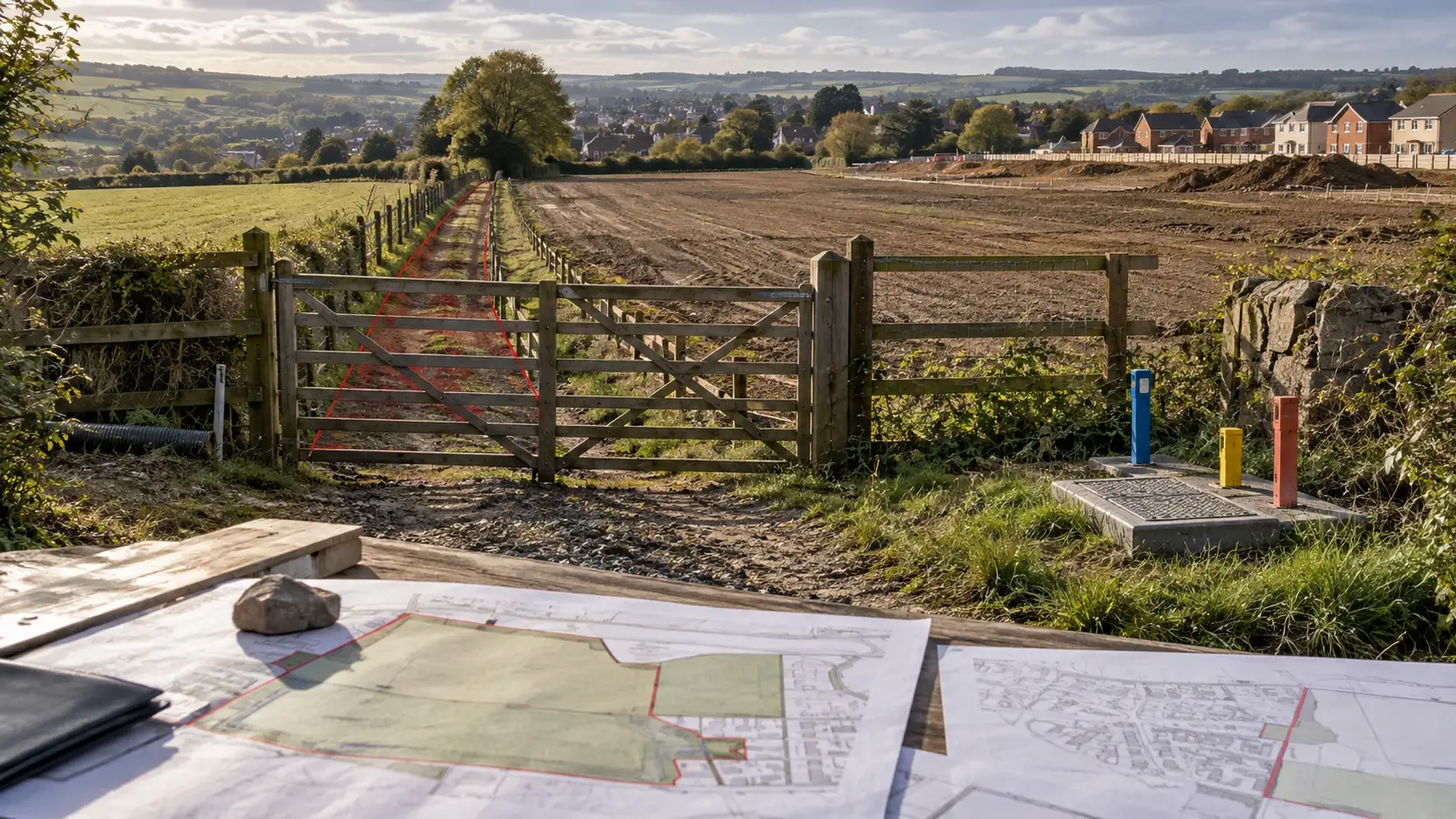
A fifteen-acre site with full planning potential, committed funding and a viable scheme can still lose most of its projected development value if the only realistic vehicular access crosses a strip of land somebody else owns and has no obligation to sell. The strip itself might have little value in its existing use. Attached to a scheme that cannot proceed without it, it can become worth a meaningful share of the entire development’s uplift. Experienced developers already know this dynamic by its shorthand — the ransom strip. What is less consistently understood, and considerably more useful to actually manage, is why the value involved bears almost no relationship to the physical land in question, and how much of the risk it creates could have been eliminated by looking earlier rather than negotiating harder later.
This article focuses principally on the position in England and Wales. Property law governing easements, covenants, title and land registration differs materially in Scotland and in Northern Ireland, and a developer or landowner with interests across the UK should treat this as England and Wales-specific analysis rather than a UK-wide statement of law.
Uplift value, not land value
The economics of dependency are the whole story here, and they are worth stating precisely. A third-party right or strip of land becomes valuable, in this context, not because of what it is worth standing alone, but because of what it enables somebody else to do with land they already own. Courts and valuers assessing what a ransom position is worth have long grappled with exactly this problem, and the reference point most practitioners still cite is the Lands Tribunal decision in Stokes v Cambridge Corporation, which attributed roughly one-third of the increase in value of the wider development site to the access required across separately owned land. That case arose in a compulsory-purchase valuation context and is regularly misremembered as establishing a fixed one-third rule for private negotiations, a mistake that RICS professional analysis explicitly warns against. The tribunal in Stokes reached that figure in the context of specific facts, including that the party controlling access held other land that would benefit from the development and would not have to fund the access road itself. Subsequent decisions have produced materially different results. In Batchelor v Kent County Council, the eventual apportionment was 15% of the uplift because alternative access possibilities weakened the ransom position, while Ozanne v Hertfordshire County Council resulted in an apportionment of 50% where only one practicable access existed. The Valuation Office Agency’s technical guidance on ransom strips records those variations and the influence of each case’s circumstances.
There is no reliable shortcut formula. The relevant uplift is not the gross sales value of the proposed development, nor simply the difference between agricultural land prices and the eventual value of completed homes. It is the additional value attributable to securing the necessary right, assessed with proper allowance for the scheme’s costs, risks, developer’s profit and the value the land would retain without that right. What is consistent across the valuation cases is the underlying principle: the party controlling the constraint may be able to negotiate a share of the value it unlocks, but the amount depends on how essential that right genuinely is, what real alternatives exist and the commercial positions of those involved. A landowner is not automatically entitled to any particular percentage merely because the developer needs cooperation.
Where dependency arises in practice
Access is the most familiar source of this problem, but it is far from the only one, and a competent pre-acquisition review needs to look considerably wider than the obvious driveway or vehicular entrance. Pedestrian access, highway connection points and visibility splays required for a safe junction can each sit outside the boundary of the land actually being acquired. Service easements — the rights needed to lay and maintain electricity, gas, water, drainage or data infrastructure across land in third-party ownership — are frequently as critical to a scheme’s viability as physical vehicular access, and are considerably easier to overlook during an initial site appraisal because they do not show up as an obvious physical barrier the way a fenced strip does. The legal arrangements for utility infrastructure may involve easements, wayleaves or statutory rights, and the existence of a physical pipe or cable does not by itself establish that the developer has all the rights its proposed scheme requires.
Existing rights of way present a subtler version of the same problem: a right benefiting the site’s existing, lower-intensity use may be inadequate in scope for a substantially different development, and establishing whether an existing easement genuinely extends to cover the proposed use — rather than assuming it does because some access already exists — is a question that requires proper legal analysis rather than casual assumption. An increase in use alone does not necessarily invalidate an existing easement; the terms of the grant, the nature of the change and, where relevant, the additional burden placed on the land crossed can all matter. HM Land Registry’s guidance on easements addresses their registration, but interpreting the extent of an existing right is not simply a matter of finding an entry on the register. Restrictive covenants add a different dimension again, discussed further below, because unlike an access dependency they do not necessarily announce themselves through the physical layout of the site at all. And title defects or genuine ownership gaps — land where historic conveyancing has left an unclear or disputed chain of ownership — can create dependency on a party whose interest in the land may not even be straightforward to establish, let alone negotiate with.
There is a further complication that can make a ransom position particularly difficult to identify from initial plans: the red edging on a registered title normally shows a general boundary, not the exact legal boundary. A narrow strip apparently included within a site, or seemingly forming part of an adopted road, may prove more complicated when the historic transfers, adjoining titles and highway records are examined. HM Land Registry’s boundary guidance explains why the precise legal line cannot ordinarily be established from the registered title plan alone. For a development whose access depends on a few metres of frontage, the distinction between what a plan appears to show and what the legal documents actually establish can be commercially decisive.
Why timing determines bargaining power
The single most useful practical insight in this area is that the same third-party dependency carries dramatically different negotiating consequences depending on when it is discovered, because each stage of the development process progressively narrows the developer’s options and can increase what the constrained party expects to extract.
Before land acquisition, a developer who identifies a ransom dependency during due diligence retains real flexibility: the purchase can be renegotiated to reflect the risk, made conditional on securing the necessary right before completion, or abandoned altogether in favour of a different site, all without having committed the full acquisition capital. After acquisition but before planning permission is secured, those options narrow considerably — the developer has already committed to the land and typically cannot simply walk away without crystallising a loss, but the development’s value uplift has not yet been demonstrated through a planning consent, which can still leave some room for negotiation on reasonable commercial terms. Once planning permission has been granted and the scheme’s value uplift becomes more concrete and capable of valuation, the position can shift decisively: the party controlling the constrained right has a clearer indication of how much value now depends on their cooperation, and negotiations at this stage are negotiations over a demonstrated development opportunity rather than a purely speculative prospect — which is exactly the point at which ransom positions can become most expensive to resolve.
That does not mean every consented site is automatically worth the maximum ransom payment its owner fears. A viable alternative access, a different development layout, a genuine uncertainty over the legal extent of the claimed right or an economic limit on what the scheme can afford to pay may constrain the third party’s bargaining position. But the danger for the developer is that these alternatives become progressively harder to pursue once land, design, professional fees and planning expenditure have been committed. A developer whose funding, contracts or planning obligations assume an access arrangement that has not been legally secured may find that a small unresolved interest becomes a condition preventing the wider transaction from completing.
The commercial consequences are not confined to the straightforward purchase of a development site. In Persimmon Homes Ltd v Hillier, Persimmon acquired companies holding options over several parcels of potential development land, but two essential freehold parcels, including land providing access, remained in a different company outside the acquisition. The dispute eventually reached the Court of Appeal in 2019 over the correction of contractual warranties and a disclosure letter, rather than the original transaction itself having secured ownership of all the required land. It is a revealing example of how a developer can acquire what appears to be control of a development opportunity without actually obtaining every interest necessary to realise it, particularly where landholdings are spread across several companies.
This is why title and rights due diligence needs to happen at the earliest commercially sensible stage of a transaction, ideally during initial appraisal and certainly before an unconditional land purchase, rather than being treated as a formality to complete once heads of terms are agreed. The objective is not simply to identify a potential problem but, where necessary, to secure an enforceable right in the correct form, over the correct land, for the intended development and its future owners. A personal permission from a neighbour may not give a purchaser or development lender the same security as a properly granted and registered easement. A dependency identified before acquisition can be reflected in the land price or the completion conditions; the same dependency discovered after planning consent has been secured, and after the capital committed to reach that point, can cost a meaningful share of the entire development’s value.
An illustrative example
Consider a hypothetical fifteen-acre site with planning potential for a substantial mixed housing scheme. The only commercially viable vehicular access crosses a narrow parcel, perhaps a quarter of an acre, retained by a separate owner following a historic land sale decades earlier. That parcel has limited independent development value — it is not large enough to support a viable scheme of its own, and its owner has no obvious use for it beyond its current agricultural or amenity function. Without the right to cross it, however, the fifteen-acre site cannot be developed in anything resembling its intended form, because no alternative access route exists that would satisfy highway requirements.
In this scenario, a negotiation over the access right is not really a negotiation over a quarter-acre of land at its standalone value. It is a negotiation over a share of the value the access unlocks across the entire fifteen-acre scheme, potentially involving a significant sum where the net development uplift is worth millions of pounds. The appropriate valuation would need to consider what the site is worth without the access, what it could be worth with a legally secure route, the costs of achieving that development, the probability of obtaining consent and whether another route could deliver a less valuable but still viable scheme. The resulting bargaining position would be informed by the same case-by-case factors the case law above sets out, not by taking a presumed one-third of the development’s gross value or applying any other percentage automatically. The figures and land configuration in this scenario are illustrative only, not a benchmark for real negotiations, which depend on professional valuation evidence and the parties’ respective legal positions.
Restrictive covenants: a different kind of dependency
Restrictive covenants deserve separate attention because they behave differently from an access-based ransom position in one crucial respect: planning permission does not override them. A local planning authority granting consent for a scheme is assessing the scheme against planning policy; its decision does not itself authorise a breach of a private restrictive covenant, and a covenant validly created and still enforceable can prevent a permitted development from proceeding regardless of how strong the planning case for it was. This is a genuinely important distinction that a developer relying purely on planning due diligence can miss entirely — a site can have full planning permission and still be legally undevelopable in its intended form because of a covenant affecting the title, created for reasons that may have nothing to do with current planning policy at all.
Where a covenant does present an obstacle, the Upper Tribunal (Lands Chamber) has jurisdiction under section 84 of the Law of Property Act 1925 to discharge or modify restrictive covenants in defined circumstances — though it is worth being precise that this power does not extend to positive covenants requiring someone to do something, or to easements such as rights of way, which sit under entirely different legal regimes. The Upper Tribunal’s guidance, updated in July 2026 explains the application and notification process, including the possibility of objections and a hearing. That route can resolve a covenant obstacle, but it takes time, costs money and carries a real risk of an unsuccessful outcome depending on the specific statutory grounds relied upon and the covenant’s continued relevance. Planning permission may be relevant to the tribunal’s assessment, but it does not guarantee that the covenant will be modified or discharged.
The risk of assuming otherwise was demonstrated in Alexander Devine Children’s Cancer Trust v Housing Solutions Ltd, decided by the Supreme Court in 2020. A developer had constructed affordable housing in deliberate breach of restrictive covenants protecting neighbouring land associated with a children’s hospice, then sought to have the covenants modified. Despite the development having already been built, the Supreme Court refused the application, emphasising the significance of the developer’s conduct when deciding whether relief should be granted. The case does not mean that every restrictive covenant will survive an application under section 84, but it is a powerful demonstration that constructing a scheme first and attempting to regularise the private property rights afterwards is not a reliable commercial strategy.
What a developer can do about it
None of the responses available once a dependency is identified amount to legal advice in themselves, and the right choice depends heavily on timing, cost and the specific right involved, but the broad options are worth setting out plainly: purchasing the relevant land or interest outright can remove an access dependency where the owner is willing to sell and the acquisition provides the rights required; negotiating the specific easement or right needed, without acquiring the underlying land, can be a cheaper and faster route where the constrained party is willing to grant it; redesigning the scheme to avoid the dependency altogether, perhaps by relocating access or reconfiguring the layout, sometimes eliminates the problem at the cost of scheme efficiency; investigating whether any statutory power might legitimately assist — including powers available to certain public authorities or statutory undertakers in defined circumstances — is occasionally relevant, though such powers are not something an ordinary developer can simply invoke at will; and, where a covenant or access dependency genuinely proves too difficult or costly to resolve within an acceptable timeframe, reassessing the acquisition or walking away from the site entirely remains a legitimate and sometimes correct commercial decision.
For a landowner selling development land, the lesson runs in the opposite direction but is just as important: demonstrating that the site already benefits from the access, service rights and legal freedom necessary for the intended development can remove uncertainty from a purchaser’s appraisal and protect the price the site is capable of achieving. A purchaser who cannot establish those rights may discount the land, require contractual conditions or refuse to proceed, even where planning prospects are otherwise attractive. What is never a legitimate assumption is that planning permission itself overrides a private property right — the two systems operate independently, and a developer who conflates them is likely to discover the difference at the least convenient possible moment.
This article provides general information about development land, valuation and property rights in England and Wales. It does not constitute legal, planning, environmental, tax, valuation or investment advice. The position will depend on the site’s title, the rights and interests involved, the proposed development and the applicable law. Specialist legal, surveying and valuation advice should be obtained before entering into transactions or relying on any particular right.

