

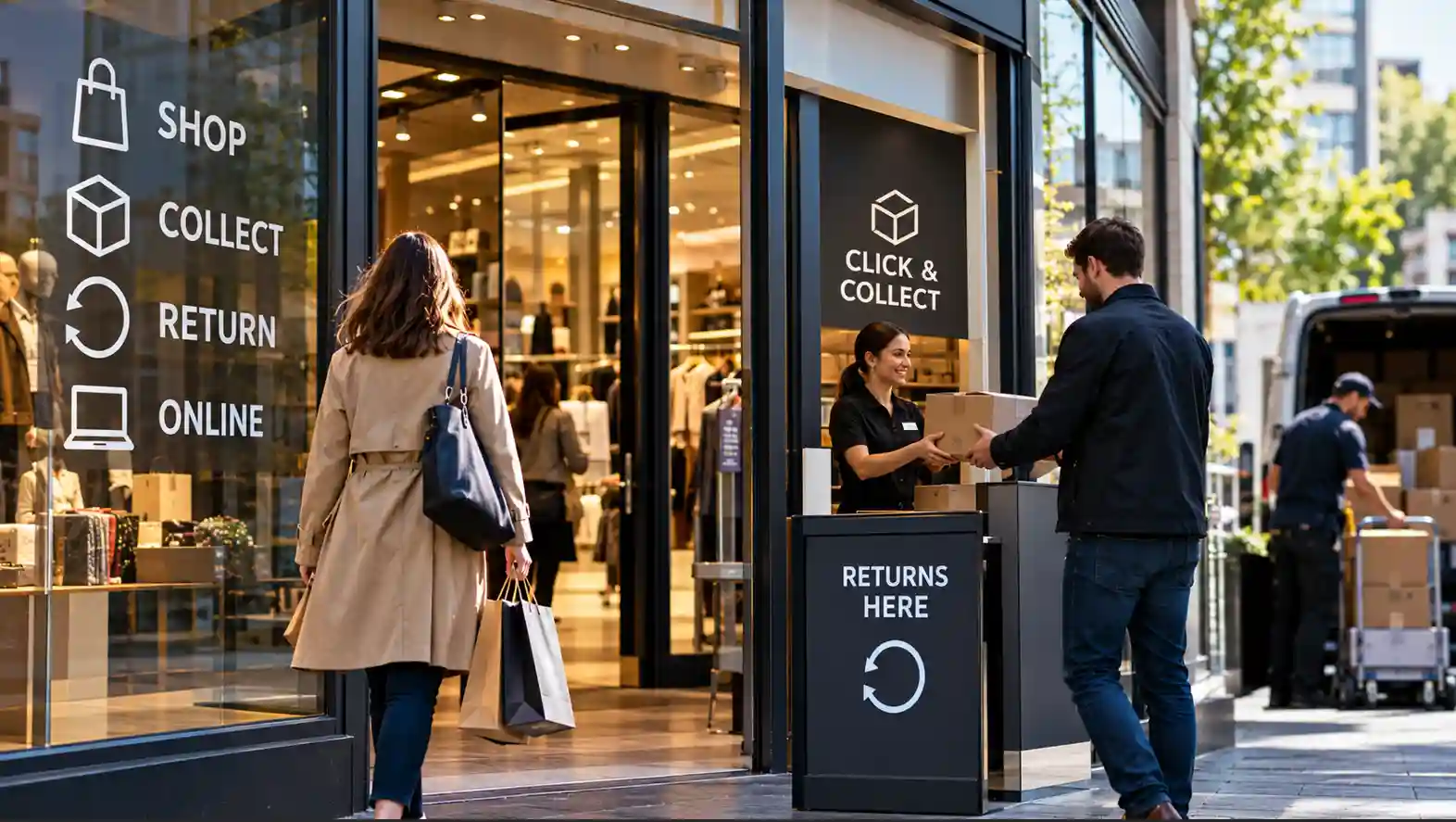
A store posting mediocre till receipts can, on paper, look like a candidate for closure. It can also, in the same breath, be quietly responsible for a meaningful share of the online sales in its catchment, the returns processing that keeps the delivery business viable, and the brand visibility that makes the retailer’s app worth opening at all. Judging that store by its till alone answers a much narrower question than the one that actually matters to whoever is deciding whether it should stay open — and the gap between those two questions is where a considerable amount of current retail property strategy now sits.
The old narrative was simpler than the current reality
The story that dominated retail commentary for much of the last decade ran roughly as follows: online retail grows, physical stores become less necessary, and property occupied by retailers should be expected to shrink accordingly. That narrative captured something real about the shift in how people shop, but it has not played out as a simple, continuing decline. The ONS internet-sales series puts online sales at 27.3% of retail sales in Great Britain in August 2026, on a non-seasonally adjusted basis, against an annual average of 27.5% in 2025, 19.2% in 2019 and the pandemic peak of 37.8% in January 2021. The separate, seasonally adjusted August estimate was 28.8%, so the two figures should not be confused. The share of spending going online has settled at a much higher level than before the pandemic without continuing to rise at its earlier pace. This is not a claim that online sales have stopped growing: ONS figures for August 2026 put online spending 8.9% above a year earlier. The change is not a return to shopping as it used to be, but a recognition that physical and digital retail are increasingly parts of the same operating model.
What a store is now doing
A modern store increasingly performs several distinct functions simultaneously, and which of them matters most varies by retailer, sector and specific location. It remains, obviously, a sales floor generating direct transactions. But it can also be a showroom where the customer researches, tries or experiences a product before completing the purchase elsewhere; a collection point for online orders; a place to handle returns; a customer-service touchpoint; and, for some retailers, a fulfilment node using store inventory for local delivery. Brand visibility gives certain locations a further value to the wider business that may never be recorded as a transaction on those premises. None of these functions, taken alone, proves that a particular shop ought to stay open. Together, they explain why till sales no longer describe the whole job it may be doing.
The operational link is visible in retailers’ own figures. NEXT’s annual report for January 2026 says nearly half of its UK online orders are collected in store and most UK online returns go through its shops. Kingfisher reports that 63% of group e-commerce sales in the year to January 2026 were fulfilled through click and collect. They are different measures from different businesses, not a national benchmark. They do, however, make the practical point more forcefully than general claims about omnichannel retail: closing shops may also mean changing how the online business fulfils orders, handles returns and serves customers. The cost of replacing those functions belongs in the closure decision, alongside the rent and wages saved.
What this does to property requirements
This shift in function has genuine and specific consequences for what retailers need from their physical space, rather than remaining an abstract point about strategy. The balance between sales floor and back-of-house space has moved for some retailers, with more capacity required for order processing, collection and returns than a traditional sales-floor-dominant layout allowed. Access for deliveries and customers collecting orders can matter almost as much as frontage, and a layout efficient for sales may not be efficient for reverse logistics. Store size decisions increasingly reflect a strategic choice between larger flagship locations intended to showcase range and brand experience, and smaller, more functionally focused stores serving a local catchment. Portfolio rationalisation can therefore mean closing one shop while putting money into another, because the two locations perform different jobs within the network rather than because the retailer has changed its mind about physical retail altogether.
Marks & Spencer’s 2026 annual reporting illustrates that selective investment: it describes new food stores, full-line openings and renewals alongside a more focused clothing-and-home estate. It does not establish that online growth caused those investments, and the retailer’s food and clothing requirements should not be treated as interchangeable. For a landlord, the more immediate implication is that investment in a retail estate does not guarantee demand for every sort of unit. A larger showroom or a store with workable collection access may be sought after while another unit in the same town no longer fits the occupier’s preferred model.
The professional question that should drive the decision
The genuinely useful question for a retailer or landlord to ask about any specific store is not simply “how much did this store sell,” but “how should the productivity of this store be judged when part of the value it creates never appears in its own till receipts at all.” A store’s direct sales record only the transactions made there, not necessarily the online sales influenced through browsing, trial or collection, or the customer acquisition enabled by having a visible location in the catchment. CACI’s May 2026 analysis of the retail halo effect argues for examining the relationship between the physical estate and local digital spending when deciding whether to open, retain or close a shop. It is a useful location-analysis approach, though research from a provider of such services is not proof that every retailer enjoys a measurable uplift.
The harder question is how much of that activity would be lost, rather than merely handled differently, if the shop closed? Orders collected there might instead be delivered to homes or picked up at another branch. Returns sent through the shop may reduce courier or warehouse costs, but they also require staff, storage and handling. A defensible appraisal therefore needs to distinguish online sales associated with a store’s catchment from sales caused by the store’s presence, and to consider the additional margin or avoided costs after the expense of providing those services. Evidence from comparable catchments or the change in purchasing after a store opening or closure may help; allocating all nearby online revenue to the shop would not. This is a material decision for an operator, but detailed customer attribution and margins are not necessarily data a landlord can demand or obtain during a lease negotiation.
How retailers are siting stores for these different jobs
The functional shift increasingly shows up in where and how retailers choose to locate different types of store, rather than remaining a purely internal distinction. A retailer building out a fulfilment-capable network may give more weight to local population density, convenient collection, loading and access for delivery vehicles than the prime pedestrian frontage sought for a flagship. A showroom-focused location still needs visibility, footfall and the neighbouring uses that draw its customers, because its principal job is about brand experience and trial rather than dispatch efficiency. The roles are not completely separate: a convenient collection point can also generate browsing and additional purchases, while a prime shop can process online orders. A landlord or agent who misunderstands which function a proposed occupier values risks marketing a unit on the wrong basis — stressing passing footfall to a retailer more concerned with workable back-of-house space, or emphasising delivery access where visibility and brand presence are decisive. The physical requirements also affect how easily the unit can be let to the next occupier if the first retailer changes its distribution model.
This is not a licence to justify every underperforming store
None of this should be read as an argument that every store with weak direct sales is secretly valuable once its network contribution is accounted for — that conclusion would simply replace one lazy assumption with another, equally unearned one. A store genuinely does support wider network value in some cases and genuinely does not in others, and the honest, harder task is establishing which is actually true of a specific location rather than assuming the more flattering answer by default. There is an instructive tension even in NEXT’s own reporting: while it describes the importance of stores to online collections and returns, it also says its stores must remain individually profitable when opened and at lease renewal. Network value may be real without being a sufficient reason to keep every branch. A store whose additional contribution and saved distribution costs still do not justify its rent, rates, staffing and other operating costs is not rescued merely by invoking omnichannel value as a general concept. The argument is a genuine and often underweighted consideration, not an all-purpose excuse for deferring a closure decision that better analysis would have reached sooner.
Why this makes lease negotiations more complicated, not simpler
A retailer citing network value as part of its case for a lower rent, a shorter commitment or landlord-funded works at a specific location is making a claim that deserves genuine scrutiny rather than automatic acceptance, precisely because it has an incentive to make the claim whether or not the alleged benefit can be demonstrated. A landlord may reasonably seek evidence that the unit has strategic importance to the retailer, while recognising that customer-level information and profitability are commercially sensitive. Refusing to engage with the argument at all may be equally unwise: a shop with modest till turnover may still be important enough to the tenant’s wider operation to make renewal attractive. Yet value to one retailer is not the same as open-market rental value for the property, which also depends on comparable rents and the demand of alternative occupiers. Under a turnover-rent lease, the treatment of click-and-collect orders, online transactions and returns is a separate contractual matter, governed by how turnover is defined and reported; RICS commentary on flexible leasing identifies those issues as important to the calculation. An attributed online sale does not automatically become a store sale for rent purposes, any more than it necessarily represents a sale that would disappear if the store closed.
What this means for how landlords read occupier performance
For a landlord assessing a tenant’s health and negotiating position, this shift changes what “how is this tenant performing” should actually mean. A retailer’s willingness to pay rent at a location may reflect more than its direct trading figures, particularly where it can demonstrate that the shop is useful to collection, returns, customer acquisition or brand visibility within its catchment. Locations that combine convenient access with footfall and presence may hold more strategic importance to a particular retailer than the till suggests. But that value depends on the retailer’s own network, which can change, and should not be confused with the price another occupier would pay for the same accommodation. A landlord relying purely on till-based turnover risks misreading the tenant’s willingness to renew; one relying on a broad claim of omnichannel value risks making the opposite error. The more useful understanding is of the function the unit performs, the evidence for its commercial contribution and how readily the premises could serve somebody else if the present tenant moves on.
This article provides general information and analysis about UK retail property and retail operations, not legal, financial, valuation, tax or investment advice. Individual store performance, channel attribution, lease terms and market conditions vary; estimates of a store’s wider network contribution require appropriate evidence and professional judgement.

