

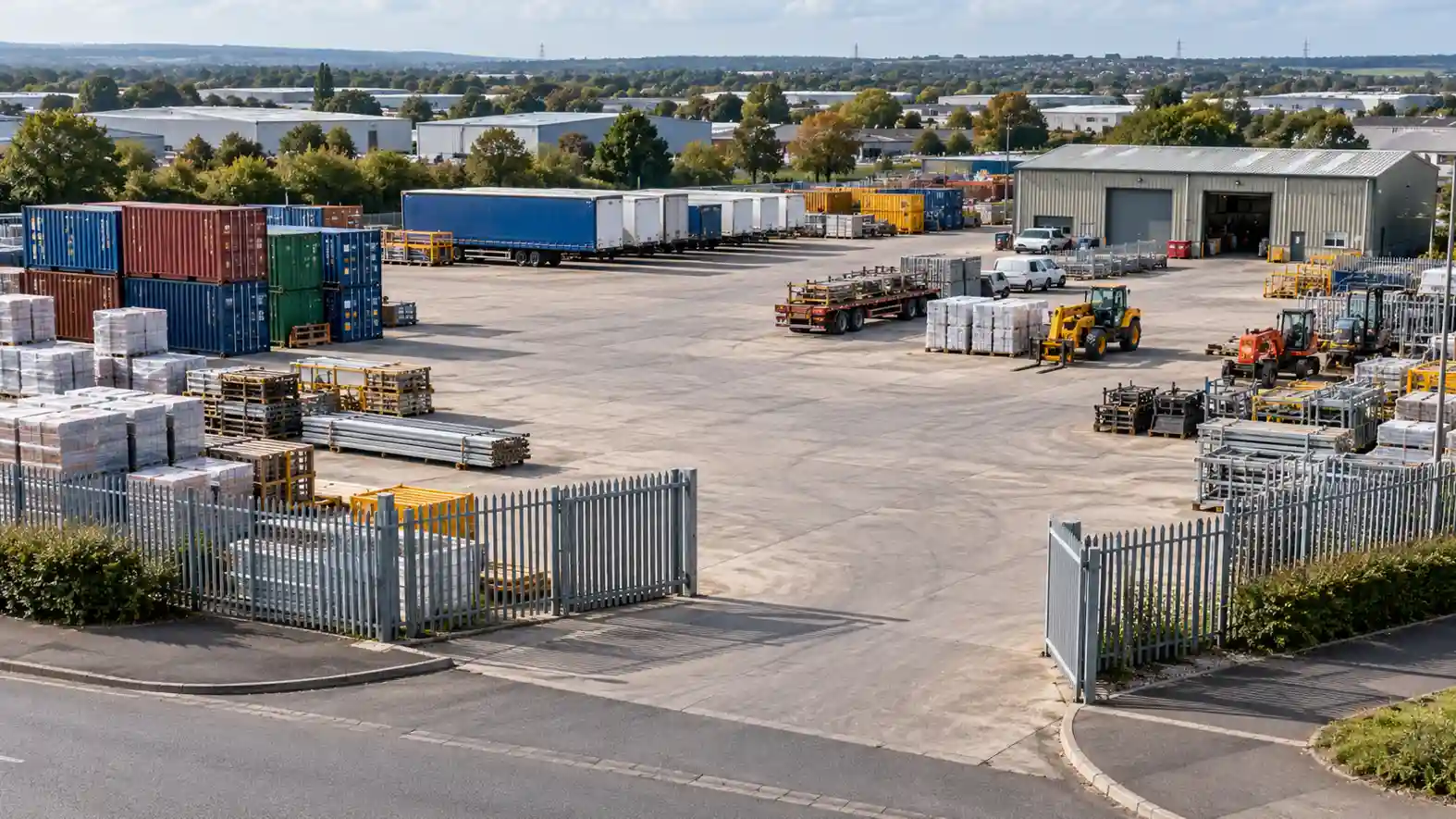
Drive past a fenced compound of stacked containers, parked HGV trailers or plant machinery on the edge of an industrial estate and there is nothing about it that looks like sophisticated property. No roof, no racking, no loading bays worth photographing for a brochure. To most people it reads as leftover land, waiting for something more permanent to be built on it. To the businesses that occupy it, and increasingly to the investors buying it, it is close to irreplaceable.
Industrial Outdoor Storage — IOS in the shorthand now used across the sector — covers a wide range of uses: vehicle and fleet depots, builders’ yards, container storage, construction and plant compounds, infrastructure-support sites, and overflow storage for logistics operators who need secure open land rather than a building. Some sites are entirely open; others include workshops or small industrial buildings alongside extensive yards. What unites them is not the absence of a shed. It is that the land itself, not floor area, is the product being occupied.
What actually makes an open yard valuable
The instinct is to explain IOS through scarcity alone — there is less suitable land, so it costs more. That is true as far as it goes, but it understates what is happening. Three separate kinds of value sit within an IOS site, and conflating them is where much of the casual analysis of the sector goes wrong.
The first is underlying land value — what the site would be worth in its existing use or, where there is a credible planning prospect, for redevelopment. The second is operational value, derived from the site’s physical suitability for the business using it. The third, and the one investors have started paying closest attention to, is strategic network value: what the location is worth because of where it sits relative to customers, roads, suppliers and contractual obligations that cannot easily be moved elsewhere.
A haulage yard two miles from a distribution customer, with authorised operating hours, suitable access and a position already embedded in its drivers’ routes, can be worth far more to that operator than an identical yard ten miles farther away. The difference is not theoretical. It can be measured in additional mileage, driver time, delivery reliability and the risk of disrupting valuable customer contracts. Infill sites — small, sometimes awkwardly shaped parcels within established urban and industrial areas — are particularly affected because there is often no comparable alternative nearby at any price.
That gap between underlying land value and operational importance helps explain why a site containing little more than hardstanding and fencing can command a surprisingly strong rent. But the distinction cuts both ways for investors. The premium one operator is prepared to pay to protect its network may not be available from another tenant when the lease ends. A yard’s current rent can therefore reflect circumstances specific to the occupier rather than a level of demand that will necessarily survive a change of tenant.
It is also why suitable sites can be so difficult to replace. A warehouse can, in principle, be duplicated elsewhere if the building specification and location are appropriate. A yard whose value derives substantially from its exact position in an operational network may be impossible to relocate without fundamentally changing the economics of the business occupying it. The physical simplicity of the land conceals a degree of location dependence that is not always present in more conventional industrial property.
What the rental data shows
The growing interest in IOS has produced a recognisable rental market, although the evidence remains considerably thinner than for conventional industrial buildings. Knight Frank’s September 2025 IOS report recorded average prime rents of £2.69 per sq ft across 41 tracked UK markets in the second quarter of 2025, representing annual growth of 7.8%. The geographical variation was substantial, with average prime rents of £5.45 per sq ft in London and the South East against £1.80 outside that region. Knight Frank published a further IOS report on 6 October 2026, although its detailed figures are not freely accessible through the report page. The 2025 figures remain useful benchmarks rather than a statement of current October 2026 rental levels.
Comparisons with traditional warehousing require care. IOS rents are normally expressed against land area, while warehouse rents are quoted against built floorspace; the products, occupational costs and facilities provided are fundamentally different. A yard with reliable hardstanding, 24-hour access and sufficient manoeuvring space cannot be valued in the same way as an irregular plot with restricted operating hours and inadequate drainage, even where both are advertised as the same acreage. The area being measured matters too. Land lost to access routes, drainage infrastructure or unusable margins can make a superficially attractive rent per square foot much less compelling once the practical storage capacity is understood.
More recent market research reinforces both the investment interest and the regional differences. Carter Jonas’s Q1 2026 IOS research recorded well over £250 million of IOS investment transactions during 2025 in its database, compared with £150 million in 2024. Its rental estimates for the best-quality sites included £10.75 per sq ft at Park Royal, £3.75 in Manchester and £2.25 in Liverpool. These are assessments for defined locations and site quality, not directly interchangeable evidence for every yard within those markets.
The same research estimated net initial yields for best-in-class IOS investments during 2025 at 5.4% in London and the South East and 6.2% elsewhere, while acknowledging that evidence for stabilised assets remains limited. Those figures show how far IOS has progressed towards an identifiable investment market, but they also expose the problem of pricing an asset class whose transactions are still relatively few and whose sites vary so widely. An institutional-quality yard with secure income, modern surfacing and established planning rights is a different proposition from a compound whose apparent return depends on substantial remedial work or an uncertain occupational future. Rental growth alone cannot bridge that difference.
Why occupiers need land, not sheds, in the first place
The reasons a business chooses open storage over a conventional unit are practical rather than exotic. Road access matters more than almost anything else: a site has to accommodate the vehicles using it without conflict with neighbouring premises or the surrounding road network. A haulage yard with difficult HGV access, inadequate turning space or a tendency to cause queuing on public roads quickly becomes a liability rather than an asset. For builders’ merchants, plant contractors and infrastructure operators, proximity to the sites they serve can be equally decisive. A yard farther away may offer cheaper rent but impose far greater costs through additional journeys and lost working time.
Surfacing, drainage and security matter for reasons that extend well beyond the initial appearance of the property. Heavy vehicles and stored plant can rapidly damage inadequate hardstanding, while certain activities present contamination and drainage risks that require appropriate infrastructure. Fencing, lighting and access control are particularly important where expensive vehicles, machinery or materials remain on site overnight. These requirements can involve substantial expenditure, despite the absence of a conventional building, and the allocation of repair and reinstatement responsibilities between landlord and tenant can materially affect the income the owner ultimately retains.
Operating hours and neighbouring uses are frequently the binding constraint. A yard accommodating overnight trailer movements or early-morning departures may sit uneasily beside residential development, while planning restrictions can materially reduce its usefulness to a transport operator. Haulage businesses face an additional consideration: the site may need to be accepted as an operating centre under the operator’s goods-vehicle licence. Government guidance on HGV operating centres explains the separate requirements concerning suitability, access and environmental effects. A yard may have an established industrial planning use without automatically being suitable or authorised for every haulage operation.
For some businesses, the land is also a buffer against disruption elsewhere in the supply chain. Container operators need space to hold equipment between movements; logistics businesses use nearby compounds for trailer parking or overflow; infrastructure contractors require secure sites from which to support projects and maintenance operations. The demand is real, but it is not interchangeable. A compound ideally suited to container stacking may offer little advantage to a fleet operator whose priority is rapid vehicle turnaround, and a yard configured around a temporary infrastructure contract may need considerable adaptation when that contract finishes.
The planning position, and why it complicates institutional ownership
Industrial Outdoor Storage sits awkwardly within the planning system, although not because open storage necessarily falls outside the established use classes. In England, Class B8 storage and distribution expressly includes open-air storage, as the Planning Portal’s use-class guidance confirms. The position becomes more complicated where a site is used for activities such as vehicle dismantling, waste processing or a mixture of operations that are not merely ancillary to storage. A conventional storage compound, transport depot and scrap-processing yard can look remarkably similar from the road while having quite different planning histories and lawful uses. Scotland, Wales and Northern Ireland operate their own planning arrangements, so the classification of sites needs to be examined within the relevant jurisdiction.
Existing occupation does not, by itself, establish that every activity taking place on a site is authorised. A change in tenant can also bring a change in use, vehicle movements, operating hours or environmental effects that the original permissions never contemplated. Planning conditions may restrict stacking heights, access arrangements, lighting, noise or hours of operation, while certain activities require separate environmental authorisation. The Environment Agency’s guidance on waste permits makes clear that waste storage and treatment can require a permit or registered exemption in addition to the planning position. For a purchaser, an apparently secure industrial letting can prove more complicated if the next occupier cannot lawfully operate in the same way.
That complexity feeds into one of the biggest structural obstacles facing anyone trying to build a large-scale IOS investment platform: ownership fragmentation. Knight Frank’s research into the sector identifies scattered private ownership and limited transactional evidence as major barriers to institutional scaling. Unlike a modern logistics park developed and managed under a single ownership structure, IOS sites are often held individually by private landlords, family businesses or operating companies that also occupy the land themselves. Building a substantial portfolio means negotiating site by site, frequently with owners who have little reason to sell on an institutional timetable.
The differences do not end when the transactions complete. One yard may have a full repairing lease and long-established lawful use; another may have poorly documented access rights, a historic contamination issue or hardstanding that needs replacing. Bringing those sites into a consistent management and investment structure can require considerable capital and specialist work before any anticipated rental growth is realised. It is a much less uniform proposition than purchasing a series of modern distribution units built to similar specifications.
The acquisition of Childerditch Industrial Park near Brentwood illustrates both the attraction of scale and the need to distinguish current income from potential. Knight Frank described the approximately 45-acre park acquired by the Almcor–Cerberus venture as fully let to 28 occupiers, with average IOS rents of around £2.80 per sq ft and potential reversion towards £4.50. The estate includes industrial buildings alongside extensive outdoor storage plots, rather than consisting entirely of bare land. The higher rental figure represents potential future income, not rent already being collected, and achieving it depends on the leases, market evidence, site condition and occupiers’ ability to support higher payments. An investment price that assumes the whole uplift has already been secured leaves correspondingly less reward for the work required to obtain it.
Five yards, five different businesses
The range of occupiers is worth distinguishing because the same broad label conceals fundamentally different operational requirements. A yard selected for its proximity to a motorway may be ideal for one tenant and poorly suited to another, while a site requiring costly surfacing or restricted to limited hours may have a much narrower market than its location initially suggests.
| IOS use | Why the occupier needs the site | What matters to future property income |
|---|---|---|
| Haulage and fleet depot | Vehicle parking and timely access to routes | Operating-centre authorisation, vehicle movements and condition of hardstanding |
| Builders’ or plant yard | Storage close to construction and trade customers | Contract-dependent demand, loading rights and reinstatement liabilities |
| Container storage | Open capacity for containers and handling equipment | Ground loading, permitted stacking and access for heavy vehicles |
| Logistics overflow | Buffer space near a principal distribution operation | Dependence on one customer or facility and alternative occupier demand |
| Infrastructure compound | Secure staging for a project or maintenance contract | Duration of work, security expenditure and future alternative uses |
The distinction becomes particularly important when considering lease length and rental reversion. A contractor needing space for a specific project may value flexibility above long-term commitment, while a haulage operator whose depot supports established customer contracts may be more concerned with security of occupation. The same lease structure will not necessarily suit both. Nor should strong demand in one part of the IOS market be assumed to translate into equally strong demand for every plot available to let.
That diversity is also part of what makes the sector interesting. IOS is not a single market with one driver but a set of overlapping requirements from businesses that have very little else in common except a need for secure, well-located open land rather than covered floorspace. The investment challenge is distinguishing sites with demand from several potential occupiers from those whose economic importance depends on a particularly specialised or temporary requirement.
Simple land, sophisticated ownership
The direction of travel is reasonably clear. IOS is moving from a category landlords and occupiers barely named as distinct, towards one with its own data, its own transaction record and its own institutional buyers. The growing depth of rental and investment evidence has made the sector easier to identify and assess, but it has not removed the individual character of the sites or the difficulties of assembling them into substantial portfolios.
What is unlikely to change nearly as quickly is the physical character of the sites themselves — they will go on looking, to anyone driving past, like leftover land rather than serious commercial property. That gap between appearance and value is not a temporary quirk of an immature market. It is close to the defining feature of the sector, and it is exactly why aggregating it at scale remains so much harder than aggregating a portfolio of sheds.
This article provides general information and analysis about the UK industrial and logistics property market and does not constitute investment, valuation, legal, planning, environmental or transport-licensing advice. Rental evidence is dated and site-specific, while permitted uses, environmental obligations, operating licences and lease terms vary by property and jurisdiction. Obtain appropriate professional advice before acquiring, developing, investing in or letting industrial outdoor storage property.

