

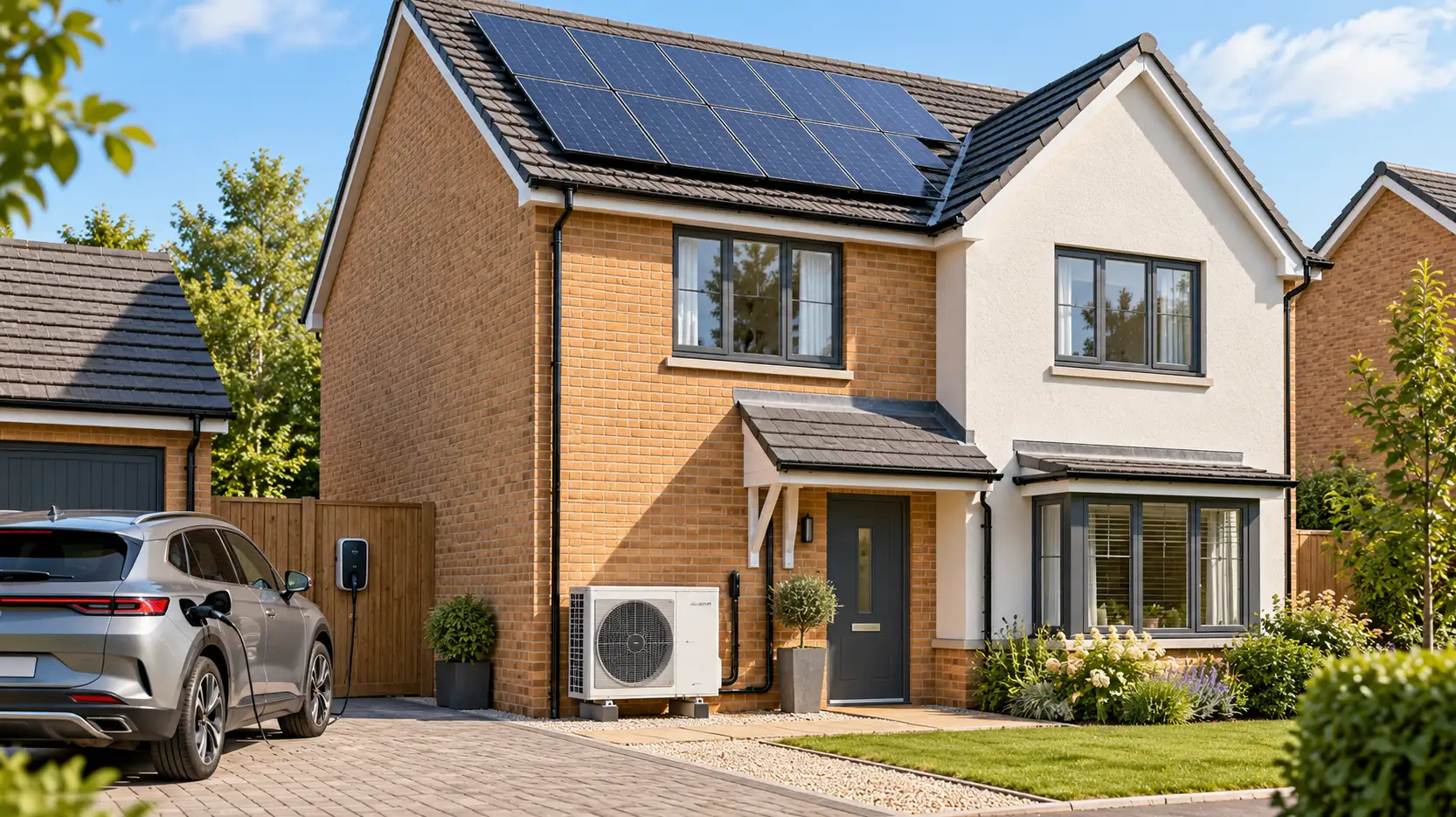
There’s a reasonable assumption behind most of these questions: if the government wants people installing this technology, surely planning permission won’t be in the way. It’s a reasonable assumption, and for the most part it’s now correct — but “for the most part” is doing real work in that sentence, because the rules for solar, heat pumps and EV chargers have moved at noticeably different speeds, and each carries its own specific conditions worth knowing before assuming a green light.
The detailed rules below are for England. That matters because planning is devolved, and the position in Wales, Scotland and Northern Ireland is not interchangeable. It also matters because this has become an unusually fast-moving corner of permitted development: England’s domestic solar rules changed in August 2026, while another change affecting households that need to charge an electric car across a pavement was laid before Parliament only on 30 September 2026.
| Technology | Position in England on 1 October 2026 |
|---|---|
| Solar | Usually permitted development for an ordinary house, but domestic rules changed on 27 August 2026 |
| Air source heat pump | Usually permitted development if the siting and MCS noise requirements are met |
| EV charger | Off-street charging is generally established permitted development; new cross-pavement rights take effect on 21 October 2026 |
Solar panels: the rules changed again in 2026
Solar remains the easiest of the three technologies to install without making a conventional planning application, and for most ordinary houses in England roof-mounted panels are permitted development. But the detailed rules were rewritten on 27 August 2026, which means a surprising amount of otherwise recent guidance is now out of date. The Planning Portal’s current guidance on domestic roof-mounted solar sets out both the previous and post-August rules.
For panels on a pitched roof, the familiar limits remain: they must not project more than 200mm beyond the roof slope and must not extend above the highest part of the roof, excluding the chimney. On a flat roof, the maximum is 600mm above the highest part of the roof. The new rules also draw a clearer distinction between houses and blocks of flats, and give houses specific limits for solar equipment mounted on walls, balconies and roof enclosures. Leaseholders should not confuse permitted development with permission from a freeholder or management company; planning law does not override the terms of a lease.
Conservation areas don’t rule solar out, contrary to a common assumption. For a house, the current restriction catches equipment on a wall, balcony or roof enclosure that fronts a highway in a conservation area or World Heritage Site; it does not amount to a blanket ban on every highway-facing pitched roof. Flat-roof installations on certain designated land can also require prior approval. Listed buildings need separate care again: the solar permitted-development rights do not extend in the normal way to listed buildings or stand-alone solar within their curtilage, and listed building consent may separately be required where the character of the listed building is affected.
Ground-mounted solar changed more noticeably. The array remains capped at 9 square metres for a house, but the permitted height now depends on where it sits. An array forward of the principal elevation and within five metres of the boundary can be limited to one metre; other installations within five metres of a boundary are generally limited to two metres; otherwise the maximum can reach four metres. Particular rules apply on designated land, while blocks of flats retain a different and generally tighter set of conditions. The current Planning Portal rules for stand-alone domestic solar are therefore worth checking before relying on the old shorthand that a garden array simply had to be “under four metres and five metres from the boundary”.
There is one further wrinkle. The August changes include a 12-month transitional period ending on 27 August 2027. During that period, Planning Portal states that qualifying installations can follow either the rules immediately before 27 August 2026 or the new rules. That matters where a proposal fits the previous regime more comfortably than the replacement one; it is not simply a concession for people who had already ordered panels before the law changed. The underlying changes were made by the Town and Country Planning (General Permitted Development) (England) (Amendment) Order 2026.
Air source heat pumps: a rulebook rewritten in 2025
Ground- and water-source heat pumps have separate domestic permitted-development rights and are usually dealt with differently for planning purposes. The recent changes that have caused most confusion concern air source heat pumps, where England’s rules were substantially relaxed in May 2025.
Until 29 May 2025, an air source heat pump relying on permitted development had to sit at least a metre from the property’s boundary. That restriction caused obvious difficulty for terraced houses and smaller semi-detached homes, where the available garden or side passage simply did not provide the clearance. It was removed. At the same time, the maximum outdoor-unit volume for a house increased to 1.5 cubic metres, while a block of flats remains subject to a 0.6 cubic metre limit. Detached houses can now have up to two air source heat pumps under permitted development, while other houses and blocks of flats are generally limited to their first. Systems capable of both heating and cooling can also qualify, provided they are not installed solely for cooling. The full current limits and siting conditions are set out in the Planning Portal guidance for air source heat pumps.
Noise has consequently become one of the main practical tests. An installation relying on permitted development must comply with MCS 020(a), which assesses the proposed heat pump at relevant neighbouring assessment positions rather than using an arbitrary boundary distance. Under Issue 1.1, the calculated sound pressure level must be no more than 37.0 dB(A) at every applicable assessment position. Crucially, that means the position of the unit can determine whether the same heat pump qualifies: moving it, changing the effect of barriers or altering its relationship to neighbouring windows and doors can change the result of the calculation. The methodology is set out in the official MCS 020(a) Air Source Heat Pump Sound Calculation standard.
The transition from the previous noise regime has finished. MCS 020(a) is now the relevant standard for new English installations relying on this permitted-development right; installers should not still be treating the older equivalent-standard route as available. There are other siting limits too. An air source heat pump on a pitched roof is not permitted development, while a unit on a flat roof must sit at least a metre from its external edge. Additional restrictions apply around listed buildings, scheduled monuments, conservation areas, World Heritage Sites and certain highway-facing positions, and permitted-development rights may have been removed locally by a planning condition or Article 4 direction.
The national picture has also moved. Wales previously retained a much tighter boundary rule, but its domestic heat-pump rights were updated on 1 June 2026. The Welsh Government’s current domestic heat-pump planning guidance now also refers to MCS 020(a), permits up to two air source heat pumps at a detached home and one at a non-detached home, and allows an outdoor compressor unit of up to 1.5 cubic metres, subject to the rest of the Welsh conditions. Scotland and Northern Ireland have separate regimes again. The practical point for homeowners, landlords and installers working across borders is simple: an installation that qualifies in England cannot be assumed to qualify elsewhere in the UK.
EV chargers: straightforward off-street, changing for the pavement
Home EV charging with off-street parking is not a new permitted-development right. England introduced specific rights for wall-mounted charging outlets and charging upstands in off-street parking areas in 2011. The changes made in May 2025 widened those existing rights, including removing the old restriction that prevented qualifying outlets and upstands from facing onto and being within two metres of a highway.
For the ordinary homeowner with a driveway or private parking space, the planning position is therefore usually straightforward rather than unrestricted. A wall-mounted outlet and casing can generally be installed as permitted development within the relevant limits, including a maximum volume of 0.2 cubic metres, while charging upstands have their own height and number restrictions. The rights do not apply in the normal way within the curtilage of a listed building or on a scheduled monument. The Planning Portal’s current permitted-development guidance for EV chargers sets out those conditions.
The harder case is the household without a driveway. A resident who parks on the road has a pavement between the home and the car, so a planning right designed around off-street parking does not solve the problem. Until now, cross-pavement cable channels or gullies have depended on a more complicated combination of local-authority policy, highway permission and planning arrangements.
That position is about to change. The Town and Country Planning (General Permitted Development) (England) (Amendment) (No. 2) Order 2026 was made on 25 September, laid before Parliament on 30 September and comes into force on 21 October 2026. It creates a specific permitted-development right for authorised cross-pavement solutions and expands the domestic chargepoint and upstand rights so qualifying equipment can serve vehicles reached across a footway rather than being confined to the traditional off-street-parking model.
That distinction matters on 1 October. The legislation now exists, so this is no longer simply a government proposal, but the new right is not yet operative. Anyone carrying out work before 21 October must still deal with the position currently in force.
Nor does permitted development give a homeowner the right to take an angle grinder to the pavement. The new regime is built around an authorised cross-pavement solution, meaning a pavement-embedded cable channel installed by, on behalf of or with the authorisation of the relevant highway authority. Government’s cross-pavement EV charging guidance makes clear that local highway authorities remain central to approval and that, depending on how a scheme is delivered, street-works permissions such as a Section 50 licence can still be relevant. Planning reform removes one obstacle; it does not transfer control of the pavement to the householder.
There is a further practical limitation that is easy to overlook. A cross-pavement channel does not reserve the parking space outside the house. Government guidance specifically warns that installing one gives the resident no ownership of, or priority over, that space. For streets where finding a space outside your own property is unreliable, that may matter just as much as whether planning permission is needed.
The pattern across all three
The useful lesson from these technologies is not simply that government has made them easier to install. It is that permitted-development rules can change quickly when policy, technology and the practical problems of existing housing stock collide. Solar remains widely permitted, but the detailed domestic rules changed only in August 2026. Air source heat pumps became materially easier to accommodate after the boundary restriction disappeared, while the noise calculation now gives the exact proposed position of the unit much greater importance. EV charging has been straightforward for many driveway owners for years, but the planning framework is only now catching up with households whose cars sit on the other side of a pavement.
There is also a distinction worth keeping firmly in mind: permitted development answers the planning question, not every permission question. An installation may still involve Building Regulations, electrical requirements, lease or freeholder consent, electricity-network requirements, environmental controls or highway-authority approval. Listed buildings have their own consent regime as well. Where significant money is being committed and the permitted-development position is uncertain, a lawful development certificate can provide formal confirmation of the planning position rather than leaving it to assumption.
The safest rule across all three technologies is therefore to check the right that applies to the exact property and the exact installation, not the rule remembered from a neighbour’s project or an installer article written a year earlier. In an area where guidance published only months ago can already be wrong, the date on the advice now matters almost as much as what it says.
Important: This article provides general property and planning information, not a formal determination of permitted-development rights or other consents for a specific property. The detailed rules discussed are principally those applying in England as at 1 October 2026. Wales, Scotland and Northern Ireland have separate planning regimes, and local restrictions, listed status, planning conditions and Article 4 directions can affect an individual property. The EV cross-pavement amendments discussed above come into force in England on 21 October 2026 and should not be treated as operative before that date. Confirm the current position for your property with the relevant planning or highway authority where necessary before carrying out work.

