

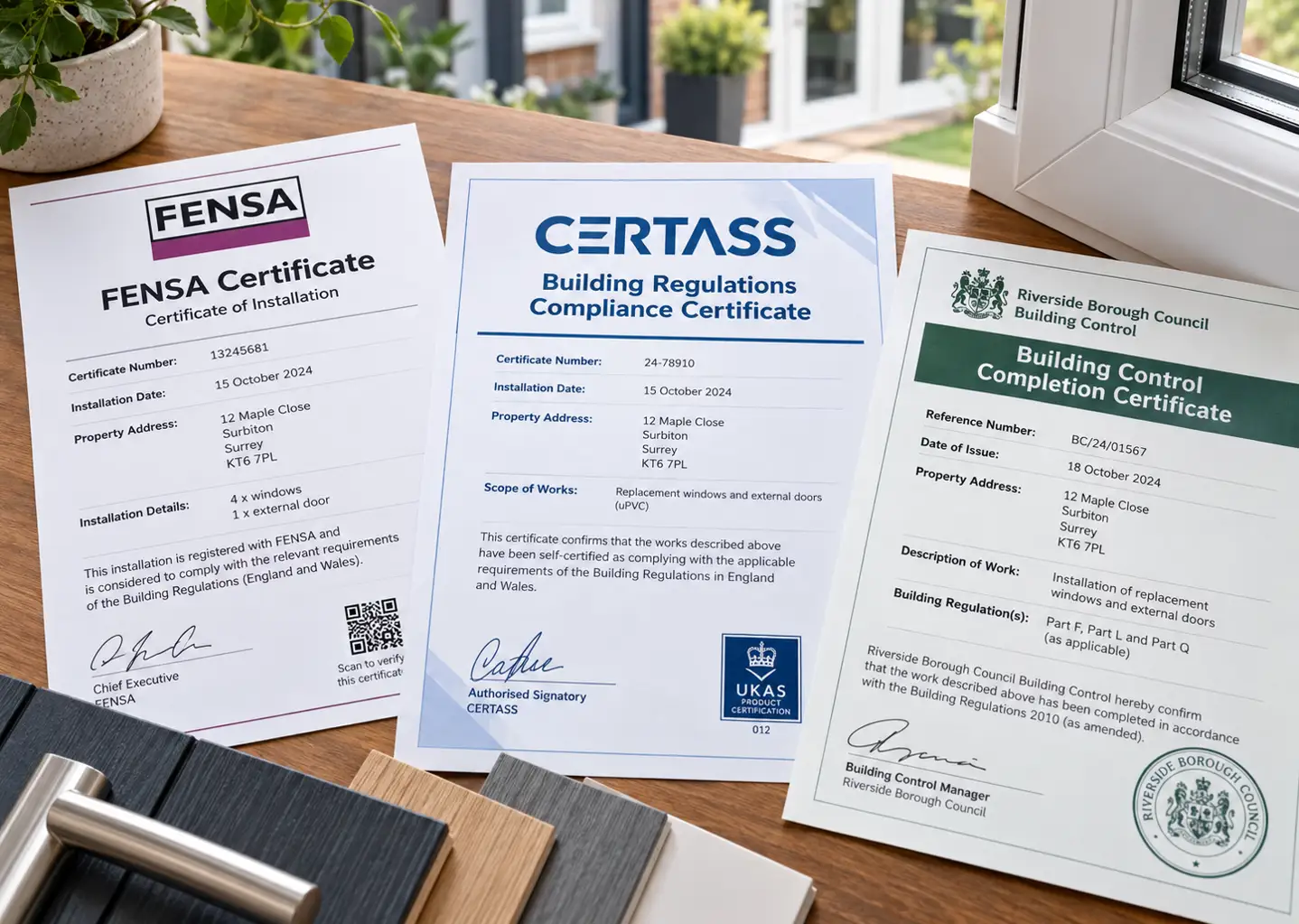
Ask a homeowner for the paperwork from their replacement windows and there is a good chance they’ll call it the “FENSA certificate”. That’s a perfectly legitimate name — FENSA itself uses it — but it can make the system sound simpler than it really is. FENSA isn’t the Building Regulations system; it’s one authorised route through it, alongside CERTASS and other government-authorised self-certification schemes.
That distinction matters because perfectly compliant windows can have paperwork that doesn’t say FENSA anywhere on it, and because even a genuine FENSA certificate only covers the qualifying work within that scheme’s scope. When a house is eventually sold, the useful question is therefore not simply “where’s the FENSA certificate?” but what work was done, whether it required Building Regulations approval, which route was used and what evidence should exist as a result.
Yes, replacement glazing needs to comply — but not every job follows the same route
Replacement glazing has fallen within the Building Regulations regime since 1 April 2002, which is why complete replacement windows installed after that date normally need to go through an appropriate compliance route. Planning Portal’s replacement-window guidance explains the basic position.
There are important boundaries to that rule. Replacing a complete external window, including its frame, is different from repairing the window that is already there. Replacing broken glass, a sash or a damaged part of a retained frame is not the same job as removing the whole fitting and installing a new controlled fitting.
Doors have another distinction. Current Government guidance says formal Building Regulations approval is not required for an external replacement door where less than half of the door and frame is glazed. That is an exemption from the formal approval process, not permission to ignore any safety or energy-efficiency requirements that still apply. GOV.UK’s guidance on work that does not need approval sets out the position.
Where qualifying replacement glazing does need approval, the most familiar route is to use an installer registered under an authorised self-certification scheme. FENSA and CERTASS are the best-known names, but the Government’s current scheme register also lists other authorised operators for replacement windows, doors, roof windows and rooflights.
A registered installer is allowed to certify qualifying work itself rather than requiring a building control officer to inspect every individual installation. The scheme assesses and monitors the installer; it doesn’t mean somebody from FENSA or CERTASS visits every house and personally signs off every window. GOV.UK’s self-certification guidance says the homeowner should receive the compliance certificate within eight weeks of completion.
The name on that document can vary. FENSA calls its document a FENSA certificate, while CERTASS commonly refers to a Building Regulations Compliance Certificate. Both can provide legitimate evidence that qualifying work has gone through an authorised Building Regulations route.
That certificate should not be confused with the installer’s product or workmanship guarantee, or with any insurance-backed guarantee supplied with the job. Those are separate forms of protection and should be kept separately from the Building Regulations paperwork.
If the installer is not using an appropriate self-certification scheme, the work can instead go through building control. For ordinary domestic work in England that may mean the local authority or a registered building control approver, depending on the project. The paperwork at the end then comes from that building-control route rather than from FENSA or CERTASS.
The important point is not which logo appears on the certificate. It is whether the route used actually covered the work that was carried out.
What the regulations are actually checking
Energy efficiency is usually the part homeowners hear most about, but replacement-window compliance is not simply a question of fitting double or triple glazing. The thermal performance of the complete fitting matters, including the glass, frame and overall construction.
Safety matters too. Glazing in vulnerable positions — particularly in doors, beside doors and low down where somebody could fall into it — may need safety glazing or another compliant form of protection. A replacement unit can therefore look entirely ordinary while still being wrong for its particular position if the glazing specification is inappropriate.
Ventilation is where disagreements often arise, especially in older houses. The current position is more nuanced than “every new window must have trickle vents”. If the outgoing windows already had background ventilators, the replacement should not reduce that provision. Where no such vents existed, replacing leaky old windows with much more airtight ones can reduce the ventilation the house previously received, so the overall provision should not be made worse.
Trickle vents fitted to the new windows are one common way of dealing with that, but they are not the only possible solution. Suitable wall ventilators or an appropriate mechanical ventilation system may already provide the necessary background ventilation. Simply leaving a window slightly open on a night latch is not treated as an adequate substitute, and a homeowner cannot make otherwise non-compliant work acceptable by signing a disclaimer saying they do not want the ventilation. The Government’s Approved Document F replacement-window guidance explains those points.
The opening style can matter for fire safety as well. Where an existing window already provides the sort of escape opening expected for a habitable room and is large enough to perform that role, its replacement should preserve the necessary escape potential rather than reducing it simply because a smaller opener looks neater.
What all of this means in practice is that a replacement window is not just a consumer product fitted into an opening. It becomes part of the home’s energy, ventilation and safety performance, which is why a compliant installation involves more than choosing the frame colour and glass specification.
When a straightforward swap becomes something bigger
Replacing a window within its existing opening is one thing. Enlarging that opening, removing masonry or changing the support above it is another.
A kitchen window being turned into wide French doors is the obvious example. Once the opening becomes larger, somebody needs to establish what is carrying the wall above and whether a new or altered lintel is required. The job now contains structural work as well as glazing.
FENSA’s own scheme-scope guidance makes the distinction clear: its replacement-glazing remit ends where an aperture is widened and alternative structural support is required. The same principle applies where windows or doors are fitted as part of a new extension. A FENSA-registered company installing the glazing does not make the extension itself FENSA-certified.
A FENSA certificate can therefore be perfectly valid for the qualifying glazing without being the approval document for the structural work around it. If an opening is being enlarged, the useful question at quotation stage is who is dealing with that structural Building Regulations approval and what paperwork will cover it when the job is finished.
Selling with replacement windows but no paperwork
This is usually when the distinction between installer, scheme and certificate suddenly becomes important. The windows were replaced years ago, the current owner either never received the paperwork or can no longer find it, and a buyer’s conveyancer asks for evidence of Building Regulations compliance.
Before doing anything else, establish roughly when the windows were installed. If they pre-date 1 April 2002, the modern replacement-glazing Building Regulations regime and FENSA certification did not yet apply, so searching for a FENSA certificate that could never have existed is unlikely to get anyone very far.
For later installations, try to establish who fitted them and which compliance route was used. If the work went through FENSA, the scheme operates an address-based certificate search and replacement service. Other authorised schemes have their own record and replacement procedures, while work approved directly through building control may have completion or final paperwork instead.
Only when those routes have been exhausted does missing paperwork start to suggest that work requiring approval may never have been properly notified. Local-authority regularisation can provide a retrospective Building Regulations route for qualifying historic work, although the authority may require information, inspection, opening-up or remedial work before deciding whether to issue a certificate. GOV.UK’s building-control application guidance explains the process.
Conveyancing indemnity insurance may also be discussed during a sale, but it solves a different problem. An insurance policy can manage a specified legal or financial risk; it does not inspect the windows or retrospectively certify that the installation complied with Building Regulations.
Finding out what happened originally is therefore usually more useful than jumping straight to a retrospective solution.
Where planning permission still has a say
Building Regulations and planning control are separate systems.
For an ordinary house, replacing windows or doors with units of similar appearance will often require no planning application. A listed building is different: listed building consent can be required where alterations affect its special architectural or historic character.
Conservation-area status does not automatically mean every replacement window requires planning permission, but additional local controls can apply and an Article 4 direction may remove permitted development rights for particular changes to windows or doors. Historic England’s guidance on permissions for older homes explains the distinction.
A FENSA, CERTASS or building-control certificate does not grant any separate planning or heritage consent.
So the question worth asking before signing a glazing contract is not simply:
“Will I get a FENSA certificate?”
It is:
“Does this particular work need Building Regulations approval, which route are you using, what exactly does that route cover, and what paperwork will I receive when the job is finished?”
If those questions have clear answers before the old windows come out, there is far less chance of discovering during a future sale that the document you thought existed either cannot be found or never covered the work you assumed it did.
Important: This article provides general property and Building Regulations information, not a determination of the requirements for a particular installation. The detailed Building Regulations discussion relates to England and reflects the position in September 2026; Wales, Scotland and Northern Ireland operate different regulatory arrangements. Scheme scope, structural alterations, ventilation requirements, planning restrictions and heritage status can change what approvals are needed. Confirm the route for your particular project with the installer, relevant scheme operator or building control body before work begins.

