

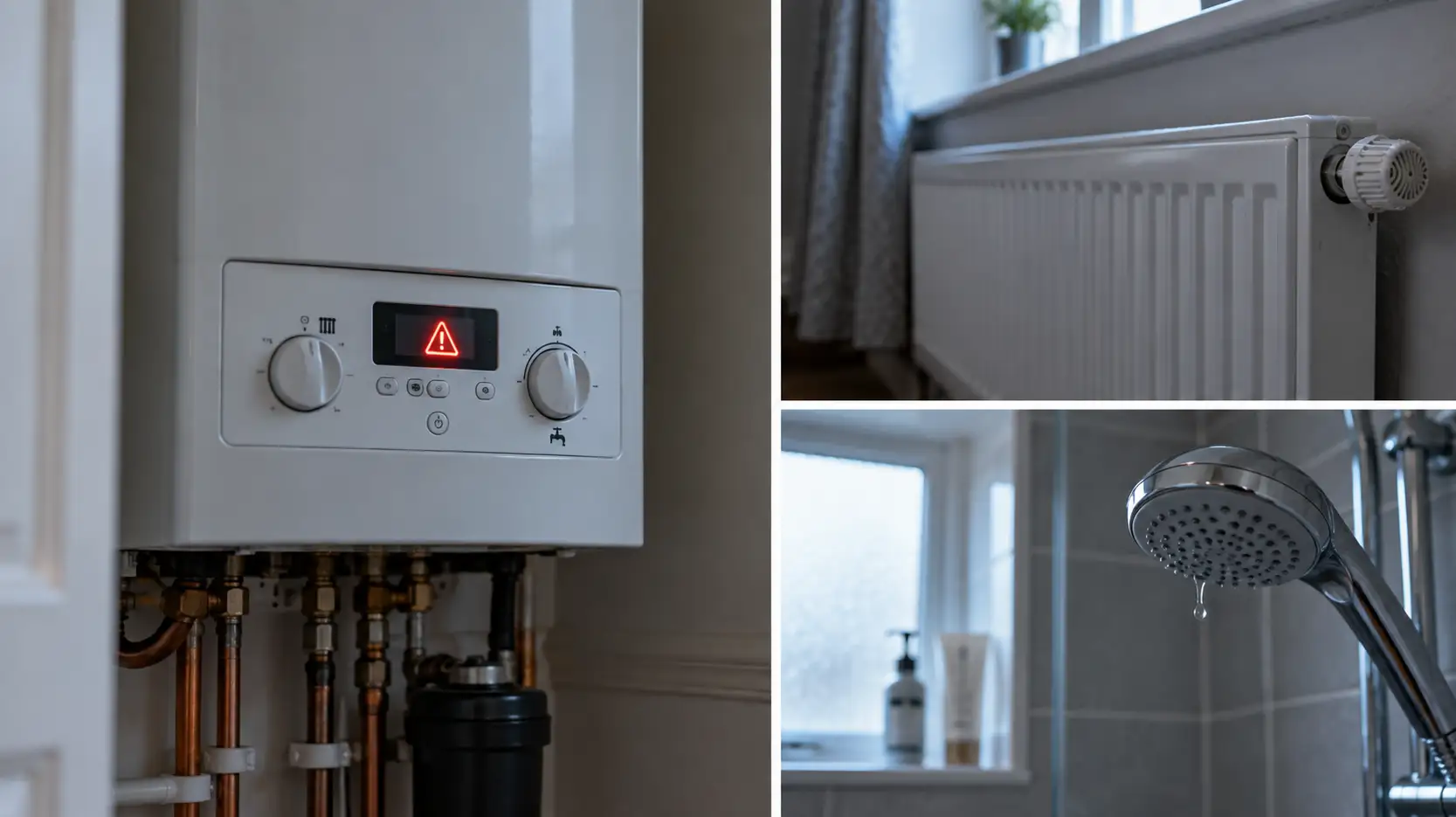
An engineer has been out, confirmed the boiler needs a part that isn’t in stock and given a date a week or more away. Both sides now face the same practical question, and it isn’t the one usually discussed. How long a landlord is allowed to take to fix a boiler is a separate subject; what needs deciding here is what should happen in the meantime, because a week without heating in January and a week without hot water in July are not the same problem, and treating them identically serves neither tenant nor landlord well.
The permanent repair may be genuinely delayed for reasons the landlord cannot immediately overcome. A specialist component may need ordering, another engineer may be required or an appointment may depend on availability outside the landlord’s control. None of that means active management of the problem should stop while everybody waits. Once the cause has been identified and the permanent fix is under way, the question changes from simply “when will the boiler be repaired?” to “is the household being managed reasonably until it is?”
Urgency isn’t fixed — it moves with the circumstances
The most useful starting point is to establish what has actually been lost, when it has happened and who is living in the property. Heating and hot water failing together during a cold spell is materially more serious than hot water alone failing during warm weather, while a household containing a baby, an older person or somebody whose health makes cold particularly risky may need a quicker and more substantial interim response than occupants who can safely tolerate a short disruption.
None of this makes the underlying repairing obligation appear and disappear with the temperature. It changes what a reasonable response looks like while the permanent repair is pending. In England, official guidance treats adequate working heating as part of a safe rented home and makes clear that the reasonable time for dealing with a defect depends on the circumstances. Wales requires landlords to keep installations for space heating and heating water in repair and to deal with notified defects within a reasonable time. Scotland’s Repairing Standard requires fixed heating and water-heating installations to remain in reasonable repair and proper working order, while Northern Ireland guidance similarly places heating and hot-water systems within landlords’ repair responsibilities. GOV.UK: How to rent a safe home Welsh Government: fitness for human habitation guidance Scottish Government: Repairing Standard nidirect: health and safety in rented accommodation
For landlords and managing agents, that makes urgency something to reassess rather than assign once when the repair is logged. If the property still has hot water but has temporarily lost heating during mild weather, one response may be proportionate; if temperatures then fall sharply, the repair date slips and an occupant is particularly susceptible to cold, the same response may no longer be enough. The useful question is not simply whether somebody is “dealing with the boiler”, but whether the interim arrangement still fits the circumstances as they develop.
Confirming an engineer has actually attended is the first useful step
There is an important difference between “the landlord says an engineer is being arranged” and “an engineer attended on Tuesday, diagnosed a failed component and the replacement is expected on Friday”. For the tenant, that distinction shows whether the repair is genuinely progressing. For the landlord or agent, it creates an audit trail showing that the fault was acted on rather than allowed to sit indefinitely in an inbox.
The useful record does not need to be elaborate. It should establish when the fault was reported, what functions were lost, when an engineer attended, what they diagnosed, whether the appliance was left safe, what work or component is required and the best available estimate for completion. If a repair date changes, record that as well. This becomes particularly valuable where the delay is caused by a genuine parts or contractor problem, because it distinguishes an unavoidable wait from inactivity and gives the landlord something concrete to communicate to the tenant.
That evidence should not, however, become a substitute for managing the consequences. A landlord may be able to demonstrate perfectly well that a replacement part is on order and still be responding inadequately to a household that has no usable heating during a prolonged cold period. Diagnosis explains the delay; it does not by itself resolve the living conditions created by it.
The practical response should therefore move with the problem rather than follow one fixed formula:
| Situation while the permanent repair is pending | Interim priority |
|---|---|
| Heating and hot water lost in cold weather | Escalate quickly, provide safe temporary heat and keep the repair timetable under active review |
| Heating lost but hot water remains | Assess indoor conditions and household circumstances; provide suitable temporary heating where needed |
| Hot water lost but heating remains | Check whether a safe built-in backup exists and, if the delay continues, agree a workable alternative for washing |
| Occupant particularly susceptible to cold | Let the actual household risk influence the interim response |
| Repair date slips or becomes uncertain | Reassess the temporary arrangement rather than repeatedly extending the same stopgap |
This is not a statutory timetable. Its value is simply that it makes visible why two households with apparently the same “broken boiler” can reasonably need different interim responses.
Ordering a part doesn’t end the job — it changes the job
This is where an otherwise competent repair response can stall. The engineer attends, the cause is identified, the part is ordered and everybody mentally moves the problem into a category marked “in progress”. From the contractor’s point of view that may be correct, but from the tenant’s point of view the home is still without whatever service failed. Once it becomes clear that the permanent repair will not be immediate, the landlord or agent needs to consider the gap itself rather than merely watching the repair appointment.
Temporary electric heaters are often the most practical response to a loss of central heating, particularly during colder weather, but they need to be appropriate to the home and sufficient to make a meaningful difference. One small portable heater placed in a large property does not necessarily amount to an effective interim solution simply because something capable of producing heat has been supplied. The number and type of heaters, the rooms that actually need to remain usable and the occupants’ circumstances all matter. Basic safety matters too: portable heaters should be positioned away from combustible materials, should not be run through overloaded extension leads and should not be left unattended simply because they are being used as emergency heating. Electrical Safety First: portable heater safety
The cost of running them deserves an equally sensible conversation. It would be too broad to say that every landlord throughout the UK is automatically required to reimburse every additional unit of electricity consumed whenever temporary heaters are used; there is no single statutory formula operating in that way. But leaving a tenant to source the equipment themselves and then unexpectedly absorb a substantially more expensive form of heating because the fixed system has failed is an obvious way to turn a repair problem into a financial dispute. Where the additional cost is likely to be meaningful, agreeing in advance how reasonable extra energy expenditure will be dealt with is far better than arguing about it once the electricity bill arrives.
A hot-water-only failure calls for a different response. A safe working immersion heater or other installed backup may make the interruption considerably easier to manage, whereas a home with no practical means of normal washing for an extended period presents a different problem. The answer should not be to leave the household improvising indefinitely with containers of boiling water. Where the delay becomes significant, the landlord and tenant need to discuss what workable alternative can reasonably bridge the gap. If neither temporary heating nor other interim measures can keep the accommodation reasonably safe and usable, particularly during severe cold, the issue may eventually need to move beyond supplying more equipment and towards considering temporary accommodation, although who is responsible for arranging or paying for that will depend on the tenancy, circumstances, insurance position and applicable law.
When repeated failures mean the wrong question is being asked
A boiler that has needed three call-outs in four months does not automatically create a legal requirement to replace it, but it should change the conversation. If the same system repeatedly fails, the useful question is no longer simply whether an engineer can get it working again this afternoon. Age, parts availability, the character of the failures, previous repair history, likely reliability and the cost of further intervention all begin to matter.
Repeated repair can sometimes be entirely rational. A comparatively young appliance with an identifiable component failure may have years of reliable service left once that part is replaced, while an ageing boiler with increasingly difficult-to-source components and a history of winter breakdowns presents a very different calculation. The point is not to invent a threshold after which replacement suddenly becomes compulsory; it is to stop treating repeated incidents as unrelated jobs when the maintenance history is beginning to reveal a pattern.
That is where repair becomes asset management. The cheapest invoice today is not necessarily the cheapest or most sensible decision across the next two winters, particularly once emergency call-outs, repeated temporary heating, tenant disruption and management time are included in the equation. For a professional landlord or managing agent, several no-heat incidents on the same property should already be visible in the maintenance history. If they are repeatedly closed as isolated jobs without anybody looking at the pattern, useful information is being lost.
Where the problem becomes a housing-condition risk
A temporary loss of heating is an inconvenience; prolonged inability to keep a home adequately warm can become a housing-condition and health issue. In England, excess cold is one of the hazards considered under the Housing Health and Safety Rating System. The current landlord and agent guidance makes an important distinction here: the formal assessment normally considers the risk to the age group most vulnerable to the particular hazard rather than simply changing its score according to the characteristics of whoever happens to occupy the property. Where a council identifies a Category 1 hazard, it has a duty to take appropriate enforcement action. GOV.UK: HHSRS landlord and agent guide
That formal assessment should not be confused with sensible day-to-day management. If the actual occupants include somebody particularly susceptible to cold, the landlord or agent should plainly take that into account when deciding how urgently temporary heating or other measures need to be escalated. Wales approaches housing condition through its own repairing and fitness-for-human-habitation framework, Scotland through the Repairing Standard and Northern Ireland through its own fitness and repair standards, so the enforcement mechanism is not identical across the UK. The practical point for the landlord is simpler: once an interim arrangement is failing to control a genuine risk to the home or the people living in it, saying that the replacement part has been ordered is no longer a complete response.
Serious or prolonged disruption can also lead to discussions about reimbursement, compensation or a rent adjustment, depending on the facts and jurisdiction. There is no universal daily tariff that becomes payable merely because a boiler has been unavailable for a particular number of days, just as a tenant should not assume that withholding or deducting rent themselves is automatically safe. Those questions become much easier to deal with when the landlord can show that the permanent repair was actively pursued and that reasonable interim measures were considered throughout the delay, rather than only after the situation escalated.
There is no universal 24-hour boiler rule
A supposed “24-hour boiler rule” appears often enough online that it has acquired the appearance of legislation. For ordinary private renting, however, there is no single UK rule requiring every loss of heating or hot water to be permanently repaired within 24 hours. The actual question is whether the response is reasonable in the circumstances, and that is precisely why season, severity, household circumstances, diagnosis and interim measures all matter.
England’s government guidance illustrates the distinction well. It gives a serious boiler failure as an example where it might be reasonable to expect a landlord to arrange for a technician to attend within 24 hours for an initial inspection. That is not the same thing as saying that every boiler must be fully repaired within 24 hours regardless of what the engineer finds. A fault diagnosed immediately may still need a specialist component that cannot realistically arrive until several days later. GOV.UK: How to rent a safe home
The landlord cannot manufacture a component or force a supplier to deliver it sooner. What they can control is how quickly the failure is investigated, whether the repair remains actively chased, how clearly the tenant is kept informed, what temporary measures are put in place and whether those measures are reconsidered when the expected repair date slips or the circumstances worsen. A landlord who can show an early engineer attendance, a genuine diagnosis, an actively pursued repair and a sensible interim response is in a materially different position from one who says “the part is on order” and disappears for ten days.
That is ultimately the distinction worth carrying away from the problem. The permanent repair and the period before it happens are connected, but they are not the same management task. A landlord may have done everything reasonably possible to get the boiler repaired and still need to do more to manage the home while waiting for it.
This article provides general property information, not legal, financial, surveying or other professional advice for your individual circumstances. Property disputes and regulatory issues can depend on the facts, documents, location and applicable law. If significant money, property or legal rights are at risk, or you are considering an irreversible course of action, take appropriate professional advice before proceeding.

