

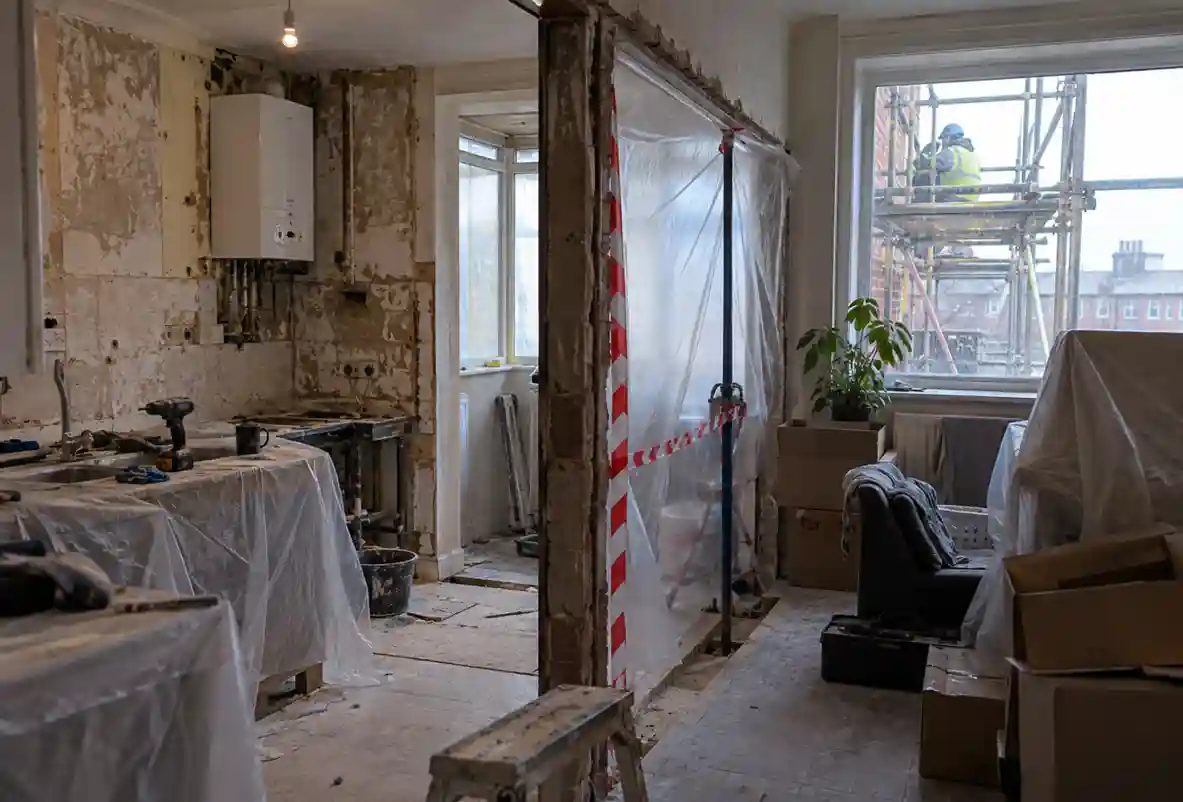
A leaking roof that closes off a box room is not the same problem as a kitchen ripped out for a fortnight for essential rewiring, and neither is the same as a property genuinely too unsafe to sleep in until structural work is finished. Yet all three tend to get reduced to the same question: “Can I get some rent back?”
The useful answer depends less on the label attached to the repair than on what you have actually lost the use of, for how long, why the problem arose and which part of the UK you live in. A temporary inconvenience may justify little more than practical accommodation between landlord and tenant. Losing a meaningful part of the home for weeks can support a rent reduction or compensation claim. A property that is genuinely unfit or unsafe raises a different question altogether: whether you can reasonably remain there while the work takes place.
There is no universal percentage table saying that a lost bedroom is worth 20%, a kitchen 30% and complete loss of occupation 100%. Nor, in most cases, can a tenant simply decide what the home is now worth and reduce the next rent payment accordingly.
Before negotiating anything, however, check the tenancy agreement itself. Some agreements contain an express clause reducing or suspending rent where all or part of the property becomes uninhabitable, where specified essential services fail or where major repairs prevent normal occupation. The agreement may also say something about alternative accommodation. Those terms can give the tenant a contractual position stronger than simply asking the landlord for a discretionary reduction, and they are easily overlooked when everyone goes straight to the general law.
This article focuses mainly on private renters, with the important differences for social tenants and the devolved nations explained where they materially change the answer.
Inconvenience is not the same as losing the use of your home
Repairs are disruptive almost by definition. Contractors arrive, rooms need clearing, floors get covered, drilling starts earlier than you would choose and ordinary life becomes less ordinary for a while.
That disruption can matter, especially where a landlord allows work to drift unnecessarily, but it does not follow that every inconvenience creates an automatic entitlement to reduced rent. The stronger cases involve an identifiable loss of use or measurable consequence: a bedroom that genuinely cannot be occupied, the only shower being unusable, prolonged loss of heating, a kitchen that cannot be used to prepare food or additional expenditure caused directly by the problem.
In England, government guidance recognises that where repairs are very disruptive a tenant may be able to claim a reduction in rent, often referred to as a rent abatement, depending on how much of the property is unusable. The same guidance says that where major repairs require a temporary move, the arrangements should be agreed clearly in writing, including how long the work is expected to last, alternative accommodation and the tenant’s right to return. The current GOV.UK guidance on repairs and temporary unfitness sets out those principles.
The important word is “claim”, not “calculate for yourself”. For most private tenants in England, serious disrepair does not give a free-standing right to decide that this month’s rent is now 40% lower and simply pay that amount. An express rent-suspension clause in the tenancy or a written agreement with the landlord is different; an unexplained shortfall can become rent arrears even where the repair complaint itself is completely justified.
One room or one facility unusable
Where part rather than all of the property has been lost, a temporary agreed rent reduction is often the cleanest way of dealing with it.
Suppose a two-bedroom home is effectively reduced to one bedroom for six weeks because water ingress has made the second room unusable. The starting point is not necessarily to divide the rent by the number of rooms. A bedroom, bathroom, kitchen, living room and storage room do not contribute equal value simply because each has a door.
The better question is how materially the tenant’s actual use and enjoyment of the home has been reduced. A box room used occasionally for storage is different from a bedroom occupied every night by one of the tenant’s children. Losing a second shower in a two-bathroom property is different from having no washing facilities at all. A temporary loss of one kitchen cupboard bears little resemblance to being unable to prepare meals for several weeks.
That is why fixed percentages are misleading. Duration, importance of the affected space, household circumstances and actual impact all matter.
Where landlord and tenant agree a reduction, it should be recorded in writing with the dates it applies to and what will bring it to an end. That protects the tenant from the shortfall later being described as arrears and prevents the landlord from believing that a temporary concession has somehow become a permanent rent variation.
Where no agreement is reached and the disrepair amounts to a breach of the landlord’s obligations, compensation can ultimately become a court issue. Courts can take loss of use and loss of enjoyment into account, but the amount is assessed on the evidence rather than through a fixed percentage formula.
For tenants, that makes records particularly valuable. Photographs showing the unusable area, dates on which the problem was reported, messages confirming what contractors found and a simple record of how long a room or facility could not realistically be used all help turn “this was awful” into evidence of what was actually lost.
Losing a kitchen, bathroom or heating changes the seriousness — not automatically the rent
Some facilities sit much closer to basic habitability than others.
Extended loss of heating in winter, having no functioning toilet or washing facilities, dangerous electrics, serious water penetration or being unable to prepare food can move the problem beyond ordinary repair inconvenience and towards the question of whether the home remains reasonably fit to live in.
In England, the Homes (Fitness for Human Habitation) framework requires qualifying rented homes to remain fit throughout the tenancy. Where a landlord fails to deal with a qualifying problem within a reasonable time after becoming responsible for it, a court can order work and award compensation. Severity, duration and the consequences for the tenant can all matter.
That still does not create an automatic daily rent tariff. A kitchen being unavailable for two days while planned work is completed efficiently is very different from being left for eight weeks with no practical means of cooking because a project stalled. A boiler failure dealt with promptly is not the same as prolonged loss of heat after repeated reports were ignored.
The tenant’s own conduct can matter too. A landlord normally needs reasonable access to diagnose and carry out repairs. If work is delayed because access repeatedly cannot be arranged, that can affect responsibility for the period of disruption. Conversely, repeated missed contractor appointments, abandoned jobs or temporary fixes that plainly did not solve the problem can strengthen the tenant’s evidence that the landlord did not deal with it within a reasonable time.
Compensation can also extend beyond the value of the lost part of the home. Current Shelter guidance on compensation for disrepair identifies potential claims for inconvenience, financial loss, damaged belongings and health consequences as well as loss of use.
If having no working cooker meant spending substantially more on food, a broken heating system led to abnormal electricity costs from temporary heaters, or repeated repair appointments caused demonstrable financial loss, those consequences are worth recording separately rather than trying to roll everything into an arbitrary percentage of the monthly rent.
Major works need an agreement before the front door closes behind you
Planned major work is one of the situations where what happens before the contractors arrive can matter almost as much as the work itself.
A full rewire, structural repairs, extensive water-damage remediation or work that removes the kitchen or bathroom for a prolonged period may be impossible to carry out sensibly while the tenant continues living normally in the property. If everyone knows that in advance, the sensible time to decide what happens to the tenancy, rent and accommodation is before the move takes place.
For private tenants in England, there is no general rule saying every landlord must automatically provide and pay for a hotel whenever major repairs make temporary relocation necessary. The tenancy agreement may contain relevant terms, and the landlord’s insurance may include alternative-accommodation cover, but those are things to establish rather than assume. Shelter’s current guidance on problems during repair work also confirms that some agreements contain rent-suspension or alternative-accommodation clauses and that most private landlords otherwise do not have a general duty to provide somewhere else to stay.
Nor does the landlord simply acquire a right to end the tenancy because the work would be easier in an empty property.
GOV.UK expressly states that a tenant has the right to remain during repairs and that a landlord cannot simply repossess the property for the purpose of doing them. Where genuinely substantial works require vacant possession and the tenant does not agree to a temporary arrangement, the landlord may need to use the formal possession route available in the circumstances rather than treating a request to move out as though it were itself an eviction notice.
That makes the written temporary arrangement especially important. If the tenant does agree to leave while the work is completed, the expected duration, rent position, alternative accommodation, additional costs, access to the original property, treatment of possessions and the tenant’s right to return should be clear enough that nobody is trying to reconstruct the agreement from a telephone conversation months later.
The right to return is not a decorative detail. Temporarily moving out so a landlord can repair the home should not casually turn into surrendering the tenancy.
Where the tenant has to pay for alternative accommodation because the landlord breached their repairing obligations, reasonable accommodation costs can in some circumstances form part of a damages claim. They are not automatically recoverable simply because the tenant chose to stay elsewhere, however, so the reason for the move, necessity and reasonableness of the expense, the landlord’s breach and evidence of what was actually spent all matter.
Insurance can sometimes remove much of the conflict. Landlord buildings policies may include alternative-accommodation cover, while tenants’ contents policies may provide their own protection following specified insured events. Whether they do depends on the actual policy rather than the fact that somebody is insured.
When the home genuinely cannot be lived in
At the serious end of the scale, debating whether the rent should be reduced by 20% starts to miss the real problem.
Structural danger, serious fire or electrical risk, extensive flooding, major contamination or a council prohibition order may mean all or part of the property should not be occupied. A prohibition order can prevent occupation entirely, restrict particular rooms or limit who can use the accommodation.
For a private tenant in England, that still does not create a universal statutory right to a landlord-funded hotel. But genuine inability to occupy can materially strengthen the tenant’s position on compensation, enforcement, rent and reasonable alternative-accommodation costs.
If you have nowhere safe to stay, the council’s homelessness service can become relevant even though the tenancy technically still exists. Under homelessness law, a person can be treated as homeless where they have accommodation but it would not be reasonable for them to continue occupying it. The council has to consider the facts of the particular household and the condition of the accommodation rather than simply asking whether the tenant still holds the keys.
That does not mean every badly maintained home automatically creates a homelessness duty, and tenants should get advice before voluntarily surrendering a tenancy. Leaving permanently when the council considers it was still reasonable to remain can create additional difficulties. But where the home is genuinely unsafe or cannot reasonably be occupied, “I still technically have a tenancy” does not by itself prevent a homelessness application.
Social tenants in England have a different additional protection under Awaab’s Law. At the time of writing, Phase 1 covers all emergency hazards and damp and mould hazards presenting a significant risk of harm. Where the landlord cannot make such a hazard safe within the statutory timescale, suitable alternative accommodation must be offered free of charge. The current Awaab’s Law guidance for social tenants explains those rights.
The regime expands again from 30 November 2026, when Phase 2 brings a wider range of significant hazards — including excess cold and heat, specified fall risks, structural collapse, fire and electrical hazards and certain hygiene hazards — within the fixed-timescale requirements.
That distinction matters because advice saying simply “landlords never have to rehouse tenants during repairs” is as unsafe as saying every private landlord always does.
England, Wales, Scotland and Northern Ireland do not give the same answer on rent
This is where generic UK advice becomes particularly risky.
For most private tenants in England, rent remains payable unless a reduction is agreed, the tenancy itself provides for suspension or reduction, or a court or other legal process establishes a different entitlement. Serious disrepair can support compensation or rent abatement, but the tenant should not simply decide what amount feels proportionate and start paying less.
Wales is materially different.
Under the Renting Homes framework, standard occupation contracts will usually contain a term providing that rent is not payable for a period during which the dwelling is legally unfit for human habitation. Welsh Government’s guidance on standard occupation contracts explains that position.
That does not make unilateral withholding risk-free. Disrepair and legal unfitness are not the same thing, and if landlord and contract-holder disagree over whether the dwelling was actually unfit, a court may ultimately have to decide. If the property is found to have remained fit, the unpaid sum may still be owed as rent.
Scotland takes a different route again. Private landlords are subject to the Repairing Standard, and tenants can apply to the First-tier Tribunal where it is not met. If the Tribunal makes a Repairing Standard Enforcement Order and the landlord then fails to comply, it can make a Rent Relief Order reducing the rent by up to 90%. Scottish Government’s guidance on the Repairing Standard and enforcement makes clear that tenants should not simply withhold rent before such an order exists.
Northern Ireland likewise does not give private tenants an automatic percentage reduction whenever repairs interfere with occupation. Specialist guidance emphasises continuing to pay the rent while pursuing the repair problem, and Housing Rights states that, unless the tenancy provides otherwise, private landlords are generally not obliged to provide or fund alternative accommodation simply because repairs require the tenant to move temporarily. Its current guidance on carrying out repairs explains the position.
The common lesson is not “rent always continues” or “stop paying once the property becomes bad enough”. It is to identify the jurisdiction, check the tenancy agreement and establish the legal basis before changing what you pay.
Damaged possessions and extra costs are separate from the rent question
A serious repair problem can produce several different losses at once.
If water from an unresolved leak ruins a mattress, an electrical defect damages equipment or repair work itself damages belongings, the value of those items is not automatically captured by whatever rent reduction might be appropriate for loss of use.
Landlords are not automatically insurers of everything a tenant owns. Buildings insurance normally protects the building and landlord-owned property rather than the tenant’s possessions, which is one reason contents insurance can be valuable.
Where the landlord’s breach or negligence caused the loss, however, damaged belongings and other reasonably incurred expenses can form part of a compensation claim. The tenant still needs evidence of what was damaged, its value, why the landlord was legally responsible and how the loss resulted from that failure.
The same applies to extra expenditure. Hotel bills, increased heating costs, laundrette charges, additional travel or food expenses can potentially matter where they were reasonably caused by the disrepair, but receipts and contemporaneous records produce a much stronger claim than an estimate reconstructed months afterwards.
This is why compensation should be kept conceptually separate from rent reduction. A tenant might agree a temporary rent adjustment for losing a room and still have a distinct claim for belongings destroyed by the leak that caused it.
The question that actually determines the outcome
The most useful starting question is not simply “Can I get compensation?” It is: what part of the home could I genuinely not use, for how long, and what did that actually cost or prevent me from doing?
A day without hot water, six weeks without a bedroom and a home that cannot safely be occupied are not different points on one compensation tariff. They are materially different situations with different practical and legal consequences.
For a tenant, a strong position is built from specifics: what the tenancy agreement says, when the problem was first reported, what the landlord knew, which rooms or facilities were affected, when contractors attended, what remained usable, what additional expenditure arose and whether any workable alternative was offered.
At the lower end, the sensible outcome may be no rent adjustment at all. Further along, a documented temporary reduction may fairly reflect losing part of the home. Where the landlord has breached repair or fitness obligations, compensation can extend beyond rent to consequential financial loss and damaged belongings. And where the property genuinely cannot safely be occupied, the immediate priorities become safe accommodation, protecting the tenancy and establishing who is responsible for the costs while the home is put right.
The more precisely the actual loss of use can be described, the less useful the vague question “Can I get some rent back?” becomes — and the clearer the tenant’s real options usually are.
This article provides general property information, not legal, financial, insurance or other professional advice for your individual circumstances. Repair obligations, rent liability and compensation can depend on the tenancy or occupation contract, the cause and seriousness of the problem, the landlord’s knowledge, the jurisdiction and the evidence available. If your home is unsafe, you cannot reasonably remain there, or significant money or legal rights are at risk, seek appropriate housing or legal advice before taking an irreversible step such as withholding rent, surrendering the tenancy or moving out permanently.

