

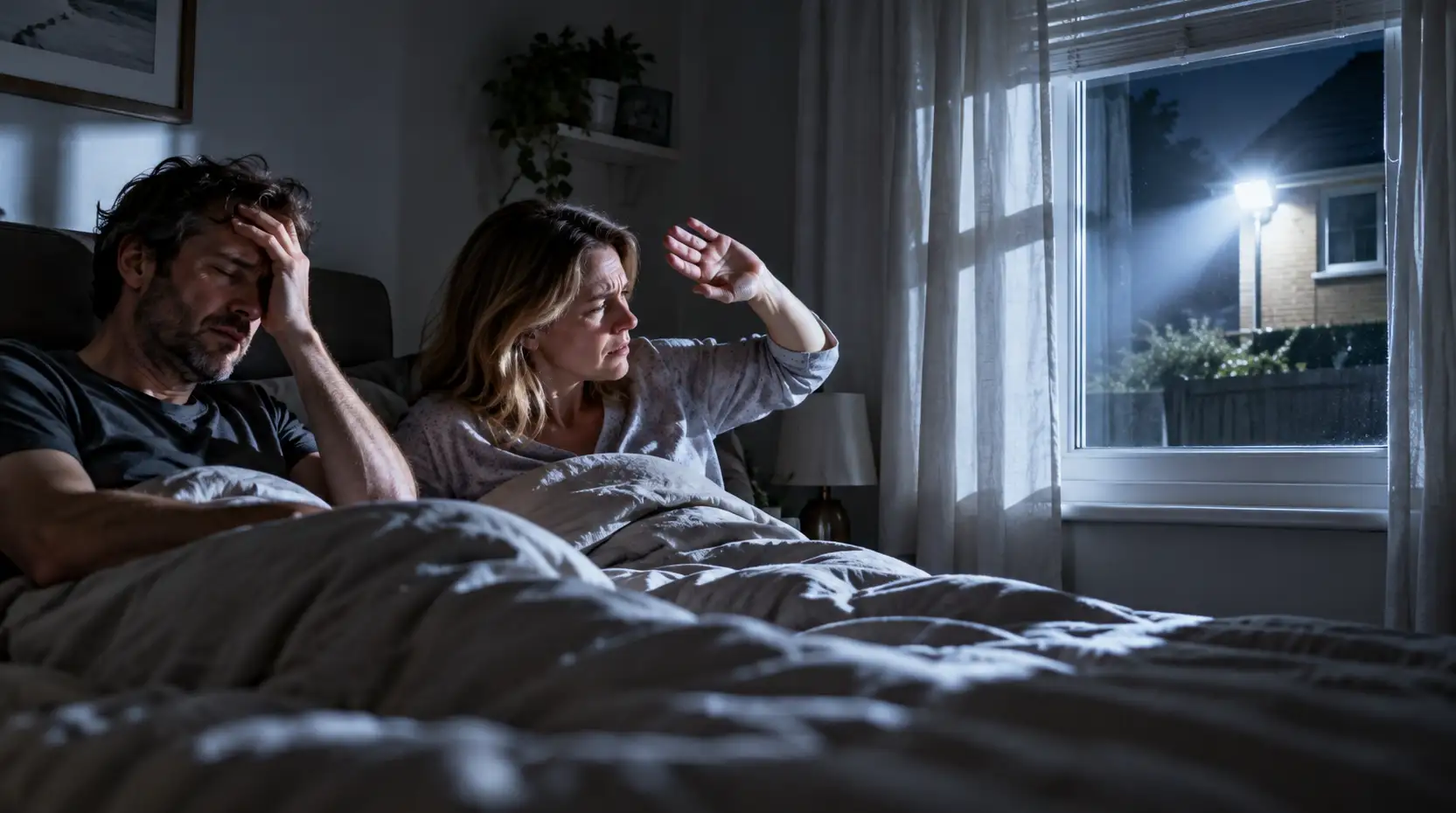
A security light is, by design, meant to be noticed — that’s the entire point of a device that switches on abruptly when something moves nearby. The trouble starts when the thing it’s noticed is you, repeatedly, through your own bedroom curtains, at whatever hour your neighbour’s cat or the wind decides to trigger it. It’s a genuinely common complaint, and one that doesn’t have the tidy answer people often expect, because there’s no simple brightness measurement that automatically tells you whether a light is a nuisance in law.
A powerful floodlight can be perfectly reasonable when it’s illuminating a driveway or garden. The same fitting, angled a few degrees higher so that its beam repeatedly reaches the bedroom next door, may create a genuine problem. The law is interested in that difference, but the quickest solution is often much simpler than establishing whether a legal nuisance exists.
Try the practical fix before the legal one
Most intrusive security lighting is the result of a poorly positioned or adjusted fitting rather than a deliberate choice, and many complaints can be resolved without needing to go anywhere near formal enforcement. A PIR-triggered floodlight aimed slightly too high, with its detection area extending beyond the garden it’s meant to protect, can switch on repeatedly as animals or passing movement activate the sensor. The beam may then illuminate a neighbouring bedroom even though the person who installed it has no idea what’s happening on the other side of the fence.
The distinction between the light itself and the sensor that activates it is useful. The beam might be pointing in roughly the right direction, but a detector that’s too sensitive causes it to come on unnecessarily. Alternatively, the sensor may be working perfectly while the fitting sends much of its light straight towards another property. Fixing one problem without checking the other can leave the neighbour with exactly the same disturbance.
There are several straightforward adjustments worth suggesting:
- Re-angle the fitting downwards, directing the light towards the driveway, path or garden it’s intended to illuminate rather than towards neighbouring windows.
- Reduce the PIR detector’s range or sensitivity, or change its direction so passing pedestrians, traffic or activity beyond the area being protected don’t repeatedly activate it.
- Fit a shield or hood to prevent unwanted sideways spill while preserving useful illumination of the neighbour’s own property.
- Reduce the light output, or use a less harsh colour temperature where appropriate. A lower-output or warmer light may be less intrusive without compromising its intended purpose.
- Shorten the activation period or adjust the operating schedule, particularly where the light remains on long after movement has stopped or operates throughout periods when that level of illumination isn’t needed.
The Welsh Government’s guidance on external lighting specifically recommends avoiding beams directed into neighbouring windows and adjusting PIR detectors and timers to minimise disturbance. It also advises preventing unnecessary activation by people or vehicles passing outside the property.
That guidance reflects a practical principle applicable well beyond Wales: security lighting should illuminate the area it needs to protect without unnecessarily lighting up somebody else’s home.
It’s worth approaching your neighbour with a particular, solvable problem rather than a general accusation. Saying that the floodlight repeatedly illuminates your bedroom around midnight and asking whether it could be angled downwards gives somebody something specific to investigate. Opening with “your light is illegal” is more likely to produce an argument, particularly when nobody has yet established that a statutory nuisance exists.
There’s also a difference between needing security lighting and needing a particular type of floodlight. A neighbour may have a genuine reason to illuminate a driveway or entrance, and they aren’t necessarily being unreasonable by wanting that protection. But it may be possible to provide the same security with a better-directed fitting, more appropriate sensor settings or a less intrusive level of illumination.
Ordinary minor domestic security lights also don’t generally require planning permission merely because they’re installed outside a house. That makes an environmental nuisance complaint, rather than a planning objection, the more relevant route for many existing fittings. Larger installations, listed buildings and particular planning restrictions can raise separate issues, but the presence of a domestic floodlight is not automatically a planning breach.
If the neighbour is willing to make an adjustment, give the change a chance to work. The effect can be checked from the room that’s been affected, ideally at the time the light normally causes trouble. There’s little benefit in escalating a dispute if a simple adjustment has already solved it.
Why there’s no simple brightness threshold
Once informal approaches haven’t worked, or aren’t realistic, the relevant law in England and Wales is the statutory nuisance framework under the Environmental Protection Act 1990. Artificial light was brought within that framework through the Clean Neighbourhoods and Environment Act 2005, allowing councils to investigate light emitted from premises where it is prejudicial to health or amounts to a nuisance.
The important point is that this doesn’t operate through a fixed lux measurement. There’s no national figure above which a light automatically becomes unlawful, nor a particular brightness below which it is guaranteed to be acceptable.
The Government’s guidance on artificial light nuisance, which applies to England, explains that councils assess whether light unreasonably and substantially interferes with the use or enjoyment of premises, or injures health or is likely to do so. Officers can consider its frequency, duration, timing, effect on the average person and the nature of the surrounding area.
That distinction matters because a bright light isn’t automatically a nuisance, and a relatively modest one isn’t automatically harmless. A floodlight that’s visible at the end of your garden when it activates briefly in the early evening presents a very different situation from one that shines through your bedroom window every few minutes throughout the night.
Direction is often as important as power. A correctly positioned light can illuminate a large driveway without causing significant glare in neighbouring rooms. A poorly positioned fitting may direct its strongest beam into a particular window, creating a much greater problem despite using less electricity.
The time and duration of the disturbance also matter. A light that comes on occasionally while people are arriving home may cause little meaningful interference. One that activates repeatedly between midnight and 5am, remains on for several minutes each time and regularly interrupts sleep presents a considerably stronger basis for investigation.
This is why buying an inexpensive light meter and obtaining a single reading doesn’t settle the legal question. Measurements can assist an assessment, but they need context. The effect on ordinary use of the property, especially a bedroom, is more important than proving that a lamp has a particular technical specification.
The legal test is also more objective than simply asking whether the person complaining finds the light irritating. Councils consider what would be unreasonable in the circumstances, taking account of the setting and the likely effect on an ordinary person. A light visible through a window may be annoying without being legally actionable, just as a light needn’t be extraordinarily bright before persistent intrusion becomes serious.
That doesn’t mean somebody is necessarily expected to install expensive blackout blinds simply to accommodate a neighbour’s badly aimed floodlight. Reasonable steps to reduce ordinary light intrusion can be relevant, but the underlying question remains whether the illumination itself amounts to a statutory nuisance. Scottish Government guidance, for example, expressly distinguishes ordinary curtains or blinds from circumstances where somebody might effectively need blackout curtains to protect a bedroom from intrusive external lighting.
If your neighbour’s fitting has repeatedly woken you, made a bedroom difficult to use or otherwise substantially interfered with normal life at home, describe those effects rather than concentrating solely on how dazzling the light looks.
Intent is another issue worth distinguishing. A poorly adjusted fitting is normally a nuisance question. A light apparently being deliberately redirected towards your windows after repeated objections, particularly as part of a wider pattern of threatening or intimidating behaviour, may raise a separate harassment concern. Deliberate annoyance doesn’t automatically establish the legal offence of harassment, but targeted conduct should be assessed in context rather than dismissed simply because it involves a light instead of shouting or unwanted messages.
What’s exempt, and why that matters here
The statutory nuisance rules contain exemptions for certain premises where powerful external lighting serves particular operational purposes. In England and Wales, these include airports, harbours, railway and tramway premises, bus stations, certain transport operating centres, lighthouses, prisons and defence premises.
Business, industrial, trade and qualifying outdoor sports lighting can also be subject to a best practicable means defence in circumstances provided for by the legislation. Broadly, this recognises that some operations need substantial lighting, while still requiring consideration of reasonable ways to prevent or reduce nuisance.
None of this creates a general exemption for an ordinary domestic security light.
A homeowner can’t avoid the statutory nuisance rules simply by explaining that the fitting is intended to deter burglars. The security purpose is relevant to understanding why the light is there and what adjustments might reasonably be made, but it doesn’t give someone an unrestricted right to direct illumination into the house next door.
Equally, the absence of an exemption doesn’t automatically make the light unlawful. An ordinary domestic floodlight still has to satisfy the statutory nuisance test before formal enforcement is justified.
The position is more complicated in Scotland, where the Public Health etc. (Scotland) Act 2008 introduced artificial-light nuisance provisions that go further than the England-and-Wales framework in some respects. Scottish law includes light from stationary objects as well as premises, has different exemptions and provides a wider best-practicable-means defence.
The Scottish Government’s detailed artificial-light nuisance guidance places considerable emphasis on the actual effect on reasonable use and enjoyment of property rather than brightness alone. It also identifies practical remedies such as redirecting lighting, reducing output and installing screening — the same kinds of adjustments that can resolve an ordinary neighbour complaint without enforcement.
Northern Ireland has its own statutory nuisance regime under Part 7 of the Clean Neighbourhoods and Environment Act (Northern Ireland) 2011. Artificial light can fall within that regime, with district councils responsible for investigating qualifying complaints. The Department of Agriculture, Environment and Rural Affairs publishes guidance for Northern Ireland councils on statutory nuisance.
The underlying practical lesson is similar across the UK, but it would be misleading to describe every exemption, defence and legal procedure as identical in all four nations. For a domestic security light, the sensible starting point remains establishing the actual interference and whether it can be reasonably reduced.
Escalating the complaint
If direct, specific requests haven’t resolved the problem, your local authority’s environmental health or pollution team is generally the appropriate next step.
Before making a formal complaint, it’s worth building a simple record of what’s happening. You don’t need a professional lighting survey to explain that a floodlight has been waking you repeatedly, but a clear account of the pattern will give the council considerably more useful information than simply saying the neighbour’s light is too bright.
Record when the light activates, roughly how long it stays on, how frequently it repeats and which rooms are affected. Explain whether it shines directly through the window, illuminates the room despite curtains being closed or makes it difficult to sleep or use the room normally. A light that comes on for thirty seconds twice an evening creates a different picture from one that repeatedly activates for several minutes throughout the night.
Photographs and short videos taken from the affected room can help demonstrate the direction of the beam and the extent of the intrusion. They’re supporting evidence rather than definitive proof of brightness, because cameras adjust exposure and don’t always reproduce what the human eye sees. A factual diary, supported by suitable images and any correspondence showing that you’ve tried to resolve the problem, is often more useful.
Where the light belongs to a rented property or illuminates a shared driveway, communal garden or entrance to a managed building, there may be another practical route. A landlord, freeholder or managing agent might be able to arrange an adjustment more quickly than a formal statutory nuisance investigation, especially where the fitting is part of a communal installation they control. That doesn’t replace the council’s powers, but it may resolve the problem without creating a wider dispute.
In England and Wales, councils have a duty to take reasonably practicable steps to investigate complaints that could amount to statutory nuisance. The precise process varies. Some authorities may ask for a diary or photographs before arranging a visit, while an officer may need to assess the light from the affected room when it is actually causing trouble.
A daytime inspection may reveal where the fitting is mounted, but it won’t necessarily demonstrate how intrusive the beam becomes after dark. If the light only activates intermittently, the council may need to understand its normal pattern or make arrangements to observe the problem at an appropriate time.
If the authority is satisfied that a statutory nuisance exists, or is likely to occur or recur, it generally must serve an abatement notice requiring the nuisance to stop or be restricted. That might mean the light being redirected, its output reduced, its operating arrangements changed or other suitable measures being taken.
An abatement notice doesn’t necessarily require the complete removal of the fitting. The objective is to stop the nuisance, not to prohibit security lighting as a category. Failure to comply with an abatement notice without a valid defence can lead to prosecution.
There’s also an important difference between the council investigating a complaint and agreeing that formal enforcement is justified. An officer may accept that the light is irritating but conclude that the evidence doesn’t establish a statutory nuisance. That doesn’t necessarily mean the complaint was unreasonable; it may mean the legal threshold hasn’t been demonstrated. Asking what evidence was lacking, and whether further observation would be useful if the disturbance continues, is more productive than assuming the council has simply refused to help.
For someone who believes a genuine statutory nuisance exists but cannot secure resolution through environmental health, there is also a private legal route. Under Section 82 of the Environmental Protection Act 1990, a person affected by a statutory nuisance may bring proceedings themselves. In England and Wales, the route is through the magistrates’ court, and artificial-light nuisance normally requires at least 21 days’ written notice to the person concerned before proceedings begin. The legislation also provides a route through the sheriff court in Scotland.
This is a substantial step beyond making a council complaint. You would need suitable evidence, the correct procedure must be followed and there may be legal costs. It’s a route worth discussing with a solicitor rather than treating it as the automatic next stage whenever environmental health declines to act.
There is one longer-term property consequence worth mentioning, although it shouldn’t discourage anyone from reporting a genuine problem. In England and Wales, the Law Society’s TA6 Property Information Form asks sellers about past and current neighbour disputes and relevant concerns about nearby properties. The Law Society’s explanatory notes make clear that disturbances can be relevant even where they haven’t developed into formal proceedings.
A single conversation about adjusting a floodlight isn’t automatically equivalent to an entrenched legal dispute. But if intrusive lighting has led to repeated disagreements, council complaints or formal action, the circumstances may need to be disclosed accurately during a future sale. Where there’s uncertainty, ask your conveyancer rather than assuming the issue is irrelevant because it concerns something as apparently minor as a security light.
The practical message is not to avoid complaining. It’s to keep the issue proportionate, document what happened and try to resolve it sensibly before a relatively straightforward technical problem becomes a lasting dispute between neighbours.
What this article isn’t about
Camera-equipped security lights, video doorbells and general surveillance concerns are a different subject with a different legal framework. A device can create both problems at once — intrusive illumination and concerns about whether somebody is recording your movements — but the rules governing the light itself are not the same as those dealing with privacy and data protection. Property Front Page covers those questions separately.
Nor is this about insisting that neighbours must live without external lighting, or that every light visible from another property should be removed. Security lighting has a legitimate purpose, and a properly positioned fitting can provide useful protection without materially affecting anyone else.
The difficulty begins when that purpose is achieved at an unreasonable cost to the person living next door.
For most households, the sensible starting point is still the least dramatic one: work out exactly what the light is doing, when it’s happening and what adjustment would solve it. If the beam can be redirected, the sensor made less sensitive or the illumination reduced without undermining the neighbour’s security, that’s a much better result than spending months debating whether the light is legally a nuisance.
But where a neighbour refuses reasonable adjustments and the light continues to substantially interfere with ordinary life at home, there is a proper route for investigation. Being able to see a security light doesn’t automatically make it unlawful. Equally, attaching the word “security” to a floodlight doesn’t give somebody an unrestricted right to illuminate the inside of the house next door.
Important: This article provides general property information, not legal, planning, medical or other professional advice for individual circumstances. Artificial-light nuisance depends on the nature, direction, duration, frequency and effect of the lighting, together with the applicable law. Statutory nuisance exemptions, enforcement procedures and private legal remedies differ across the UK. Obtain appropriate advice before taking formal legal action or making decisions involving significant property rights or costs.

