

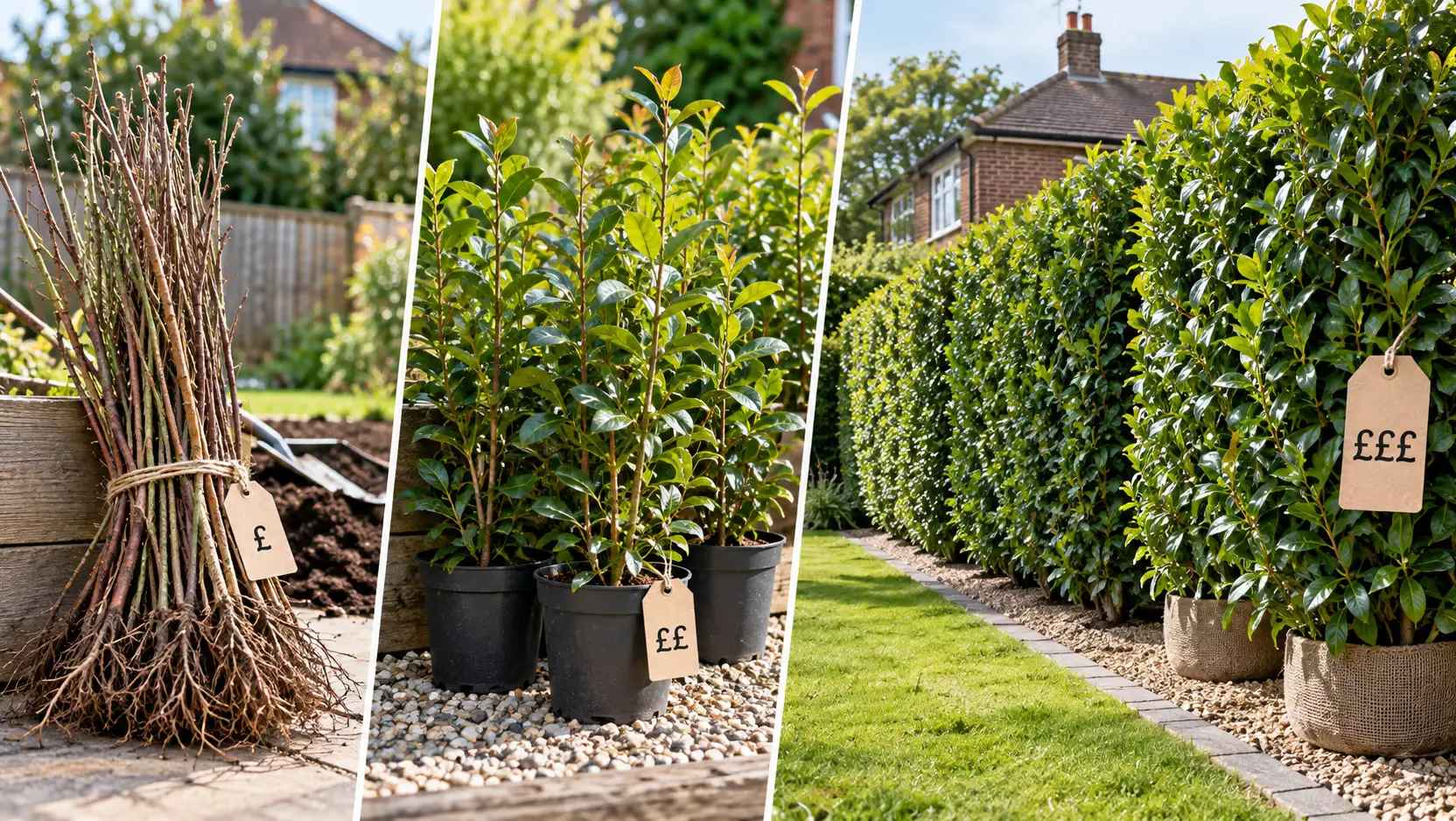
The price difference between the cheapest and most expensive way to plant the same hedge, at the same eventual height, can be well over tenfold. That’s not a sign that one option is a rip-off — bare-root, pot-grown and instant hedging are genuinely different products solving different problems, and the right choice depends less on the size of your budget than on how long you’re willing to wait for the result.
Take a ten-metre boundary planted with hawthorn. At current nursery prices, the plants alone could cost around £90 if you buy young bare-root stock, £320 for pot-grown plants or £1,600 for pre-grown instant hedging. That’s a remarkable difference for something that will eventually serve much the same purpose, although the three options look very different when they first arrive.
The cheapest might turn up as a bundle of dormant, rather unpromising sticks. The most expensive could arrive as heavy sections of established growth, already clipped together into something resembling a finished hedge. Neither is necessarily the better long-term purchase. One simply requires you to do the waiting yourself.
Before paying the premium, though, there’s another question worth asking: are you buying an attractive new boundary, or do you need actual privacy? Those aren’t always the same thing, and an expensive mistake can begin with confusing the two.
Bare-root: the cheapest way to plant a hedge, by a wide margin
Bare-root plants are grown in nursery fields, lifted while dormant and sold without a pot or substantial soil around their roots. They are generally supplied from November to March, with availability depending on the species and weather. For a homeowner able to organise the planting during that window, the savings can be enormous.
Small native hedging plants such as hawthorn often cost around £1 each when bought in quantity. They tend to arrive as young whips, perhaps 40–90cm tall, with little foliage or branching to suggest that they will one day become a substantial garden boundary. If you need immediate screening from the house next door, the result may initially be disappointing.
But the unimpressive appearance shouldn’t be confused with poor quality. Smaller plants often establish particularly well because they have less mature top growth to support while their roots settle into the surrounding soil. The Royal Horticultural Society’s hedge-growing guidance makes this point directly: smaller stock generally establishes more rapidly and successfully than larger plants, although it takes longer to develop into a joined-up hedge.
The real expense, then, is time. A new bare-root hedge may need several growing seasons to reach the required height and become thick enough to provide meaningful screening. The precise wait depends on the species, soil conditions, watering and pruning, rather than a guaranteed timetable supplied with the plants.
That waiting period isn’t a particular disadvantage if you’re planting a long boundary primarily for appearance, shelter or wildlife. A mixed native hedge of hawthorn, field maple, blackthorn and other suitable species can develop into an attractive feature without the cost of buying established plants. Over 30 or 40 metres, the difference in purchase price can become substantial.
There is some additional work involved. Bare roots need protecting from drying out between delivery and planting, the ground must be suitable rather than frozen or waterlogged, and the young hedge needs watering during dry weather while it establishes. Those requirements are manageable for many homeowners, but they matter because buying inexpensive plants is no saving if they fail and need replacing.
For somebody who can wait, bare-root is difficult to beat. The drawback isn’t necessarily the hedge you’ll have in five years. It’s what you’ll be looking at in the meantime.
Pot-grown: paying to plant when it suits you
Imagine moving into a house in June and discovering that the boundary hedge is missing several plants. Waiting until November to order bare-root replacements might be entirely sensible from a gardening perspective, but less appealing if the gaps are exposing the garden throughout the summer.
That’s where pot-grown hedging earns its premium.
Container-grown plants are available through much more of the year, and the range of sizes gives homeowners considerably more choice. You can buy a few modest shrubs to fill gaps, replace a short boundary in spring or choose larger specimens that already provide some height. Spring and autumn remain favourable planting periods, and anything put in during warm weather will need particular attention to watering.
The extra cost reflects the time and resources involved in growing plants in containers, but there’s no useful universal rule that pot-grown stock costs twice or three times as much as bare-root. The difference varies considerably with species, age, pot size, quantity and supplier.
More importantly, a pot-grown plant isn’t automatically a better plant. It may have a more developed appearance when purchased, but its roots still need to establish in the garden. Larger stock can be more demanding to water, and the RHS advises that small plants often establish particularly successfully.
The advantage is flexibility rather than a guarantee of faster growth. That flexibility may be worth paying for when only a handful of plants are needed. Across a long boundary, however, the premium multiplies quickly.
Pot-grown stock also offers more choice where evergreens are wanted. Species such as laurel, holly and yew are frequently offered in containers or other soil-rooted nursery formats, whereas inexpensive bare-root hedging is particularly associated with deciduous stock. For someone who wants a green screen throughout winter, the species may matter more than the way the plants are supplied.
And this is where the comparison becomes more interesting than simply finding the cheapest hawthorn. Hawthorn is deciduous: its leaves fall in autumn, leaving branches and stems that may still offer some screening but not the same leafy privacy as an evergreen. If the purpose is to block overlooking all year, buying a more expensive instant hawthorn hedge may still fail to achieve the effect you’re paying for.
Instant hedging: when waiting is the expensive option
Instant hedging is a different proposition from purchasing a collection of individual plants. It is typically grown and trained in sections, often metre-long troughs, with the plants already forming a continuous-looking hedge when delivered.
The nursery has done much of the work that a homeowner would otherwise wait years to see. The price covers growing space, clipping, watering, handling and the cost of keeping relatively mature stock until it is ready for sale.
For a newly built house with an exposed garden, that could be money well spent. Perhaps the patio is directly overlooked by neighbouring windows, or an old hedge has been removed and the boundary suddenly feels much less private. Waiting years for young whips to reach a useful height might be cheap financially but costly in terms of how the garden can be enjoyed.
There is a catch, however, in the word instant. It describes how established the hedge looks, not necessarily how tall it is.
A pre-grown section only 60–90cm high can be marketed as instant hedging because it is already dense and joined together. It might look excellent as a low boundary, yet do very little to screen someone standing on the other side of a fence. If you need a hedge around 1.8 metres high, buying a beautiful, dense 80cm section doesn’t solve that problem simply because it costs more.
Taller instant hedging, large root-balled stock and semi-mature plants are available, but the prices and handling requirements can rise sharply. Root-balled specimens are also a different nursery format from trough-grown instant hedging, so they shouldn’t be compared as though they were identical products.
Delivery is another practical dividing line. A bundle of bare-root plants can often be carried through a narrow side passage without difficulty. Several metres of established hedging in heavy troughs may require additional people, machinery or specialist handling. That matters particularly for terraced houses where the only route to the back garden is through the property itself.
Nor does the nursery’s work eliminate the need for careful aftercare. Larger plants can be vulnerable during establishment, and RHS planting advice stresses the additional care needed for semi-mature hedges, particularly with planting and watering.
For homeowners who genuinely need a finished-looking boundary immediately, the extra expense can make sense. But that decision should be based on the height, density and species being delivered, not simply the promise of an instant hedge.
The ten-metre price difference
Hawthorn provides a useful example because the same species is offered in all three forms. Using one supplier also avoids comparing a discounted bare-root bundle from one nursery with a much more expensive specimen product from another.
The following figures use the displayed October 2026 listings from Hedges Direct for hawthorn hedging. They are plant-only retail examples, not installed prices, and use the supplier’s stated planting quantities for each format.
| Format | Starting height | Quantity for 10m | Approximate plant cost |
|---|---|---|---|
| Bare-root hawthorn | 60–90cm | 70 plants at £1.29 | £90 |
| Pot-grown hawthorn | 60–90cm | 40 plants at £7.99 | £320 |
| Instant hawthorn | 60–90cm | 10 metre-long units at £159.99 | £1,600 |
Prices checked 16 October 2026 and rounded to the nearest pound. Bare-root plants were listed for November preorder; prices and promotions may change. Delivery, labour, ground preparation and aftercare are excluded.
The figures are striking, particularly because the advertised starting heights are broadly comparable. The £1,600 hedge isn’t fifteen or twenty times taller than the £90 one. It is simply much further along in its development, arriving with the density and finished appearance that the cheaper plants may take years to produce.
The different quantities also matter. This supplier specifies seven young bare-root hawthorns per metre, four pot-grown plants per metre and one pre-grown trough section per metre. That isn’t a universal rule for hedging. The Woodland Trust’s native hedge-planting guidance, for example, describes a staggered double row using five plants per metre. The correct number depends on species, starting size, planting arrangement and the density intended.
That is why cost per metre, using a suitable planting density, is a more useful measure than simply comparing the price of one plant.
There is a second limitation to the table: it doesn’t tell you the cost of having a finished hedge professionally installed. The bare-root plants might be a manageable weekend project for a homeowner with straightforward access and prepared ground. Instant hedging may require delivery equipment, labour and careful positioning. An existing hedge that has to be removed first can make either project considerably more expensive.
It would be misleading to apply an arbitrary national labour rate to all three. A level, cleared ten-metre border and a restricted garden requiring mature roots to be excavated are not comparable jobs. Anyone obtaining quotations should therefore distinguish the supply price from the full cost of removal, preparation, planting and waste disposal.
The costs that can overturn the calculation
The cheapest plants aren’t necessarily the cheapest completed project, particularly where the existing garden requires substantial work.
Removing an old established hedge can mean digging out heavy root systems and arranging disposal before a new plant can be placed in the ground. Compacted or poorly drained soil may need preparation, and a long exposed boundary can require protection for young plants. Those costs may exceed the price of inexpensive bare-root stock.
There is also little value in paying for an expensive hedge and then allowing it to fail during a dry first summer. Whether the plants arrive bare-root, in containers or as pre-grown sections, a suitable watering and establishment plan matters. The larger the plants, the greater the potential financial loss if things go wrong.
Access deserves attention before ordering, not after delivery. A supplier may be willing to deliver ten metres of instant hedging, but that doesn’t mean the sections can be moved safely through a narrow passage, around a tight corner or down garden steps. Where specialist handling is required, ask about it before agreeing to the purchase.
The eventual maintenance cost matters too. Fast-growing species can provide screening sooner but may need more frequent trimming, while a hedge planted too close to a boundary can create recurring difficulties with overhang and access. A little thought about its mature width and the effort needed to maintain it may save problems later.
None of this means hedge planting needs to become a complicated landscaping project. It means the apparent bargain depends on what is already on the site and how much work is involved in getting the new plants established.
So which hedge is actually worth the money?
For most homeowners planting a conventional boundary without an urgent privacy problem, bare-root is the clear value choice. The plant costs are low, particularly over longer distances, and young hedging can establish very well. The saving is large enough to outweigh the inconvenience of waiting for many ordinary garden projects.
Pot-grown makes more sense when you want to plant outside the dormant season, have only a few gaps to fill or want a particular species or starting size. It isn’t automatically the sensible middle option merely because it sits between the other two on price.
Instant hedging is worth considering when the waiting period is itself a significant problem. If an exposed garden needs usable screening now, the extra cost might be justified — but only when the delivered plants provide the actual height, density and seasonal coverage required.
For a homeowner choosing between £90 and £1,600 worth of hawthorn, the key question isn’t whether the expensive hedge is seventeen times better. It isn’t. Both are living plants that still need suitable conditions and care. What the larger bill buys is a boundary that already looks established.
There is little point paying for those years of nursery growth if you’re perfectly happy to wait. But equally, the cheapest young hedge isn’t much of a solution if privacy is the one thing you need this summer.
The sensible purchase is the one that meets the real purpose of the hedge, at a total cost you understand. Once you know how much height, screening and waiting time you’re prepared to accept, the choice between bare-root, pot-grown and instant becomes a great deal easier.
Prices are illustrative UK retail figures checked on 16 October 2026, not quotations or guaranteed future prices. Costs and availability vary by species, plant size, supplier, quantity, planting density, delivery, site conditions and labour. Growth rates, screening and establishment depend on the plants and the conditions in which they are grown. Check current nursery specifications and obtain appropriate quotations before committing to a particular project.

