

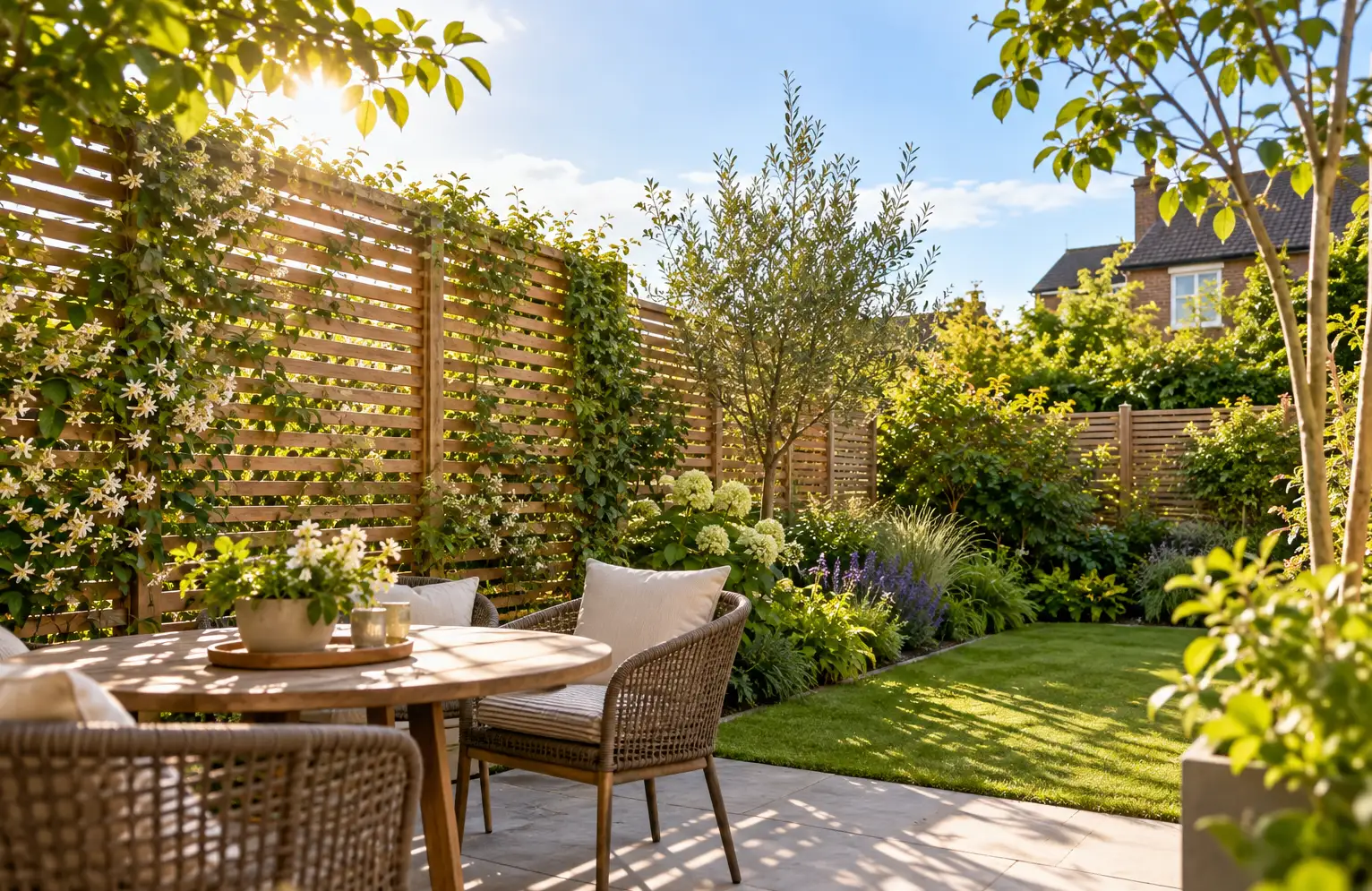
The instinctive answer to feeling overlooked is to build the tallest, most solid fence permitted and be done with it. It can also be the wrong answer — particularly on a smaller plot, where a garden boxed in on every side by opaque timber can lose far more in daylight, openness and outlook than the privacy gained is worth.
Privacy and enclosure aren’t actually the same problem, and treating them as one can leave people with a darker garden that still doesn’t quite solve the bit that was bothering them.
The better starting point is working out exactly where the overlooking happens from, and dealing with that, rather than the whole boundary at once.
Work out the actual sightline before you screen the whole boundary
Overlooking is usually angular, not total. A neighbouring upstairs window, a raised decking area next door or a footpath that runs slightly higher than your own garden creates a particular line of sight — not an equally intrusive view of everything you do outdoors.
Stand, and then sit, where you normally use the garden. Look towards the window, path or neighbouring area that makes you feel overlooked and work out where that sightline crosses your boundary. It is worth checking from inside the house as well: a screen that gives privacy while you are sitting at the patio table may not block the same view when you are standing, or when somebody looks into the garden from a kitchen or living-room window.
That exercise often reveals that only a section of the boundary — sometimes not even the tallest or widest section — needs serious screening. Everywhere else can stay lower and more open, which is where much of the garden’s daylight and sense of space comes from.
Before paying for permanent screening, there is a simple test worth doing. Ask somebody to stand where you are considering putting the screen and hold a long pole, sheet of cardboard or another temporary marker at roughly the proposed height while you sit where privacy matters. Move it along the boundary until the troublesome view disappears.
It is crude, but it tells you much more than choosing a fence height while standing beside the fence itself.
Concentrate height and solidity where it earns its keep
Once the problem sightline is identified, the most effective response is often a taller or more solid section of screening exactly there — around a seating or dining area, for instance — rather than raising the whole boundary to match.
A well-placed panel, a run of trellis with sufficiently dense planting, or slatted screening positioned to interrupt the particular view can do more for useful privacy than uniformly increasing an entire fence line, while leaving the rest of the garden considerably brighter.
The screen does not necessarily have to sit on the boundary either.
This matters particularly where the overlooking comes from an upstairs window. Trying to block that view by continually adding height to a distant boundary can make the garden increasingly enclosed before the sightline is properly interrupted. A smaller screen positioned closer to the patio or seating area may cross the same sightline at a much lower height.
That can mean screening the place where privacy is actually needed rather than screening the entire property.
Choose open structures over solid ones where you can
Slatted fencing can interrupt a direct view while still allowing light and glimpses through the gaps — visually and practically different from a closeboard panel that reads more like a wall.
Trellis does something similar and can carry climbing plants, softening the boundary without immediately adding the visual weight of more solid timber.
Neither automatically gives the same privacy as an opaque fence, and the effectiveness of slatted screening depends heavily on the size of the gaps, the direction of the slats and the angle from which somebody is looking. A screen that appears almost solid from one position can be noticeably more open from another.
That is precisely why it can work so well when the problem is one particular sightline rather than a need for complete visual separation.
The Royal Horticultural Society’s guidance on garden screening makes the same broader point: effective screening can be permeable or angled rather than completely solid, allowing privacy to be balanced against retaining light and views.
Let planting do some of the work
Planting alongside a lower boundary structure — rather than instead of one — can give a better balance of immediate screening, softness and longer-term privacy than relying entirely on either approach.
A newly planted hedge will not usually provide dense screening immediately and needs maintenance as it establishes; a solid fence provides instant separation but little visual softness. Combined, a lower fence or trellis can provide the initial structure while planting fills in around and above it.
Evergreen shrubs or a mixed hedge planted just inside a boundary can provide more consistent screening through the year. Deciduous planting can be useful where the privacy problem is mainly during the warmer months when the garden is being used most heavily, while allowing more light through once the leaves have fallen.
Climbing plants can also turn trellis into a much less conspicuous barrier without requiring another expanse of solid fencing.
For people who do not want to plant directly into the ground, larger containers can provide movable planting too. That can be useful in a rented garden, subject to the tenancy agreement, or where a permanent hedge is not wanted. The trade-off is that large container plants still need watering and maintenance and should not be assumed to provide instant dense screening simply because they are tall.
The point is not to replace every fence with planting. It is to let each do the part it does best.
Think about the whole day, not just the moment you notice being overlooked
A screen that solves an evening privacy problem can cast a shadow across the same place at another time of day, and the reverse is just as possible.
Before committing to its height and position, watch where the sun actually falls across the garden at different points during the day. A tall solid screen positioned on the sunnier side of a small garden can have a much greater effect on direct sunlight than one whose shadow falls largely away from the part of the garden you use.
Season matters too. The sun sits much lower in the sky outside summer, so a screen that casts a relatively short shadow on a bright June afternoon may affect a considerably larger area during spring, autumn or winter.
You do not need a complicated calculation. Observing the proposed position at different times on a sunny day — and thinking about where a longer seasonal shadow will fall — is often enough to spot an obvious mistake before it becomes permanent.
Small gardens need a different calculation
In a small garden, height reads very differently than in a larger one. A boundary treatment that would feel proportionate around a generous plot can feel like standing inside a box when the opposite fence is only a short distance away.
Here, the angled or concentrated approach matters more than almost anywhere else: screen the particular overlooked corner or seating area, keep the remaining boundary lower or more visually open where possible, and lean more heavily on planting to soften the harder elements.
It is also worth resisting the assumption that every boundary has to match.
Uniform fencing can look neat, but overlooking problems are rarely uniform. A more solid section where privacy genuinely matters, lighter screening elsewhere and planting between them can make a small garden feel considered rather than enclosed.
Where planning rules and existing boundaries come into it
Planning rules matter if additional boundary height forms part of the solution, but they differ across the UK and there are exceptions even within the usual permitted development limits.
In England, for example, a new or altered fence, wall or gate can generally fall within permitted development where it does not exceed two metres in height, reducing to one metre where it is next to a highway used by vehicles or the footpath of such a highway. Listed buildings, planning conditions, Article 4 directions and some other circumstances can change that position, so the rule should not simply be treated as an automatic entitlement. The Planning Portal guidance on fences, gates and garden walls explains the England position in more detail.
The planning systems elsewhere in the UK have their own rules and qualifications — even where some of the headline height limits appear similar — so check the rules applying to the property before substantially increasing a boundary’s height. Wales, for example, has its own guidance and permitted-development regime, while Scotland applies its own tests to fences, walls and other means of enclosure.
And if the fence or wall you want to alter does not belong to you, that is an ownership question rather than simply a design one. Property Front Page covers fence height, ownership and responsibility separately rather than turning this article into another boundary-law guide.
The underlying principle is worth holding onto: privacy is about blocking a specific view, not building a wall around the whole garden. Solve the actual sightline, and there is usually far more scope to keep the rest of the boundary open, planted and full of light than the instinct to “just make it taller” would suggest.
This article provides general property and garden-boundary information, not legal, planning, surveying or other professional advice for your individual circumstances. Planning rules, boundary ownership, title documents, tenancy terms and site conditions can affect what is possible. Check the rules, permissions and ownership position that apply to the property before altering a boundary or installing substantial screening, and take appropriate professional advice where needed.

