

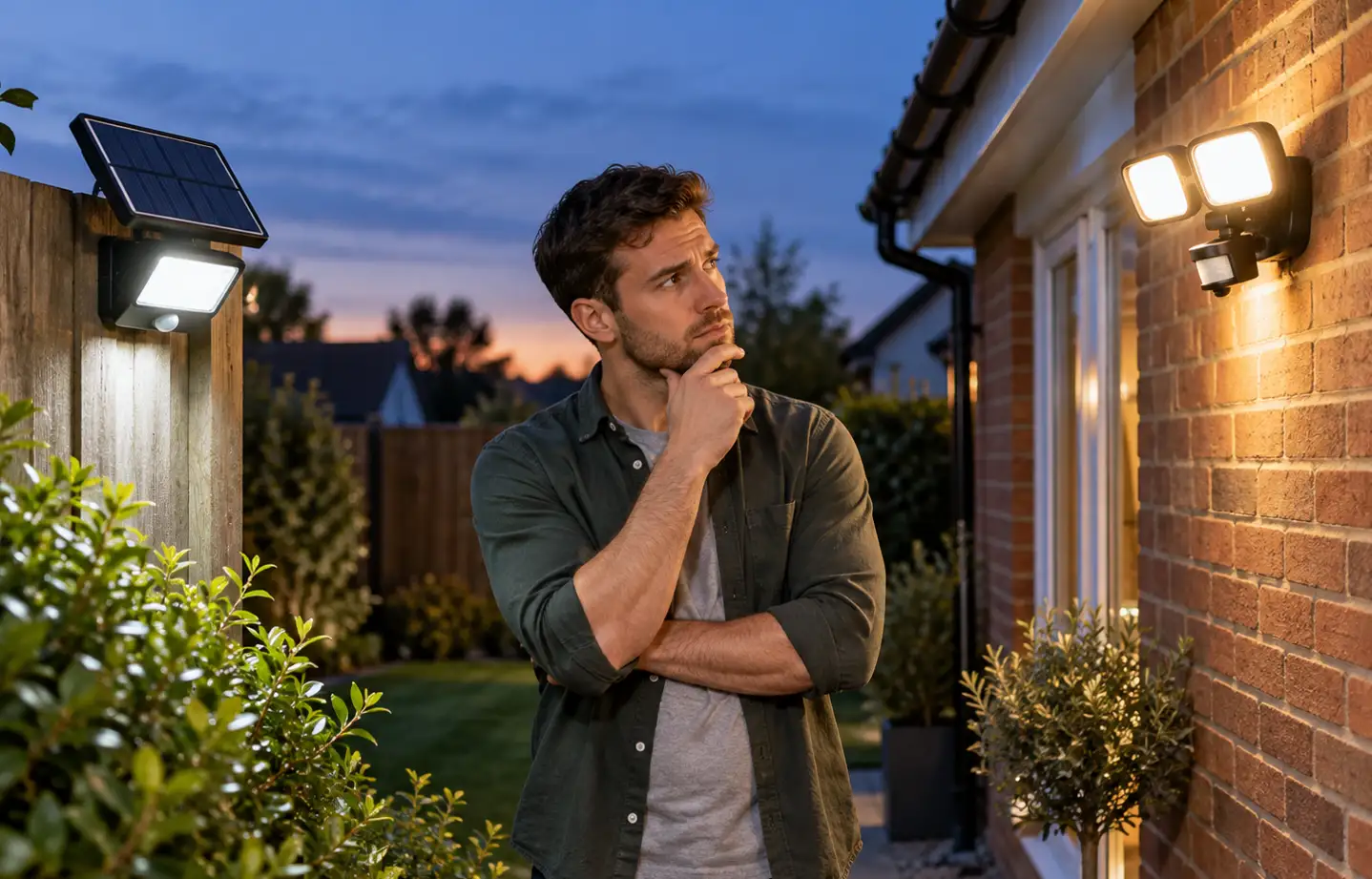
There is an awkward fact at the centre of this decision that many buying guides skip past: security lighting matters most during the long, dark part of the year, and that is also when a small solar panel has the least daylight available to replenish its battery. A solar light that seems excellent in June can behave very differently after several grey December days, particularly if its panel is shaded or poorly orientated.
That does not make solar the wrong choice. It means “solar is cheaper, wired is brighter” is the wrong comparison. The useful question is whether the specific place you need to illuminate gets enough usable daylight for that solar system to remain dependable when you actually need it — and, if it does not, whether avoiding a cable run is worth accepting less predictable winter performance.
There is another distinction worth making before choosing a fitting. Solar versus wired describes how the light is powered; PIR versus dusk-to-dawn describes how it operates. Those are separate decisions. A mains-powered fitting can be motion-activated or provide a low level of light throughout the night, while some solar fittings offer different operating modes too. Current police-backed security guidance does not simply recommend fitting the brightest PIR floodlight available: consistent low-level lighting can make sense at entrances, while motion-triggered lighting has a different role elsewhere.
What actually determines whether solar will work in a given spot
Aspect and shade matter enormously. The Energy Saving Trust’s solar guidance relates to domestic photovoltaic systems rather than miniature security lights, but the underlying solar principle is the same: an unshaded south-facing panel receives the most useful solar energy, while nearby buildings and trees reduce output and north-facing positions are considerably less favourable.
With a security light, however, panel orientation is only part of the answer. The panel size, battery capacity, operating mode and efficiency of the particular fitting all affect how long it can operate, which is why universal promises about winter runtime are not especially useful. What can be said confidently is that a small panel in persistent shade has less energy available to replenish its battery, and that weakness becomes most obvious during short, dull winter days.
The position of the light and the position of the solar panel do not necessarily have to be the same. Some systems use a separate panel connected to the light by a cable, allowing the fitting to sit in a shaded passage or beside a doorway while the panel is mounted higher up, around a corner or on another face of the building where it receives more daylight. That can turn a location which is poor for an all-in-one solar fitting into a perfectly plausible solar installation.
Battery condition matters too. Rechargeable batteries gradually lose capacity, so a solar light that performed well for its first few winters and later becomes unreliable may be showing battery deterioration rather than proving that the location was always unsuitable. Before buying, check whether the rechargeable battery can be replaced. If it is sealed into the fitting, declining battery capacity may eventually mean replacing the entire light rather than an inexpensive component, which changes the long-term cost comparison with a wired installation.
How often the light operates interacts with all of this. A motion-triggered solar light activated occasionally has a very different energy requirement from one firing repeatedly for cats, foxes, pedestrians, traffic or moving vegetation. Secured by Design’s current external-lighting guidance specifically warns that PIR lights can be activated by animals and genuine visitors, reducing their effectiveness where they are badly positioned or adjusted.
Panel exposure, battery capacity, operating mode and sensor positioning therefore need considering together rather than buying on a lumen figure and assuming the rest will look after itself.
Working through the property, location by location
Front entrance. The priority here is dependable, useful light rather than one particular power source. This is the place where you need to see callers, find keys, use the doorstep safely and, increasingly, obtain useful images from a doorbell or security camera. Because the front entrance is usually close to the house electrics, wired lighting is often straightforward to provide and removes uncertainty about winter charging. But a properly specified solar fitting can still be entirely reasonable where its panel has excellent exposure and the operating pattern does not demand large amounts of stored energy.
Secured by Design recommends considering low-level dusk-to-dawn white lighting at entrances rather than assuming security always means a powerful floodlight firing whenever anybody approaches. A continuously available modest light and a powerful motion-triggered fitting solve slightly different problems, so decide which one you actually need before choosing how to power it.
Driveway. Solar can make particularly good sense where there is open sky and a convenient position for the panel, especially where running mains cabling across a large frontage would add unnecessary disruption. But a driveway is also an area where reliable illumination may matter for recognising vehicles and visitors and for the walk between the car and the house.
Think first about what needs to be seen. Lighting the driveway entrance, gate and pedestrian route effectively can be more useful than flooding every square metre from one extremely bright fitting. Where trees, high boundaries or neighbouring buildings leave the available panel position heavily shaded, or where you want dependable lighting through the longest winter evenings regardless of recent weather, wired lighting becomes easier to justify.
Side passage or side return. This is often the most difficult solar location around a typical house. The building shades one side, a wall or fence shades the other, and useful direct light may reach the area for only a limited part of the day. It is also frequently one of the important routes from the front of the property into the rear garden.
A separate solar panel can make a substantial difference here. The light can remain in the passage while the panel is mounted higher or on a better-exposed elevation. Where there is no useful location for the panel and the passage is an important security route, a properly installed wired light is normally the more dependable answer.
Rear garden. The answer depends heavily on the garden. An open south- or west-facing plot may provide very good charging conditions for occasional solar lighting around a gate, shed or path, while a small garden enclosed by buildings and mature planting may provide very little useful exposure.
It is also worth asking whether the entire garden needs illuminating. Carefully positioned switched or motion-operated lighting can make gates, doors and routes visible without turning the whole garden into a floodlit area. Excessive brightness can create glare and strong areas of contrast, while poor positioning can also make CCTV images less useful if the light produces reflections or extreme differences between bright and dark parts of the scene. Useful visibility usually matters more than the largest lumen figure on the packaging.
Detached garage, shed or outbuilding. This is where solar’s independence from a mains supply can have its greatest practical value. Running a new electrical supply to a distant shed purely for one light may be disproportionate, whereas a solar fitting can be installed with very little disturbance if its panel has a good view of the sky.
But inconvenience in running a cable does not make solar reliable by default. An outbuilding underneath dense trees or permanently overshadowed by the house may be one of the poorest charging positions on the property. If tools, bicycles or other valuable items make dependable illumination important, decide whether a remotely positioned solar panel solves the problem before defaulting to an all-in-one fitting simply because it is easy to install.
Where new fixed mains lighting is being installed outdoors, treat it as electrical work rather than ordinary garden decoration. Electrical Safety First’s garden electrical-safety guidance recommends appropriate outdoor equipment, protection against weather and damage, and RCD protection for outdoor electrical equipment. Permanent exterior wiring and new cable runs are jobs to discuss with a competent electrician rather than improvising with indoor fittings or extension leads.
Where new wiring is difficult or undesirable. Solar has an obvious advantage where there is no convenient electricity supply, trenching or cable routing would be disproportionately disruptive, or you simply do not want to alter the building for one fitting. It is still too simplistic, however, to say solar is automatically the answer for rented or listed properties. A tenant may need permission to attach equipment to the building, while external alterations to a listed property can require particular care regardless of whether the fitting uses mains electricity or its own panel. Solar removes the need to run a power cable; it does not remove every other property constraint.
Brightness isn’t the same as effective security
A good security light helps you see the people, doors, gates and approach routes that actually matter. It does not necessarily illuminate the greatest possible area.
Secured by Design recommends exterior lighting at entrances and exits, while also warning that PIR fittings can be activated by animals and legitimate visitors. It suggests considering photocell-controlled dusk-to-dawn lighting providing a constant low white light. That is a more useful starting point than treating maximum brightness as maximum security.
There is also a practical behavioural point. A light that activates continually for ordinary activity rapidly becomes unremarkable to the people living nearby. With a solar fitting, those unnecessary activations also consume the finite battery energy collected during the day. Sensor coverage should therefore match the area you genuinely want monitored rather than reaching across a public pavement, neighbouring garden or every moving branch.
The same restraint helps where cameras are present. Poorly positioned lighting can create glare, reflections or extreme contrast that makes images harder to interpret rather than clearer. Aim for useful illumination of faces and routes rather than spectacle.
When a security light becomes someone else’s problem
The choice between solar and wired makes no difference to a neighbour if either fitting shines into their bedroom.
Aim the light down towards the path, gate, doorway or ground it is intended to cover rather than towards the horizon. Limit the detector to your own relevant space where possible, and avoid using more brightness or operating time than the job needs. Those are sensible security decisions as well as considerate ones.
In England, domestic security lighting can potentially amount to a statutory nuisance. GOV.UK’s guidance on artificial-light nuisance specifically identifies domestic and commercial security lights as possible sources of complaints, with councils considering matters such as how often the light occurs, how long it lasts and whether it substantially interferes with someone’s use of their property.
Property Front Page’s separate guide to intrusive neighbour security lighting deals with what happens once a complaint already exists. From the installer’s side of the fence, prevention is much easier: sensible output, downward aiming, appropriate operating periods and a detector that does not watch half the street.
The honest summary
Solar works best where the panel has good exposure, where cabling would be awkward or disproportionate, and where the lighting requirement is intermittent enough for the battery to recover between activations. Systems with separate panels considerably widen the number of locations where that approach can work, while a replaceable battery can make a meaningful difference to the product’s long-term value.
Wired lighting earns its installation cost where dependable illumination matters most, where the available solar position is shaded, or where you want consistent dusk-to-dawn lighting through winter rather than intermittent bursts governed by the energy collected the previous day.
The important thing is not to make the power source do all the thinking. Decide where the light is genuinely needed, whether it should remain on at a low level or operate only when movement is detected, how dependable it needs to be in winter and whether the proposed solar panel position can realistically supply the energy that operating pattern requires. Then choose between solar and wired.
This article provides general information about domestic external security lighting in the UK. Solar-light performance varies substantially with product design, panel exposure, battery capacity, weather and operating pattern. Electrical-installation requirements and light-nuisance law can differ across the UK, and rented, leasehold or listed properties may have additional consent requirements. Fixed mains electrical work should be carried out safely by an appropriately competent person.

