

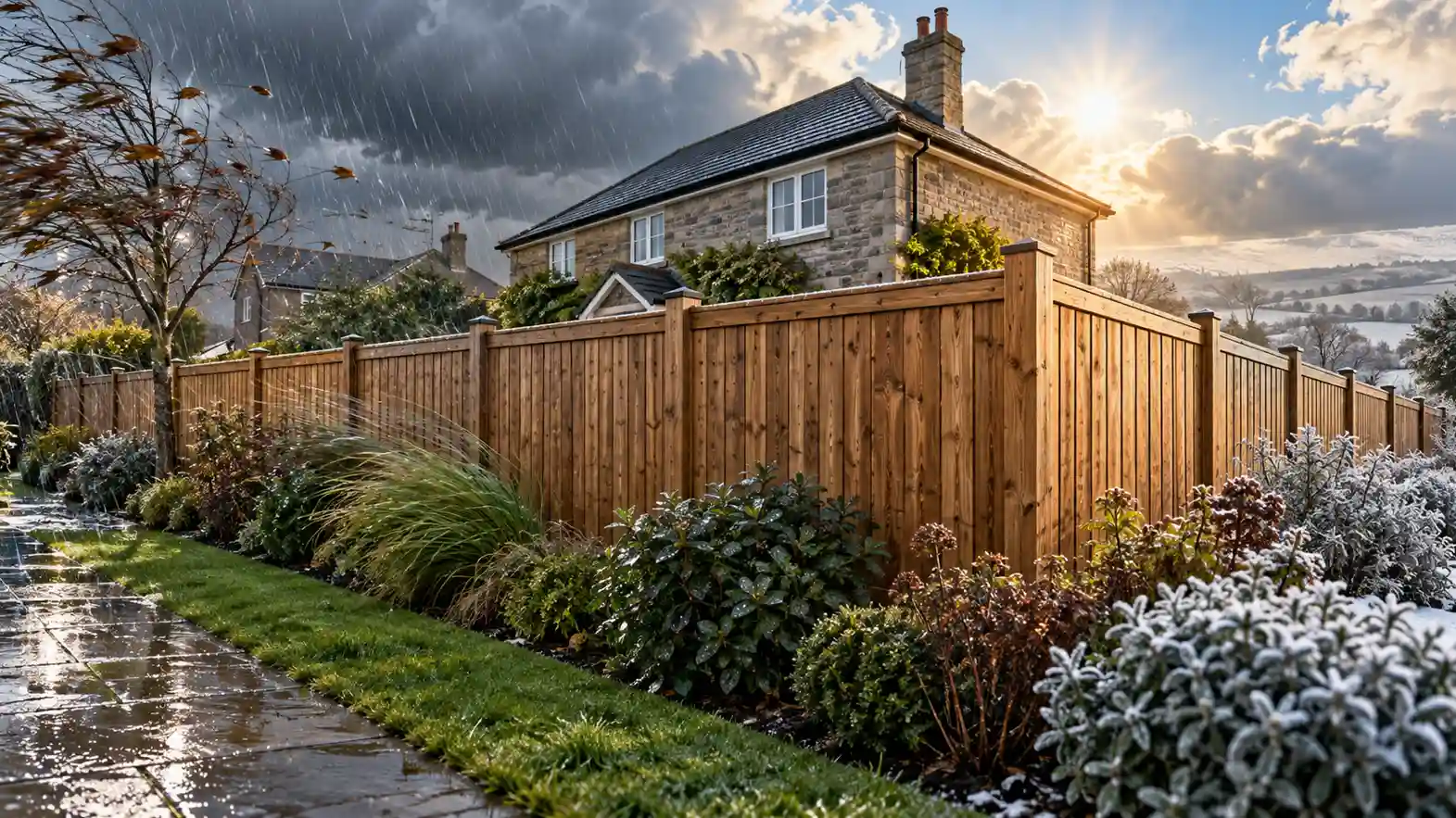
Most people choosing a new garden fence spend their attention on the panel — the style, the height, the colour of the stain. Yet the part that often decides whether a fence lasts is the part most buyers barely see: the posts, their foundations and what happens at ground level. An expensive panel can fail early if the posts move, good timber can decay prematurely if a post intended for above-ground use is buried in wet soil, and a heavy, solid fence can prove unsuitable for an exposed garden where every storm loads its full face.
That is why there is no honest answer as simple as “composite lasts longest” or “concrete is best”. Choosing fencing that survives British weather means considering the whole structure — posts, foundations, timber treatment, fixings, ground contact and wind exposure — before deciding which panel looks best in the garden centre. The material matters, but it is how the different components work together, and whether they are appropriate for the conditions in which the fence will stand, that largely determines how long the installation remains serviceable.
Start with the post, not the panel
Timber treatment is one of the most useful specifications to understand before comparing fencing quotations, particularly where posts or gravel boards will remain in contact with the ground. The current British Standard for wood preservation is BS 8417:2024, with the associated Use Classes describing the conditions in which timber will be used. Fence boards and rails exposed to the weather but kept clear of the soil are treated differently from posts and timber gravel boards that remain in ground contact. For those components, the relevant specification is Use Class 4, usually abbreviated to UC4, as explained in the Wood Protection Association’s guidance to timber Use Classes.
This makes the description “pressure treated” or simply “treated timber” considerably less reassuring than it might appear. The Wood Protection Association recommends specifying both the Use Class and the desired service life, while BS 8417 provides treatment specifications for desired service lives including 15, 30 and 60 years, depending on the application and timber concerned. These are specification targets rather than promises that an installed fence will stand for precisely that number of years. Drainage, soil conditions, installation quality and subsequent damage can all alter the outcome. A homeowner comparing two apparently similar fencing quotations may therefore be comparing products manufactured for quite different conditions without realising it. The Association’s guidance on specifying and buying treated timber provides further information on what should be established before ordering.
The useful question to put to a merchant or contractor is not simply whether the posts have been treated, but whether they are treated for UC4 ground contact and what desired service life they are specified to achieve. Incising — the small cuts sometimes made in timber before treatment — can help preservative penetrate wood that is otherwise difficult to treat and is used in some higher-service-life specifications. An incised surface alone, however, does not demonstrate that a post has received the correct treatment or is suitable for prolonged ground contact. The treatment specification and intended service life are what need to be established.
Concrete posts remove the particular vulnerability of timber decay at ground level, which explains their enduring popularity where previous wooden posts have rotted. They are not immune to other problems: inadequate footings can still move, the posts can be damaged by impact, and the timber panels between them remain exposed to the weather. Their practical advantage is that a sound supporting structure can survive several replacements of the panels it holds. Gravel boards perform a similar protective function for the bottom of the fence, separating the panels from wet soil, splashback and persistent moisture. Where a gravel board is itself made from timber and remains in contact with the ground, it also needs treatment suitable for UC4 conditions.
Comparing the main fencing systems
Giving every fencing material a neat lifespan in years is tempting, but it creates a precision that real gardens rarely justify. A correctly specified and well-installed timber fence can outlast a poorly installed low-maintenance alternative, while a lengthy warranty on composite panels says relatively little about the durability of the foundations, posts or fixings supporting them. The more revealing comparison is where each system gains its resistance to deterioration, what tends to cause failure and how easily damaged components can be repaired or replaced.
| Fencing system | Durability strengths | Main vulnerability | Maintenance and repair |
|---|---|---|---|
| Treated timber panels or closeboard with timber posts | Affordable, repairable and capable of long service with properly specified ground-contact posts | Post life depends on treatment, drainage and installation | Boards and panels can be replaced; decorative finishes may need renewing |
| Timber panels or closeboard with concrete posts and gravel boards | Eliminates timber post decay and protects panel bottoms from wet soil | Footing movement, impact damage and timber weathering | Panels can usually be replaced while retaining sound posts |
| Composite panels with suitable supports | Resists ordinary timber decay and needs little decorative maintenance | Support design, installation and wind loading on solid panels | Mainly cleaning and inspection; proprietary replacement parts may cost more |
| Hot-dip galvanised steel or suitably protected metal fencing | No timber decay, long potential coating life and low wind resistance in open designs | Corrosion conditions and coating specification, especially near the coast | Generally limited maintenance where protection suits the environment |
| Slatted or hit-and-miss timber fencing | Allows airflow while remaining relatively easy to repair | Post specification, fixings and workmanship remain important | Individual boards can normally be repaired or replaced |
Where privacy is not essential, a properly specified hot-dip galvanised open steel fence has a particularly strong claim to longevity. SteelConstruction.info’s guidance on galvanised-steel durability explains how the protective coating helps resist corrosion, with coating life strongly dependent on thickness and environmental conditions. Standard galvanised coatings can achieve lives exceeding 50 years in many UK environments, although the rate of corrosion varies with exposure and can become considerably more demanding in aggressive locations. Protected metal fencing may therefore be attractive for some boundaries, but it is not necessarily the best choice for a private garden where screening neighbours or providing a more traditional appearance matters as much as durability.
For the conventional garden boundary, timber infill supported by well-founded concrete posts and gravel boards remains an especially practical combination. The part most vulnerable to ground-contact timber decay has been removed, the panels are kept away from persistent ground moisture, and individual sections can be renewed without replacing the entire structure. Correctly specified UC4 timber posts can also provide a long service life, while composite fencing appeals to homeowners who want to minimise routine decorative maintenance. The important distinction is between the durability of a material and the durability of the complete fence. Panels capable of resisting decay for decades offer little benefit if inadequate foundations allow the entire run to lean after a succession of storms.
Why a solid fence can fail where a weaker-looking one survives
Wind exposure is one of the most easily underestimated factors in choosing a fence, particularly where a boundary faces open countryside, an exposed hillside or a prevailing coastal wind. A tall solid fence acts rather like a sail: wind strikes its face and the resulting force must be resisted by the panels or boards, their fixings, the posts and ultimately the foundations. A slatted or hit-and-miss arrangement allows some air to pass through, reducing the resistance offered by the fence. It may appear less substantial than a heavy solid panel, but that does not mean it is less capable of surviving difficult conditions.
The principle is established in windbreak design. The Royal Horticultural Society’s guidance on windbreaks and shelterbelts recommends semi-permeable barriers rather than completely solid ones for exposed locations because solid barriers can create strong turbulence around them. That does not make every slatted panel storm-proof, nor can gaps between boards compensate for undersized posts or inadequate foundations. Fence height, post spacing, ground conditions and the extent of exposure all influence the loads involved. It does explain, however, why replacing a storm-damaged solid fence with an even heavier solid fence may repeat the original mistake. In some gardens, reducing wind resistance will achieve more than increasing the weight or apparent strength of the panels.
Coastal gardens introduce another complication because salt-laden air is more aggressive towards metalwork. Describing a product simply as a metal fence gives little indication of how it will withstand those conditions without knowing the type and thickness of its corrosion protection, the treatment of cut edges, the suitability of its fixings and whether an additional coating system is needed. The same attention to local conditions is necessary below ground. Around 600mm is often used as a starting point for domestic fence-post installations, but no single depth is suitable for every boundary. Soil type, fence height, post spacing, exposure and the amount of solid surface all affect the loads that the foundations must resist.
Where the same stretch of fencing has already failed once or twice, that history is more useful than it may initially seem. Posts that have rotted at ground level point towards a different problem from foundations moving in soft ground, panels being repeatedly damaged by wind or metal fixings corroding prematurely. Simply replacing the failed components with more expensive versions of the same arrangement may do nothing to address the underlying cause. Establishing why the previous installation failed gives a much better basis for choosing the replacement, particularly where the boundary has already demonstrated that ordinary domestic fencing specifications may not be sufficient.
What this means for spending your budget wisely
For homeowners working within a limited budget, posts, foundations and the correct material treatment are poor places to economise. A relatively inexpensive timber panel supported by durable, properly founded posts may prove a better long-term purchase than a premium panel installed on inadequate supports. Reusing existing posts can make financial and environmental sense where they are genuinely sound and suitably installed, but deserves considerably more scrutiny if the previous fence failed at the post line. Spending more on appearance is reasonable once the structure has been properly specified; spending more on decorative panels while neglecting their support is less likely to improve the life of the fence.
The right allocation of money also depends on where the boundary stands. An exposed garden may benefit more from some permeability and robust foundations than from heavier, solid panels, while a sheltered urban garden may allow greater freedom to choose according to appearance, privacy, maintenance requirements and initial cost. Timber remains attractive because it is familiar, relatively affordable and straightforward to repair. Concrete posts remove the principal ground-contact weakness of wooden supports, composite reduces the need for staining or similar decorative work, and appropriately protected steel can offer considerable durability where an open metal boundary suits the setting. None is automatically superior in every garden, because the requirements of a sheltered back garden and an exposed coastal boundary are fundamentally different.
Maintenance still plays a part in the long-term outcome, although it cannot compensate for an unsuitable original specification. Applying stain or a water-repellent coating to exposed timber is not the same as preservative treatment designed for permanent ground contact. Repeatedly coating a post that was never adequately treated for UC4 conditions will not turn it into one that was. External fixings deserve similar attention: screws, nails, brackets and other connectors live outdoors with the fence and need to suit both preservative-treated timber and the level of environmental exposure, particularly near the coast where corrosion can shorten their service life.
Repairability is another consideration that often receives too little attention when the initial purchase is made. A fence designed so that individual boards, rails or panels can be removed and replaced may continue serving its purpose long after some of those components have deteriorated. A proprietary system that requires a large section to be dismantled or replaced following relatively localised damage may prove less economical over its lifetime, even if the original material needs little maintenance.
Comparing quotations on that basis requires more than looking at the panel price. The dimensions, material and spacing of posts, the method of founding them for the soil and exposure, the timber’s specified Use Class and desired service life, and the suitability of fixings all contribute to the likely performance of the installation. The scope of any warranty deserves particular attention, especially whether it covers only the fencing material or also the posts, panels and workmanship. Two contractors offering what appears to be the same fence may be proposing substantially different supporting structures, with consequences that become apparent only after several winters.
The longest-lasting fence is therefore rarely a single product sitting on a shelf. It is the system whose posts, foundations, materials, treatment, fixings and wind resistance have been chosen for the place where the fence will actually stand. A well-specified, repairable installation suited to its exposure will generally provide a better basis for lasting value than an expensive material chosen on the assumption that durability comes from the panel alone.
This article provides general property and maintenance information, not structural or installation advice for a particular site. Timber desired-service-life figures are specification targets rather than guarantees, and product warranties vary in scope and exclusions. Ground conditions, exposure, workmanship, materials and maintenance can materially affect the life of any fence. Obtain an itemised specification and appropriate professional advice where a boundary is unusually exposed, structurally demanding or repeatedly failing.

