

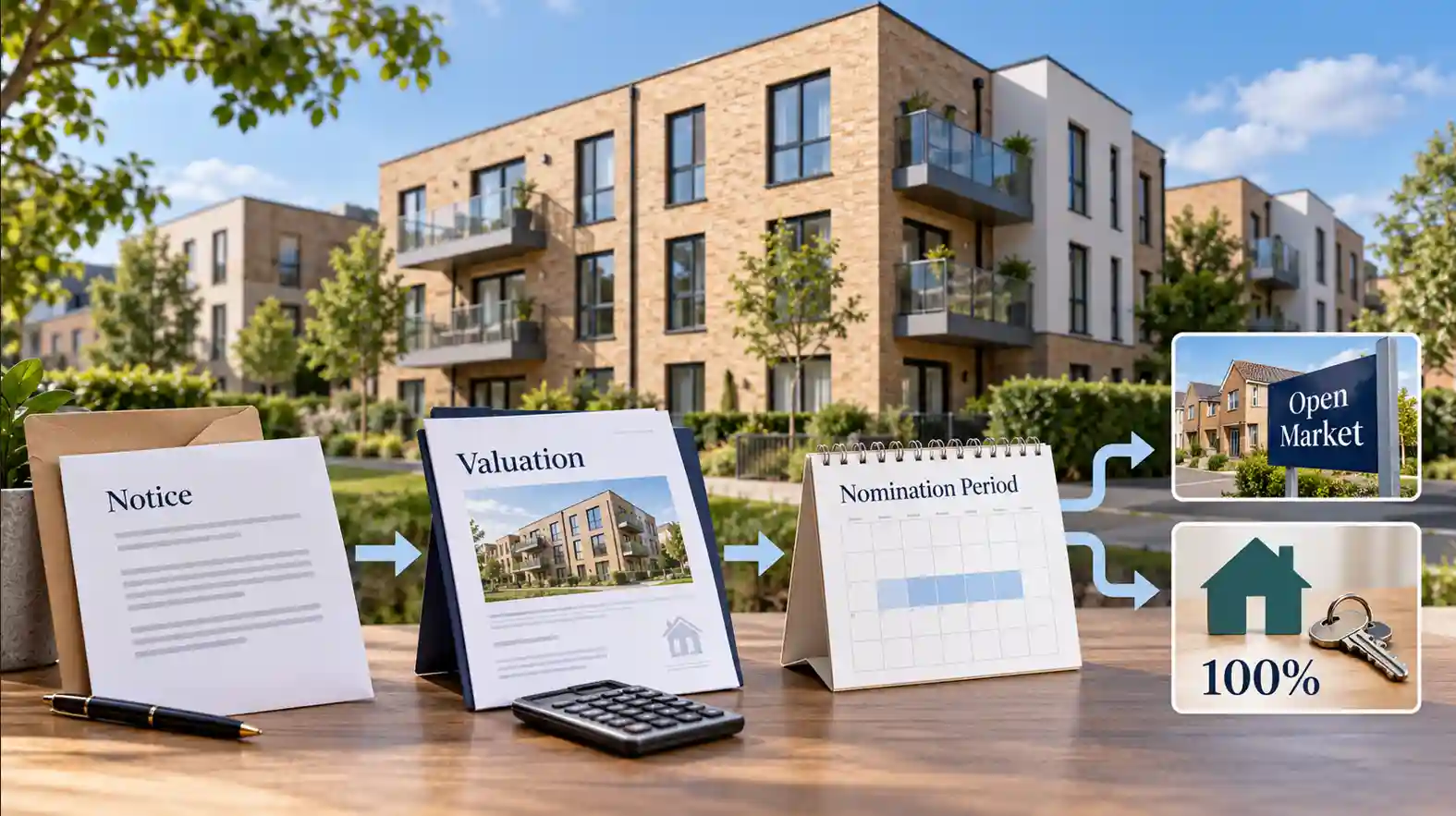
A Shared Ownership home is bought differently, and it turns out to be sold differently too. Owners who assume they can simply choose an estate agent, settle on an asking price and list the property the way any other homeowner would are usually surprised to discover that the lease sets out a specific resale process first — one that determines who gets the first opportunity to buy, and, at least for part of the process, how the price itself is worked out.
This article covers the mainstream Shared Ownership resale route in England. If the question is whether Shared Ownership is the right scheme to buy into in the first place, that sits separately in our Buying a Home coverage. If the home is in Wales, Scotland or Northern Ireland, or it sits within a specialist scheme, the detail may differ.
Step one: tell your landlord before you tell an agent
The first move is not instructing an estate agent. It is telling the housing association, local authority or other provider that you intend to sell.
That is not simply an administrative courtesy. Under Shared Ownership, the lease is the controlling document, and the resale process begins with notice to the landlord. If you do not own 100% of the home, the landlord normally gets the first opportunity to find a buyer for your share. GOV.UK: selling your Shared Ownership home
This is one of those areas where generic descriptions quickly become less useful than the actual lease in front of you. Shared Ownership rules have changed over time. Older leases, standard model leases and newer model leases do not always work in exactly the same way, so your own lease and your provider’s written resale procedure should be treated as the starting point.
The RICS valuation sets the starting price
Unlike an ordinary sale, you do not necessarily begin by choosing whatever asking price you hope the market might bear.
Where the sale is proceeding through the landlord’s nomination period, the price is normally established by a current market valuation from an appropriately qualified RICS valuer. That valuation determines the current market value of the whole home and, from it, the value of the share being sold.
Who actually commissions it is worth checking rather than assuming. Under current and recent Homes England model leases, the landlord normally applies for the RICS valuation for a resale within the nomination period where no staircasing is involved, although providers can agree to let the shared owner commission it instead. The seller is normally responsible for the cost of the initial valuation used to support the sale during the nomination period, unless a different arrangement has been agreed. Homes England Capital Funding Guide: Shared Ownership
That makes this valuation materially more important than an estate agent’s opinion of what the property might achieve. During the nomination period, it is not simply evidence to inform an asking price; it establishes the value on which the Shared Ownership resale is based.
Valuations are time-sensitive, but the rules are more flexible than a simple “three months and start again” rule suggests. Homes England treats a RICS valuation as normally valid for three months unless the valuer states otherwise. For delayed resales, however, providers can allow the transaction to continue on the original valuation where the seller, buyer and provider are satisfied to proceed, rather than automatically requiring a new valuation that could disturb an existing mortgage offer or jeopardise the sale.
So if a resale runs beyond three months, check with the provider before simply paying for another valuation.
The nomination period: your landlord’s first window
Once notice has been served and any required valuation obtained, the next stage is normally the nomination period.
This is the period during which the landlord can identify an eligible buyer for your share before you take greater control of the sale yourself. The length depends on the lease.
That is one of the details sellers most often encounter differently from somebody else’s Shared Ownership experience. Official key-information guidance distinguishes between older models that can carry eight- or twelve-week periods, standard-model leases with eight weeks, and the newer model with a four-week nomination period. Homes England Shared Ownership key information documents
A provider can also decide not to exercise its nomination rights or waive them before the period has run its full course. The figure in somebody else’s lease is therefore less useful than knowing exactly what your own lease says and what your provider intends to do.
If the landlord does find a buyer during the nomination period, the buyer must meet the normal Shared Ownership eligibility and affordability requirements and the sale proceeds on the basis of the RICS valuation.
If the landlord does not find a buyer in time
If the nomination period expires without an eligible buyer being found — or the landlord waives its nomination rights — the seller gains considerably more control over what happens next.
There are two importantly different routes.
You may sell your existing share on a Shared Ownership basis. In that situation you can choose your own buyer rather than having the landlord nominate one, and outside the nomination period the provider no longer controls the price in the same way. The existing share can be sold above or below an earlier RICS valuation, and a new RICS valuation is not required simply to determine the price of that existing share.
But it is still a Shared Ownership sale. The buyer must meet the normal Shared Ownership eligibility requirements and pass the required affordability assessment. An estate agent marketing the property therefore does not suddenly have the entire unrestricted owner-occupier market available to them simply because the nomination period has ended.
The other route is a back-to-back staircasing sale. Here, the seller staircases to 100% at the same time as selling the whole property to the eventual buyer. The buyer’s money helps fund the seller’s purchase of the landlord’s remaining share, so the two transactions complete together.
That can widen the potential buyer pool because the eventual purchaser is buying the whole home rather than entering Shared Ownership. Where staircasing forms part of the transaction, however, a valid RICS valuation is still needed to determine the price of the landlord’s remaining share.
This distinction is important. “The nomination period has ended” does not mean every Shared Ownership restriction simply disappears. What changes depends on whether you are still selling your existing share or using the transaction to staircase out of Shared Ownership altogether.
One important exception sits outside that normal route. A home with a Designated Protected Area mandatory-buyback lease cannot simply be sold on the open market in the ordinary way; the landlord must buy it or arrange for another purchaser. That is another reason the lease itself matters more than a generic description of the scheme.
There is also a practical mortgage complication worth knowing about. If the eventual buyer’s lender values the property below an earlier RICS valuation, the sale is not necessarily automatically dead. Homes England’s current guidance gives providers scope to consider the lender’s valuation, other market evidence or, in appropriate cases, the mortgage offer itself when deciding whether the transaction can proceed. There will still be cases where agreement cannot be reached and the sale falls through, but a mortgage down-valuation should be raised with the provider rather than treated as an automatic end to the transaction.
And this is not a process to bypass. Selling the share on the open market without first following the landlord’s nomination provisions can create problems later in the transaction, including the possibility that final staircasing is required. The lease-led process comes first; open-market marketing comes when the lease permits it.
If you have already staircased to 100%
Once you own 100% of the home, the picture is usually much simpler.
For mainstream Shared Ownership, the landlord’s nomination period no longer applies once full ownership has been reached and the home can normally be sold on the open market.
That does not necessarily make every legal feature of the original arrangement disappear. A flat remains leasehold, while houses and specialist schemes can retain title restrictions or administrative requirements depending on the lease and the circumstances.
The important distinction is between owning a large share and owning the whole interest. A seller at 75%, 80% or 90% can still be within the Shared Ownership resale machinery. Reaching 100% normally removes the landlord-led nomination process itself.
Some forms of Shared Ownership also restrict how far the owner can staircase in the first place — including certain Older Persons Shared Ownership and protected-area schemes — so 100% ownership should never be assumed to be available under every lease.
What it actually costs
The costs of selling a Shared Ownership home can stack up in layers rather than appearing as one obvious selling fee.
There may be a RICS valuation charge, a landlord resale or administration fee, conveyancing costs and leasehold or management information charges. If the nomination period ends and you employ an estate agent to market the property, agency fees may then be added as well. A back-to-back staircasing sale can introduce further valuation, legal and potentially tax considerations because the seller is acquiring the remaining share as part of the onward transaction.
That is why it is worth asking the provider for a written breakdown of the resale process and charges at the beginning, rather than relying on what another Shared Ownership owner paid under a different lease with a different landlord.
The important thing to understand before you start
Selling a Shared Ownership home is not simply an ordinary sale with an extra form attached. It is a lease-controlled resale process in which responsibility shifts as the transaction progresses: the landlord has rights at the beginning, the valuation can control the price during the nomination period, and the seller gains more freedom if that period ends without a buyer.
Even then, the distinction between selling the existing Shared Ownership share and selling the whole home through back-to-back staircasing matters. The former still requires an eligible Shared Ownership buyer; the latter can open the property to a wider market but introduces the mechanics and cost of staircasing.
Once you understand which parts you control, which parts your landlord controls, and the point at which that balance changes, the resale process becomes much easier to navigate.
This article provides general property information, not legal, tax or financial advice. The Shared Ownership resale process described here principally concerns mainstream schemes in England. Lease terms, nomination periods, staircasing rights, buyer eligibility, landlord approval requirements, valuations and resale fees vary between schemes and providers. Specialist arrangements, including some Older Persons Shared Ownership and Designated Protected Area leases, can operate differently. Confirm the requirements under your own lease and with your provider and conveyancer before proceeding.

