

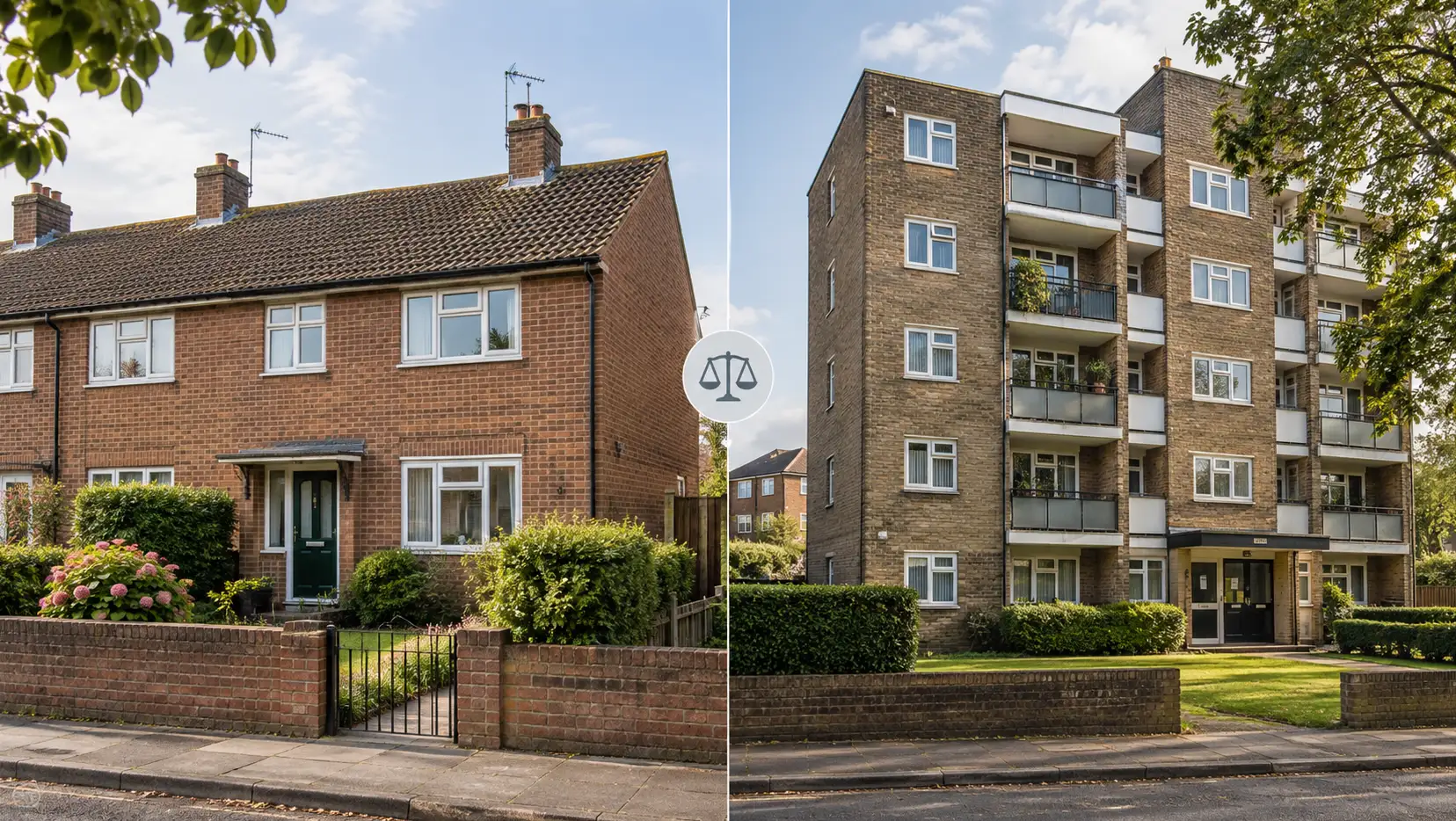
Former council housing carries a reputation that rarely matches any individual property closely enough to be useful. Some buyers assume it is automatically a bargain — generous rooms, practical layouts and a lower price than privately built alternatives nearby. Others assume the opposite: mortgage problems, difficult estates and large service-charge bills. Both impressions describe properties that undoubtedly exist. Neither tells you much about the home actually in front of you.
An ex-council property is not automatically a good buy or a difficult one simply because of who originally built or owned it. What matters is the tenure, the construction, the condition, the building or estate it sits within and, particularly for flats, the costs and responsibilities that come with the wider block.
The distinction between a house and a flat matters considerably here. The detailed Right to Buy and building-safety rules referred to below are principally England-specific. Former council homes exist across the UK, but the legal framework differs: Right to Buy ended in Scotland in 2016 and Wales in 2019, while Northern Ireland has its own arrangements.
Houses and flats are genuinely different propositions
Many former council houses are freehold, although that should always be confirmed rather than assumed. Where the property is freehold, most of the leasehold questions that dominate the purchase of an ex-council flat disappear. The investigation becomes much more familiar: what is the house made from, what condition is it in, are there unusual title restrictions, and will mainstream lenders accept the particular construction?
Former council flats are usually leasehold. The freeholder may still be the local authority, or ownership and management may have passed elsewhere over the years. Either way, the buyer is acquiring a flat within a larger building and cannot sensibly judge the purchase from the condition of the front door inward. The lease length matters, so do the service charges, the condition of the block, planned major works, building-safety issues and the way lenders view the building as a whole.
That is why a neat two-bedroom council-built house on an ordinary street and a two-bedroom flat on the eighth floor of a council-built block can be completely different buying decisions even if both are described by an agent as “ex-council”.
Where the reputation for good value comes from
There are former council homes that offer a great deal of usable space for the money. Some have larger rooms, practical layouts, decent storage or plots that compare favourably with newer private developments at a similar price. But that should be tested against the local alternatives rather than treated as a characteristic of council housing generally.
Floor area is particularly useful here. If an ex-council house at £250,000 provides substantially more usable space than privately built homes selling around the same figure in the same neighbourhood, that is a real advantage. If it is simply cheaper because buyers are pricing in a construction problem, a difficult lease or a large future bill, the comparison looks rather different.
The same applies to location. Some former council estates now sit in areas with good transport, schools, shops and employment access, and the original tenure of a property may say very little about what it is like to live there today.
The useful comparison is with the homes you could actually buy for the same money now, not with a general idea of what an ex-council property ought to be worth.
Where genuine caution is warranted
Construction type is particularly important with some post-war houses. A number of council housing programmes used prefabricated reinforced concrete, steel frames and other non-traditional systems to build homes quickly. Some particular systems subsequently developed well-documented defects, while others continue to be accepted by mortgage lenders.
This is where broad phrases such as “non-standard construction” can become unhelpful. A house being timber-framed, steel-framed or system-built does not by itself tell you whether it is defective or unmortgageable. The practical job is to establish what the property actually is. Do not rely on appearance: alterations, rendering and later cladding can obscure the original structure. If a non-traditional system is suspected, use a surveyor who understands that construction rather than assuming that ordering a particular survey level automatically answers the question. More specialist structural investigation may be appropriate depending on what is found.
For flats, the lender is interested in more than the individual home. Former local-authority status is not itself an automatic mortgage problem, but the valuer may look at the block’s construction, height, access, condition, marketability and demand as well as the flat itself.
That makes early mortgage investigation worthwhile. A beautifully refurbished flat is not necessarily a straightforward mortgage security if the wider building presents a problem, while an ordinary-looking ex-council flat in a well-maintained, readily saleable block may attract perfectly normal lending.
If you need a mortgage, establishing lender appetite for the specific block before spending heavily on surveys and legal work can save a great deal of frustration. If lender choice already looks unusually narrow, ask your broker not only whether you can finance the purchase today but how broad the likely lender market would be for a future buyer, because mortgageability is part of resale liquidity too.
Major works can matter far more than the current service charge. For leasehold flats, one of the most important questions is not simply what the annual service charge is today but what the building is likely to need next.
Roof repairs, lift replacement, windows, external decoration, concrete repairs and other large projects can produce substantial contributions from individual leaseholders where the lease allows the landlord to recover those costs.
Section 20 is often misunderstood here. Under the current consultation rules, a landlord generally has to consult leaseholders where qualifying works will cost any one leaseholder more than £250. That £250 is not a limit on the eventual bill. It is the threshold that triggers the consultation process; where consultation is carried out correctly and the charges are recoverable and reasonable, the leaseholder’s contribution can be considerably higher. LEASE — Section 20 consultation guidance
Before committing to an ex-council flat, ask about current Section 20 notices, recent major works and anything already planned or being discussed for the building. Do not assume that the absence of a live Section 20 notice means that no expensive work is coming. Your conveyancer should also obtain the landlord or managing agent information relevant to planned works and service charges before exchange.
There is another timing issue worth checking. Major works may already have been consulted on, or even carried out, without the final contribution having been billed to the current leaseholder yet. Do not assume that the seller will automatically remain responsible simply because the work predates your purchase. Ask your conveyancer to establish how liability will pass on completion and whether the sale contract needs a retention or other arrangement where the final figure has not yet been settled.
Looking at several years of service-charge history can help too. It shows more than the latest annual figure and may reveal whether expenditure is stable, whether large one-off charges are common and whether a reserve or sinking fund exists to absorb at least some future costs.
Building safety needs to be separated from ordinary major works. For flats affected by historic cladding or other fire-safety defects, the Building Safety Act 2022 introduced statutory cost protections for qualifying leaseholders in certain buildings in England. The protection is significant, but it is not sensible to assume that every flat, every building or every category of work is covered in the same way. GOV.UK — Building safety leaseholder protections
For a particular purchase, establish the building’s current safety and remediation position, whether work is required or funded, and whether the lease you are buying benefits from the relevant protections. This is both a cost question and a mortgageability question.
The lease still matters even where the freeholder is a council. A local-authority freeholder does not remove ordinary leasehold due diligence. Check the remaining term, service-charge obligations, repair responsibilities, restrictions on alterations or letting and any estate-level charges that apply.
The important point is not whether a council or private company sits above the lease. It is what the lease requires you to pay for and what rights and obligations you are actually buying.
A recent Right to Buy sale can carry resale conditions. In England, a seller who bought through Right to Buy can be required to repay some or all of their discount if they sell within five years. If they sell within ten years, they must normally first offer the property back to their former landlord or another social landlord in the area. GOV.UK — Selling a Right to Buy home
Those obligations are primarily the seller’s issue rather than an extra bill for the new buyer, but they can affect how the transaction proceeds. If the title or seller’s purchase history suggests a relatively recent Right to Buy acquisition, your conveyancer should confirm that any relevant restrictions have been dealt with rather than leaving the question until late in the sale.
Estate reputation versus the property you are actually buying
An estate or block’s reputation can affect demand, and it would be unrealistic to pretend otherwise. But reputation is a poor substitute for investigating the current property and its immediate surroundings.
A large estate can contain streets, blocks and pockets that perform quite differently from one another. A reputation formed twenty years ago may no longer match what is happening today; equally, a cheap price should not be dismissed as prejudice if buyers are responding to genuine management, condition or resale problems.
Visit at different times. Look at the common areas if you are buying a flat. Notice how the building and surrounding estate are maintained. Check parking rather than assuming it from the listing. Look at comparable sales and how long similar properties take to sell. For a flat, the condition of the communal parts is also information about an asset you will partly depend upon but will not control yourself.
The question worth answering before you offer
Whether an ex-council property represents good value comes down to a more useful question than whether ex-council homes are “good” or “bad”.
What exactly explains the price?
If an ex-council house is cheaper because buyers are overlooking a sound, spacious property in a perfectly workable location, the history of the property may be giving you a genuine price advantage. If the discount exists because only a limited number of lenders accept the construction, that is part of the price. If an ex-council flat looks cheap immediately before a major-works contribution becomes due, that is part of the price too. And if the wider block will restrict your eventual pool of buyers, the lower purchase price has to compensate for a problem that may still exist when you come to sell.
That is why the house-versus-flat distinction is so useful. With a house, the investigation is usually concentrated much more heavily on the building itself, its construction, condition and title. With a flat, you are buying both the home and a financial relationship with the wider building.
Neither is automatically the better buy. A former council property can be spacious, well located, perfectly mortgageable and very good value; it can also contain risks that are easy to underestimate if the asking price is doing most of the persuading. The difference is rarely visible from the words “ex-council” in the listing. It comes from finding out what, exactly, you are buying.
This article provides general property information, not surveying, legal or mortgage advice for your individual circumstances. Former council properties vary substantially by construction, tenure, building and jurisdiction. Confirm the property’s construction and tenure, investigate lender requirements where relevant, and obtain appropriate legal and surveying advice before committing to a purchase.

