

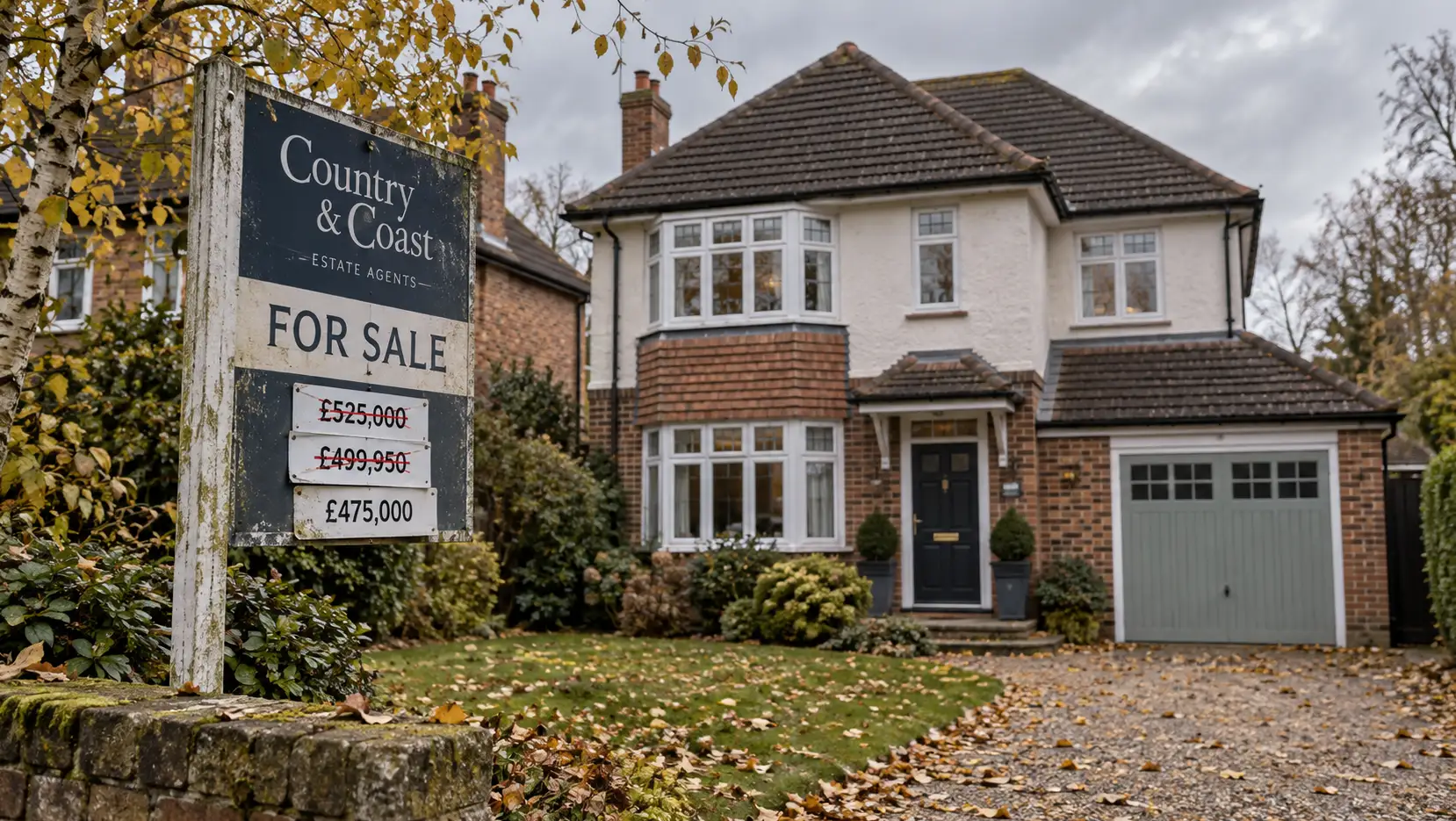
There’s a particular kind of hesitation that sets in when a buyer notices a listing has been up for months. The property itself might be exactly what they’re looking for, but a quiet voice starts asking what everyone else who’s viewed it already knows and decided against.
Sometimes that voice is worth listening to. Sometimes it’s simply market noise, and the property has been sitting unsold for reasons that have nothing to do with anything a buyer should worry about.
Time on market is a clue, not a diagnosis. It narrows down the possible explanations; it doesn’t tell you which one is true. And “a long time” is relative. Three months may be conspicuous for a conventional family house in a fast-moving local market while being much less remarkable for an expensive rural property, an unusual conversion or a type of home for which there are simply fewer buyers. The useful comparison is not with an arbitrary number of weeks, but with similar homes at a similar price in the same local market. Working out what is really happening takes a little investigation, not a hunch.
What the listing history actually shows you — and what it hides
The major property portals can give you useful clues, but they do not necessarily provide the same picture. Zoopla currently includes a Listing History section on its property adverts showing when a home was first listed and whether the asking price has been reduced. That can be genuinely useful. A property currently asking £340,000 that first appeared considerably higher and has since been reduced tells you something concrete about how the seller’s expectations have changed. Zoopla itself recommends checking listing history when assessing a property before making an offer. Zoopla — how to use listing history when considering an offer
Rightmove needs slightly more interpretation. The “Added on” date should not automatically be read as the date the property first entered the market. Rightmove confirms that a previously advertised property can qualify for a new date after a sale falls through, following a sufficiently long break from marketing, or when it is subsequently advertised by a different agent. A house that appears to have arrived on the market recently may therefore have a longer history than the current listing immediately suggests. Rightmove — why a previously marketed property can appear as new
That is why the date on the advert is a starting point rather than proof of how long the seller has actually been trying to move. If something seems odd, ask the agent when the property was first marketed, whether it has previously been with another agent and whether an earlier sale has fallen through.
There is another distinction worth making. Asking-price history shows what a seller has hoped to achieve; it does not necessarily show what the property is worth. Recent completed sales of genuinely comparable nearby homes are usually a better reality check. For properties in England and Wales, HM Land Registry provides a free sold-price search, with equivalent official services available for Scotland and Northern Ireland. HM Land Registry — search sold property prices
Why a property can sit unsold
Price started too high. One of the first explanations worth testing is simply that the seller began with an asking price buyers were not prepared to pay. That is not necessarily a problem with the house. A property that has since been reduced and is now priced more closely to comparable recent sales may simply have gone through the process of finding the level at which buyers are prepared to engage.
What matters is where the price stands now. A large reduction does not automatically make a property a bargain, just as several months on the market do not automatically make it defective. The more useful question is often not simply how long the property has been listed, but how long it has been available at its current price. A house that spent seven months at an unrealistic figure and only two weeks at a much more credible one is in a different position from a house that has been correctly priced for months and still attracted little serious interest.
Weak marketing or poor timing. Some perfectly sound properties sell slowly for reasons that have little to do with the bricks and mortar. The original photographs may have been poor, the description may have undersold the house, it may have launched into a quieter period or the first agent may simply have failed to generate much interest. This is difficult to establish from the advert alone, which is another reason to view the property rather than treating its listing history as a verdict.
Limited demand for this particular type of property. An unusual layout, a very large house in an area dominated by smaller homes, a property needing a buyer with particular tastes or a home at a price point where relatively few local buyers are active can all take longer to sell. That is not the same as saying the property is objectively bad. It may simply have a smaller pool of potential purchasers.
This distinction matters to a buyer too. A feature that makes a house unusual today may make it harder to resell later, even if you personally like it. Slow demand is therefore not necessarily a reason to walk away, but it is something worth understanding.
A previous sale fell through. A property returning to the market after a previous transaction collapsed is not automatically bad news. Buyers withdraw because financing fails, chains break, circumstances change, surveys uncover issues or somebody simply decides not to continue.
Ask directly whether the property has previously been under offer and, if so, why the transaction did not proceed. If the explanation is that the previous buyer “couldn’t get a mortgage”, go one step further: was the problem the buyer’s own finances, or did their lender have a problem with the property? Those are very different explanations. A buyer failing an affordability assessment tells you little about the house; a lender declining to lend because of construction, condition, valuation or another property-specific concern deserves further investigation.
Something was found during a survey or the legal work. This is where a slow sale can become more significant. If an earlier buyer discovered structural movement, non-standard construction, a title complication, a lease problem, an unresolved boundary issue or something else affecting the property itself, that issue does not disappear simply because the previous buyer walked away.
That does not mean you should rely on somebody else’s survey or assume you are entitled to see it. You should commission your own appropriate survey and have your conveyancer investigate the legal position. But an estate agent who is aware of information material to a buyer’s decision cannot simply treat it as irrelevant. Under the current consumer-protection regime, material information needed by a consumer to make an informed transactional decision must not be misleadingly omitted, obscured or provided too late. Government is also developing more detailed property-specific guidance for the sector. GOV.UK — material information in property listings
A direct question is therefore worthwhile: did anything relating to the property’s condition, construction, title, lease, searches or mortgageability contribute to the previous sale falling through? The agent may not possess the previous buyer’s private reports and may not be able to disclose every confidential detail, but that is different from concealing a material problem of which they have become aware.
Buyers in Scotland start from a somewhat different position because a property offered for sale will normally have a Home Report containing a Single Survey and valuation, Property Questionnaire and Energy Report. That gives Scottish buyers useful condition and property information before purchase, although specialist investigation may still be appropriate where the report identifies something requiring further examination. mygov.scot — understanding the Home Report
Seller circumstances rather than the property. Sometimes the honest explanation has nothing to do with marketing, price or condition and everything to do with the seller. Someone may have listed before they were genuinely ready to move, rejected realistic offers because they need a particular figure to fund their next purchase, changed their plans midway through the process or simply decided they will sell only if somebody meets their expectations.
A seller who is not particularly motivated can keep a perfectly good house on the market for a very long time. That is useful information for a buyer, because it affects how likely a transaction is to progress smoothly even if there is nothing wrong with the property itself.
The questions worth asking, and what the answers tell you
Rather than treating time on market as inherently suspicious, it is more useful to ask direct questions and look at how the answers fit together. Has the property previously been under offer, and if so, why did that sale not proceed? When was the house first marketed, including with any previous agent? Has the asking price changed, and over what period? A single reduction after an ambitious launch tells a different story from repeated attempts to find a price buyers will accept.
One particularly useful question is whether the property has had very few viewings, or plenty of viewings but no acceptable offers. Those patterns can point in different directions. Very little viewing interest may suggest that the price, marketing, location or type of property is restricting demand before buyers even walk through the door. Plenty of viewings but no offers can suggest that people like the advert enough to visit but something about the price, condition, layout or property itself is putting them off once they see it. Neither pattern proves anything on its own, but it helps tell you where to look next.
Ask whether the seller has previously rejected offers and whether their expectations are now broadly aligned with the current asking price. The agent may not be free to tell you exactly what another buyer offered, but you are trying to establish something more useful anyway: whether the seller is realistically engaging with the market or is still hoping for a figure that buyers have repeatedly declined to pay.
It is also reasonable to ask why the seller is moving and whether their circumstances have changed since the property was first listed. A seller does not need to disclose their private life to you, but knowing whether they have found somewhere to move to, whether there is an onward chain or whether their plans remain uncertain can help explain why a property has been sitting without anything being wrong with the house itself. Pay attention to the quality and consistency of the answers rather than expecting every question to produce a neat piece of evidence. A clear explanation that still makes sense as the transaction progresses is more reassuring than vague answers that change each time the subject arises.
Where this sits relative to negotiation and offer strategy
Knowing why a property has been slow to sell is different from deciding what to offer for it. The first is diagnostic; the second is strategic, and conflating them leads to weaker decisions on both fronts.
A house that began overpriced and has since been reduced does not automatically mean there is another large discount waiting to be negotiated. The current price may already represent the correction the market demanded. Equally, a perfectly innocent explanation for a long listing does not mean a buyer should ignore the seller’s circumstances or the evidence from comparable sales when deciding what the property is worth to them.
Time on market is therefore one piece of negotiating information, not a negotiating strategy in itself. The property’s condition, recent comparable sales, competing interest, the seller’s position and your own willingness to lose the house all matter too.
The distinction that actually matters
By the time you’ve checked the listing history, looked at comparable sold prices and asked the direct questions, most slow-selling properties begin to fall into one of three broad categories: some started at a price the market would not support and have since moved closer to reality, which may be no more concerning than the fact that the original asking price was unrealistic; others have something more complicated going on — perhaps a survey issue, mortgageability problem, legal complication or seller situation that genuinely deserves further investigation before you commit more money; and some have simply been waiting longer than expected for the right buyer because the property is unusual, demand is limited or the right combination of buyer, price and timing has not yet come together.
Working out which of those situations you’re looking at is worth the modest effort it takes. Months on the market should make you curious, not automatically suspicious. The useful question is not simply why nobody else has bought the house. It is whether the reason they haven’t matters to you.
This article provides general property information, not professional advice for your individual circumstances. Where a previous sale may have fallen through because of the property’s condition, construction, mortgageability or legal position, commission your own appropriate survey and ask your conveyancer to investigate fully before proceeding.

