

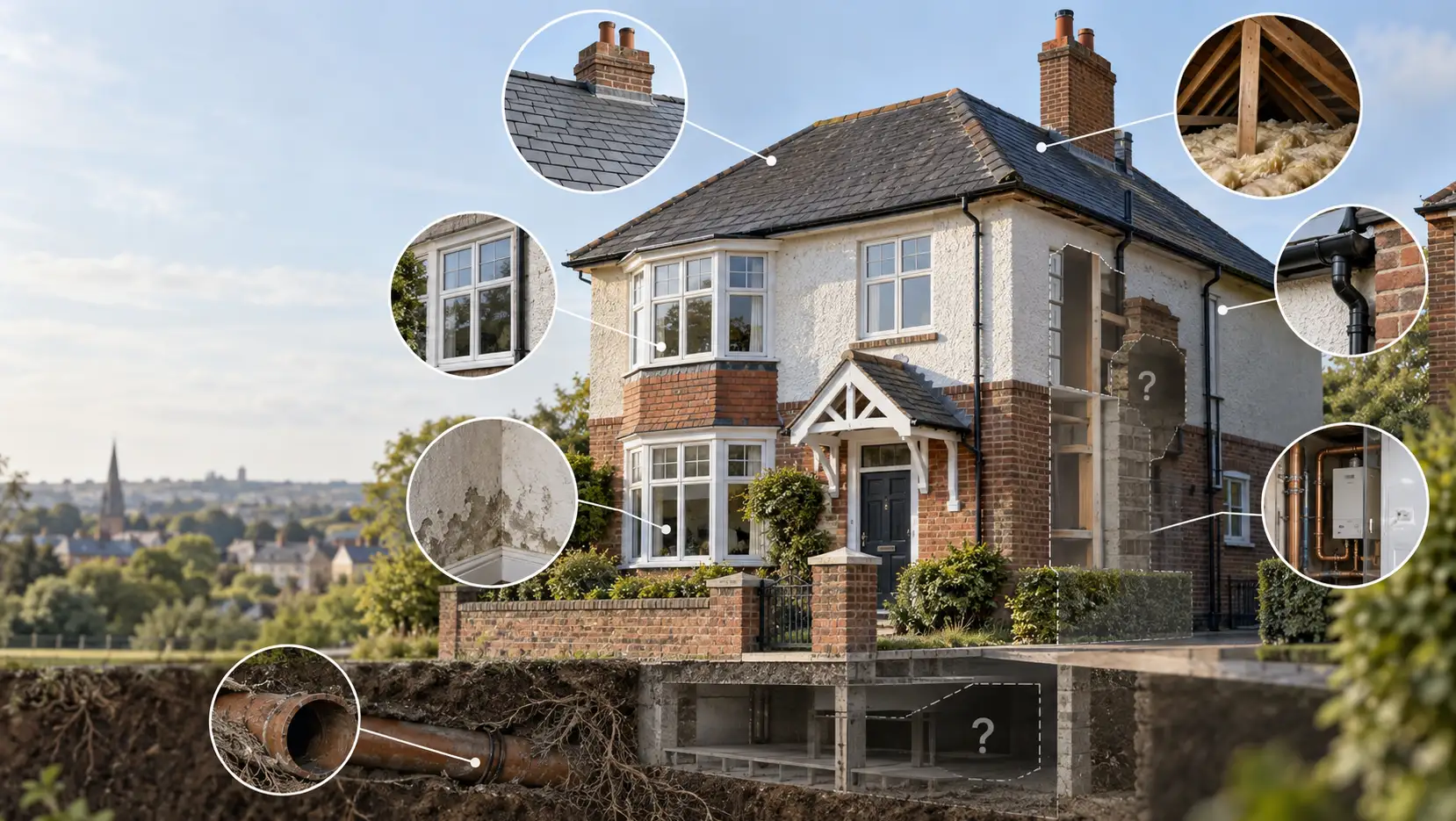
Ask most first-time buyers what a survey does, and the answer tends to be some version of: it checks the house is sound. It’s an understandable assumption, and it’s also one of the biggest misconceptions buyers carry into the process. A survey is a genuinely valuable piece of professional judgement — but it is not a certificate, and knowing the difference matters more than almost anything else you’ll learn about the buying process.
RICS Home Surveys are carried out under the RICS Home Survey Standard. The current first edition came into effect on 1 March 2021 and, as at September 2026, remains the standard RICS members should use. RICS is developing a second edition, but that has not yet replaced it. The current RICS Home Survey Standard page confirms that the first edition remains in force while the replacement is being finalised.
The standard sets benchmarks for different levels of survey and, crucially, for the limits of the inspection. Understanding those limits is the difference between reading your report with realistic expectations and being blindsided later by something the survey never claimed to rule out.
First, not every home survey checks to the same depth
Before getting into what a surveyor can and cannot see, there is an important distinction: a Level 1, Level 2 and Level 3 RICS Home Survey are not simply the same inspection with progressively longer reports.
A Level 1 survey is the least extensive and is generally intended for conventional properties in satisfactory condition. Level 2 involves a more extensive inspection and is the level many buyers of conventional homes in reasonable condition encounter. Level 3 is designed for buyers wanting a detailed assessment and is particularly relevant to older, larger, altered, unusual or neglected properties.
The difference matters on the ground. A Level 2 surveyor may enter an accessible roof space, inspect accessible drainage chambers and examine subfloor areas through existing unfixed access points where it is safe to do so. A Level 3 goes further: RICS expects a more thorough inspection, allows more investigation of normally accessible concealed areas and requires the surveyor to follow the trail of suspected problems to a greater extent.
RICS provides a useful consumer comparison of the three Home Survey levels. The appropriate choice depends not simply on how much reassurance you want, but on the age, construction, condition and complexity of the property. That means the question “does a survey check this?” sometimes has an irritating but necessary answer: which survey did you instruct?
The inspection is non-destructive — but it isn’t passive
The starting point for understanding a survey’s limitations is that an ordinary RICS Home Survey is not an invasive investigation. The surveyor does not start dismantling the house in search of defects. They work within the agreed level of service, what can safely and reasonably be accessed and what can be examined without causing damage.
But describing the inspection as “visual only” can make it sound more superficial than it actually is. A surveyor can use professional judgement and appropriate equipment to investigate what they encounter. RICS identifies equipment such as binoculars, ladders, moisture meters and other inspection tools as part of surveying practice. Floors may be checked for excessive movement. Windows may be opened where access, permission and safety allow. Accessible drainage covers may be lifted at Level 2 and Level 3. A roof that cannot be viewed adequately from the ground or a window may be inspected using appropriate methods or equipment where its height and conditions make that safe and reasonable.
At Level 3, the differences become more noticeable. The surveyor may lift corners of loose, unfitted floor coverings where practicable, move a small number of lightweight possessions where permission has been given and it is safe to do so, and lift small areas of loft insulation to establish its type and thickness. Accessible under-floor areas can also receive a more thorough inspection.
The services are a good example of where the boundary sits. They are not specialist-tested as part of an ordinary Home Survey, but a Level 3 inspection can include observing them in normal operation — for example, operating a sample of lights and extractor fans or asking the occupier to operate the heating where it is safe and permitted. That is very different from an electrician carrying out an Electrical Installation Condition Report or a Gas Safe engineer testing a boiler.
The RICS Level 2 scope of inspection and Level 3 scope show how much those details can differ.
What sits outside the inspection, and why
Even a Level 3 Home Survey remains non-destructive. The surveyor is not there to remove fixed floor coverings, dismantle fitted furniture, open wall cavities, take ceilings down or expose pipework concealed inside the structure simply to find out what is behind it.
A surveyor therefore cannot directly inspect the middle of a closed wall cavity, see pipework buried beneath a floor simply because it might leak one day, or assess a roof void that cannot safely be entered. Heavy furniture and fixed finishes can obscure defects, while underground drains may require a CCTV drainage survey if there is reason to investigate them beyond what can be seen through accessible chambers.
Electrical, gas, heating and plumbing systems are another important limitation. The surveyor can report on their visible condition and, depending on the survey level, observe aspects of their normal operation. They do not undertake the specialist testing needed to certify that an electrical installation is safe, a boiler is operating correctly or the installations comply with current regulations.
Asbestos works in much the same way. A Home Survey is not an asbestos survey and the surveyor does not take samples to confirm whether a material contains asbestos. If something visible appears capable of containing asbestos, however, that possibility can be reported and further specialist investigation recommended. “Not tested for asbestos” therefore does not mean “the surveyor ignores asbestos”.
Technology can extend what some surveyors offer, but buyers should not assume that every survey includes thermal imaging, drone photography, CCTV drainage inspection or other specialist techniques. Those may be additional services or tools used by particular surveyors where appropriate. If one matters to you, ask what is included before instructing the survey rather than discovering the boundary when the report arrives.
“No visible defect” is not the same statement as “no defect”
This is the distinction worth sitting with, because it’s where buyers most often misread their own report.
When a survey comes back without a major problem being identified, it means the surveyor did not find evidence requiring that problem to be reported within the inspection they were instructed and able to carry out. It does not mean every part of the building has somehow been proven defect-free.
A badly deteriorated timber hidden behind an inaccessible finish does not become sound because the surveyor could not see it, nor does a concealed leak cease to exist because the ceiling beneath it happened to be dry on the morning of the inspection. That is why access limitations in a survey report matter. They are not boilerplate to skip on the way to the red condition ratings. If the loft was packed with possessions, a room could not be entered, a floor was completely covered, vegetation obscured an external wall or an inspection chamber could not be opened, the report is telling you that the surveyor’s evidence about that part of the property was restricted.
Level 3 reporting goes further than simply describing visible defects. RICS expects the surveyor to consider identifiable risks of potential or hidden defects in areas that could not be inspected, propose likely causes of defects found and explain likely remedial work and the consequences of leaving problems unresolved. But even that is professional assessment based on available evidence, not destructive proof of what exists behind every finished surface.
When the report arrives, it is therefore worth reading three things together: what the surveyor actually observed, what they could not inspect, and what they recommend happens next. A serious condition rating attached to a clearly identified defect is not the same as a recommendation for investigation because access was restricted, and both are different again from a routine warning that an installation has not been specialist-tested.
Sometimes the most consequential sentence in a report is not “a defect was found” but “the area could not be inspected”. If that limitation relates to an otherwise unremarkable part of the building, it may change very little. If it sits exactly where the surveyor has already found cracking, moisture, decay or another sign of trouble, the uncertainty itself can become a reason to investigate further before you commit.
A survey substantially reduces uncertainty about a property. It cannot eliminate it.
Why a recommendation for further investigation isn’t automatically bad news
Surveyors regularly recommend another inspection or specialist opinion: perhaps from a structural engineer, electrician, drainage contractor, roofing specialist or somebody qualified to investigate a particular material or defect.
Buyers can read those recommendations as though the surveyor has discovered something catastrophic. Often the meaning is more limited: the surveyor has found evidence or uncertainty that cannot responsibly be resolved within the Home Survey they were instructed to provide.
A crack may be consistent with historic movement but have features that justify a structural engineer’s opinion. High moisture readings can indicate an area requiring further investigation without, by themselves, establishing the precise cause. Slow drainage through an accessible chamber may justify a CCTV inspection rather than allowing the surveyor to declare that an underground pipe has failed. The responsible professional response to uncertainty is sometimes to investigate further rather than to guess.
It also helps to distinguish why the recommendation is there. Sometimes it follows something specific the surveyor has observed. Sometimes the problem is that an important area could not be inspected properly. And sometimes the recommendation reflects the boundary of the Home Survey itself — electrical installations, for example, require specialist testing before anyone can give the kind of assurance an electrician can provide.
Those are quite different messages even if the report uses similar phrases such as “further investigation recommended”. If the reason is not clear, ask the surveyor what prompted it before treating every referral as evidence of a newly discovered defect.
What’s typically checked, and where the limits sit
The exact scope depends on the survey level, the property and the terms you agreed with the surveyor, but the distinction looks broadly like this:
| Area | What an RICS Home Survey may check | Where the limit usually sits |
|---|---|---|
| Roof | Coverings and visible roof structure from accessible viewpoints; appropriate access equipment may be used where safe | No assumption that the surveyor will walk over the roof; inaccessible areas remain a limitation |
| Roof space | Extent depends on survey level; Level 2 normally includes entry where safely accessible, with a more detailed Level 3 inspection | Secured access is not forced; the extent to which insulation or possessions are moved differs by level |
| Floors | Visible condition and signs of excessive movement; accessible subfloor areas may be inspected depending on level | Fixed coverings and floorboards are not routinely removed simply to expose the structure |
| Damp and moisture | Visual evidence considered alongside moisture readings and the building as a whole | A meter reading alone does not establish the cause or constitute a specialist damp investigation |
| Electrics, gas and heating | Visible elements inspected; Level 3 can include observation during normal operation where safe | No specialist safety, performance or compliance testing |
| Drainage | Visible components; accessible chambers can be opened and visually inspected at Levels 2 and 3 | Buried drainage runs are not comprehensively inspected without a separate specialist survey |
| Walls and structure | Cracking, distortion, deterioration and other visible evidence considered professionally | Closed cavities and concealed structural elements are not opened up as part of the standard survey |
| Asbestos-type materials | Suspected materials may be identified and further advice recommended | No sampling or asbestos survey is included in an ordinary Home Survey |
You can make the survey more useful before it happens
One of the easiest opportunities buyers miss is telling the surveyor what concerns them before the inspection. If you noticed a crack above the rear extension, a persistent smell of damp in a particular room, a visibly uneven floor or an unusual roof conversion during the viewing, say so.
That does not change a Level 2 into an invasive building investigation, but it gives the surveyor useful context and may also help establish whether you have chosen the right level of service in the first place. It is worth understanding the agreed scope before the inspection rather than discovering its limitations only after the report arrives.
What this genuinely gives you
None of these limitations is a reason to skip a survey — quite the opposite.
A properly conducted survey gives you independent professional judgement about the condition of a property before you commit to buying it. It can identify defects you did not notice at the viewing, distinguish important problems from cosmetic ones, expose areas requiring specialist investigation and help you understand the maintenance burden you may be taking on.
For many buyers, that makes it one of the most useful pieces of independent information obtained during the entire purchase. The mistake is expecting something it was never designed to provide.
A survey is not a guarantee that no defect exists behind an inaccessible wall, beneath a fixed floor or inside an untested electrical installation. Nor is a report with few serious condition ratings a certificate that the house is “sound”.
It is a professional assessment of the property at a particular point in time, carried out to an agreed level and within stated limits. Read those limits as carefully as the defects themselves, and a survey becomes considerably more useful — because you know not only what the surveyor found, but where uncertainty still remains.
This article provides general property information and is not a substitute for the terms, findings and recommendations of your own survey. The scope of an inspection varies according to the level of service, property, accessibility and any additional services agreed with the surveyor. If a report identifies a concern or recommends further investigation, discuss what prompted that recommendation with your surveyor before deciding how to proceed.

