

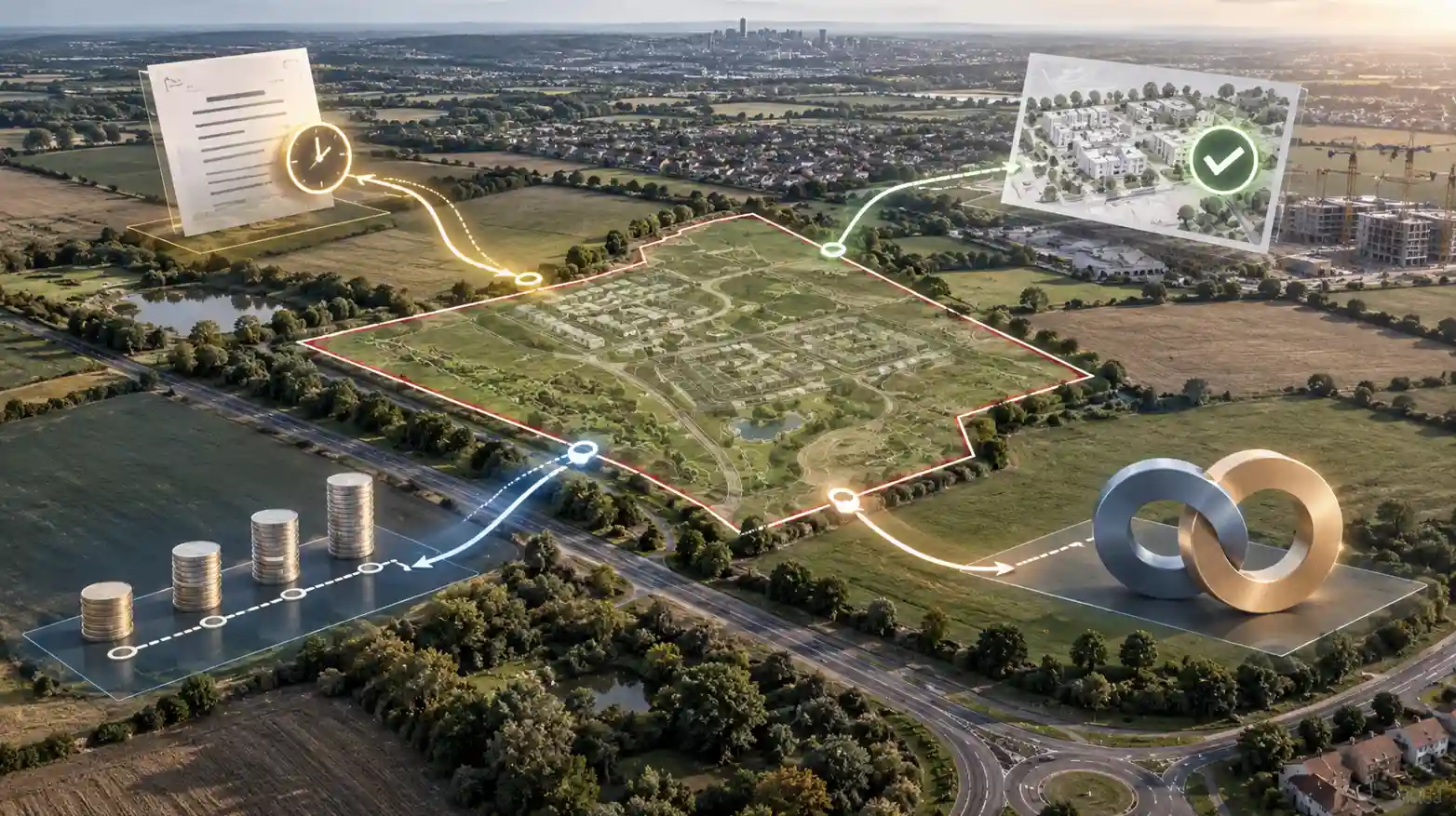
Every pound of equity locked into a site that’s still waiting on planning is a pound not working anywhere else. That’s the entire logic behind land control structures, and it’s worth stating in exactly those terms rather than as a legal preference: why deploy full capital into a site today when the uncertainty that determines its actual value — planning, viability, sometimes even final quantum — may not be resolved for years?
The commercial question isn’t “which agreement structure is correct?” It’s how much capital needs to be exposed, for how long, to control this opportunity while its uncertainty gets resolved?
That distinction matters because ownership and control are not the same thing. A developer can secure a commercially meaningful route to a site without paying the full acquisition price on day one, but the structures used to achieve that shift risk in very different ways. Capital may be deferred, planning risk may be redistributed, control may become conditional and part of the future uplift may be shared with somebody else. The attraction is therefore not simply spending less upfront. It is matching the form of control to the uncertainty that still remains.
Outright acquisition: maximum ownership, maximum immediate exposure
Buying the land outright gives the developer legal ownership and the greatest degree of direct control over what happens next, subject to the title, planning position and any existing third-party rights. That certainty can be genuinely valuable where ownership itself is strategically important, where the developer needs freedom to progress technical work or infrastructure, or where an alternative control structure simply does not fit the transaction.
The price of that certainty is immediate capital exposure. If planning, viability, infrastructure or another major uncertainty then takes two or three years to resolve, the buyer owns the risk throughout that period. Finance and holding costs may continue to accrue, management resource remains committed and the same equity cannot simultaneously be deployed into another opportunity. That does not make outright purchase inefficient: a substantially de-risked site that can move quickly towards development may justify committing the capital, while some strategic acquisitions have value beyond the return from a single scheme. It becomes a harder proposition where the largest unresolved component of value is something that will only be known later, because the buyer is effectively paying for full ownership before the uncertainty that determines the economics has been removed.
Option agreements: paying for the right to decide later
An option agreement can give the developer the right, but not the obligation, to acquire the land during a specified period or following an agreed event. The distinction matters because the developer obtains control over a future acquisition without assuming the same commitment as an outright purchase or a contract that automatically requires completion once agreed conditions are satisfied. The current RICS professional standard on land agreements for development purposes deals specifically with options, conditional contracts, promotion agreements, overage and related development-land structures.
The strategic value is straightforward. Rather than paying the full land price while the planning position remains uncertain, the developer can secure a contractual route to acquisition while spending the intervening period investigating or creating the value on which the eventual purchase depends. But the economics depend heavily on the drafting. The option period has to bear some relationship to the realistic planning programme rather than the timetable everyone hopes for when the document is signed; extension provisions matter if an application, appeal or local-plan process takes longer than expected; and the eventual purchase price may be fixed, formula-based or established through a valuation mechanism at exercise, each producing a different exposure to future land-value movement.
Planning obligations within the agreement can be equally important. The developer may be required to pursue an application, incur agreed expenditure or use specified endeavours to obtain an acceptable consent even though the ultimate decision to exercise remains theirs. Definitions of the planning outcome sought, deductions from the eventual land price and treatment of planning expenditure can therefore affect the economics almost as much as the option price itself. What distinguishes the structure commercially is that, subject to the agreement’s terms, the developer retains the decision whether to exercise; once the arrangement instead obliges acquisition automatically when specified conditions are satisfied, the exposure has moved towards a conditional contract.
Conditional contracts: controlling the trigger rather than retaining the final choice
A conditional contract answers a different question. Rather than giving the purchaser a unilateral right to decide later whether to buy, it normally commits the parties to complete once defined conditions have been satisfied. That makes the quality of the condition itself central to the deal.
If completion depends on obtaining “satisfactory planning permission“, for example, the useful question is not whether permission exists but what the agreement says counts as satisfactory. A consent for fewer units, less floorspace or a different mix of uses may technically amount to permission while producing economics materially below the original appraisal. Infrastructure contributions, affordable housing requirements, access obligations, conditions or other burdens can alter the same calculation. Longstop dates determine how long the parties remain tied together, while appeal provisions can dictate whether a refusal ends the transaction or merely moves it into another stage of the planning process.
The possibility that conditions are satisfied while the wider economics have deteriorated also needs to be understood before signing. Sales values, rents, construction costs or funding conditions can move materially during a long planning period, so a purchaser entering a conditional contract needs to know whether the contractual trigger still obliges completion in circumstances that look very different from those originally modelled. That does not make the structure inferior to an option: a landowner may reasonably want greater certainty that the buyer will complete after the site has effectively been taken off the market, and a developer may accept that commitment in exchange for price or control. The commercial distinction is that an option principally preserves discretion, while a conditional contract gives greater transactional certainty once its agreed trigger has been achieved.
Deferred consideration: changing when the capital leaves the business
Sometimes the principal uncertainty is not whether the developer wants to own the land but how much capital should leave the business at completion. Deferred or staged consideration can separate legal acquisition from the timing of the full land payment, with part of the price paid initially and further sums becoming due at agreed dates or development milestones. Overage can achieve something different but related, allowing the landowner to participate in additional value if a defined future event occurs or the development produces an outcome beyond that reflected in the original consideration.
For the developer, those mechanisms can reduce the immediate equity burden and align part of the land cost more closely with when value is actually created. For the seller, however, payment later introduces counterparty exposure: they are no longer simply exchanging land for cash at completion but relying on the purchaser’s future obligation and ability to pay. The negotiation therefore extends well beyond the amount being deferred. Payment triggers, calculation mechanisms, information rights, security, restrictions on disposal or financing and the treatment of changes to the development can all alter the real value of the arrangement. Deferred consideration does not make the land cheaper; it changes the timing, conditionality and distribution of the financial risk.
Joint ventures: sharing the opportunity means sharing the decisions
A landowner-developer joint venture can go further by changing who participates in the development economics altogether. In one common form, the landowner contributes or makes available the land while the developer contributes development expertise, management, capital or access to funding, with both participating in the eventual outcome rather than settling their relationship through a single fixed land payment.
That can reduce the developer’s upfront requirement to acquire the site and give the landowner exposure to development upside that would otherwise pass to the purchaser on sale. It can create genuine alignment where both parties benefit from increasing the value of the same scheme, but alignment at the headline level does not remove the possibility of conflict underneath it. Scheme design, planning strategy, funding, phasing, procurement, refinancing and disposal may all require decisions after the venture has begun, making governance critical: the parties need to know who controls those decisions, which matters require joint approval, what happens when additional capital is needed and how either side can eventually exit.
The valuation attributed to the land contribution affects how the economics are divided, as do development-management fees, finance, cost overruns and the return on further capital. A venture can therefore be commercially attractive and still be badly structured if the parties have not dealt with how value and control will be allocated when the scheme stops following the original business plan. The benefit of the JV is not that it is intrinsically more sophisticated than an option or purchase; it arises where sharing land, capital, risk and upside produces a better commercial outcome than separating them.
Promotion agreements: similar land control, a different endgame
Promotion agreements sit alongside these structures but generally create a different endgame. A promoter typically undertakes to pursue the planning process and, if successful, facilitate the subsequent sale of the land, receiving remuneration from the resulting proceeds rather than necessarily becoming the eventual developer. That changes the alignment compared with an option: an option holder intending to purchase may have an interest in limiting the eventual acquisition price, whereas a promoter whose remuneration is linked to net sale proceeds may have a stronger incentive to maximise the value achieved when the site is marketed, although the precise incentives always depend on the agreement.
The landowner continues to own the asset while the promoter will commonly commit professional expenditure, expertise and management resource to the planning process, so the risk is not transferred wholesale from one party to the other. Each carries different elements of it. For a developer subsequently bidding on promoted land, the existing agreement may also matter because the promoter’s remuneration, reimbursable expenditure, marketing obligations and commitments to the landowner can influence both the sale process and the flexibility available to the eventual purchaser.
The question every structure decision should actually answer
Strip away the legal labels and the comparison comes back to capital, control, risk and participation in the upside. The useful questions are how much money has to be committed before the major uncertainties are resolved, how long it is likely to remain exposed, who pays for the planning and technical work during that period, which party can decide whether the scheme still proceeds if the outcome changes materially, and how value and loss are divided when reality differs from the original appraisal.
Those questions have to be considered together. An option may require relatively little acquisition capital but still leave the developer funding several years of planning work. A deferred purchase can preserve liquidity at completion while creating substantial payment obligations later, potentially just as construction expenditure accelerates. A joint venture may reduce the initial land cheque but surrender part of the upside and introduce governance constraints that an outright owner would never face. Opportunity cost belongs in the same calculation because capital committed to one strategic land position cannot support another scheme at the same time, while the cheapest structure is not necessarily the best if it provides insufficient control over an unusually valuable opportunity.
Nor do these structures have to exist in isolation. Larger or more complicated transactions can combine them: different parcels or phases may sit under different forms of control, while deferred consideration, overage or other mechanisms can operate alongside the principal acquisition agreement. RICS expressly recognises hybrid development-land arrangements of this kind. The better commercial starting point is therefore not to choose a preferred legal label and force the site into it, but to determine how capital, control, planning exposure and future value should be allocated and then structure the transaction accordingly.
The objective is not control-before-ownership as a universal doctrine. It is securing enough control over the opportunity to justify the capital and risk being committed at that particular stage of the development process.
The contractual-control regime changes what becomes visible
There is now another consideration for developers and promoters using some of these structures in England and Wales. The Provision of Information (Contractual Control) (Registered Land) Regulations 2026 — S.I. 2026/615 — were made on 8 June 2026 and come into force on 6 April 2027. They introduce information requirements for qualifying contractual control rights over registered land, including certain options, rights arising under conditional contracts, pre-emption rights and rights associated with promotion agreements.
Not every agreement carrying one of those labels is automatically caught. The government’s current contractual-control guidance sets out scope requirements and exemptions, with the regime applying to registered land in England and Wales and to relevant rights held for the purposes of an undertaking. It also confirms that the grantee of the contractual control right is generally responsible for ensuring the required information is provided, with submissions made digitally through a regulated conveyancer.
The transition dates matter for deals being agreed now. HM Land Registry’s implementation guidance says qualifying rights granted from 8 June 2026 to 5 April 2027 must be reported by 6 October 2027 once the service is available. From 6 April 2027, information about new qualifying rights generally has to be submitted within 60 calendar days, with qualifying variations, assignments and endings also capable of creating reporting requirements. The digital submission service is due to operate from 6 April 2027.
That is not the same as the information becoming publicly searchable immediately. Current government guidance says HM Land Registry expects to begin publishing contractual-control information in a structured open database from April 2028 onwards, with the stated purpose of making land-control arrangements more transparent. For developers and promoters, that means qualifying structures will become progressively less private as a matter of market intelligence, while the same regime should eventually make it easier to see where registered land is already subject to somebody else’s contractual control before significant time is spent pursuing it.
The regulatory change does not alter the underlying case for an option, conditional contract or promotion agreement. It adds another characteristic to be priced and understood alongside capital efficiency, control and planning risk: visibility.
This article provides general development-land, commercial and legal-context information, not legal, tax, financial, valuation or investment advice for individual circumstances. Options, conditional contracts, deferred consideration, promotion agreements, joint ventures and hybrid structures can produce materially different legal, tax, funding and commercial consequences depending on their drafting and the jurisdiction involved. Appropriate professional advice should be obtained before entering into a land-control or acquisition arrangement.

