

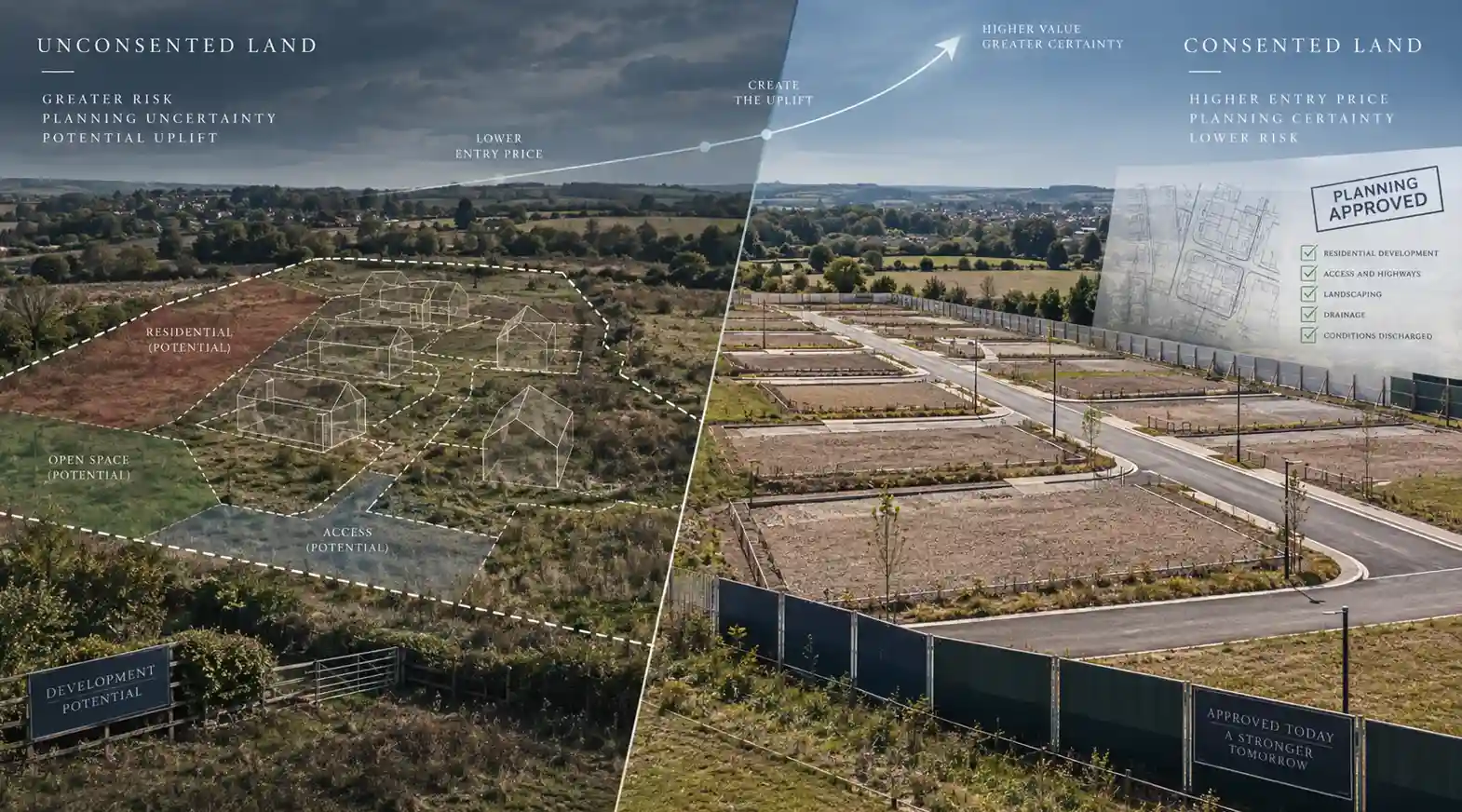
Two developers can look at the same parcel of land and reach opposite, equally rational conclusions. One walks away because the unconsented price doesn’t compensate for the planning risk. The other pursues it, confident that planning risk is precisely the risk they’re best equipped to underwrite.
Neither is necessarily wrong. They’re running different businesses, earning their return in different places, and the question that actually matters isn’t “is this site cheap?” — it’s “am I being paid enough for the specific risk I’m being asked to take on, and is that risk one my business is actually good at pricing?”
The de-risked end: what you’re really buying
A site with a detailed planning permission — or one where the substantive planning parameters have otherwise been established — materially reduces planning risk. It does not remove it. The land price will usually reflect at least part of the value created by that greater certainty: the seller, land promoter or previous owner that secured the permission has undertaken work, spent money and carried risk to move the site further along the development process, and the market can price that progress accordingly.
What the incoming developer can gain is a clearer development proposition, a potentially faster route towards construction and a scheme against which costs, revenues and funding can be underwritten with greater certainty. What the buyer does not receive merely because permission exists is immunity from viability drift, technical surprises, infrastructure constraints, planning obligations, conditions requiring further approval, changes needed to the consented scheme or the consequences of delay.
Planning conditions can remain commercially significant after permission is granted. In England, for example, government guidance on the use of planning conditions makes clear that pre-commencement conditions can prevent development from lawfully starting until specified requirements have been satisfied, while other conditions can affect phasing, occupation or operation. The permission itself also has a life, so a buyer needs to understand what has actually been consented, what remains to be approved or discharged, what obligations sit alongside the permission and how much time remains to implement it.
A consented site is therefore better described as more defined on planning risk, not risk-free.
Outline permission: less risk than nothing, more risk than it looks
Outline planning permission can narrow the range of planning outcomes considerably because the principle of development has been accepted, but important detail may remain unresolved.
In England, reserved matters can include access, appearance, landscaping, layout and scale depending on what was determined at outline stage. GOV.UK planning guidance distinguishes outline applications from the subsequent approval of reserved matters. Wales operates a comparable outline-and-reserved-matters route, with Welsh Government guidance covering approval of matters left unresolved at outline stage. Scotland uses planning permission in principle, followed where required by approval of matters specified in conditions, with the different terminology and process set out in Scottish Government development-management guidance.
For an acquisition appraisal, the commercial point is the same: an in-principle planning position is not equivalent to having every material aspect of the development fixed. Detailed design can alter net saleable or lettable area, while conditions and infrastructure requirements can affect programme and cost. Reserved details may produce a scheme that is technically acceptable but less valuable or more expensive than the bidder originally modelled.
An outline or equivalent in-principle permission therefore removes part of the planning uncertainty while leaving another part to be priced. Treating it as economically equivalent to an implementable detailed permission can give the residual more certainty than the consent itself actually provides.
Allocation is a probability shift, not a permission
Land identified for development through the plan-making process is in a stronger planning position than land with no policy support at all, but allocation is not planning permission. In England, government guidance on Permission in Principle is explicit that a site allocation in an existing local or neighbourhood plan does not itself confer Permission in Principle.
Commercially, an adopted allocation can improve the planning case by establishing policy support for the principle or broad form of development, subject to the allocation wording and the rest of the development plan. There can nevertheless be substantial work between allocation and an implementable permission: technical evidence, infrastructure, access, environmental mitigation, design, affordable housing or other policy requirements may all affect what ultimately comes forward.
An emerging allocation deserves even more care. Its value depends partly on how advanced the plan is, whether objections remain and whether the allocation survives examination and adoption in materially the same form. That distinction matters because the land market can anticipate planning progress long before permission exists. Landowner expectations can rise as soon as allocation becomes plausible, sometimes leaving the buyer paying for a substantial part of the anticipated uplift while still carrying much of the risk required to realise it.
Allocation is valuable information, but it is not the same thing as consent.
Unconsented land: where the return is genuinely different, not simply bigger
The attraction of unconsented land is real: a lower entry basis may leave room for substantial planning uplift, and the party taking the planning risk can potentially shape the scheme rather than inherit somebody else’s design and development quantum. The downside is just as real. Refusal, appeal, policy change, consultant costs, environmental and infrastructure work, technical investigations and years of programme uncertainty can all sit between control of the land and an implementable development.
Even the phrase “buying unconsented land”, however, can oversimplify how experienced participants actually take that risk. A developer or land promoter does not necessarily acquire the freehold outright on day one. Conditional contracts, options, promotion agreements and other structures can change how much capital is committed upfront, who funds the planning process, how the eventual uplift is shared and what happens if consent cannot be secured. Those structures do not make planning risk disappear — professional costs, management resource and opportunity cost remain real, while the transaction itself can create contractual risks — but they materially change how the exposure is carried.
That distinction matters when comparing an apparently expensive consented acquisition with a supposedly cheap unconsented one. The correct comparison is not simply purchase price against purchase price. It is the capital at risk, time to potential realisation, planning probability, cost of getting there and share of the successful uplift that the chosen transaction actually leaves with the developer.
Unconsented land is not the same development opportunity with a cheaper ticket price. It is a different risk position.
Two different businesses, wearing the same industry label
Being good at constructing and selling homes, warehouses, offices or other development efficiently is not the same capability as being good at taking speculative planning risk. Some developers are strongest once the planning proposition is relatively clear; their advantage may lie in construction procurement, delivery speed, sales, leasing, finance or operational efficiency. For them, paying more for a substantially de-risked site is not necessarily overpaying. It can be a rational decision to acquire the type of risk the business is equipped to manage.
At the other end are strategic-land specialists, promoters and developers whose expertise lies precisely in identifying land where the market may be mispricing planning probability, assembling the right professional team and managing the site through an uncertain planning process. Those businesses can look at exactly the same unconsented site and rationally attach different values to it because the difference is not simply appetite for danger; it can be comparative advantage.
A business with deep planning capability, patient capital and a diversified strategic-land portfolio may therefore be able to accept a planning risk that would be unattractive to a highly leveraged developer whose business depends on rapidly turning capital through consented sites. Conversely, planning expertise does not turn a poor planning prospect into a good one. The risk still has to be priced correctly.
The question isn’t “is unconsented land cheaper?” — it’s whether you’re paid enough for the risk
Framing the choice as “unconsented land is cheaper, consented land is safer” misses the analysis that matters. Planning risk is not simply the probability of obtaining a consent; it also includes the risk around what quantum and mix is ultimately permitted, what conditions and obligations attach to it, what infrastructure or mitigation is required and how long it takes to reach an implementable position.
The additional potential return from taking that risk has to compensate for the probability that the desired outcome is not achieved, the professional and technical expenditure required to pursue it, the time before value can be realised and the alternative uses of the capital and management resource involved. That means looking beyond the difference between today’s land price and the theoretical value of the site with permission.
Suppose an unconsented site is available at a large nominal discount to its consented equivalent. If achieving that consent is uncertain, takes several years and requires substantial expenditure before there is any realisable uplift, the headline discount may still represent poor compensation for the risk. Equally, a site does not become unattractive simply because planning is uncertain. If the acquisition or control price leaves sufficient room for failure, delay and cost — and the planning case is one the buyer has genuine expertise in assessing — taking that uncertainty can be exactly where the development return is created.
The useful number is therefore not the nominal discount to consented value but the risk-adjusted return from taking the site from its current planning position to the next one.
Time value: the variable that separates good deals from good-looking ones
A 30% nominal uplift achieved after five years of planning work is not economically equivalent to a 30% uplift realised quickly. Time changes the return even when the eventual planning outcome is exactly what the original appraisal hoped for.
A realistic appraisal needs to recognise the planning programme for that particular site and authority, professional and holding costs throughout the period, finance where relevant and the internal resource required to manage the process. It must also recognise the capital or balance-sheet capacity that remains tied to the opportunity rather than being deployed elsewhere. For that reason, a simple percentage uplift between today’s land value and an assumed future consented value is an incomplete measure. The business needs a return measure that reflects when cash is spent and when value is expected to be realised, whether through IRR, NPV or another time-sensitive investment metric appropriate to the organisation.
A superficially impressive planning uplift can therefore look far less compelling once the period required to create it is properly recognised, while a smaller nominal uplift that can be realised with considerably greater certainty and in a much shorter period may produce the stronger use of capital. Time is not an administrative inconvenience sitting beside planning risk; it is part of the risk itself.
The decision runs through the developer’s own balance sheet, not just the site
The right planning-risk position depends as much on the developer as it does on the land. A business with patient equity, a diversified pipeline and limited pressure to recycle capital can carry an uncertain land position very differently from a highly geared developer whose funding model depends on moving into construction and sales quickly.
Pipeline matters too. A business already carrying several long-dated planning positions may rationally favour a more expensive consented site to rebalance delivery risk, while another with a thin strategic-land pipeline may deliberately seek opportunities further back in the planning process. Funding partners can alter the answer again: some lenders or equity investors may be comfortable once detailed permission exists but unwilling to fund speculative planning expenditure, while others may specifically target planning-led value creation.
Capability adds a further layer because planning risk is not generic. Taking a greenfield allocation through a residential application, promoting strategic land through a local-plan process and securing consent for an employment or mixed-use scheme can involve different policy, technical and political challenges. Two developers can therefore produce similar site appraisals and still reach opposite acquisition decisions because the same planning exposure sits differently against their balance sheets, funding, pipeline and expertise.
The site’s risk does not exist in isolation from the business carrying it.
This isn’t only about housing
Residential development provides many of the obvious examples, but the same risk ladder applies across development land. An industrial developer may choose between buying a consented logistics site and trying to create employment-land value through the planning process. A commercial owner-occupier may decide whether to acquire a plot already capable of accommodating its proposed premises or pursue a cheaper site whose development position is less certain. Mixed-use schemes can add further complexity because value creation may depend not merely on obtaining permission but on securing the right balance and quantum of uses.
The underlying commercial question is the same: how much of the future value has already been reflected in today’s land price, what still has to happen before that value can be realised, and who is carrying the risk that it does not happen? RICS guidance on the valuation of development property recognises this kind of optionality, with development land capable of containing value attributable to the prospect of a more valuable future use even where that use is not currently permitted.
For a business ultimately intending to occupy the completed premises, the calculation may also include strategic operational value that would not appear in the appraisal of a speculative developer. That does not make the planning risk free; it simply changes what a successful outcome is worth to that particular buyer.
Where this leaves the decision
Consented and unconsented land should not be ranked as simply safer-but-worse and riskier-but-better, nor is planning status a neat four-step ladder in which every movement towards consent automatically creates the same proportionate increase in value.
Detailed permission, outline or equivalent in-principle permission, allocation and unconsented land represent different combinations of certainty, remaining work, cost, time and optionality. Even two sites carrying apparently identical permissions can have very different risk profiles once conditions, obligations, infrastructure and technical constraints are examined. The right acquisition is therefore the one where the price paid genuinely compensates the buyer for the risks that remain, and where those risks are ones the business is properly equipped and capitalised to manage.
For one developer, the planning uplift may be the opportunity; for another, paying somebody else to have already created it may be the better business. The important thing is knowing which business you are actually in before you price the land.
This article provides general development-land and strategic information, not planning, valuation, legal, tax, financial or investment advice for individual circumstances. Planning terminology, procedures and policy differ across England, Wales, Scotland and Northern Ireland, while planning prospects, land values, transaction structures and risk vary materially by site. Appropriate planning, legal, valuation and other professional advice should be obtained before acquiring or taking control of development land.

