

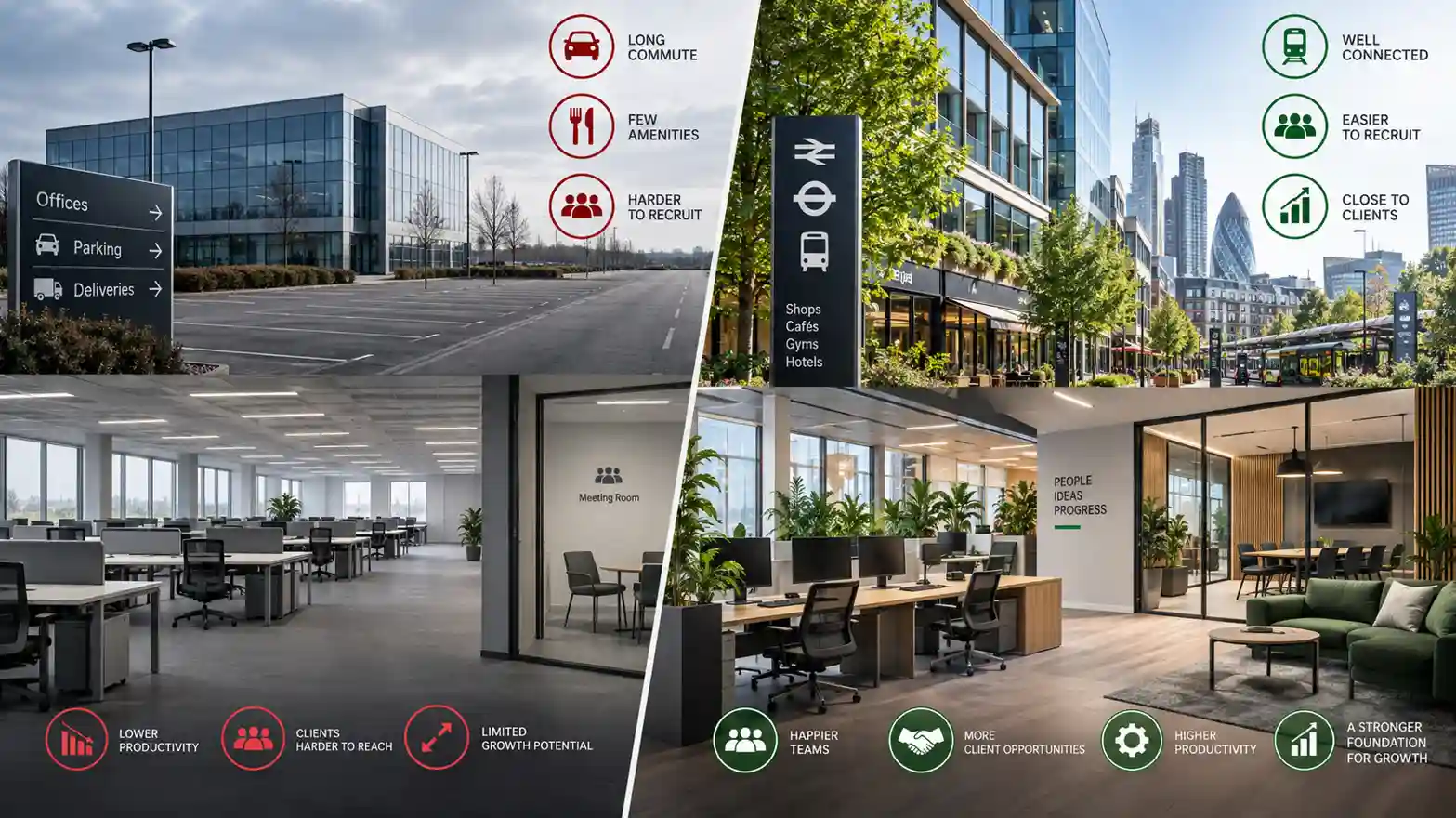
Picture a well-specified, competitively priced floor in a business park just outside a mid-sized city — good parking, modern building, a fifteen-minute drive from the ring road.
For a regional sales team that spends most of its week visiting customers and treats the office as a base for paperwork and occasional meetings, that building could be close to ideal.
For a software business trying to recruit graduate engineers who do not all drive, competing for people across a wider labour market and expecting the office itself to help bring teams together, the same building at the same rent could quietly become one of the more expensive decisions the company makes.
Not because the lease is bad.
Because the office is wrong for what the business actually needs from it.
That is the distinction this article is built around. A property can be legally sound, well managed and competitively priced and still be the wrong commercial choice. The right office is not only a property question. It is a question about how a specific business recruits people, serves clients, organises work, deploys capital and expects to grow.
Location changes the labour market a business can realistically reach
The simplistic version of office-location strategy says city centre for one type of workforce, business park for another.
The more useful commercial question is:
Who can realistically reach this location, by the means they actually use, within a journey they are prepared to make?
For the regional sales team, motorway access and plentiful parking may improve the working day. Employees are already travelling by car to customers, equipment may move in and out of vehicles, and the office functions as an operational base rather than the centre of everybody’s week.
For a business drawing heavily from graduates, technical specialists or a geographically dispersed urban workforce, the catchment may look very different. A building that appears inexpensive on a rent-per-square-foot basis can become less attractive if reaching it materially narrows the pool of people who would realistically commute there several times a week.
That is why location analysis is better done through travel-time catchments than postcodes alone.
Current employees matter, but so do the people the company expects to recruit during the life of the property commitment. Public transport frequency, road access, parking, cycling, walking and the surrounding amenity offer all alter the effective labour market.
JLL’s UK office-market analysis describes occupier demand increasingly concentrating on high-quality, amenity-rich and accessible locations — including CBDs, transit-connected city-fringe locations and stronger business parks close to talent pools. JLL — The shifting landscape of UK offices
That is an important distinction. A business park is not intrinsically poor for recruitment, just as a city-centre address is not automatically good.
A park next to a railway station, motorway junction and established residential catchment can outperform a nominally central office that is awkward for the actual workforce to reach.
For an occupier making a long commitment, this is worth modelling rather than assuming. Mapping journey times for current staff is useful; mapping them for the roles the company expects to recruit next can be even more revealing.
The client-facing firm and the business whose clients rarely cross the threshold
A professional-services firm where clients regularly visit may derive real commercial value from accessibility, reception, meeting-room quality and the wider experience of arriving at the building.
For this business, spending more on location and presentation is not necessarily vanity. The property is participating in the client experience.
But that does not automatically mean buying the most expensive address available.
A client may care considerably more about a straightforward journey, somewhere sensible to park, a good meeting room and a professional arrival than whether the office occupies a fashionable postcode.
The useful question is what role the office actually plays in winning, retaining or serving clients.
A software company whose customers are overwhelmingly remote has a different calculation. If almost every client interaction takes place through video calls and shared systems, an expensive reception and prestigious address may be doing relatively little work.
That business may get much more value from excellent connectivity, acoustic privacy, reliable meeting technology and enough rooms for simultaneous calls.
The test is therefore not:
“Would this office impress a client?”
It is:
“How often do our clients actually encounter the office, and what does the property need to accomplish when they do?”
Those are very different questions.
An agent or occupier adviser comparing two buildings should therefore be careful about assigning automatic value to prestige. For one occupier it may support revenue and positioning. For another it may simply be a more expensive backdrop.
Productivity problems are usually specific, not vague
It is easy to say that a better office improves productivity.
That becomes much more useful when the claim is broken into the actual sources of friction.
A video-heavy business loses time when connectivity is unreliable or there are too few spaces for calls. A team doing concentrated analytical work struggles if every task has to be performed in a noisy open-plan environment. A client-facing operation loses meeting capacity when rooms are permanently occupied by internal video calls. A business that frequently works late can discover that air conditioning, reception or building access operates around somebody else’s working day rather than its own.
Temperature, ventilation, lighting and available workspace are not simply matters of preference either. HSE guidance requires employers to provide a healthy working environment with appropriate ventilation, reasonable temperature, suitable lighting and adequate space and seating. HSE — Workplace facilities employers must provide
The commercial point goes beyond compliance.
A building can satisfy minimum requirements and still be badly matched to the work being carried out inside it.
A customer-service operation handling calls throughout the day has different acoustic needs from a software team doing concentrated individual work and regular video collaboration, which differs again from a sales team that spends much of the day away from the office.
Specifying the same generic workplace for all three is how a technically adequate building starts quietly working against one of them.
The office should therefore be assessed against tasks and workflows, not merely headcount.
That distinction matters particularly in multi-let buildings and fitted offices where the specification already exists. An attractive floor can tempt an occupier to adapt its working pattern to the space rather than asking whether the space supports the working pattern in the first place.
A good office doesn’t fix a bad hybrid policy
Property and workplace policy are separate levers.
A beautifully specified office will not solve an uncoordinated hybrid schedule, a location most employees dislike travelling to or a management team that has never established why people should be together.
Conversely, a relatively modest office can perform extremely well where teams coordinate attendance intelligently and the space supports what they actually come in to do.
This matters because utilisation problems are sometimes blamed on the property when the underlying problem is the attendance model.
If everybody independently chooses Tuesday, the office can look under-sized for one day and over-sized for four.
If teams expected to collaborate never attend together, an expensive collaboration floor can sit largely unused even while management concludes that the workplace itself is failing.
Our article How Much Office Space Does Your Business Actually Need? Right-Sizing for Hybrid Working deals with that capacity question in more detail.
The broader lesson is that property spend cannot compensate indefinitely for poor workplace strategy.
An occupier should know what the office is expected to achieve before deciding how much of it to buy.
Growth can turn a cheap office into an expensive constraint
A cheap office can become expensive surprisingly quickly if the business outgrows the things that made it cheap.
Floor area is only the most obvious constraint.
A growing occupier should understand whether additional accommodation might become available in the same building or estate; whether power, cooling, telecoms and other infrastructure can support the planned operation; whether access and servicing arrangements remain workable as the business expands; and whether the property can physically accommodate the way the company expects to change.
There is also option value in having somewhere to grow without moving.
A landlord with adjacent space, a building containing several suitable floor sizes, an agreed ability to expand, or an occupation structure that makes moving within a portfolio relatively straightforward can be worth considerably more than a slightly lower starting rent in an inflexible building.
The relevant comparison is not just today’s occupational cost.
It is also the cost and disruption of the second move the business may otherwise have to make.
Planning and lease restrictions deserve separate attention.
In England, ordinary office use falls within the broad Class E commercial, business and service category. Movement between primary uses within the same use class is not normally development requiring planning permission, although physical works, planning conditions and other consents may still matter. GOV.UK — When planning permission is required and Class E uses
That does not mean the lease automatically permits everything planning law would allow.
A commercial lease can define the permitted use more narrowly. The RICS Code for leasing business premises treats permitted use, alterations and other operational terms as matters that should be addressed during heads-of-terms negotiations rather than discovered after the tenant has committed. RICS — Code for leasing business premises
For a growing occupier, that distinction can become important.
A building may be physically capable of accommodating the company’s next phase while the lease signed several years earlier restricts the activity, alterations or configuration needed to make that phase work.
Growth therefore needs to be considered in terms of space, infrastructure and contractual freedom, not simply spare desks.
Brand matters when the property is actually carrying part of the brand
A consumer-facing company, creative business or professional firm competing partly through reputation may derive genuine value from the right premises.
But the operative word is right, not expensive.
The office can reinforce positioning through location, architecture, client experience, fit-out and the environment around it. Equally, conspicuous property spend that contributes little to how customers choose or experience the business can simply become expensive theatre.
A B2B software business selling through product performance and remote account teams may obtain little commercial return from a trophy reception that clients almost never see.
A wealth-management or advisory firm bringing prospective clients into confidential face-to-face meetings may reach a very different conclusion.
There is an internal dimension too.
The workplace says something to employees and prospective recruits about how the organisation operates and what it values. That message does not require marble reception desks. It might instead come from a location people can reach easily, technology that works, usable collaboration space, good environmental conditions or an office that simply feels as though it has been designed around the work rather than around a property brochure.
Brand value in property is therefore real but occupier-specific.
It should be treated as an expected commercial benefit, not as an automatic justification for spending more.
Continuity risk sits beyond the office door
An occupier can control what happens inside its own business and still depend on systems and counterparties outside it.
That is particularly obvious in serviced, coworking and managed space, where access systems, connectivity, reception, security, room-booking systems and sometimes the whole operational layer sit with a third-party provider.
But conventional offices have external dependencies too.
Landlord-operated plant, shared building systems, lifts, power, telecoms, security and access can all determine whether the occupier can function.
The useful question is therefore not merely whether those services exist.
It is:
What happens when one of them fails?
For a business where interruption carries material cost, that may justify examining telecoms resilience, backup arrangements, access during outages, incident escalation and the division of responsibility between landlord, operator and occupier.
Shared environments introduce additional questions around security and control. The National Protective Security Authority’s guidance for users of shared workspaces recommends assessing the security appropriate to the organisation’s activities and asking providers about access, visitors, information, devices and shared responsibilities. NPSA — Shared Workspaces: Users Guidance
For flexible-space occupiers there is also a counterparty issue.
A managed or serviced office works partly because the operator continues to provide the service layer the occupier is paying for. The quality of the building and the quality of the operating business are therefore not completely separate considerations.
This does not make flexible space inherently riskier than a lease. It means the risk sits somewhere different.
The question worth returning to
The most expensive, newest or best-reviewed office on the market is not automatically the right office for a particular business.
Neither is the cheapest.
An office is a bundle of capabilities and constraints: access to labour, access to clients, working conditions, capacity, technology, flexibility, resilience and cost.
The value of each changes with the business occupying it.
That is why the same business park can be an excellent choice for the regional sales team and a poor one for the software company trying to recruit from a transport-dependent urban talent pool.
The building has not changed.
The commercial requirement has.
The question worth asking of any office under consideration is therefore not:
“Is this a good property?”
It is:
“What does our business need this property to do — and where would this building make that easier or harder?”
Once that question is answered properly, rent, specification and location become much easier to judge.
Without it, a business can negotiate a perfectly good property deal and still end up with the wrong office.
This article provides general commercial property and workplace information and is not legal, planning, recruitment, workplace, financial or other professional advice for individual circumstances. Location, planning position, lease terms, infrastructure requirements, workforce needs and operational risks vary materially between businesses and properties. Businesses making a significant property commitment should assess premises against their own operational requirements and obtain appropriate professional advice where required.

