

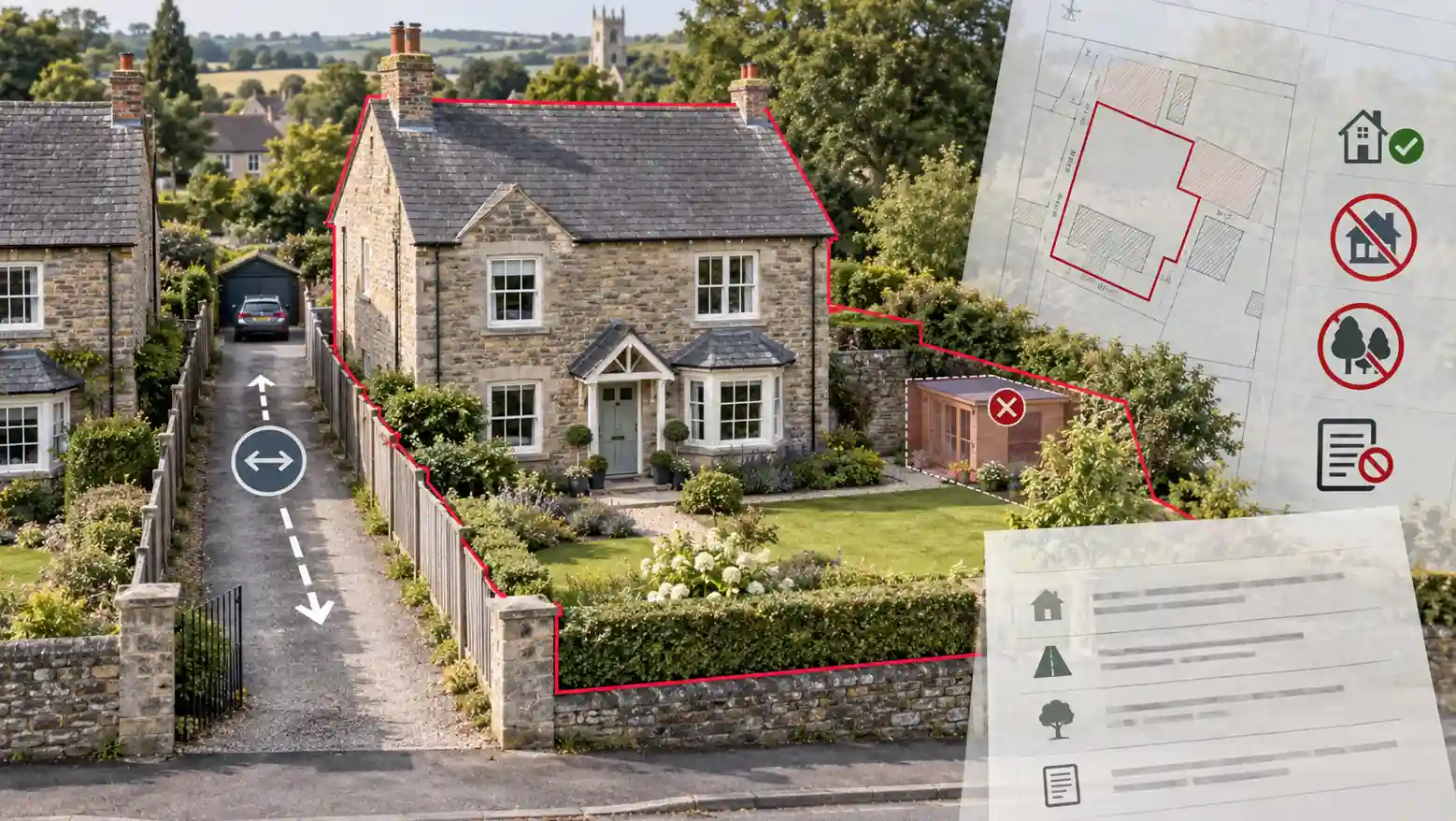
Stand in the garden of almost any house being sold, and it’s easy to assume the sale is exactly what it looks like: the building, the plot, the driveway, the fence line. Mostly, it is. But buying a home is buying a legal interest in land, and that interest can carry conditions, obligations and other people’s rights woven into it that no amount of careful looking will ever reveal — because they were never written into the bricks. They’re written into the title.
This applies most directly in England and Wales, where the system described below sits. Scotland and Northern Ireland run genuinely different registration systems, covered separately further down.
The three sections behind a registered title
In England and Wales, an HM Land Registry title register is organised into three sections — the Property Register, Proprietorship Register and Charges Register. A buyer’s conveyancer reviews the register as a matter of routine, but understanding roughly what each part is for helps make sense of what actually gets flagged during a purchase. HM Land Registry’s guide to reading a title register
The Property Register describes the land itself — its general extent, tenure, such as freehold or leasehold, and rights that benefit the property. This last part matters more than it sounds: if the property has the right to use a shared driveway, or benefits from a right of way across a neighbour’s land to reach a rear parking area, that right may be recorded here as something the property gains rather than something it’s burdened by.
The Proprietorship Register identifies the registered owner and the class of title held — broadly, the quality of the registered ownership. It may also state the price paid where that information is available and, significantly, contains restrictions affecting how the registered owner can deal with the title.
The Charges Register is where mortgages and other registered financial charges usually appear. It can also contain some of the matters that tend to matter most to an ordinary buyer: restrictive covenants and rights burdening the property, meaning limitations on how the land can be used or rights somebody else holds over it.
Restrictive covenants: promises that can outlive the person who made them
A restrictive covenant is a promise limiting what can be done with land. Many were created decades — sometimes more than a century — ago when land was first sold off from a larger estate, with the intention that the restriction would continue beyond the original buyer.
Common examples include restrictions on putting up further buildings, using a property for particular business purposes, subdividing a plot or making certain alterations without consent.
These can matter enormously to a buyer with specific plans. Someone hoping to run a business from home, build a large extension or add an annexe may discover that an old covenant potentially affects what they want to do.
The important qualification is that the appearance of a covenant on the title does not automatically answer whether it remains enforceable in the way its wording appears to suggest. That can depend on the wording, the land that benefits from it, subsequent changes and whether the covenant has ever been modified, released or discharged.
That is a substantial subject in its own right. For a buyer reading the title during a purchase, the immediate lesson is simpler: an old covenant should neither be ignored because of its age nor assumed to be an absolute prohibition without the conveyancer establishing what it actually means for this property.
Restrictions are not restrictive covenants — a genuinely common confusion
This is one of the more easily misunderstood points in the whole title system, and it’s worth being precise about because the two terms sound almost interchangeable and mean quite different things.
A restriction, in HM Land Registry’s technical sense, regulates whether a future transaction involving the title — such as a sale, transfer or mortgage — can be registered unless specified requirements are met. It is principally about dealings with the title, not about whether the owner can build an extension, keep a caravan on the drive or run a business from the house. HM Land Registry guidance on notices and restrictions
A restriction might, for example, require a consent or certificate before a transfer can be registered, something buyers sometimes encounter on managed developments.
A restrictive covenant, by contrast, is a promise concerning the use of the land itself — potentially restricting building, business use or some other activity affecting the property.
That distinction matters. A buyer can see a restriction and fear that it prevents them doing something to the house when it may instead be a procedural requirement dealt with during the conveyancing process. Equally, they can overlook a restrictive covenant because it sounds like another piece of Land Registry administration when it may continue to affect how they use the property after they move in.
Easements and rights: who benefits, and who’s burdened
An easement is a right attached to land, benefiting one property and burdening another, and it’s worth being clear about which side of that arrangement a specific property sits on before assuming anything.
A shared driveway might mean the property being purchased has the right to use it — potentially recorded as a benefit in the Property Register — or it might mean a neighbour has the right to cross this property to reach theirs, potentially appearing as a burden in the Charges Register.
Those situations can sound almost identical in casual conversation and be very different in practice: one gives the property a legal right over somebody else’s land; the other means somebody else may have a legal right over part of this property.
Common examples include rights of way over shared access roads and rights relating to pipes, drains, cables or other services crossing neighbouring land. Similar rights can also concern support, light and access in particular circumstances.
The register is central to discovering these rights, but it is not necessarily a complete inventory of every interest capable of affecting registered land. English and Welsh land law recognises certain overriding interests that can bind a buyer despite not appearing on the register. HM Land Registry’s guidance on overriding interests is one reason the conveyancer’s investigation goes beyond simply downloading the register and reading what appears on it.
The title plan doesn’t show an exact boundary — and it isn’t meant to
Every registered title will normally be accompanied by a title plan showing the general extent of the property, usually edged in red on an Ordnance Survey base map. It’s tempting to treat that red line as the definitive legal boundary, precise to the inch. It generally isn’t.
Under the general boundaries system, the title plan normally identifies the general position of a boundary rather than determining its exact legal line. HM Land Registry makes this distinction explicitly: title plans are intended to be read alongside the register rather than treated as precision surveys. HM Land Registry guidance on general boundaries
That matters when, for example, a fence appears to sit slightly away from the red edging or two neighbours disagree over a narrow strip of land. The plan may be strong evidence of the general extent of the title without settling the precise legal boundary by itself.
It is possible to have the exact line of a boundary formally determined through a specific HM Land Registry procedure, but that requires evidence supporting the claimed line. Most titles remain registered on the general-boundaries basis.
For the ordinary buyer, the title plan is therefore a valuable picture of what the registered title broadly contains. It is not the right document to use on its own to resolve a genuine boundary dispute.
Older documents referred to, but not fully reproduced, in the register
A title register will sometimes reproduce the wording of an older covenant or right directly. At other times it refers the reader back to a historic conveyance, transfer or other deed.
An entry might, for example, say that the land is subject to covenants contained in a conveyance from a particular date without setting out every word of those covenants in the register itself.
Where HM Land Registry has retained a copy of a referred document, the register will normally indicate this with wording such as “copy filed”, and a copy can be requested. But not every historic document mentioned in a title register is held by HM Land Registry. HM Land Registry guidance on obtaining copies of deeds explains the distinction.
That matters where the exact wording of a covenant or right is important to a buyer’s plans. The summary entry in the register may be the start of the investigation rather than the end of it.
Unregistered land still exists
Some land in England and Wales remains unregistered, generally because there has not yet been an event that required first registration.
Buying or mortgaging unregistered land normally triggers an application for first registration with HM Land Registry. Instead of beginning with a modern title register, the conveyancer has to establish the seller’s title from historic deeds before the new registered title can be created. HM Land Registry guidance on first registration
It is a more involved conveyancing exercise than buying an already registered title, but the fact that land is unregistered is not, by itself, evidence that something is wrong with it.
Scotland: a different register, with its own structure
Scotland’s Land Register, administered by Registers of Scotland, has its own title-sheet structure.
A Scottish title sheet is divided into four sections. The Property section describes the property and associated rights; the Proprietorship section identifies the registered owner; the Securities section records mortgages and other securities; and the Burdens section records obligations and conditions affecting the property. Registers of Scotland’s guide to title documents explains the information these documents can contain.
Scottish real burdens perform some of the work that an English buyer might associate with restrictive or positive covenants, while servitudes are broadly comparable to easements.
Some older Scottish titles remain in the historic General Register of Sasines rather than the modern Land Register. A Scottish solicitor will identify which system applies to the property and examine the relevant title documents accordingly.
Northern Ireland: folios rather than an England-and-Wales title register
Northern Ireland has its own land-registration system, administered by Land & Property Services.
Registered title is recorded in a folio, supported by the Land Registry map. Folios contain information about the property, its ownership and burdens affecting the land, including matters such as mortgages, rights of way and other legal interests. Northern Ireland’s Land Registers glossary explains the principal terminology.
The concepts are recognisable — ownership, mortgages, covenants and rights benefiting or burdening land — but the terminology and statutory framework are not the same as in England and Wales.
As in England and Wales, however, the registered record should not automatically be treated as containing every legally relevant interest. Northern Ireland law recognises certain statutory burdens capable of affecting registered land without appearing on the folio. The Department of Finance explains these burdens and other charges.
For a buyer, the practical point remains the same: the registered title is central to understanding the property, but it sits within the wider conveyancing investigation rather than replacing it.
Why this is worth understanding, not just delegating
A conveyancer will review all of this as a matter of course, and most buyers never need to interpret a title register unassisted.
But understanding the basic shape of what is being investigated changes the conversation.
The property being bought is not just the house, garden and driveway visible on the viewing. It is the legal title to that land, complete with the rights the property enjoys, the rights other people may have over it, restrictions on future transactions, covenants affecting its use and a boundary record that may deliberately stop short of identifying the exact legal line.
Most of those matters will cause no difficulty at all. Some will amount to routine entries that a conveyancer deals with almost automatically. Occasionally, though, a single sentence in a decades-old transfer or a right across part of the title can materially affect what a buyer thought they were going to be able to do after moving in.
That is why questions raised about the title are not simply bureaucratic obstacles standing between an offer and the keys. They are part of establishing what, in legal terms, the buyer is actually buying.
This article provides general information about property titles and land registration in the UK and is not legal or conveyancing advice. The effect and enforceability of covenants, restrictions, easements, servitudes, burdens and other title entries depend on the wording, jurisdiction, property and individual circumstances. Buyers should ask the solicitor or conveyancer handling their transaction to explain any title entry that may affect their intended use of the property.

