

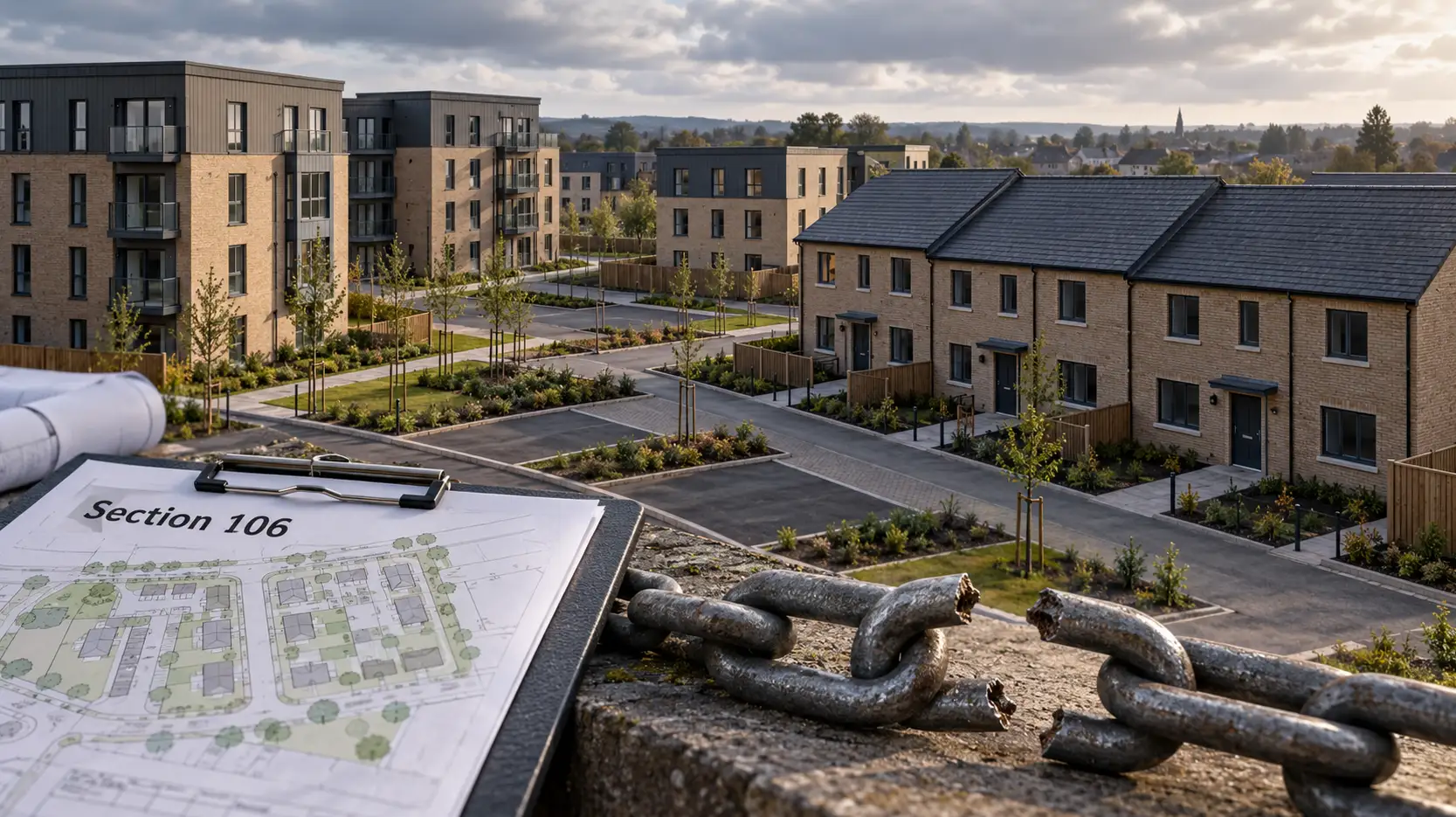
On a completed housing development in England, most of the market homes may already have buyers. Yet a block or terrace of affordable homes on the same site can remain unoccupied — not because there is nobody who needs them, but because the registered provider expected to acquire them has not come forward and the developer cannot simply put them onto the open market.
This is the uncontracted Section 106 problem, and it has become serious enough for government to intervene. Home Builders Federation research published in October 2025, based on Freedom of Information responses from local authorities in England and Wales, estimated that around 900 completed Section 106 affordable homes were sitting without a registered-provider buyer, with a further 8,500 under construction or expected to start within the following twelve months similarly uncontracted. Those England-and-Wales figures were extrapolated rather than counted directly: 302 completed homes were identified across 105 local authorities, while 2,254 uncontracted homes under construction or expected to start within twelve months were recorded across 84 authorities. The same exercise estimated that more than 700 sites had been delayed or stalled during the preceding three years because a registered provider could not be secured. Home Builders Federation — Uncontracted Section 106 Affordable Homes
A separate HBF survey from 2024 found 17,432 uncontracted affordable homes with detailed planning permission among 31 participating developers and 139 delayed sites. The exercises use different samples and time horizons — the earlier developer survey stretched further through the forward pipeline, while the later council exercise concentrated on a much shorter delivery window — so the totals cannot sensibly be combined. But they point to the same underlying problem: the market through which developers transfer Section 106 affordable homes to registered providers has not been clearing reliably.
How the system is meant to work
Section 106 of the Town and Country Planning Act 1990 allows legally enforceable planning obligations to be entered into in connection with development. In housing schemes, those obligations can secure affordable homes alongside the market housing and deal with matters such as tenure, delivery, phasing and transfer arrangements.
The model matters enormously to affordable housing supply. Official estimates put the figure at 36% of all affordable homes completed in England in 2024–25 being delivered through Section 106 nil-grant agreements. That was down from 45% the previous year, but still means more than one in three affordable homes depended on this route. The statistics also underline an important point about how the system has traditionally worked: partial grant used to be more common, but the vast majority of recent Section 106-funded homes are now delivered without government grant. MHCLG — Affordable housing supply in England 2024–25
In the conventional arrangement, a developer builds the affordable homes required by the planning obligation and transfers them at an agreed value to a registered provider — often a housing association, although councils and for-profit registered providers can also acquire stock. The provider then owns and manages the homes under the required affordable tenure.
That model depends on three things lining up: the planning obligation the council has secured, the economics and construction programme of the development, and the type of homes a registered provider is actually prepared and financially able to acquire.
Increasingly, on a meaningful number of sites, they have not lined up.
Why registered providers have pulled back
There is no single nationwide explanation. Some schemes still attract bids and complete normally, while others struggle to attract any credible offer. The more useful way to understand the problem is not as a simple shortage of housing-association money but as a failure of alignment between planning requirements, developer economics and registered providers’ investment criteria.
Financial capacity has tightened. Registered providers have been committing unusually large sums to repairs, building safety and improvements to existing stock while also facing higher financing costs. The Regulator of Social Housing’s 2025 Global Accounts showed aggregate EBITDA MRI interest cover falling to 87%, below 100% for the second consecutive year. On that measure, sector-wide earnings after major-repairs expenditure were below interest costs. Regulator of Social Housing — 2025 Global Accounts
That headline should not be read as meaning the entire housing-association sector is unable to cover its interest bill. Only 38% of providers reported interest cover below 100%, and the regulator emphasised how widely performance varies between organisations. The practical problem is therefore not that every registered provider has stopped acquiring homes, but that purchasing capacity is uneven — and some large development-active providers have considerably less financial headroom than they once did.
Price can stop an apparently obvious transaction. The developer may already be offering the homes at a substantial discount to open-market value, but the registered provider still has to decide whether the transfer price works against the rent that can be charged, the tenure, financing costs, future maintenance liabilities and competing calls on its capital. A property can look cheap compared with the neighbouring private home and still be unattractive to the organisation that must own and manage it for decades.
Specification and tenure matter as much as price. A registered provider is not merely buying units; it is taking on long-term assets. Design standards, tenure mix, service charges, building configuration, maintenance obligations and whether the homes fit the provider’s management model can all affect appetite. The government’s Section 106 roadmap itself recognises that part of the unsold stock may consist of homes constructed to specifications that do not meet providers’ needs or business plans.
That is why additional funding alone cannot cure every failed disposal. A provider can have capital available and a developer can have affordable homes ready to transfer, yet the transaction can still fail because the tenure is unsuitable, management costs are unattractive, the package is operationally awkward or the parties cannot agree a price.
Geography and package size matter too. Registered providers generally gain efficiencies by acquiring homes in areas where they already operate and in numbers large enough to manage economically. A handful of affordable units on a small development outside an existing management footprint may be much less appealing than a larger package within it.
That matters particularly for SME housebuilders. A national developer may be able to reshape packages, negotiate across multiple developments or absorb a delayed transfer within a much larger pipeline. A smaller developer with one or two active sites has fewer alternatives and can be disproportionately exposed when the likely buyer disappears.
Timing can turn a viable transaction into an unworkable one. Registered providers have their own approval, funding and acquisition cycles. Developers have construction programmes, finance facilities and planning triggers. If a provider needs certainty long before the developer can offer it — or if the affordable homes reach a contractual delivery point before the provider’s funding is available — both sides can rationally want the transaction and still be unable to complete it on the timetable the development assumes.
This is also why the traditional Section 106 model should not simply be described as one in which grant fills the gap. Much of the system has historically been expected to work without grant. What government is now doing is using additional public funding and exceptionally cheap finance more deliberately to restore purchasing capacity where the established market is no longer producing a buyer.
The consequences reach beyond the affordable units themselves
The most visible result is an affordable home standing empty. The commercial effect can be much wider.
Section 106 agreements can contain phasing and occupation controls intended to keep delivery of affordable and market housing broadly in step. Planning Inspectorate guidance specifically contemplates restrictions on development until affordable-housing transfer arrangements have been secured and says phasing should not allow most of the market housing to be sold before the affordable units are available for occupation. Planning Inspectorate — Planning obligations good-practice advice
The absence of a registered-provider buyer can therefore become much more than an unsold-stock problem. Capital can remain tied up in completed or nearly completed affordable units while development finance continues to accrue. Planning or contractual triggers can affect later market phases. Cash that would ordinarily be recycled into construction of the next parcel remains trapped. For development lenders, equity investors and landowners, the delay can therefore feed back into financing duration, viability assumptions and, at the margin, the residual value a scheme can support.
The effect is particularly acute for smaller developers. A major housebuilder can spread a difficult site across a national portfolio; an SME may have much of its equity, borrowing facility and management capacity tied to one or two projects. An affordable-housing package worth a relatively modest sum in the context of a national business can therefore become a serious cash-flow problem for a smaller one.
There is evidence that this risk can influence what developers choose to build in the first place. HBF has reported anecdotal feedback from some SME members that they are avoiding sites where an RP contract is not already in place, favouring land without affordable-housing obligations or concentrating on smaller sites below the relevant threshold. That evidence is not a national measure of developer behaviour, but the commercial logic matters: a failure in the disposal market can change land-buying decisions long before an affordable home reaches construction.
The problem therefore cuts into a wider housing-supply question. If an uncontracted affordable element slows a development, fewer private homes may be completed as well. Contractors and suppliers wait longer for later phases, capital remains tied up and the developer has less capacity to start the next site.
Securing an affordable-housing obligation in a planning agreement is not the same thing as securing a purchaser for the homes it requires. When those two things become disconnected, a mechanism designed to deliver affordable housing can start interfering with delivery of the wider scheme around it.
What government has done about it
Homes England launched the Section 106 Affordable Housing Clearing Service in December 2024 to expose uncontracted homes to a wider pool of registered providers and local authorities. The January 2026 government roadmap then created a time-limited process for genuinely stalled legacy schemes. To qualify, developers had to have exhausted reasonable efforts to find an RP buyer, upload the relevant homes to the Clearing Service by 1 June 2026, leave them live for at least six weeks and have them due for completion on or before 1 December 2027. The June listing deadline has therefore passed: homes not uploaded by that date fall outside this particular emergency route. MHCLG — Roadmap for Section 106 delivery in England
For qualifying schemes, the policy does not give developers an automatic right to convert affordable homes to open-market stock. Councils are expected to avoid tenure renegotiation where a willing and suitable provider has made a reasonable offer. When judging whether an offer is reasonable, local planning authorities are encouraged to look at evidence including site-specific viability material, published commuted-sum policies, prevailing grant rates, surveyor evidence and recent local Section 106 transactions. Where the developer and council still disagree over whether a bid was reasonable, the roadmap points to an existing alternative dispute resolution route through which a third-party view can help break the deadlock.
Only once those steps have failed does the government’s tenure cascade move further. Councils are encouraged first to seek another affordable or discounted-market tenure. If no purchaser can be found on that basis, private market rent or sale can be considered, with equivalent affordable provision sought elsewhere in the authority’s area where feasible or a financial contribution taken instead. The emergency process is therefore a route for unlocking genuinely stalled schemes, not a general escape from affordable-housing obligations.
Government has also tried to improve the buying side of the market. Since March 2026, the National Housing Bank has offered a £2.5 billion low-interest loan facility for private registered providers, with £1 billion administered through the Bank and £1.5 billion through the Greater London Authority. The loans carry a 0.1% interest rate, run for 25 years and are unsecured and subordinated; up to 10% of the funding can support acquisitions of Section 106 affordable homes. National Housing Bank — Support for registered providers of affordable housing
That is a substantial intervention in financial capacity, but it still cannot make every package attractive. Cheap capital can help a provider acquire a viable set of homes; it cannot turn an unsuitable specification, difficult management arrangement or uneconomic tenure into a good long-term asset.
The longer-term reforms increasingly focus on preventing those mismatches arising in the first place. On 25 August 2026, government published national Section 106 affordable-housing engagement guidance developed with the National Housing Federation, Home Builders Federation, Chartered Institute of Housing and Local Government Association. Its emphasis is on earlier engagement, transparency and collaboration between developers, councils and providers, rather than discovering late in the build programme that nobody wants the affordable package that planning has produced. MHCLG — Section 106 affordable housing engagement guidance
On the same day, MHCLG opened consultation on four standard planning templates for medium-sized housing sites of 10 to 49 homes inclusive and up to 2.5 hectares. They include bilateral and unilateral agreement templates plus affordable-housing schedules for full and outline permissions; the full-permission schedule includes a discretionary cascade mechanism. The consultation remains open until 20 October 2026. MHCLG — Standard planning agreements for medium-sized sites
Other ideas remain less developed. The roadmap has also explored registered-provider consortia that could pool purchasing capacity and an acquisition vehicle capable of taking otherwise unwanted Section 106 stock while retaining it within regulated affordable housing. Those should still be regarded as possible structural reforms rather than established parts of the market.
What remains unresolved
The response is now considerably more substantial than it was at the beginning of 2026. There is a mechanism for exposing uncontracted homes to more purchasers, a time-limited route for qualifying stalled schemes, extremely cheap financing for registered providers, new national engagement guidance and draft standard agreements intended to reduce future negotiation and delivery problems.
What remains uncertain is whether those interventions repair the market itself.
The emergency variation route can release an individual development after attempts to secure a provider have failed. It does not make the next provider want the next scheme. A 0.1% loan can restore purchasing capacity, but it cannot fix an inappropriate tenure or an operationally unattractive building. Standardised agreements may reduce legal friction and increase predictability, but they cannot force buyer and seller to agree a transfer price.
There is also an unavoidable policy tension in allowing stalled affordable homes eventually to move into private sale or rent. Doing so can release a development, get an empty home occupied and allow construction to continue. But unless the replacement provision or payment produces equivalent affordable housing elsewhere, solving the immediate development problem can also mean the homes originally expected on that site are never delivered there.
The more important test of the reforms will therefore be what happens before construction reaches that point. If developers, councils and registered providers agree earlier on tenure, design, management arrangements and a realistic transfer value, fewer schemes should arrive at completion carrying homes that nobody is prepared to acquire.
For developers, that changes the commercial lesson. Affordable housing cannot safely be treated simply as a disposal exercise near the end of construction. Where delivery depends on a registered-provider acquisition, the likely purchaser, specification, price and timetable increasingly need to be considered alongside design, planning, funding and viability much earlier in the development process.
And for government, the test has moved beyond disposing of the backlog already built into the system. The harder question is whether the reforms create a Section 106 market in which that backlog stops rebuilding.
Until they do, England can simultaneously have an acute need for affordable housing, developers legally required to provide it, completed homes waiting to be occupied — and no institutional buyer willing or able to take them on.
This article concerns Section 106 affordable-housing policy and practice in England and provides general information only. It is not legal or planning advice. Section 106 agreements are site-specific, and developers, registered providers, landowners or other parties considering a particular development should take appropriate professional advice.

