

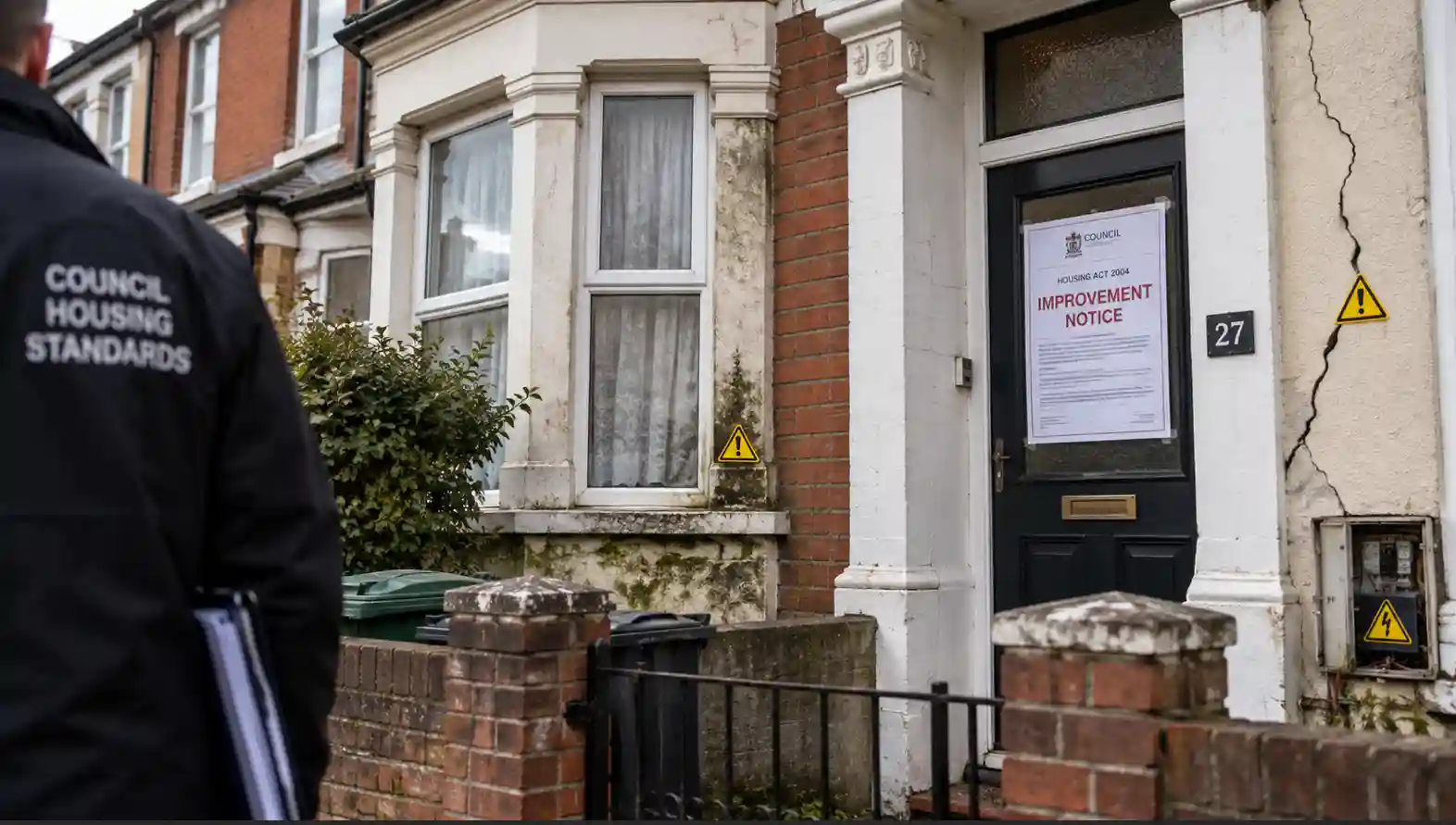
“Report it to the council” is where a lot of repair advice stops, as though a phone call sets off a fixed, predictable sequence of events. It doesn’t. What actually happens after a council gets involved depends on what has been reported, what an officer finds, how serious the hazards are and how the landlord responds at several separate points — and knowing that sequence changes how both a tenant and a landlord should behave once a complaint has been made.
The complaint doesn’t automatically become an inspection
A complaint about the condition of a rented home does not automatically produce a council inspection. In England, the local authority will consider the information it has received and may decide to inspect the property. What happens initially will depend on the nature and apparent seriousness of the problem, the information available and how the authority decides the case should be handled.
That makes specifics considerably more useful than a general complaint. Dated photographs, a clear description of where and when the problem occurs, copies of previous reports to the landlord or letting agent and records of what happened afterwards give the council something concrete to assess. Where a health condition or particular vulnerability is relevant, supporting information may also help the authority understand the circumstances of the household.
For landlords and agents, the same principle works in reverse. Repair reports, inspection records, contractor invoices, photographs, correspondence and documented attempts to obtain access can become important if an ordinary maintenance complaint develops into something more formal.
An important distinction is that the condition of the actual occupants does not usually determine the HHSRS hazard score itself. In England, most hazards are assessed by reference to the age group considered particularly vulnerable to that hazard rather than whoever happens to be living in the property at the time. Overcrowding and lack of living space is the main exception. The circumstances of the people actually living there can, however, still matter when the council considers what enforcement response is appropriate. The Government’s current HHSRS landlord and agent guide explains how the revised system operates.
Hazard scoring, not just a repair list
Where an inspection does go ahead, the officer is not simply compiling a snag list.
In England, the assessment starts with a full inspection of the property, potentially including the garden, yard, external structures and relevant communal areas. That means the council is not necessarily restricted to the problem that triggered the complaint. A report about damp in one room can lead an officer to identify unrelated fire, electrical, fall or other hazards elsewhere in the property.
The officer then assesses deficiencies under the Housing Health and Safety Rating System, or HHSRS. The system considers both how likely harm is to occur and how serious the consequences could be. Hazards are assessed separately, so the same property can contain a mixture of more and less serious risks.
England substantially revised HHSRS in June 2026. What had previously been 29 hazard types was consolidated into 21, alongside changes to the assessment framework and new statutory guidance. A hazard score of 1,000 or more now falls into the High Band and is a Category 1 hazard; lower scores fall into the two Category 2 bands. The current HHSRS enforcement guidance sets out the revised framework.
That distinction matters because the council’s legal position changes with the category. Once a local authority confirms a Category 1 hazard, it has a duty to take appropriate enforcement action. For Category 2 hazards, it has a power to act rather than an automatic duty, which leaves considerably more room for the circumstances of the case and the council’s enforcement policy.
This is one reason apparently similar repair complaints do not always end in the same place. A defect, a statutory hazard and a Category 1 hazard are not interchangeable descriptions.
The formal tools, and what they actually do
Once a council decides formal action is warranted, it has several tools, and they do genuinely different things rather than being interchangeable levels of the same letter.
A hazard awareness notice formally records that a Category 1 or Category 2 hazard exists and recommends appropriate action, but it does not itself compel the recipient to carry out work. It is more commonly used where the authority considers a less coercive response appropriate.
An improvement notice is different. It specifies remedial action that must be taken and gives a date by which the work must be completed. Under the Housing Act 2004, required remedial action cannot start earlier than 28 days after the notice is served. Failing to comply without reasonable excuse is a criminal offence.
A prohibition order restricts or prevents the use of all or part of the property. It may be appropriate where the risk cannot reasonably be dealt with while the affected accommodation continues to be used, and it can also restrict the number or type of people permitted to occupy particular accommodation. An ordinary prohibition order normally comes into force 28 days after it is made.
Where a Category 1 hazard creates an imminent risk of serious harm, the council has stronger emergency powers. It can carry out immediately necessary remedial work itself, or make an emergency prohibition order restricting use straight away.
For a landlord or letting agent, the point at which formal paperwork arrives is therefore critical. A hazard awareness notice, an improvement notice and a prohibition order are not different names for the same outcome. They create different obligations, different deadlines and different consequences.
Appeal deadlines can also be short. An appeal against an improvement notice in England normally has to be lodged within 21 days of service, while most other Housing Act enforcement appeals have 28-day limits. Negotiations with the council may still resolve a disagreement, but allowing an appeal deadline to expire while discussions continue can materially change the recipient’s position.
The financial exposure has also changed. Since the 2026 reforms, an English council taking action over a Category 1 hazard can, in qualifying circumstances, impose an additional civil penalty of up to £7,000 where it considers that the responsible person could reasonably and practicably have removed the hazard but failed to do so.
That should not be confused with the consequences of subsequently ignoring an improvement notice. For relevant offences committed on or after 1 May 2026, failure to comply with an improvement notice can instead lead to prosecution or a civil financial penalty of up to £40,000. The council may also carry out the work itself and recover its reasonable costs. The Government’s statutory guidance on civil penalties under the Renters’ Rights Act and other housing legislation explains the current penalty framework.
The distinction matters. Being responsible for a serious hazard and committing a later offence by ignoring the formal notice issued to deal with it are separate stages of the enforcement process.
Why cooperation genuinely matters — without assuming it stops enforcement
A landlord who responds promptly when a council makes contact is in a very different position from one who ignores letters until a statutory deadline is approaching.
Providing the repair history, explaining investigations already carried out, arranging access, commissioning appropriate work and keeping the officer updated can help establish what is actually happening at the property and prevent avoidable problems being added to the original complaint. Genuine constraints — refused access, specialist diagnosis, ordered parts or work that cannot safely be completed immediately — are also easier to explain when there is a contemporaneous record rather than an explanation produced after a deadline has been missed.
But cooperation should not be mistaken for a guarantee that formal enforcement will disappear. If an English council establishes a Category 1 hazard, it has a statutory duty to take appropriate action. Engagement can influence how effectively the problem is resolved; it cannot remove the council’s legal responsibilities.
Formal notices can also outlive the immediate repair dispute. Once operative, improvement notices and prohibition orders are generally registered as local land charges until revoked. They can therefore surface during a future property search, and an improvement notice does not simply vanish because the property has been sold: responsibility can pass to the new owner while the notice remains in force. Where the underlying hazard has been resolved, the recipient can ask the council to revoke the notice or order.
That is particularly relevant to landlords and managing agents. Completing the physical repair is not always the final administrative step.
One piece of older landlord advice also now needs treating cautiously. Before 2026, articles about council enforcement commonly discussed improvement notices in the context of restrictions on using section 21. For most private rented tenancies in England, that is now historical: section 21 was abolished from 1 May 2026 and possession now depends on the statutory grounds available under the reformed tenancy system.
Scotland: a tribunal, not an English-style HHSRS notice, at the centre
Scotland does not use HHSRS.
The equivalent private-rented-sector framework centres on the Repairing Standard under the Housing (Scotland) Act 2006 and the First-tier Tribunal for Scotland (Housing and Property Chamber). A tenant can apply to the Tribunal where they believe the landlord has failed to meet the standard, and local authorities also have a role in the system.
If the Tribunal concludes that work is required, it can make a Repairing Standard Enforcement Order specifying what the landlord must do. Failing to comply with that order without reasonable excuse is an offence.
There is also a sanction with no direct English HHSRS equivalent. Where a landlord fails to comply with a Repairing Standard Enforcement Order, the Tribunal can make a Rent Relief Order reducing the rent payable by up to 90% while the breach continues. The tenant does not simply decide to reduce the rent themselves; the reduction comes from a Tribunal order. The Housing and Property Chamber’s repairs guidance explains how Repairing Standard enforcement and Rent Relief Orders work. Recent Tribunal decisions show both enforcement orders and rent-relief decisions continuing to be made in 2026.
For landlords or agents operating across Britain, that difference is more than terminology. A process built around a Scottish Tribunal order should not be managed as though it were an English council improvement notice.
Wales and Northern Ireland
Wales also needs separating from England more carefully than older UK-wide explanations often suggest.
Welsh local authorities continue to use HHSRS under the Housing Act 2004, but Wales has not adopted England’s 2026 move to a 21-hazard system. The Welsh framework continues to use the 29-hazard HHSRS model.
That council-enforcement regime sits alongside the separate Fitness for Human Habitation obligations under the Renting Homes (Wales) Act 2016. The two are related but are not the same test: the existence of an HHSRS hazard does not automatically determine whether a dwelling is unfit for human habitation under the Welsh contractual regime. Welsh Government’s fitness for human habitation guidance for landlords explains that distinction.
Northern Ireland uses a different system again. Private rented property is subject to statutory fitness standards rather than the English HHSRS Category 1 and Category 2 framework.
District councils can become involved where accommodation does not meet the required standard and can use statutory notices requiring work. The Private Tenancies (Northern Ireland) Order 2006 provides for notices of unfitness and disrepair, appeal rights to the county court and the possibility of the council carrying out required work and recovering its costs where an operative notice is not complied with. The official Northern Ireland guidance on housing standards in rented accommodation explains when tenants can involve the council’s environmental health service.
So “the council inspected my rented home” can describe materially different legal processes depending on which UK jurisdiction the property is in.
What “the council is involved” actually means, in practice
For a tenant, council involvement is neither a guarantee of a swift fix nor a pointless formality. It is a regulatory process with its own evidence, assessment and enforcement stages, and the outcome depends on what the authority actually finds.
For a landlord or letting agent, it is the point at which understanding the exact stage of that process becomes far more important than treating every communication as another repair complaint. A council asking for information is not the same as an improvement notice. A hazard awareness notice is not the same as a prohibition order. And a formal notice with an appeal deadline and required completion date is not something that can safely be managed through ordinary maintenance correspondence.
Once formal action begins, the useful questions become very specific: what document has been served, what hazards does it identify, what action does it require, when does it take effect, when must the work be completed and when does any right of appeal expire?
That is usually far more useful — to the tenant, landlord and agent alike — than treating “the council got involved” as a single, undifferentiated event.
This article provides general property information, not legal, financial, surveying or other professional advice for your individual circumstances. Property disputes and regulatory issues can depend on the facts, documents, location and applicable law. If significant money, property or legal rights are at risk, or you are considering an irreversible course of action, take appropriate professional advice before proceeding.

