

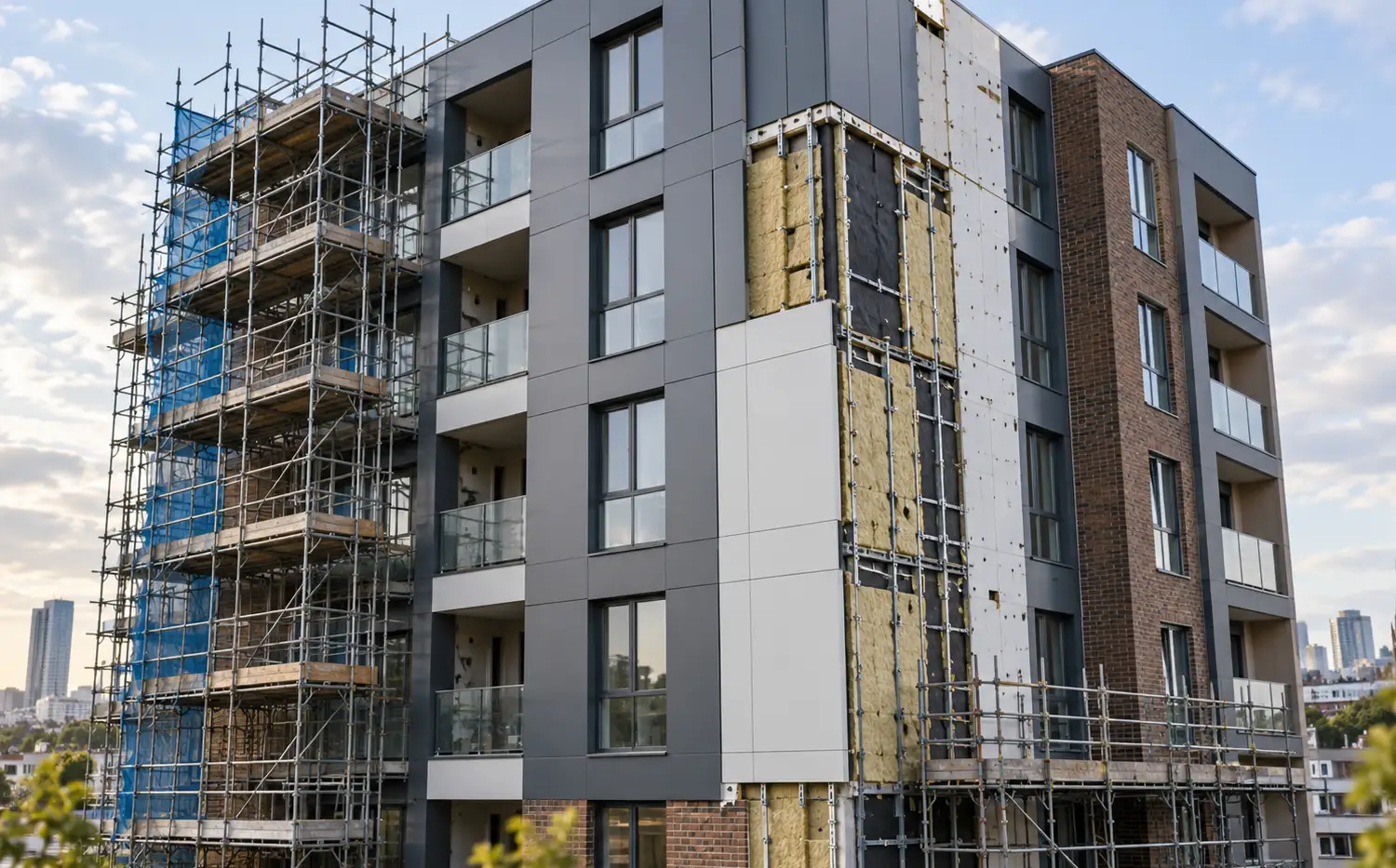
A leaseholder who receives a letter referring to a six-figure remediation bill for their building’s cladding is, understandably, likely to assume they’re personally on the hook for a share of it. In a meaningful number of cases in England, they’re legally not — not because the building doesn’t need fixing, but because a specific set of protections introduced since the Grenfell Tower fire is designed to push historic building-safety costs towards developers, building owners and government funding before they can reach an individual flat owner.
There is an equally important distinction underneath that reassurance, though. Being legally protected from the cost does not mean the defect has been fixed, that the flat will immediately become straightforward to sell or remortgage, or that remediation will happen quickly. Cost protection and physical remediation are connected, but they are not the same thing.
Understanding where a particular building and lease sit within that system is therefore the most useful starting point for a flat owner facing a cladding or building-safety problem.
Last checked: 15 September 2026.
The chain of responsibility
Historic building-safety defects in England are no longer supposed to begin with the assumption that individual leaseholders should simply fund whatever work their leases might otherwise have allowed a landlord to recover through the service charge.
The Building Safety Act 2022 created statutory protections around relevant historic safety defects, while the government has separately secured contractual commitments from major developers and created remediation funds for buildings where the responsible party cannot otherwise meet the cost. The broad policy intention is that those responsible for creating unsafe buildings, or those with the financial means and legal responsibility to put them right, should carry the burden before protected leaseholders do.
Where a landlord or superior landlord was responsible for the relevant defect, commissioned the relevant work, was the developer, or is associated with the responsible developer, the Building Safety Act can prevent the remediation cost being passed to leaseholders. Separately, developers that signed the government’s developer remediation contract committed to address life-critical fire-safety defects in qualifying buildings they developed or refurbished.
Where those routes do not settle the cost, the position then depends heavily on the building, the lease and the leaseholder’s statutory status. Qualifying leaseholders have complete protection against relevant cladding remediation costs and tightly controlled protection against historic non-cladding defects.
That makes this less a simple three-step queue than a set of overlapping legal and funding tests. The practical effect, however, is the same principle: the leaseholder should no longer automatically be the first person asked to fund a historic safety failure.
This article deals with the English system. Wales, Scotland and Northern Ireland operate different building-safety and remediation arrangements, so the English protections described below should not simply be assumed to apply elsewhere.
Which buildings does this actually cover?
The main Building Safety Act leaseholder protections apply to what the legislation calls a relevant building.
Broadly, that means a residential building in England containing at least two dwellings which is either at least 11 metres high or has at least five storeys. There are further technical rules around how height and storeys are measured, and some leaseholder-owned buildings are excluded from the statutory definition, so height alone is not always enough to settle the question. The government’s definition of a relevant building explains the legal test.
The height threshold matters enormously because a leaseholder in an 11-metre building and one living in an otherwise similar block just below that height do not automatically receive the same statutory protection.
That did not mean government support for lower-rise buildings disappeared entirely, however, and this position changed materially during 2026.
In July 2026, government announced a new route through the Cladding Safety Scheme for certain buildings under 11 metres where a PAS 9980-compliant external-wall appraisal identifies unsafe cladding presenting a serious life-critical fire risk. Applications opened in August 2026 and, at the point this article was last checked, the current application window was due to close on 9 October 2026.
The important limitation is that this is a targeted funding route for unsafe cladding, not an extension of the complete Building Safety Act leaseholder-protection framework to every defect in every lower-rise building. Leaseholders cannot apply directly: the responsible entity for the building has to make the application. The government’s current guide for residents and leaseholders in buildings under 11 metres explains the scheme.
A leaseholder in a shorter block should therefore no longer assume that there is no possible help, but equally should not assume that all of the protections described for 11m-plus buildings now apply below the threshold.
What a “qualifying lease” actually means
This is the single most important concept for a leaseholder trying to establish their own financial protection, and it is more nuanced than simply counting how many properties somebody owns today.
For the statutory protections, a qualifying lease generally needs to be a long lease originally granted for more than 21 years, under which the leaseholder is liable to pay a service charge, in a relevant building in England. Crucially, the lease also needs to have been granted before 14 February 2022, the qualifying date used by the legislation.
The personal test is then applied by reference to the position on 14 February 2022. Broadly, the lease qualifies if, at that date, the flat was the leaseholder’s only or main home or the leaseholder owned no more than three dwellings in the United Kingdom in total.
That “or” matters.
Someone who owned four residential properties on 14 February 2022 is not necessarily excluded if the affected flat was their main home at the qualifying date. Conversely, somebody who owned several properties and did not live in the affected flat may fall outside the qualifying-lease protections even though they are now living there.
The government’s guidance on the qualifying date and qualifying leases sets out the test and examples.
There is another particularly important protection for buyers. The qualifying status attaches to the lease based on the position at the qualifying date and passes to future purchasers. Someone buying an affected flat in 2026 does not lose the protection merely because they were not the owner in February 2022. Equally, buying a lease that did not qualify at the relevant date does not normally create qualifying status simply because the new purchaser owns only one home.
That makes the historic documentation around the lease especially important in a sale. A buyer is not simply asking whether they themselves would have qualified in 2022; they need to establish the legal status that has followed the lease.
What qualifying leaseholders are protected from
For relevant cladding remediation, a qualifying leaseholder cannot be charged through the service charge for the cost of removing and replacing the unsafe cladding system. This is not a £10,000 or £15,000 cap. For cladding remediation covered by the protections, the qualifying leaseholder’s contribution is zero.
Non-cladding historic safety defects are treated differently.
These can include problems such as inadequate compartmentation, defective fire-stopping and other relevant historical defects created through earlier construction or refurbishment. Interim measures connected with those defects, including certain waking-watch costs, can also fall within the protective regime.
Before any capped contribution reaches a qualifying leaseholder, the landlord’s position matters. If the landlord was responsible for the defect or is associated with the responsible developer, the developer test can prevent the cost being passed on. There is also a contribution condition: where the relevant landlord group had net wealth exceeding £2 million for each relevant building it owned at the qualifying date, qualifying leaseholders are protected from those non-cladding remediation costs as well.
Where neither protection removes the cost entirely, statutory contribution caps apply.
For most qualifying leases, the maximum is £10,000 outside Greater London or £15,000 within Greater London, spread over ten years. Higher-value properties have higher caps: the maximum rises to £50,000 for qualifying leases valued above £1 million but below £2 million and £100,000 above £2 million.
At the other end of the scale, qualifying properties valued below £175,000 outside Greater London or below £325,000 within Greater London have a zero cap for these historic non-cladding costs.
The current bands are set out in the government’s leaseholder contribution-cap guidance.
Amounts already paid towards qualifying remediation or relevant interim measures since 28 June 2017 count towards the applicable cap. Shared owners also receive a proportionate cap based on their equity share.
A simple example shows why that matters. Suppose a qualifying leaseholder outside London owns a flat within the ordinary £10,000 band. If £4,000 of qualifying historic non-cladding remediation and interim costs has already been paid since June 2017, the statutory ceiling is not another £10,000: those earlier payments count towards it, leaving no more than £6,000 potentially recoverable under the cap, assuming the landlord is legally entitled to pass any contribution on in the first place.
The cap is therefore a maximum liability after the other protections have been considered, not an automatic bill every qualifying leaseholder has to pay.
There is also broader protection where the landlord or superior landlord was responsible for the defect or associated with the responsible developer. Those provisions can protect leaseholders irrespective of whether their own lease satisfies every part of the qualifying-lease test. This is one reason a leaseholder who discovers that their lease is technically non-qualifying should not immediately assume they have no protection at all.
The government’s main leaseholder-protection guidance is the appropriate starting point for working through the position.
Buildings under 11 metres: a genuinely different position
The new 2026 funding is significant precisely because leaseholders in lower-rise buildings were previously in a much more difficult position.
The Building Safety Act’s principal leaseholder-protection regime still does not simply extend to every building below 11 metres or five storeys, and neither does the developer remediation contract generally operate in the same way below that threshold. The government’s position remains that widespread life-critical cladding risk is less common in lower buildings.
But “less common” does not mean impossible.
Under the new Cladding Safety Scheme route, an under-11m building can potentially receive remediation funding where a properly conducted Fire Risk Appraisal of External Walls identifies unsafe cladding presenting a serious life-critical risk. Buildings assessed as presenting the greatest danger are intended to be prioritised.
For residents, the practical first step is to establish whether the freeholder, landlord or other responsible entity has had the external wall properly assessed and, where the risk appears to meet the funding criteria, whether an application is being made. The resident cannot submit the funding application in place of the responsible entity.
That makes the under-11m position meaningfully better than it was, but still materially different from the statutory protections enjoyed by many qualifying leaseholders in taller buildings.
EWS1: what it is, and what it isn’t
An EWS1 form — External Wall System 1 — is an industry document created by RICS, UK Finance and the Building Societies Association to provide lenders and valuers with assurance about the external wall of a residential building.
It is not a government safety certificate, it is not itself a statutory requirement, and it does not certify that a building as a whole is safe.
The form records the conclusion of a suitably qualified professional about the building’s external wall system. Since the introduction of PAS 9980, the underlying external-wall fire-risk appraisal is generally expected to follow that risk-based methodology where applicable. RICS’s current EWS1 guidance makes clear that an EWS1 applies to the building rather than an individual flat and that not every building requires one.
This is important because the early years following Grenfell saw EWS1 requests spreading well beyond the high-rise buildings the process was originally designed around. Current valuation practice is more proportionate: height, cladding type, quantity, balconies and other risk characteristics matter, and a valuer should have a reason for asking for an EWS1 rather than treating it as routine paperwork for every flat.
The familiar five-year period also needs some nuance. EWS1 forms were designed around a five-year life and RICS still describes the form as valid for the whole building for that period. But lender practice has evolved. Following updated industry statements in 2025, some lenders may accept forms beyond five years or rely on alternative evidence about remediation and statutory protection rather than automatically requiring an entirely new assessment. Whether a particular lender will accept an older form remains a lender-specific question.
An EWS1 also should not be confused with proof that remediation has been completed. A form can identify that remediation is needed; the building can then spend years moving through funding, design and construction before the problem is physically resolved.
Does an affected flat automatically become unmortgageable?
No, although an unresolved safety problem can still complicate both selling and remortgaging.
Lenders are concerned not only with whether a defect exists but with the financial and practical route to resolving it. Evidence that a building is accepted into a government remediation programme, that a responsible developer has committed to carry out the work, or that the lease benefits from statutory cost protections can materially alter the lender’s view even before work is finished.
That is why two flats in buildings with superficially similar cladding defects can face very different outcomes. One building may have identified funding, a signed remediation contract, a programme of works and complete leaseholder certificates; another may still be arguing over who is responsible.
The existence of a defect therefore matters, but so does certainty around who will fix it, who will pay and when the work is expected to happen.
For a buyer or seller, the conveyancing file can consequently include documents that would rarely appear in an ordinary flat sale: the leaseholder deed of certificate, the landlord’s certificate, technical fire-safety reports, evidence of funding approval and correspondence identifying the remediation route.
A solicitor who regularly handles building-safety-affected flats is considerably better placed to recognise what is missing than somebody encountering the regime for the first time.
Why remediation can take years
The national figures explain why delay remains such a large part of the story.
At the end of July 2026, the government was monitoring 4,697 residential buildings of 11 metres or more identified with unsafe cladding. Of those, remediation had been completed on 1,833 buildings — about 39% — while another 718 were under way. In total, therefore, around 54% had either started or completed remediation, while 46% remained in programme without work recorded as started.
The same government release estimated that roughly 104,000 dwellings were in monitored buildings where remediation had not yet begun. Those numbers do not represent every unsafe building in England — the government estimates that the buildings being monitored account for around 64% to 81% of the eventual total expected within its remediation programmes — which makes the scale of the remaining task clearer rather than smaller. The latest position is published in the government’s building-safety remediation data.
The process itself helps explain the pace. A building can require intrusive investigation, a PAS 9980 assessment, agreement over the scope of remediation, identification of the responsible party or funding programme, detailed design, building-control approval, procurement of specialist contractors and then substantial construction work while residents continue to occupy the block.
Responsibility can add another layer. Where the original developer has disappeared, ownership structures are complex or liability is contested, months or years can pass before the physical work becomes the main problem.
Government policy has therefore shifted from simply making funding available towards imposing harder remediation deadlines. Under the current Remediation Acceleration Plan, the target is for 18m-plus buildings in government-funded schemes to be remediated by the end of 2029. For 11–18m buildings, government has described 2031 as the natural end point for completion, with increasingly strong enforcement intended where landlords fail to act without reasonable excuse.
Those are national policy targets, not promises to an individual leaseholder about the date scaffolding will disappear from their own block.
Documentation that actually matters — especially if a bill arrives
The paperwork in this system is not administrative background; it can determine whether thousands of pounds are lawfully recoverable.
A leaseholder deed of certificate records the information needed to establish qualifying status and calculate any applicable cap. A leaseholder can submit one proactively and must provide one when formally required by the landlord. Where requested correctly, failing to supply it can mean losing the additional protections that depend on qualifying-lease status.
The certificate should therefore be completed carefully and retained, particularly because it is relevant when the flat is later sold.
The landlord’s certificate performs a different role. It records matters including whether the developer test or contribution condition applies and is part of the evidence a landlord must provide before certain historic building-safety costs can lawfully be passed through the service charge. A landlord must provide one in a number of situations, including where it intends to recover relevant remediation costs and when requested by a leaseholder.
The government’s certificate guidance explains both documents.
This becomes particularly important if a substantial remediation demand arrives.
A leaseholder should not assume that the existence of an invoice proves the charge is lawful. Government guidance says protected leaseholders should not pay historic cladding or non-cladding remediation charges before the landlord has demonstrated that the cost falls outside the statutory protections or supplied the required landlord’s certificate showing why a contribution can legally be recovered.
There is also a government building-safety costs checker which can help establish the starting position.
Where a landlord continues to demand costs that appear to be protected, the Building Safety Act provides routes through the First-tier Tribunal. A remediation order can require a landlord to remedy relevant defects, while a remediation contribution order can in appropriate circumstances require landlords, developers or associated companies to meet specified remediation-related costs. Leaseholders who have already paid protected costs may also be able to seek recovery through that route.
Those are legal remedies rather than simple complaint procedures, so an individual case can justify specialist advice. But the existence of the tribunal powers matters because the statutory protections are not merely statements of government policy: they are capable of being enforced.
The question that actually matters
For a flat owner facing a building-safety problem, the useful question isn’t simply “does my building have cladding?” and it isn’t even “am I a qualifying leaseholder?” in isolation.
The answer comes from several connected facts.
Does the building meet the relevant-building test? Was the lease granted before 14 February 2022? What was the property’s and leaseholder’s position at that qualifying date? Was the flat the main home, or were no more than three UK dwellings owned? Is the landlord or a superior landlord connected with the developer responsible for the defect? Is a developer already contractually responsible for remediation? Does the landlord satisfy the wealth test? Is the defect cladding or non-cladding? Has funding already been secured? And if a capped contribution genuinely remains lawful, what is the property’s statutory cap and how much has already been paid towards it?
For a building under 11 metres, the questions are different again: what risk has a PAS 9980 appraisal actually identified, and does the new lower-rise Cladding Safety Scheme provide a route to funding?
The most reassuring part of the post-Grenfell legal framework is that a large remediation figure attached to the building does not automatically become an equally frightening personal liability attached to the flat owner.
But financial protection is only one part of the outcome. A leaseholder can be fully protected from the bill and still spend years living with scaffolding, uncertainty, difficult sales and lender questions while the building moves through remediation.
That is why the real measure of building-safety policy is no longer simply whether government has decided who should pay. It is whether unsafe buildings are actually being identified, funded and fixed quickly enough for the people living in them to move on.
This article provides general information about historic building-safety defects, cladding remediation and leaseholder protections in England and is not personalised legal, fire-safety, mortgage or financial advice. The legal position depends on the building, lease, defect, ownership history and circumstances at the statutory qualifying date, while funding and remediation programmes continue to change. Wales, Scotland and Northern Ireland operate different arrangements. If a remediation charge, sale or dispute materially affects you, obtain advice from a solicitor or housing adviser experienced in building-safety matters before making a financial or legal decision.

