

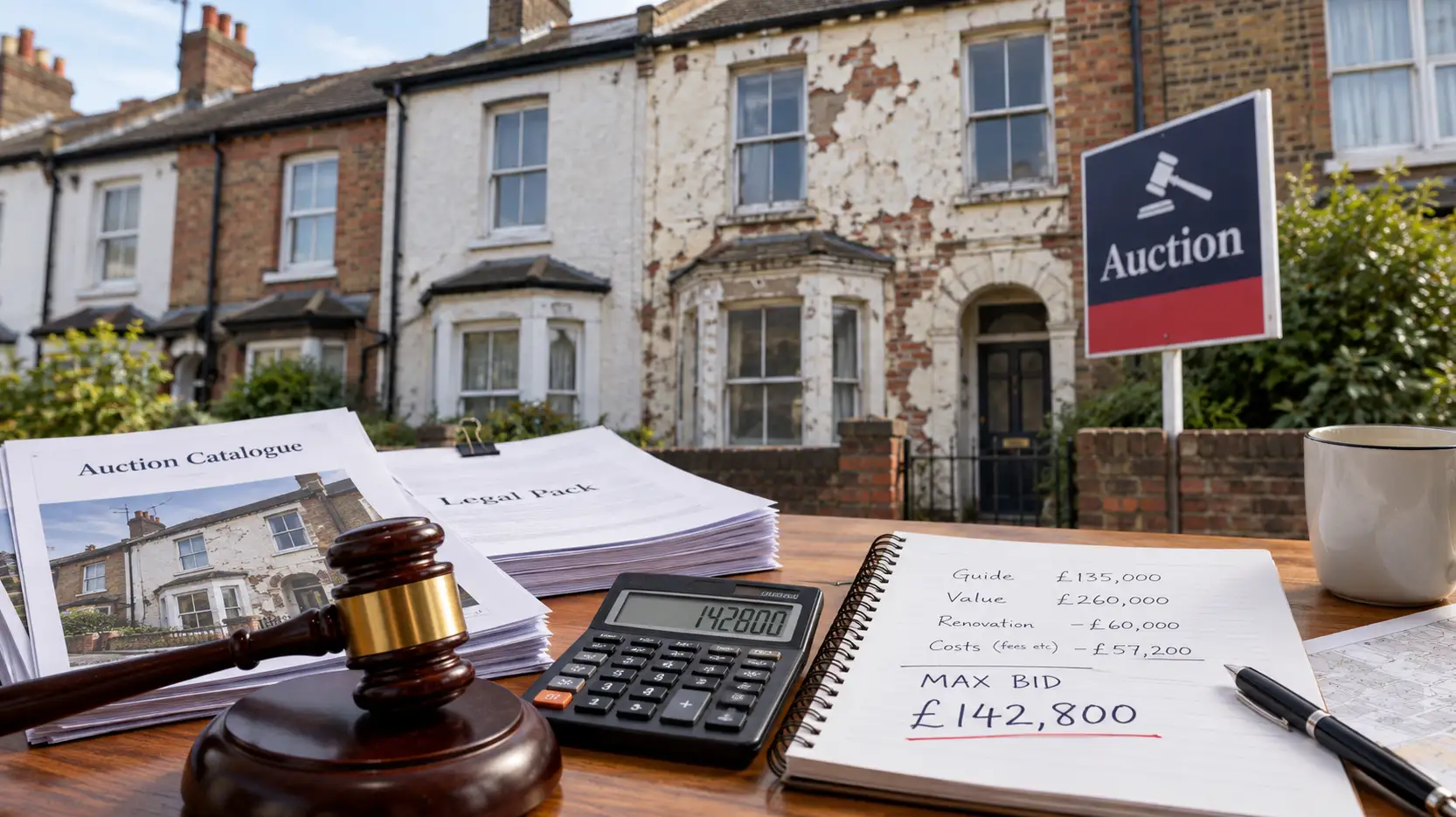
A terraced house in need of complete renovation appears in an auction catalogue with a guide price of £135,000. Fully refurbished houses on the same street sell for around £260,000. On the face of it, that is a gap of £125,000.
Worked through properly, the most a developer should rationally bid for that house on the assumptions below is about £142,800. Every pound above that comes directly out of the planned profit — and under this example costs a little more again because both Stamp Duty Land Tax and the assumed bridging-finance cost rise with the bid.
The gap between those two numbers is the subject of this article. Auction catalogues are full of prices that look cheap in comparison with finished homes nearby. Whether any individual lot is actually a bargain depends on everything that sits between the hammer price and the day the property is worth what the comparison implies. That calculation has to be done before the auction, because once the bidding starts it is too late to do it well.
The worked figures below use an English residential purchase. Property transaction taxes and parts of the auction and conveyancing process differ elsewhere in the UK, but the principle of calculating a maximum price before bidding does not.
What the guide price is actually telling you
The guide price is a marketing figure, not a valuation. RICS’s published professional standard gives a recommended definition under which a guide represents the minimum price at which the seller is prepared to sell at the date of publication, while the reserve is the confidential minimum below which the property will not be sold. The standard also says a guide should be amended if a change in the seller’s minimum acceptable price would otherwise make the published figure misleading. RICS professional standard for real-estate auctioneers
Current ASA/CAP guidance makes the central distinction particularly clear: an auction guide price represents the seller’s minimum expectation and is not a valuation, while relevant non-optional charges should be made sufficiently clear for prospective buyers to understand what can be payable on top of the hammer price. RICS’s standard also reflects the requirement that, where an auctioneer does not routinely update the guide when a higher reserve is set, the explanatory wording should indicate that the minimum sale price falls within the published range or, for a single-figure guide, within 10% of it. ASA/CAP guidance on auction guide prices and charges
The reserve can therefore sit above a single-figure guide. More importantly, neither figure tells you what the property is worth to you. A buyer who starts from £135,000 and asks, “How far above this am I willing to go?” is anchoring on the seller’s marketing. A buyer who starts from what the property will realistically be worth when the work is finished, and works backwards, is anchoring on their own economics.
Working backwards: a developer’s maximum bid
The worked example below is hypothetical. The costs are illustrative assumptions for a property in England bought by an individual as an additional residential property, with the higher rates of Stamp Duty Land Tax applying. Real figures should come from comparable completed sales, builders’ quotations, actual finance terms and a conveyancer’s review of the auction documents.
The £260,000 completed value is the most important assumption in the entire calculation. It should be based on genuinely comparable completed sales rather than the best asking price nearby or an optimistic appraisal. HM Land Registry’s sold-price service is a useful starting point for checking recorded transactions in England and Wales, although the buyer still needs to judge differences in condition, size, specification and exact location. HM Land Registry sold-property price search
Assumptions:
- Realistic completed value: £260,000, based on recent sales of genuinely comparable renovated houses nearby.
- Refurbishment: £45,000, based on quotations rather than generic online averages, plus a 15% contingency.
- Bridging finance: 70% of the purchase price for nine months. Bridging Trends data for the second quarter of 2026 recorded an average monthly rate of 0.81%; the example uses that only as an industry benchmark and assumes a 2% arrangement fee. Actual bridging costs can also include valuation, legal, broker and other charges. Bridging Trends Q2 2026 summary
- Auction buyer’s fee: £1,800 including VAT, assumed for this example.
- Required project profit: £35,000 before the buyer’s own tax treatment — the return required for committing capital, time and risk.
| Working backwards from completed value | £ |
|---|---|
| Realistic completed value | 260,000 |
| Less selling costs on eventual resale | –6,000 |
| Less refurbishment | –45,000 |
| Less 15% refurbishment contingency | –6,750 |
| Less holding costs for nine months | –3,000 |
| Less indicative bridging interest and arrangement fee | –9,290 |
| Less required project profit | –35,000 |
| Left for purchase price and acquisition costs | 154,960 |
| Less buyer’s fee, legal review, conveyancing and survey | –4,500 |
| Left for bid plus SDLT | 150,460 |
| Indicative SDLT at higher rates | –7,625 |
| Maximum rational bid | about 142,800 |
Because finance cost and purchase tax themselves change as the bid changes, this is an iterative calculation rather than a perfectly linear subtraction. Re-running the numbers gives a balancing figure of roughly £142,837; £142,800 is therefore an appropriately rounded maximum for the example rather than false precision.
The reusable principle is straightforward:
Maximum bid = realistic finished value minus every cost of buying, financing, improving, holding and eventually selling the property, minus the return you require — with bid-dependent costs recalculated until the numbers balance.
Two details in that table are particularly worth noticing.
The first is Stamp Duty Land Tax. HMRC’s guidance on auction-house fees includes an example where a buyer agrees to pay the vendor’s auction-house fee and that payment forms part of the chargeable consideration. That does not mean every charge described as a “buyer’s fee” is automatically treated identically; its purpose and contractual wording matter, which is why it belongs in the conveyancer’s pre-auction review. HMRC guidance on auction-house fees and SDLT
At the current higher residential rates for an additional property in England or Northern Ireland, the rate is 5% on the first £125,000 of chargeable consideration and 7% on the portion from £125,001 to £250,000. Those are the rates used in this example. Current residential SDLT rates
The second is that the profit line is not a leftover. It is part of the economics of doing the project. A developer who treats profit as “whatever remains after I win” has no meaningful maximum bid at all.
How quickly the margin disappears
Run the same assumptions with relatively modest changes and the fragility of the auction arithmetic becomes clear.
If the buyer gets carried away and bids £155,000 instead of roughly £142,800, the bid itself rises by a little over £12,000. Once the additional SDLT and higher bridging cost under the same financing assumptions are included, the project cost increases by roughly £13,800. The planned £35,000 project profit falls to around £21,200 before anything else has changed.
If the refurbishment ultimately costs £60,000 rather than the £45,000 base estimate, the £6,750 contingency absorbs only part of that £15,000 overrun. A further £8,250 then comes directly off the remaining margin. Combined with the £155,000 bid, planned profit falls to roughly £13,000.
If the finished house then sells for £245,000 rather than £260,000 because the original comparables proved too optimistic or the market moved during the project, another £15,000 disappears. On these assumptions the project has moved from an intended £35,000 profit to a small loss, before allowing for any additional finance and holding costs caused by delay.
None of those changes is extraordinary on its own. Together they turn an apparent £125,000 gap between guide price and finished value into a deal that no longer works.
That is the reason to be sceptical of apparent auction bargains. Competition can compress the discount until what remains is largely payment for the cost, work, financing and uncertainty involved in turning the auction lot into the finished property rather than money sitting untouched on the table.
Costs that do not appear on the guide
Not every lot carries every one of these costs, but a buyer should rule each one in or out before the auction rather than discover it afterwards.
Fees on top of the price. Buyer’s premiums, administration charges and, in some conditional or Modern Method of Auction sales, reservation fees can materially alter the effective purchase price. Current ASA/CAP guidance expects relevant non-optional charges to be sufficiently clear and the basis of their calculation to be explained.
Seller’s costs passed to the buyer. Special conditions can require the buyer to contribute towards the seller’s legal fees, searches or other costs. The catalogue headline will not necessarily reveal them. Property Front Page’s separate guide to the auction legal pack examines the provisions that can change the economics of a lot before you bid.
Arrears and apportionments. Tenanted property may come with provisions dealing with rent arrears, while leasehold lots can involve service-charge balances, reserve funds or other adjustments on completion. The special conditions and lease documents matter more than the catalogue summary.
Leasehold exposure. A short lease, major works or significant service charges can affect both value and finance. Current government guidance says the cost of extending a lease can increase significantly once 80 years or fewer remain. The Leasehold and Freehold Reform Act 2024 is intended to remove marriage value from the future statutory calculation, but the Government confirmed in September 2026 that further consultation, regulations and legislative changes are still required before those reforms come into force. Government explainer on the lease-extension reforms
The cost of time. Insurance, finance, council tax where payable, utilities and security may look small in isolation but become significant when a refurbishment or resale takes longer than planned.
Finance that does not arrive in time. Unconditional auction contracts operate to fixed completion dates. Under the RICS Common Auction Conditions for England and Wales, where no other date is specified in the special conditions the agreed completion date is 20 business days after the contract date. An individual auction can therefore set a different deadline, while conditional and Modern Method sales operate under different arrangements that need to be checked on their own terms. Property Front Page’s separate guide to financing an auction purchase looks at the funding problem in detail.
One final check belongs immediately before the auction rather than several days earlier: recheck the auctioneer’s addendum and any updated legal documents before bidding. RICS recognises that particulars and legal documentation can change after marketing begins and that those changes may be issued in an addendum before the lot is offered. A maximum calculated from last week’s information is only reliable if the assumptions behind it have not changed.
If you are buying a home to live in
An owner-occupier does not need a developer’s profit line and should not force the decision into one. But they do need a comparison — and the relevant comparison is not the guide price. It is the full cost of the realistic alternative.
Take the same house. Suppose an equivalent renovated home on a neighbouring street can be bought for £255,000. For the owner-occupier, the auction property is only financially cheaper if its total completed cost — hammer price, auction fees, purchase tax at whatever rate applies, refurbishment, contingency, finance and any accommodation costs while the work is carried out — remains sufficiently below that £255,000 alternative to compensate for the additional risk and inconvenience. The ready-to-live-in house has no refurbishment overrun, may be immediately habitable and is likely to be easier to finance through an ordinary residential mortgage.
In effect, the owner-occupier has their own version of the developer’s profit requirement: the saving they need in return for accepting renovation risk, delayed occupation, financing uncertainty and the time involved in managing the work. If that saving has disappeared by the time the bidding reaches their maximum, the auction property may still be the home they prefer, but it is no longer a bargain on price alone.
There are legitimate reasons to pay more than a developer would. A buyer may strongly prefer the street, want to design the renovation themselves, intend to stay for many years or have the skills to carry out some of the work at lower cost. Those are real values, and it can be entirely rational to pay for them. What matters is recognising them explicitly rather than allowing them to justify whatever the bidding happens to reach.
First-time buyers should be particularly careful about finance. Properties requiring extensive work can fall outside an individual lender’s normal criteria, and an agreement in principle does not guarantee that the lender will accept the particular property. That question needs resolving before the bid becomes binding, not afterwards.
The moment the plan meets the room
Auction bidding can create its own momentum. Bids arrive in quick increments, time is short, and the most visible information is what other people appear willing to pay. A buyer who has spent weeks preparing can start to feel that stopping one bid short of winning wastes all the effort already spent.
That feeling is the problem. The survey, legal review, viewing and finance work are spent whether you win or lose. They should not influence how much you pay. Nor should the presence of another bidder. Their willingness to go higher does not tell you the property is worth more to you; they may have cheaper finance, lower refurbishment costs, a completely different plan — or simply a different view of the risk.
The practical remedy is simple. Write down the maximum before the auction and treat it as a decision already made. If necessary, have someone else bid with clear instructions not to exceed it. The RICS auction conditions permit bidding on the seller’s behalf below the reserve where the applicable conditions allow it, so apparent early bidding activity should not automatically be treated as evidence of competing buyers.
So is it a bargain?
Sometimes, yes. Auctions can offer genuine value on properties the ordinary market handles less easily: houses requiring major work, unusual tenure or occupancy arrangements, or sales where certainty and speed matter particularly to the seller. A buyer with the right skills, secure finance and a disciplined number can buy well.
But a property is only a bargain if the price you pay still works once every material cost and risk between the hammer and the finished result has been allowed for. For an investor, that means preserving the return required for the project to be worth doing. For an owner-occupier, it means comparing the full cost and inconvenience of the auction purchase with the realistic alternatives available elsewhere.
The guide price does not answer either question. Your own calculation does — and it has to be done, written down and respected before the bidding starts.
This article provides general property information, not legal, financial, tax, surveying or investment advice for your individual circumstances. Auction conditions, finance, tax treatment and property risks depend on the particular lot and buyer. The worked example is illustrative and uses an English residential purchase. Stamp Duty Land Tax applies in England and Northern Ireland; Wales uses Land Transaction Tax and Scotland uses Land and Buildings Transaction Tax. Have the legal pack reviewed and obtain appropriate professional advice before making a binding auction bid.

