

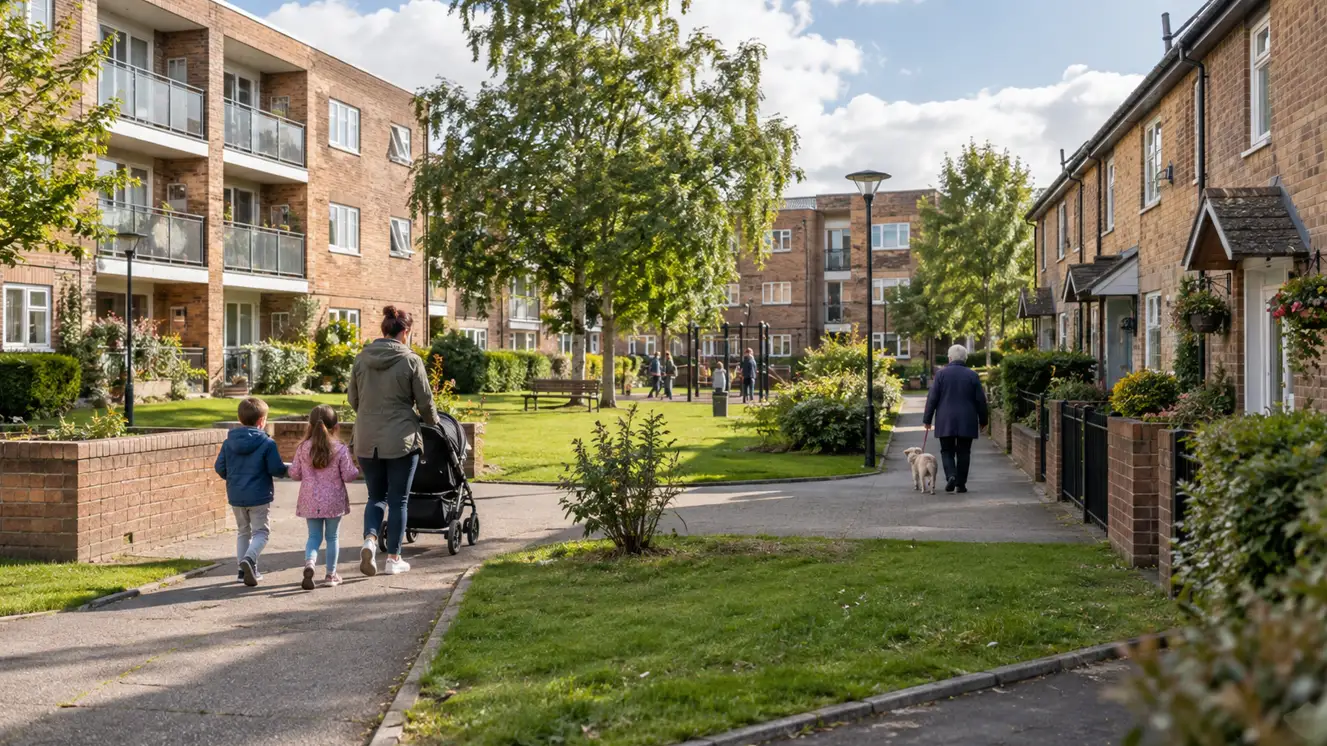
There were 1.34 million households on local authority housing registers in England at 31 March 2025, the highest figure since 2014. During the same financial year, around 263,000 households received a new social letting, including existing social tenants moving between properties as well as people entering social housing for the first time. Meanwhile, just over 12,000 new social-rent homes were delivered through England’s affordable housing supply in 2024/25.
Those figures need reading together rather than treating new construction as though it were the only source of homes becoming available. Most annual lettings come from existing social homes being vacated and relet, not simply from new homes being built. Even so, the imbalance is obvious: demand is extremely high, turnover is limited and new social-rent supply remains small relative to the number of households seeking a home. The government’s latest social housing lettings statistics show the scale of the register and the lettings taking place, while its 2024/25 affordable housing supply figures record 12,198 new social-rent homes delivered that year.
The national waiting-list figure isn’t a perfect measure of unique current need. Councils review their registers at different intervals, some households may remain recorded after their circumstances change, and somebody registered with more than one authority can appear more than once in the national total. But none of that changes the underlying problem: there are nowhere near enough suitable social homes becoming available in many areas to house everybody who qualifies quickly.
That doesn’t mean the system is simply a lottery, though. Understanding how eligibility, local qualification rules, priority and allocation actually interact — rather than assuming joining a waiting list means taking a numbered place in a queue — makes the whole process considerably less baffling, even where the wait itself remains genuinely long.
This article focuses mainly on England, where the detailed allocation rules discussed below apply. Scotland, Wales and Northern Ireland operate different systems, covered separately later in the article.
Eligible is not the same as high priority
This is the distinction that causes the most confusion, and it’s worth stating plainly: being allowed onto a housing register does not by itself say anything about how quickly, or whether, you’ll actually be offered a home.
In England there are effectively several stages to the decision. A council first has to consider whether somebody is legally eligible for an allocation. It can also have local qualification rules within its allocation scheme — around matters such as local connection or residency, subject to statutory restrictions and exceptions — before assessing where a qualifying applicant sits in relation to everybody else who needs housing.
Priority is therefore a separate question from eligibility.
Someone can be entirely eligible, properly registered and still face a wait measured in years because there are applicants with greater housing need ahead of them, or because very few properties suitable for that household become available. Conversely, somebody who joined much more recently can sometimes be rehoused first because their circumstances place them at substantially higher priority.
The numbers show just how unlike an ordinary queue the system can be. Of households who were new to the social rented sector and received a new social letting in England in 2024/25, 56% had been on the housing register in that area for less than a year. That does not mean most applicants can expect to be housed within twelve months; it means waiting time alone does not determine who is housed first. A newly homeless household or someone with an urgent medical or welfare need may legitimately move ahead of somebody who has been registered for considerably longer.
How priority is actually decided
In England, local authorities are legally required to give “reasonable preference” to specified categories of people in housing need. Broadly, these include people who are homeless or owed certain homelessness duties, people living in overcrowded, insanitary or otherwise unsatisfactory housing, people who need to move on medical or welfare grounds, and people who need to move to a particular locality to avoid hardship.
Beyond that statutory framework, each council has its own allocation scheme setting out how it turns those obligations into an actual order of priority. The government’s current allocation guidance for local authorities, updated in April 2026, reflects the amount of local discretion built into the English system.
Many councils use bands, with households grouped into broad levels of housing need. Others use points, or combine priority categories with the date from which that level of priority was awarded. The labels themselves mean very little outside the local scheme: a household placed in “Band A” by one authority cannot safely compare itself with a Band A household somewhere else, because the number of bands, qualifying conditions and priority attached to each one can be different.
This is why advice about social housing becomes unreliable very quickly when it says things such as “Band B usually takes two years” without naming the council, property size and area involved. There is no national Band B.
Applicants do have more rights to understand the decision than the allocation process can sometimes make obvious. In England, councils must make information available that enables an applicant to assess how their case is likely to be treated under the local scheme, including whether accommodation suitable for their needs is likely to become available and, where possible, how long that might take. Applicants also have rights to be told about certain decisions affecting their case and to request a review of decisions about matters such as ineligibility, whether they qualify under the local scheme and factual findings being used in considering an allocation. The government’s guidance on allocation decisions and reviews sets out those protections.
That doesn’t mean disagreement with a band automatically means the council has made an error. But if an application has been assessed using information that is wrong or no longer current — household composition, medical circumstances or some other fact relevant under the scheme — it is worth finding out exactly what decision has been made and what the council’s review process requires rather than simply assuming the original assessment cannot be challenged.
Why an estimated wait can be misleading
Where a council publishes estimated waiting times, they can be useful as a rough indication, but they’re rarely a prediction of what will happen to one particular household.
The property itself matters enormously. A one-bedroom general-needs flat behaves differently from a three-bedroom family house; a four-bedroom property may turn over only occasionally; and an adapted ground-floor home may have both a smaller pool of potential applicants and an even smaller supply of suitable vacancies.
Location changes the calculation again. An applicant willing to consider a much wider area may encounter considerably more vacancies than somebody whose circumstances reasonably restrict them to a small number of neighbourhoods. Two households in the same band, registered at roughly the same time, can therefore experience completely different waits without either application having been handled incorrectly.
For the same reason, the most useful local information is often not a headline “average wait” but the recent pattern of actual lettings for the type of property you need. Where a council or choice-based lettings service publishes previous letting results, seeing which priority band, waiting date or household type succeeded for comparable two-bedroom flats or three-bedroom houses can give a much clearer sense of the competition than one authority-wide average.
It still isn’t a promise. The next property can attract a different set of bidders entirely.
Choice-based lettings: bidding, and why being “first” doesn’t travel
Choice-based lettings are now a major route through which social homes are allocated in England. Rather than simply waiting for the council to select a property, applicants in these schemes see available homes advertised and express an interest — usually described as “bidding”, although no money is involved.
The government’s guide to council housing explains the basic process, but the important point is what happens after the bid.
Applicants are normally shortlisted according to the rules of that council’s allocation scheme, taking account of priority, suitability and often the date from which that priority applies. The person at the top of a shortlist for one property may be much lower down for another because a different group of households has expressed an interest.
So an applicant who sees themselves ranked first, third or twentieth should not think of that number as a permanent national or council-wide position. It belongs to that particular property and that particular group of competing applicants.
That is why being “number one” on one unsuccessful bid does not mean the next advertised home is effectively yours, just as being number thirty on a highly sought-after property does not mean you are permanently thirty households away from being housed.
Council versus housing association: overlapping, not identical
Council homes and housing association homes both sit within the wider social rented sector, but they are not simply the same stock under different branding.
Housing associations are separate landlords — typically private registered providers of social housing — and many are not-for-profit organisations. Their lettings can nevertheless be closely connected to the council’s allocation system because local authorities frequently have nomination agreements giving them access to an agreed proportion of housing-association vacancies.
Under the statutory framework, registered providers are expected to cooperate reasonably with councils over housing people given priority through local allocation and homelessness functions, and nomination agreements can specify how many vacancies are made available and the circumstances in which nominees can be accepted or rejected.
At the same time, the exact route into a housing association home varies. Some properties appear within the council’s own choice-based lettings system, some landlords operate additional letting routes of their own, and arrangements differ between areas and individual providers.
That is why “apply separately to every housing association” is neither universally necessary nor universally pointless. In some areas the council’s register already provides access to much of the relevant housing-association stock; elsewhere additional direct application routes may exist. The useful question is how the providers operating in your area actually allocate their vacancies.
What actually happens if you refuse an offer
This is one area where a single national rule would be actively misleading.
Under an ordinary housing-register allocation scheme, the effect of refusing an offer depends on the council’s published policy. A refusal might simply mean losing that particular property; repeated refusals may affect priority or registration in some schemes; and councils can distinguish between an offer that was genuinely unsuitable and one that met the applicant’s assessed housing needs but was turned down for preference reasons.
Anyone considering refusing an offer should therefore check the actual allocation policy rather than relying on what happened to somebody registered with another council.
There is an additional complication for applicants who are also being dealt with under the homelessness legislation. Refusing social housing in that situation can have consequences separate from whatever the housing-register policy says. In England, a suitable final Part 6 offer can, where the statutory conditions are satisfied, bring a council’s main homelessness duty to an end even if the applicant refuses it. The applicant must be told about the consequences and has a right to seek a review of the property’s suitability. The government’s Homelessness Code of Guidance sets out the distinction.
That makes “should I refuse this?” one of the questions where somebody owed a homelessness duty should be particularly cautious about acting on general internet advice. The consequences can be much more significant than simply waiting for the next advert.
Why the queue behaves the way it does: the supply side
None of these allocation mechanics would create the same level of frustration if suitable supply roughly matched demand. It doesn’t.
England delivered 12,198 new social-rent homes in 2024/25, the highest annual total for more than a decade, but still modest when set against the scale of demand. And national totals hide the problem that applicants actually experience: a new one-bedroom flat in one part of England does nothing for a family waiting for a four-bedroom house somewhere else.
Turnover in existing homes is therefore just as important as new development. Most people receiving a social letting are not moving into a newly constructed property; they are moving into a home that has become vacant within the existing stock.
This also explains why simply comparing the number of people on a waiting list with the number of homes built in a year gives the wrong picture. New construction expands or replaces the stock; vacancies within existing stock produce much of the actual annual flow of lettings. Both matter, and neither currently produces enough suitably located homes of the right types to remove the pressure.
The mismatch becomes particularly visible where one type of property is scarce. A council can have thousands of social homes overall and still have almost no realistic movement for a household requiring a large family house, a wheelchair-adapted property or a home within a very restricted area for compelling welfare reasons.
The UK isn’t one system
Social housing allocation is not a single UK-wide system, and the English rules above should not simply be carried across the border.
Scotland has its own reasonable-preference framework and a materially different relationship between homelessness duties and registered social landlords. Scottish housing associations can receive section 5 referrals from councils for households assessed as statutorily homeless and are generally required to provide accommodation unless specific grounds for refusal apply. The Scottish Government’s social housing allocations guidance sets out that framework.
Wales also operates under its own housing and homelessness rules, which were further changed by the Homelessness and Social Housing Allocation (Wales) Act 2026. Welsh Government allocation and homelessness guidance was updated again in July 2026. The terminology and way local registers, reasonable preference and homelessness responsibilities interact should therefore be checked against the Welsh system rather than assumed from an English article.
Northern Ireland is different again because the Northern Ireland Housing Executive plays a central role in the common selection system used for NIHE and housing-association accommodation. At 31 March 2026, there were 50,381 applicants on the waiting list who did not already hold an NIHE or housing-association tenancy, of whom 39,008 were in “housing stress” — meaning they had reached the points threshold used by the Northern Irish system. The figures are published in the Northern Ireland Housing Bulletin.
The broader principle is therefore UK-wide — scarce social housing has to be rationed according to housing need — but the law, terminology and route to an actual tenancy are not.
Temporary accommodation is a separate, connected system
Being in temporary accommodation and being on a general housing waiting list are connected, but they are not the same legal position.
A household may be placed in temporary accommodation while a council considers or performs duties under homelessness legislation, and some households remain there while waiting for settled housing. Others on the ordinary housing register have never been through the homelessness system at all.
There is an important practical consequence to that distinction. Somebody whose housing is actually breaking down should not assume that the only thing to do is remain on the register and keep bidding. In England, where an eligible person is threatened with homelessness within 56 days, the council can owe a separate prevention duty requiring it to take reasonable steps to help prevent the homelessness. If the person becomes homeless, further relief and, in some circumstances, accommodation duties can follow. The current Homelessness Code of Guidance on the prevention duty explains that separate route.
Making a homelessness application does not guarantee a council tenancy and should not be thought of as a device for jumping the housing register. It is a different statutory process designed for somebody who is homeless or at genuine risk of becoming homeless, and waiting passively for a bidding position to improve can be the wrong response where that situation has arisen.
The distinction also matters because temporary accommodation has its own duties, suitability rules and routes by which those duties can end. It should not be understood simply as a special section of the ordinary waiting list.
The scale of that parallel system has continued to rise. At 31 March 2026, 135,580 households in England were living in temporary accommodation, including 86,460 households with children. The government’s latest statutory homelessness statistics put the number at a record high. Government figures also show around £2.8 billion was spent on temporary accommodation in 2024/25.
Those numbers help explain why homelessness and allocation policy cannot be understood only by looking at the general waiting list. Councils are simultaneously trying to allocate scarce permanent homes and accommodate large numbers of households to whom separate homelessness duties are owed.
Making sense of a long wait
None of this makes an individual wait easier, and it isn’t a substitute for checking the specific council’s published allocation scheme. That document is where an applicant can find the rules that actually determine local qualification, priority, bedroom entitlement, bidding, refusal consequences and review rights.
What understanding the mechanics does offer is a more accurate way of interpreting what is happening.
Being accepted onto the register means you have crossed one part of the process; it does not mean you have joined a first-come-first-served queue. Priority can change as circumstances change. New applicants with more urgent need can move ahead of people who have waited longer. Your apparent position can change from one property to another because the competing bidders change. And even very high priority cannot create a suitable home where no suitable vacancy exists.
That also means an application should not simply be treated as something completed once and then forgotten. Where circumstances materially change, the relevant council needs the information required under its scheme to assess the application on the facts that actually exist. And where a decision about eligibility, qualification or the facts being used to assess priority appears wrong, applicants should look at the authority’s review procedure rather than assuming there is no route to question it.
The 2024/25 lettings figures make the wider point unusually clearly. More than half of households entering social housing who had been registered locally had waited for less than a year, while many other eligible households remain registered for years. That isn’t evidence that the waiting list is random. It is evidence that time waiting is only one part of a system designed primarily around housing need and the suitability of the homes that actually become available.
Underneath all of those rules is the harder problem the allocation system cannot solve by itself: demand for secure, affordable social housing substantially exceeds the number and type of homes becoming available in many parts of the country. A perfectly administered waiting list would still be a long waiting list if the homes aren’t there.
This article provides general information about social housing allocation, focused primarily on England. Scotland, Wales and Northern Ireland operate different legal and allocation systems, while individual councils and social landlords apply local policies that can change. If you are making a decision about an offer, homelessness duty, registration or priority, check the current allocation scheme for the relevant authority and seek housing advice where the consequences could affect your right to accommodation.

