

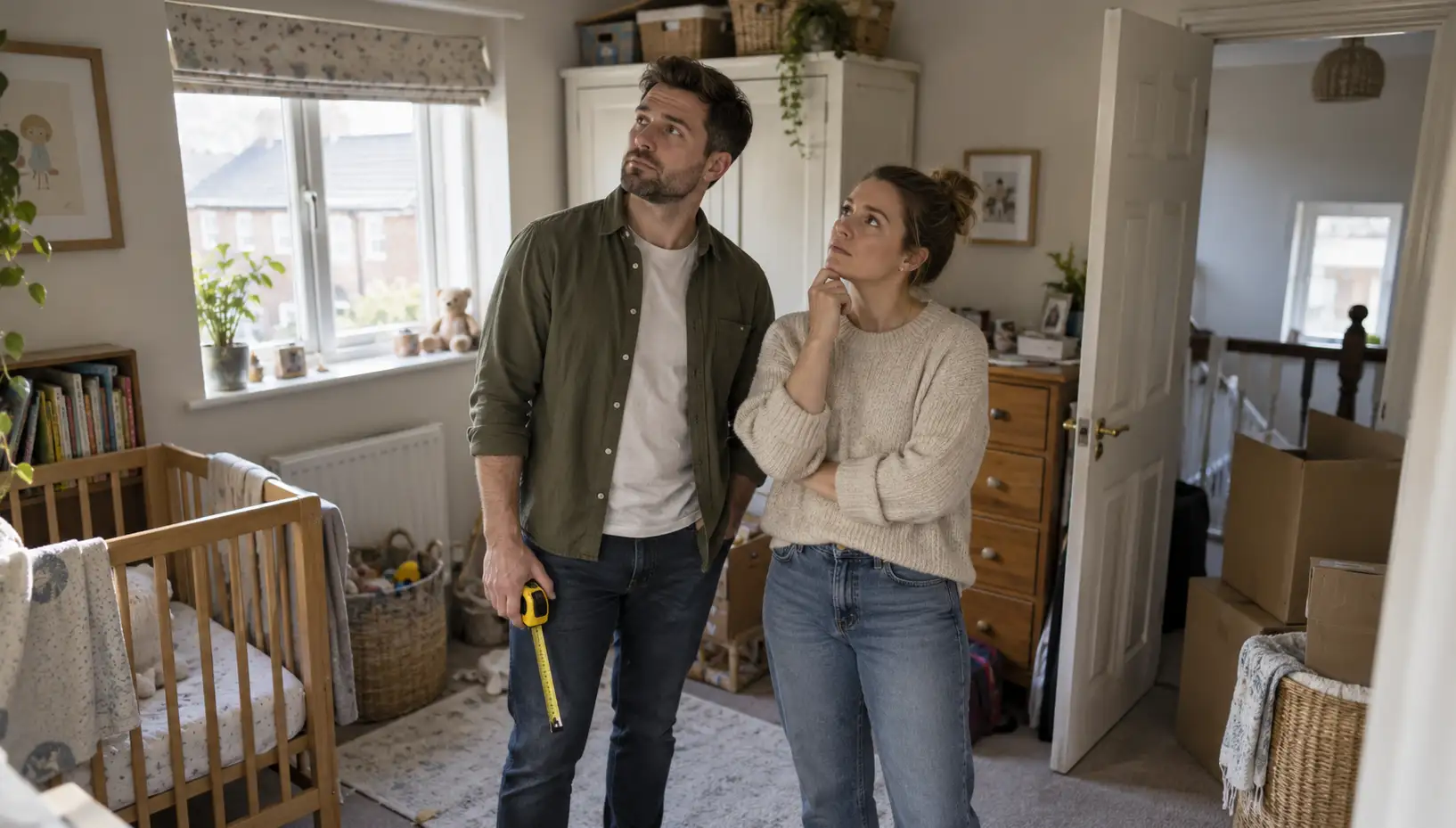
The conversation usually starts the same way: the house has got too small, and there are two doors marked “extend” and “move.” Most people walk through whichever door feels more familiar rather than working out which one actually leads where they want to go. Builders are keen to point out that moving costs a fortune in fees and stamp duty. Estate agents are equally keen to point out that building work is disruptive, expensive and doesn’t always pay for itself. Both are right, some of the time, which is exactly why this deserves a proper comparison rather than a gut decision.
Start with the actual problem, not the square metres
Before comparing costs, it’s worth being precise about what’s actually missing. “We need more space” covers a lot of very different situations: one more bedroom because a third child is on the way, a bigger kitchen because the current one can’t fit a table, a home office that doesn’t double as a spare room, better flow between rooms that currently feel cramped and disconnected, space for a parent moving in, or simply more storage so the house stops feeling cluttered.
This matters because an extension solves some of these problems very well and others not at all. A rear extension is excellent at fixing a poky kitchen. It does nothing for a bad school catchment, a garden that’s already too small, or a commute that’s becoming unbearable. Getting clear on the real problem, before pricing anything, avoids the common trap of buying square metres that don’t actually fix what’s bothering you.
What extending actually costs, roughly
Extension costs vary too much by size, specification, location and site conditions for a single national figure to be particularly useful. Even a relatively ordinary rear extension can move quickly from tens of thousands of pounds into a much larger project once structural work, glazing, a new kitchen, professional fees and finishes are added.
On top of the construction cost, factor in design and professional fees, Building Regulations and any planning-related costs, plus a realistic contingency for things that weren’t obvious before work started.
Then there’s the disruption: dust, noise, tradespeople coming through the property, rooms temporarily out of use and the possibility of the programme taking longer than originally expected.
Our companion article on extension costs breaks down those numbers properly rather than trying to compress them into one misleading national average here.
What moving actually costs, roughly
Moving comes with its own substantial bill before you’ve paid a penny more for the larger house.
HomeOwners Alliance currently puts the average estate agent fee in 2026 at around 1.42% including VAT for a sole-agency sale, although actual fees vary considerably. It also estimates the total cost of buying and selling an averagely priced property in 2026 at around £13,018, including tax, estate agency, conveyancing, survey, mortgage and removal costs. Those figures are useful benchmarks rather than quotes for a particular move, and costs rise with the value and complexity of the transaction.
On the buying side, Stamp Duty Land Tax in England and Northern Ireland is charged in bands. Under the current SDLT rates, a buyer replacing their main home pays nothing on the first £125,000, 2% on the portion from £125,001 to £250,000 and 5% on the portion from £250,001 to £925,000, with higher bands above that.
First-time buyer relief is different: qualifying purchases of £500,000 or less have a £300,000 nil-rate band, with 5% charged on the portion between £300,001 and £500,000.
Add conveyancing, a survey, mortgage fees where applicable, removals and the cost of whatever the new house needs once you’ve moved in, and a move can consume a significant amount of money that isn’t reflected in the difference between the two property prices.
Scotland uses Land and Buildings Transaction Tax rather than SDLT. Its ordinary residential nil-rate band currently runs to £145,000, followed by its own progressive rates; Revenue Scotland publishes the current bands.
Wales uses Land Transaction Tax. Its current main residential rates start with a nil-rate band to £225,000, with the Welsh Revenue Authority publishing the current bands.
Whichever nation the move happens in, calculate the tax for the actual purchase rather than carrying over a figure from another jurisdiction or an old online article.
Neither number tells the whole story on its own
This is the part a simple cost comparison misses.
Money spent extending can create additional usable space and may add value to the property, although the increase in value is not guaranteed to equal what was spent.
Moving costs are different. Estate agency, conveyancing, tax and removals are transaction costs: they enable the move, but don’t themselves improve the house you end up owning.
But moving also delivers something an extension structurally cannot: a different house, in a different place, with a different garden, different neighbours, and potentially a different school catchment or commute.
If what’s actually wrong with the current situation is the location rather than the layout, no amount of well-executed building work fixes it.
Is there a ceiling on this particular house?
Every property and every street has a rough ceiling on what buyers are likely to pay, however good the work.
Overdeveloping — pushing a modest terraced or semi-detached house to a specification and size well beyond what comparable properties nearby achieve — creates the risk of spending more on the project than the local market will recognise in additional value.
There’s no reliable universal percentage rule for this, and confident claims that every extension adds a fixed percentage to a property’s value should be treated cautiously.
A local estate agent can give a useful market view by comparing the property with genuinely similar extended and unextended homes. Where the sums are substantial, a chartered surveyor’s valuation advice can provide a more independent assessment.
The useful calculation is not simply:
What will the extension cost?
It’s:
What will the house realistically be worth afterwards — and am I comfortable with the difference if the project costs more than the value it creates?
That gap isn’t automatically wasted money if you’re buying years of better use from a home you want to stay in. It simply needs to be a conscious decision.
Will an extension actually fix what’s wrong?
It’s worth being honest about whether the current house has limitations an extension genuinely cannot touch.
A cramped kitchen can be fixed. A garden that becomes uncomfortably small once a chunk of it is built over cannot be un-shrunk afterwards.
Insufficient parking, an awkward or already-constrained internal layout, structural limits on what can realistically be altered, a school catchment that no longer fits the family’s needs, or a neighbourhood that’s simply stopped suiting the household — none of these automatically improve because a rear extension has been added.
If the honest answer is that several of these apply, extending may buy short-term relief while leaving the underlying reason for wanting to move fully intact.
The decision isn’t only financial, and that’s fine
Plenty of good reasons to stay have nothing to do with resale value: children settled in a local school, ageing parents nearby, a genuinely loved garden, neighbours who’ve become friends, or simply not wanting the upheaval of starting again somewhere unfamiliar.
These are legitimate factors in a housing decision, not distractions from the “real” financial analysis.
A family that stays and extends a house they love, at a cost that doesn’t fully return at resale, hasn’t necessarily made a bad decision. They’ve made a decision that weighted quality of life above pure financial optimisation, which is a choice worth making consciously rather than by default.
A worked comparison
To make this concrete, consider a hypothetical family in England living in a three-bedroom semi and needing a fourth bedroom and a bigger kitchen-diner.
These figures are deliberately illustrative. They show how to structure the decision rather than predict what either option will cost for a particular household.
Option A: Extend. A single-storey rear extension plus a loft conversion for the fourth bedroom could readily become a project in the broad region of £90,000–£130,000 or more, depending heavily on the size and type of extension, the loft structure, specification, kitchen, professional fees and site conditions.
The family also has to accept several months of disruption and keep enough contingency available for variations or unforeseen work.
Option B: Move. Sell the current home for £350,000 and buy a four-bedroom house for £480,000.
At an illustrative estate-agent fee of 1.42%, selling commission would be about £4,970.
Assuming the existing main residence is sold so that the ordinary SDLT rates apply, Stamp Duty Land Tax on the £480,000 purchase is currently £14,000:
- 0% on the first £125,000 = £0
- 2% on the next £125,000 = £2,500
- 5% on the remaining £230,000 = £11,500
Add typical conveyancing on the sale and purchase, a survey, mortgage fees if applicable, removals, an EPC and other ordinary transaction costs, and a reasonable illustrative total for the move is around £23,000 before any decorating, repairs or improvements to the new house.
HomeOwners Alliance’s 2026 cost-of-moving figures provide current benchmarks for those ancillary costs.
The new house itself also costs £130,000 more than the existing one. How that difference is funded depends on the family’s equity, savings and mortgage position, so it should not automatically be described as £130,000 of extra borrowing.
Set out like this, extending may require less total capital than moving to the £480,000 property — but that still doesn’t make it automatically better.
The real comparison is what the family has at the end.
If £110,000 spent on the existing house produces exactly the home they want, in a location they want to keep, extending may make considerable sense.
If they still have a compromised garden, poor parking, the wrong school catchment and a layout that remains awkward after spending that money, the cheaper option may turn out to have solved the wrong problem.
The question this article is really asking
Not “what’s cheaper,” but “does improving this specific house actually solve my specific problem better than a different house would?”
Where the answer is a straightforward yes — the location’s right, the plot has room, and the only real gap is space — extending can be the sensible route, and our companion articles on extension cost, extension type and loft or garage conversion feasibility go on to help make that project work well.
Where the honest answer involves a school catchment, a commute, a garden that’s already too small, or a neighbourhood that’s stopped fitting, no extension fixes that, however well it’s built.

