

“Everyone can build an extension without planning permission, can’t they?” No. Permitted development is a national grant of planning permission, but it isn’t a flat, uniform entitlement that attaches equally to every house in the country.
Specific rights can be withdrawn by an Article 4 Direction, restricted by conditions attached to an earlier planning permission, reduced by the property’s location, or unavailable because of the type or planning history of the dwelling itself. Previous development can also affect how much further work still fits within the permitted development limits.
A homeowner who assumes their situation matches a neighbour’s, a friend’s, or a generic online guide can end up designing — and sometimes starting — a project that was never actually permitted development at all.
This article focuses on the position in England and on establishing what your specific property actually has before assuming the general rules apply unchanged.
Article 4 Directions
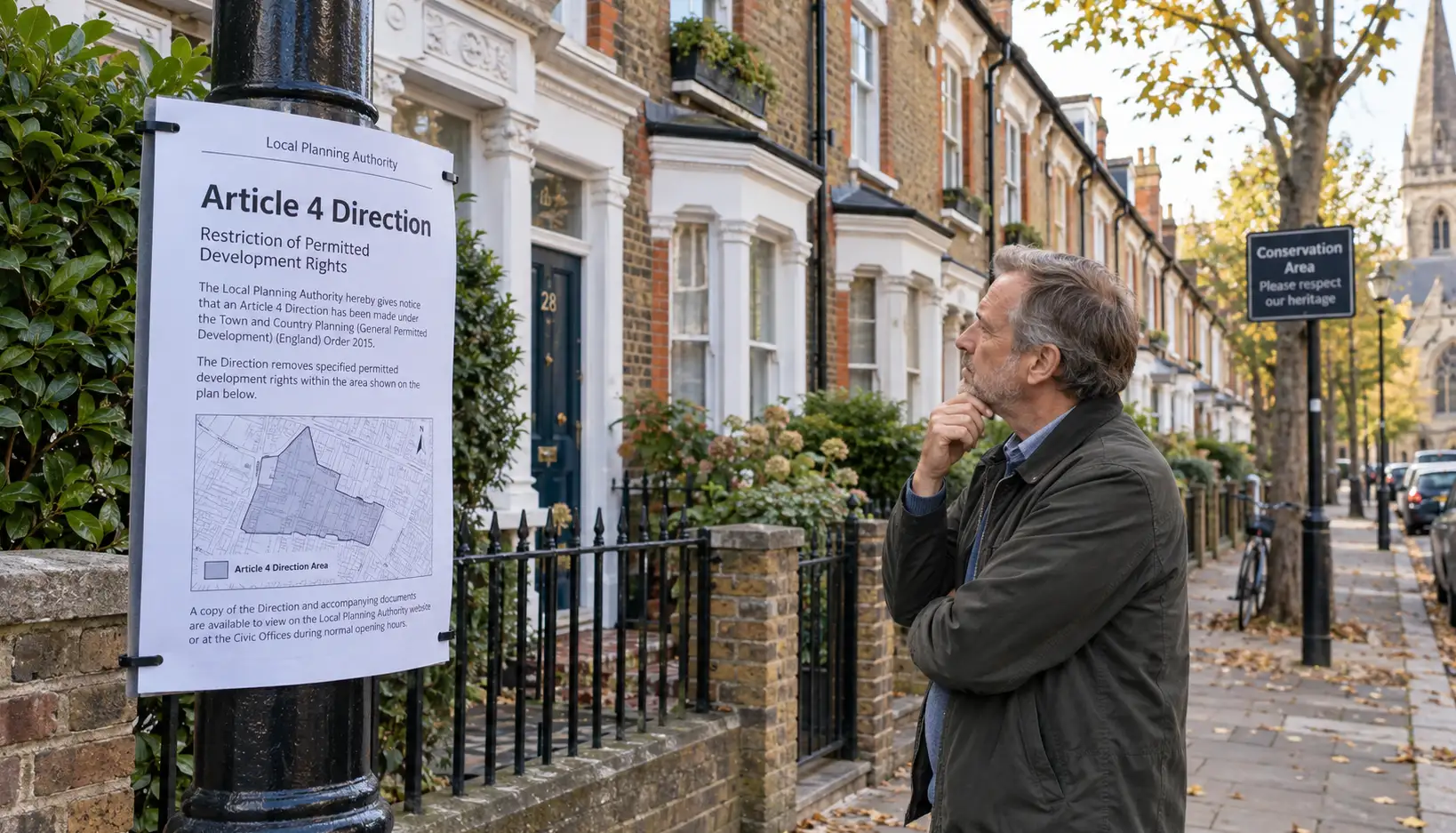
An Article 4 Direction is a direction made by a local planning authority that withdraws one or more specified permitted development rights from a defined area, type of development or, in some cases, particular site.
It doesn’t remove every right automatically. A Direction targets the development identified within it. That might mean certain alterations to houses in a conservation area require planning permission where they ordinarily would not, or that the permitted development right to change a house into a small house in multiple occupation has been withdrawn within a particular neighbourhood.
Current national policy expects Article 4 Directions to be targeted and justified rather than used as a blanket restriction without good reason.
Where a Direction applies, work falling within the right that has been withdrawn requires a planning application. The Direction doesn’t necessarily mean the development is unacceptable; it means the council gets to assess it through the planning application process rather than permission being granted automatically by the GPDO.
The government’s Article 4 guidance explains how these restrictions operate.
The important practical point is to check the actual Direction and map, not merely whether someone has told you the property is “in an Article 4 area”. You need to know which permitted development right has been withdrawn and whether your proposed work falls within it.
Planning conditions on an earlier permission
Permitted development rights can also be restricted by a condition attached to a planning permission for the property.
This sometimes happens where a council considers that allowing particular alterations later without further control would undermine something important about the development it approved — for example, its design, layout, amenity or another site-specific consideration.
But conditions removing permitted development rights aren’t supposed to be imposed automatically. National policy says there should be clear justification, and government guidance says the condition should identify precisely which rights are being limited or withdrawn.
That means the relevant restriction may not simply appear as a broad statement that “permitted development rights are removed”. It may refer to particular classes within the General Permitted Development Order.
And it isn’t only the original permission for an estate that can matter. A relevant restriction may appear on the original or a subsequent planning permission affecting the house.
The government’s guidance on planning conditions explains the limits on using conditions this way.
For a property with a planning history, reading the actual decision notices and conditions is therefore considerably safer than assuming the age or appearance of the house tells you what rights it has.
Conservation areas and other designated land
Some permitted development rights are restricted on what the England GPDO calls Article 2(3) land.
This includes:
- conservation areas;
- National Parks;
- the Broads;
- World Heritage Sites;
- Areas of Outstanding Natural Beauty, now generally known publicly as National Landscapes.
The effect depends on the particular permitted development class.
For example, the larger home extension route isn’t available on Article 2(3) land. Roof enlargements under the ordinary Class B loft-conversion right are also excluded, while other householder rights have more limited restrictions.
It’s therefore worth being precise: designation doesn’t mean every alteration suddenly requires planning permission.
Plenty of permitted development rights can survive, but sometimes in a more restricted form. The mistake runs in both directions — assuming nothing has changed can be wrong, but so can assuming the designation removes everything.
The government’s householder permitted development technical guidance sets out the principal England restrictions.
Listed buildings
A listed building brings a separate consent regime into the equation.
Some permitted development rights are themselves restricted where listed buildings or their curtilage are involved. But even where a particular proposal may not require a conventional planning application, listed building consent can still be required if the work would affect the building’s character as a building of special architectural or historic interest.
That distinction is important because planning permission and listed building consent answer different legal questions.
Carrying out works requiring listed building consent without obtaining it is a criminal offence, and there is no statutory time limit equivalent to the ordinary planning-enforcement periods for issuing a listed building enforcement notice.
Historic England’s listed building consent guidance explains when the separate consent may be required.
This article doesn’t attempt to cover listed building consent in depth — it deserves its own dedicated treatment — but the headline point is simple: owning a listed building changes the level of checking required, and ordinary householder permitted development assumptions should not be applied casually.
Flats and maisonettes
The familiar householder permitted development rights in Part 1 of the GPDO apply to dwellinghouses, not flats and maisonettes.
A flat owner therefore does not have the same ordinary rights to extend, carry out roof enlargements or build garden outbuildings that may be available to the owner of a house, even where the physical circumstances look similar.
That doesn’t mean flats can never benefit from any permitted development right. Separate rights elsewhere in the GPDO can apply to particular types of development.
The useful distinction is that the standard householder permitted development allowances described throughout this section should not simply be transferred from a house to a flat.
Homes created through a change of use
Where a dwelling was created through certain permitted development change-of-use routes, the resulting home may not benefit from the ordinary Part 1 householder permitted development rights that apply to a conventionally created house.
Current guidance also identifies restrictions affecting some homes created through permitted development rights for new dwellinghouses under Part 20.
That can produce a genuinely counter-intuitive result: two homes that now look broadly similar can have very different rights because of how they became homes in planning law.
A relatively new dwelling created from an office, shop, agricultural building or another former use should therefore not be assumed to carry the same extension, roof and outbuilding rights as the conventionally built house next door.
The Planning Portal’s extension guidance identifies the main categories excluded from the ordinary householder extension rights.
Previous planning permissions on the site
The wider planning history of a property can matter for more than one reason.
A permission may contain a condition withdrawing a particular permitted development right. A later permission may also have altered the house in a way that affects the physical calculations for future permitted development.
That makes the council’s planning register useful even where you’re not looking for an application specifically approving the project you now want to build.
For newer estates in particular, finding the original development permission and reading its conditions can reveal restrictions that aren’t obvious from looking at the property itself.
Previous alterations already made
As our companion article on extension limits sets out in more detail, previous alterations can affect what remains possible under permitted development.
For example, an existing extension joined to a proposed new extension can form part of the total enlargement used when applying the Class A dimensional limits. Existing extensions and outbuildings can also count towards the 50% curtilage-coverage rule.
That applies whether you carried out the earlier work or a previous owner did.
But it is better not to think of every alteration as permanently “using up” a fixed allowance. Different permitted development classes use different tests, and something that has genuinely been demolished does not necessarily continue to count as though it were still standing.
The practical question is what currently exists, what the original house was, and which particular permitted development rule the new proposal is trying to use.
A house that’s already heavily extended, sits in a conservation area and is affected by an Article 4 Direction may therefore have considerably less straightforward permitted development potential than a superficially similar property nearby.
A sensible sequence for checking
Before designing around an assumed permitted development right, work through the property itself rather than starting with the maximum measurements in a generic guide:
- Check the property’s planning history. Look for the original permission, later applications and any conditions affecting future development.
- Check for an Article 4 Direction. Use the council’s current Article 4 information and map, then identify exactly which rights have been withdrawn.
- Check the property’s status and location. Establish whether it is listed, in a conservation area, or on other Article 2(3) land.
- Establish how the dwelling was created. This matters particularly for flats, converted buildings and homes created through certain permitted development routes.
- Establish the original house and what has changed since. Previous extensions and outbuildings may affect the calculation for the work now proposed.
- Check the actual permitted development class. Don’t stop at “the house has PD rights”; confirm that the particular right you want to use still applies and that every relevant limit and condition is satisfied.
Where genuine uncertainty remains after those checks, consider getting advice from the local planning authority or an appropriate planning professional.
If formal proof matters, a Lawful Development Certificate can provide a statutory determination that proposed development would be lawful rather than leaving the conclusion as a private interpretation.
The buyer’s version of this problem
This matters as much, if not more, before a purchase as it does afterwards.
A large, unextended garden looks, superficially, like obvious potential — but a large garden says nothing on its own about whether an Article 4 Direction, a planning condition, a conservation designation, the way the dwelling was originally created or the property’s specific history has reduced what can be done without making a planning application.
Buyers weighing up a purchase partly on the strength of future extension potential are, in effect, making a financial decision based on an assumption that’s worth verifying before exchange, not after.
Limited or absent permitted development rights don’t automatically mean an extension can never be built. A planning application may still succeed. But that changes the process, cost, timing and certainty of plans on which a purchase decision may be resting.
Before designing anything
The starting question for any project should not be “what does permitted development generally allow?”
It should be: “what does permitted development allow here, on this specific house, given its type, designation, conditions and history?”
The general rules, covered in our companion articles on extension limits and the prior approval process, tell you what may be possible under the national permitted development regime.
Whether this particular property actually benefits from the right you want to use is a separate question — and it’s worth answering properly before spending money designing around an assumption.

