

“You don’t need planning permission for that” is one of the most repeated, and most misleading, sentences in home improvement. What’s usually meant is: you don’t need to apply for it.
In England, the permission already exists. Government has granted it in advance through the Town and Country Planning (General Permitted Development) (England) Order 2015 — usually shortened to the GPDO — and like any grant of planning permission, it comes with limits and conditions attached. Miss one of those requirements, and the work simply isn’t permitted development under that right, whatever anyone assumed going in.
This is the concept worth getting straight before looking at any specific project: permitted development is not a planning-free zone. It’s planning permission granted nationally for defined categories of development that do not require a conventional planning application, provided the work stays within the detailed rules that apply.
The government’s householder permitted development technical guidance explains how the main England rules operate.
What permitted development can potentially cover
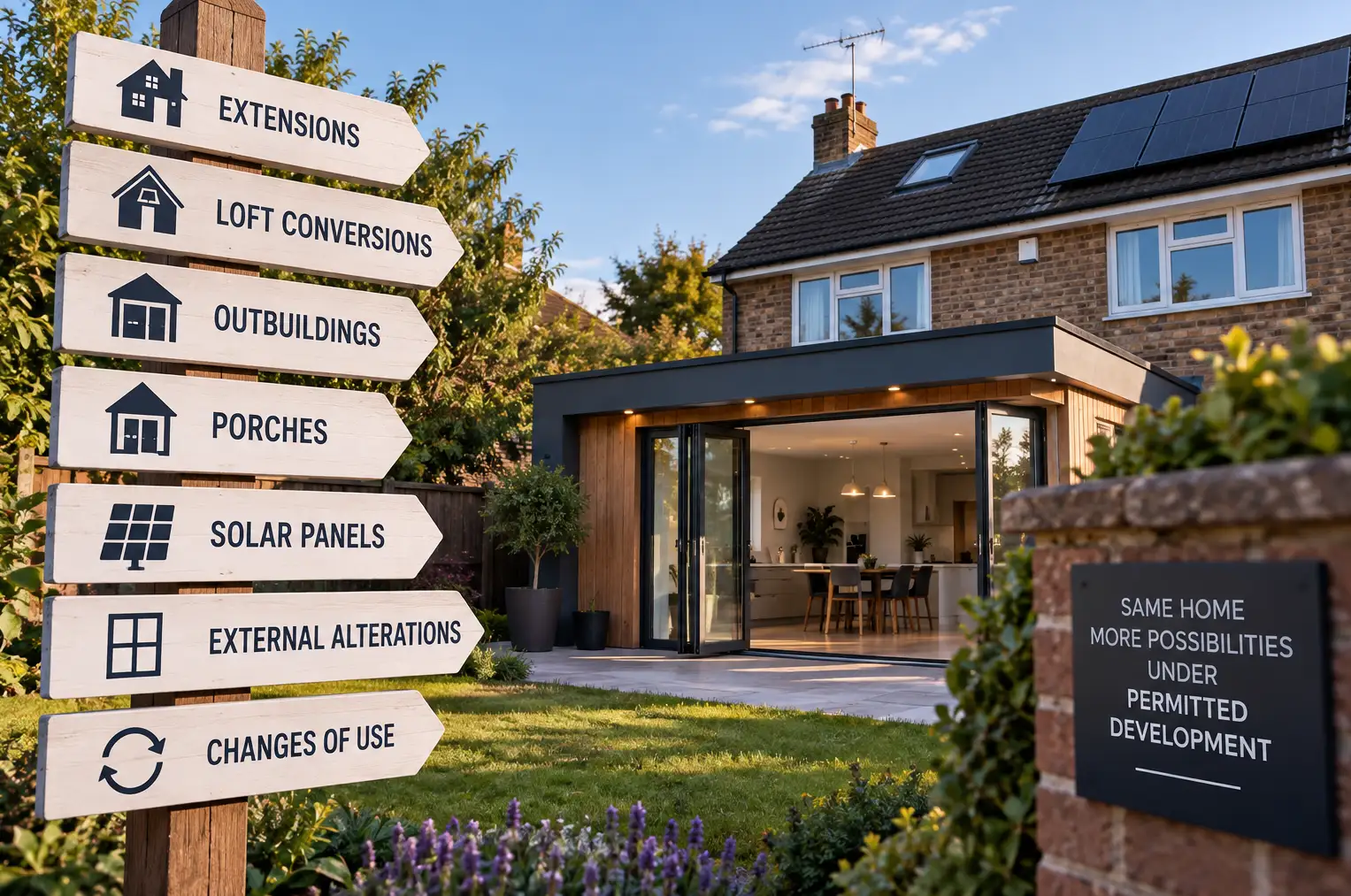
The General Permitted Development Order grants a wide range of rights, and different classes within it cover different kinds of work. For an ordinary homeowner, the ones that come up most often include:
- rear and side extensions to a house;
- loft conversions and other roof alterations;
- porches;
- garages and outbuildings in the garden;
- solar panels and some other renewable installations;
- certain external alterations;
- some changes of use, in specific circumstances.
Each of these sits under its own class or part of the Order, with its own limits and conditions, and satisfying one class’s rules tells you nothing about another. A garden office that qualifies as permitted development doesn’t mean a loft conversion on the same house automatically will, and vice versa.
Some permitted development rights also require prior approval from the council before work starts, so even where a full planning application isn’t needed, that does not necessarily mean there is no application process at all.
This article introduces the concept; our companion piece on extension limits goes into the rear and side extension rules in detail.
A handful of terms worth knowing
Planning language can be off-putting, and a lot of it isn’t necessary for a general understanding. A few terms genuinely do matter, though, because they turn up in almost every permitted development question:
Original house — the property as it was first built, or as it stood on 1 July 1948 if it existed before then. This is an important baseline for many permitted development calculations, not simply the house as it stands today.
Curtilage — broadly, the land forming part and parcel of the house and used with it, commonly including its garden or driveway. It is a fact-specific planning concept rather than simply everything within the same Land Registry title. A field, paddock or other adjoining land is not automatically part of the residential curtilage just because it has the same owner.
Principal elevation — usually the elevation containing the main architectural features of the house and facing the main highway serving it. It will often be what most people think of as the front of the house, but that isn’t an absolute rule, particularly on unusual or corner plots.
Designated land — a shorthand often used when explaining locations where particular permitted development rights are more restricted. In the England householder rules, relevant protected areas include conservation areas, National Parks, the Broads, World Heritage Sites and Areas of Outstanding Natural Beauty, now generally branded as National Landscapes. The restrictions vary according to the particular permitted development class.
Article 4 Direction — a direction that can withdraw specified permitted development rights from a defined area or site. It doesn’t remove every permitted development right automatically: you need to know exactly which right the direction covers. The government’s Article 4 guidance explains how these directions operate.
Prior approval — a formal council process that some permitted development projects still have to go through before work starts, even though no full planning application is needed. The council can consider only the particular matters specified for that permitted development right. This confuses a lot of people, understandably, and we’ve given it a dedicated article of its own.
Lawful Development Certificate — a formal decision confirming that particular existing or proposed development is lawful for planning purposes. It isn’t generally a requirement before carrying out permitted development, but it can provide useful formal evidence of the position. Our dedicated article explores when obtaining one is worth considering, while the government’s Lawful Development Certificate guidance explains the legal process.
Why “the original house” matters more than people expect
Permitted development limits are often measured by reference to the original house rather than simply the building as it stands today — and previous alterations can therefore affect what remains possible.
If a past owner has already enlarged the house, that earlier development can reduce what can now be added under particular permitted development limits. Previous extensions and other buildings can also count towards rules such as the limit on how much of the curtilage may be covered.
This surprises a lot of buyers, who reasonably assume their own permitted development allowance starts fresh when they take ownership. It doesn’t. The property carries its development history with it, which is one of several reasons it’s worth checking a property’s planning record and physical history before assuming what can still be built.
What permitted development doesn’t replace
Qualifying for permitted development answers one specific planning question — whether the proposed work can rely on an existing grant of planning permission rather than requiring a conventional planning application — and it doesn’t answer several others that may still apply to exactly the same piece of work:
- Building Regulations approval is a separate legal regime covering matters such as structural safety, fire safety, insulation and ventilation. Where Building Regulations apply, permitted development status does not remove those requirements.
- Party Wall procedures under the Party Wall etc. Act 1996 in England and Wales may apply where work falls within the Act. They are separate from planning permission.
- Listed building consent may be required where work to a listed building would affect its character as a building of special architectural or historic interest, whether or not planning permission is separately needed. The government’s listed building guidance explains the distinction.
- Restrictive covenants attached to a property’s title are private legal obligations unaffected by the fact that planning law permits the development.
- Lease or freeholder consent, for leasehold properties, may be a separate contractual requirement.
- Highway authority approval may be needed for work such as constructing a vehicle crossing or altering a kerb. Depending on the particular road and works, planning permission may also be required.
None of these should be assumed to disappear simply because the planning work qualifies as permitted development. Treating “it’s permitted development” as the only box to tick is a common and avoidable mistake.
Flats and maisonettes are a different story
The ordinary householder permitted development rights in Part 1 of the England GPDO belong to dwellinghouses in the relevant planning sense. They do not apply to flats and maisonettes in the same way.
That does not mean a flat can never benefit from any form of permitted development right. Separate rights exist for some specific types of development — including, subject to their own conditions, certain solar installations — but a flat owner should not assume that the familiar extension, loft and house-alteration rules available to an ordinary house apply to their property.
This is a frequent source of disappointment for flat owners who’ve seen a neighbouring house extended without an apparent planning application, without realising the comparison doesn’t hold.
If you’re buying, not building
“Potential to extend, subject to planning permission” is a common phrase in estate agent listings, and it’s worth reading exactly as written: a statement of possibility, not confirmation that permitted development rights exist on that specific property.
A generous garden says nothing on its own about whether the current owner, let alone a buyer, actually has the right to build in it without applying.
Article 4 Directions, conditions attached to an earlier planning permission, previous extensions and the property’s particular development history can all restrict what would otherwise be possible. Some houses created through particular permitted development change-of-use routes also do not benefit from the ordinary Part 1 householder rights in the same way as a conventional house.
That makes permitted development potential something to investigate rather than assume where an intended extension or conversion is an important part of a purchase decision — a subject our companion article on property-specific permitted development risk covers in depth.
This differs by nation
Permitted development is devolved. This article, in common with most of this subcategory’s launch coverage, focuses on England, where the Town and Country Planning (General Permitted Development) (England) Order 2015, as amended, provides the framework described above.
Wales operates under its own version of the permitted development regime, with householder guidance available from the Welsh Government.
Scotland has its own GPDO and materially different householder rules. The Scottish Government’s current householder permitted development guidance was published in 2024.
Northern Ireland operates under the Planning (General Permitted Development) Order (Northern Ireland) 2015 and its subsequent amendments.
A rule learned from an English case, or from an English homeowner forum, therefore shouldn’t be assumed to transfer to a property in Cardiff, Edinburgh or Belfast. Check the rules for the jurisdiction the property actually sits in.
The one idea worth keeping
Permitted development can make ordinary home improvement genuinely simpler, and for many straightforward projects it does exactly that.
But it still operates within a detailed, property-specific planning framework — and “I probably don’t need to apply” is a very different, much riskier statement than “I’ve checked this against the actual rules for this house.”
Our companion articles walk through the extension limits themselves, when it’s worth paying for formal proof of lawfulness, how prior approval fits into the picture, and the property-specific circumstances that can remove rights you might otherwise assume you have.

