

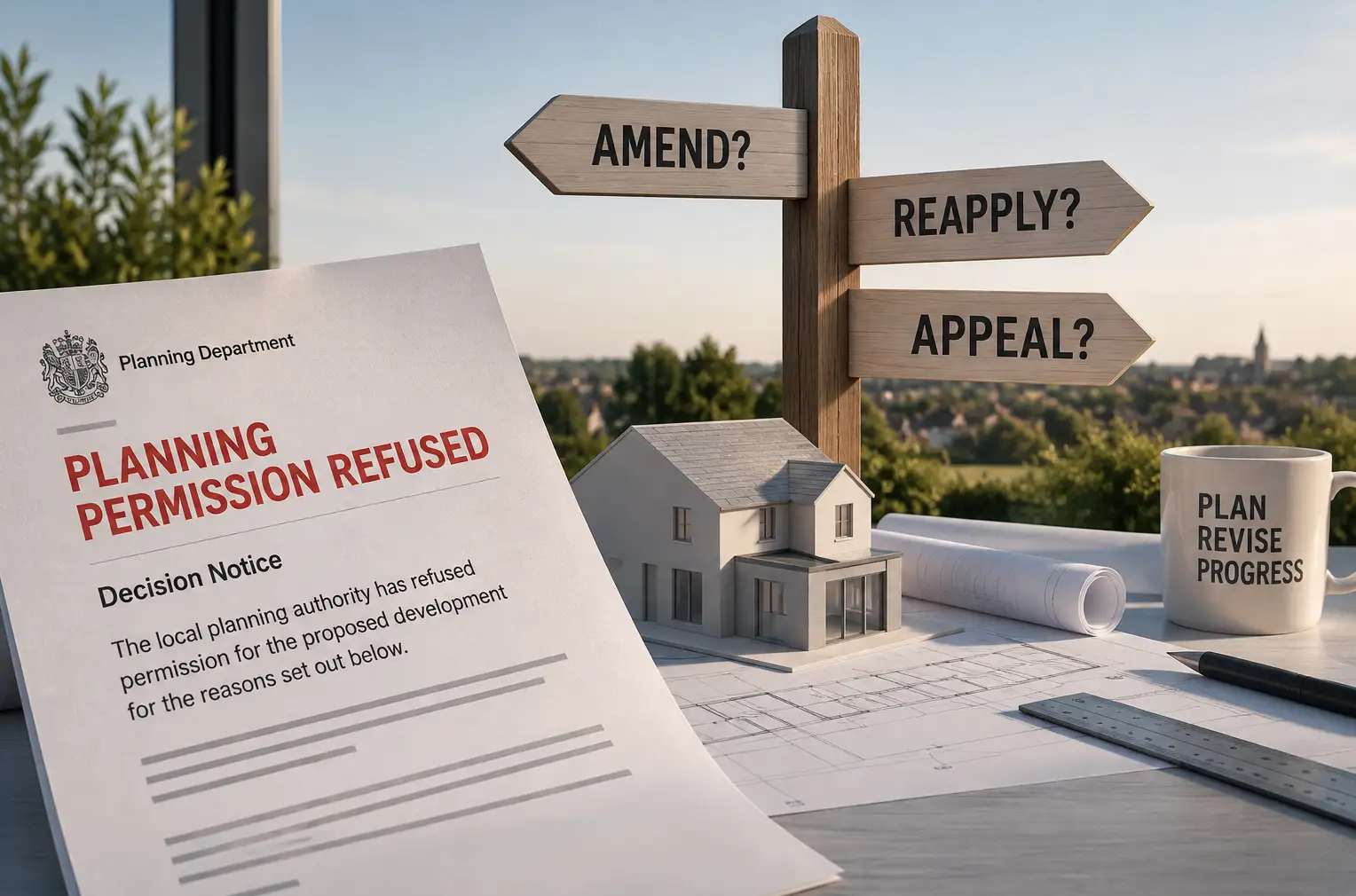
The decision notice lands, and the instinct for a lot of people is either to give up entirely or to appeal immediately on principle, because refusal feels unfair. Neither is usually the right first move. The single most useful thing you can do with a refusal is read it properly, because the reasons for refusal tell you something specific: whether the council is objecting to this particular design, or to the principle of building something here at all. Those are very different problems, and they often call for very different responses.
Read the reasons for refusal before you decide anything
Every refusal notice sets out formal reasons, usually with reference to specific development plan policies. It’s worth working through each one and asking a simple question: is this a design problem, or a policy problem?
A design problem might read something like “the proposed rear extension, by reason of its scale and proximity to the shared boundary, would result in an unacceptable loss of light and an overbearing impact on the amenity of the neighbouring property.” That’s specific, and it points fairly directly at what would need to change — reduce the scale, move it away from the boundary, alter the roof form.
A policy problem reads differently: “the proposed development, being outside the settlement boundary, represents an unsustainable form of development contrary to policy [X] of the Local Plan.” That’s not primarily a comment on your drawings. It’s a comment on whether development of that kind is acceptable there at all, and a cosmetic redesign is unlikely to resolve it.
That distinction is a useful starting point rather than an absolute rule. A design judgement can sometimes be worth appealing if you believe the council has assessed the impact unreasonably, while some policy objections can be addressed through a materially different proposal.
Officer reports, where available, often add useful context beyond the bare reasons on the decision notice itself — it’s worth reading the full report, not just the notice, before deciding your next move.
Amend, reapply or appeal?
| What the refusal is really saying | Route most worth considering |
|---|---|
| The scheme is too large, too close, overlooks a neighbour or has another identifiable design problem | Redesign and submit a new application |
| A technical issue could be fixed with revised access, landscaping, drainage or supporting evidence | Usually revise and reapply |
| The council’s objection goes to the principle of development or its interpretation of policy | Consider specialist advice and whether an appeal is justified |
| You believe the council’s judgement on design or amenity is unreasonable and the submitted evidence already supports your case | An appeal may be worth considering |
| Important evidence was missing from the original application | Usually make a new application rather than relying on the appeal to repair the case |
When redesigning is the sensible answer
Where the refusal is genuinely design-led, amending the scheme and resubmitting is often the fastest and cheapest route back to a permission. Common, effective changes include reducing overall scale or footprint, altering roof form or window positions to address overlooking, pulling development back from a boundary, upgrading proposed materials in a sensitive area, or resolving a highways or parking objection through revised access or layout.
It’s worth being honest with yourself, or with whoever’s advising you, about whether the proposed changes genuinely address the stated reason for refusal, rather than simply being changes you’re willing to live with. A resubmission that doesn’t actually engage with the council’s stated objection is likely to be refused again, at the cost of a further fee and further delay.
Resubmitting: what it costs now
It used to be possible in certain circumstances to resubmit a revised scheme without paying another application fee — the so-called “free go”. That repeat-application fee exemption was removed in England from 6 December 2023.
For a resubmission made now, you should therefore normally expect to pay the applicable planning application fee again unless a separate statutory exemption or reduction applies. Planning fees are also subject to change, so check the current fee before submitting rather than relying on an old figure.
The relevant change was made through the 2023 amendments to the planning application fee regulations.
Appealing: what’s actually involved
If the objection is one of policy principle, or if you genuinely believe the council has misapplied policy or reached an unreasonable planning judgement on the evidence before it, an appeal to the Planning Inspectorate may be the more appropriate route.
It’s worth being clear about what an appeal is. It isn’t a second attempt to charm the same decision-maker. For most appeals, an independent planning inspector determines the planning merits of the proposal, applying the development plan and other material considerations. An appeal is therefore a way of challenging the refusal of the scheme you actually submitted, not simply a chance to redesign it once the council has said no.
Time limits are strict. For an appeal against refusal of a householder planning application in England, the Planning Inspectorate must normally receive the appeal within 12 weeks of the date on the decision notice. Minor commercial refusal appeals also generally have a 12-week limit. For most other planning appeals, the limit is six months.
Where an enforcement notice has been served in relation to the same or very similar development, a much shorter deadline can apply — in some circumstances 28 days. The Planning Inspectorate’s current procedural guide sets out the different deadlines.
If the relevant deadline is missed, the Planning Inspectorate will not accept the appeal. A fresh planning application may then be the practical route if the proposal can still be pursued.
The appeal rules changed in 2026
For appeals relating to planning applications submitted on or after 1 April 2026, the written-representations process changed significantly.
Most of these appeals start under the new Part 1 written-representations procedure. Under that procedure, the appellant normally cannot introduce evidence that the local planning authority had not already considered when it determined the application.
The Inspector will generally work from the original application, its supporting material, interested-party comments, the decision notice, the officer report and other documents already forming part of the case. There are limited exceptions where circumstances have materially changed — for example, a relevant change in planning policy, a new court judgment or a significant new planning decision.
That matters enormously in practice. If what you now need is a new technical report, a materially altered design or evidence that should reasonably have been supplied with the original application, a fresh application will often be the better route. The appeal process is no longer something applicants should assume they can use to repair a weak original submission.
How long an appeal takes
Appeal times vary considerably by case and procedure, so broad online estimates can become outdated quickly.
As a current benchmark, Planning Inspectorate figures for cases decided in June 2026 showed a median of about 12 weeks for householder appeals, 17 weeks for section 78 planning appeals decided by written representations, 19 weeks for hearings and 27 weeks for inquiries.
Those are medians, not service guarantees, and individual cases can take much longer. The Planning Inspectorate publishes current appeal timescales, which are more useful than relying on a figure quoted in an older article.
There is normally no Planning Inspectorate application fee simply for making an ordinary planning appeal, but each party usually bears its own professional and other costs. Costs can be awarded against a party where unreasonable behaviour causes another party unnecessary expense.
What an appeal doesn’t do
An appeal is not normally a route for substituting a substantially different scheme for the one the council refused. If the changes needed to make the development acceptable materially alter the proposal, the proper route is generally a fresh planning application.
Under the new Part 1 procedure in particular, amendments and new evidence are tightly restricted. Even under other appeal procedures, substantial amendments can create fairness problems because neighbours, consultees and the council may not have had an opportunity to consider the changed scheme.
An Inspector can dismiss the appeal and uphold the refusal, allow it and grant permission, or allow it subject to conditions. The Inspector may also identify a planning issue beyond the council’s stated reasons, but procedural fairness requires affected parties to have an appropriate opportunity to address any new issue that could be decisive.
An appeal therefore carries a genuine possibility of confirming the original refusal, not simply a chance of overturning it.
Talking to the council before you resubmit
Discussing the reasons for refusal directly with the case officer, where an authority offers this, can be a genuinely useful step before committing to a redesign or a resubmission. Officers may be willing to explain which elements caused the problem and whether particular changes appear capable of addressing their concerns.
This isn’t a guarantee of approval, and no officer can bind the authority to a future decision in advance, but it can save a wasted redesign.
The Planning Inspectorate’s own guidance encourages applicants who believe amendments could overcome the reasons for refusal to consider a new application, and says local planning authorities should be open to discussing whether an amended proposal is likely to be viewed more favourably.
Getting professional advice at this stage
A planning consultant’s advice tends to be at its most valuable precisely at this point — reading a refusal accurately, judging whether it’s genuinely arguable on appeal, and building a case that engages with the specific reasons given rather than restating the original application with minor tweaks.
Our companion article on choosing an architect or planning consultant covers how to weigh up whether that spend is justified for your situation; the short version is that the more the refusal turns on policy interpretation or contested planning judgement rather than a straightforward design defect, the more that kind of specialist judgement can earn its fee.
The question worth asking yourself
Is the refusal telling you the design needs to change, or telling you the council has decided this kind of development doesn’t belong here?
Get that diagnosis right, and the rest of the decision — redesign, resubmit, or appeal — tends to follow much more naturally. Get it wrong, and you risk paying twice for the same mistake: once in fees, and once in months of delay.

