

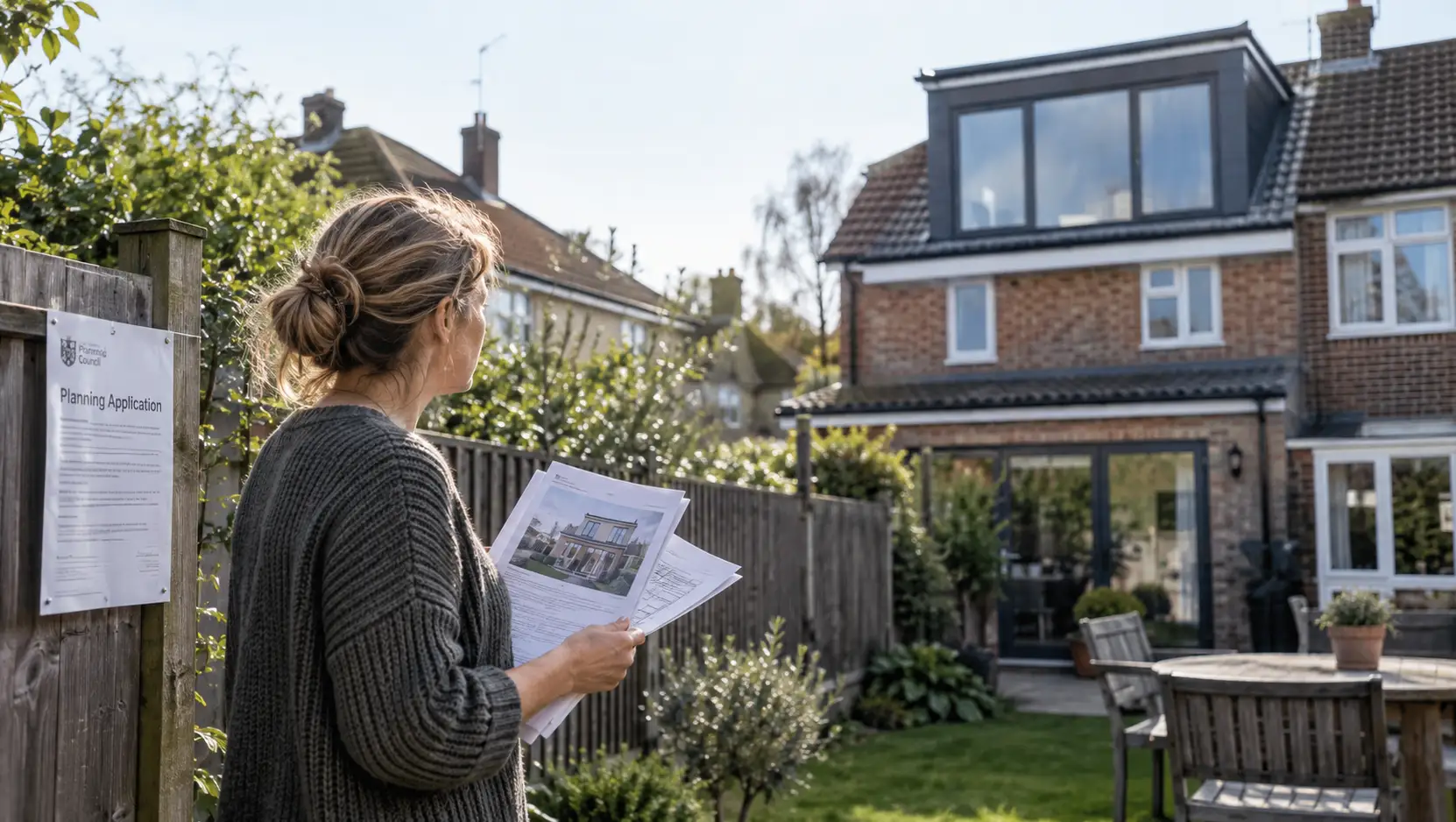
A site notice appears on a lamp post, or a letter drops through the door, or someone mentions they’ve seen an application on the council’s website with your street name attached. However it arrives, the instinct is usually the same: object, and object strongly. What’s less obvious, and what genuinely changes how effective that objection is, is that a planning decision isn’t a referendum. A hundred objections do not automatically carry more planning weight than one, and one well-aimed objection can carry a great deal more weight than a hundred that miss the point.
That isn’t a comfortable thing to hear when you’re worried about a two-storey extension six feet from your kitchen window. But understanding it is the single best way to make sure your objection actually lands.
The legal test: material considerations
Planning law requires applications to be determined in accordance with the development plan unless material considerations indicate otherwise. Section 70(2) of the Town and Country Planning Act 1990 requires the council to have regard to the development plan, so far as material to the application, and to other material considerations, while section 38(6) of the Planning and Compulsory Purchase Act 2004 provides the central plan-led decision-making rule.
A material consideration is something legally relevant to the planning decision being made — not a general licence to weigh in on anything that bothers you about the proposal or the applicant. Concerns that are not material to the planning decision cannot properly influence whether permission is granted or refused. The government’s planning decision guidance explains the distinction between material considerations and purely private interests.
What typically counts as material:
- Loss of privacy or overlooking — new windows, balconies or raised decking that give a direct line of sight into a neighbour’s private space.
- Daylight, sunlight and overshadowing impacts — genuine effects on the amenity of neighbouring rooms or gardens, where relevant to the proposal and local policy. This is different from a private legal right to light, which is a separate civil-law issue.
- Overbearing or oppressive impact — a structure so close to a boundary or so tall relative to a neighbouring property that it dominates outlook, distinct from ordinary loss of a private view.
- Design, scale and character — whether the proposal is out of keeping with the pattern, materials or form of the surrounding area, particularly in a conservation area.
- Heritage impact — effects on a listed building or its setting, or on the character or appearance of a conservation area.
- Highway safety and parking — genuine impact on road safety, visibility, traffic or parking provision where these are relevant planning issues locally.
- Noise, disturbance and odour — particularly the ongoing effects of non-residential uses or activities likely to harm amenity, rather than simply the temporary inconvenience of construction.
- Trees, ecology and flood risk — loss of protected trees, harm to protected species or habitats, or genuine flood-risk implications.
- Conflict with the development plan or relevant national policy — a specific, identifiable policy the proposal doesn’t comply with, rather than a general sense that it “shouldn’t be allowed.”
What typically doesn’t count, however strongly it’s felt:
- Loss of property value — the effect on the market value of a neighbouring property is a private financial interest rather than a material planning consideration.
- Loss of a private view — loss of a view is not normally a material planning consideration in England, although overlooking, loss of privacy and an overbearing effect may be.
- Dislike of the applicant, or a personal dispute with them — planning decisions are about the proposal, not the person.
- Boundary or ownership disputes — these are generally civil matters rather than questions for the planning application.
- Competition concerns — objecting simply because a new business may compete with an existing one is not a planning reason for refusal.
- General objection to development, or a wish that nothing changes locally — without a specific, identifiable planning harm attached, this carries no planning weight.
There are genuine grey areas and case-by-case judgement calls within this list. Daylight and sunlight impacts, for instance, can require technical assessment, and the existence of some impact does not automatically mean the impact is serious enough to justify refusing permission. Treat this as a guide to the direction of a useful objection rather than a guarantee of the outcome in your particular case.
Why numbers of objectors matter less than people assume
At the time of writing, some English councils still operate local schemes of delegation under which the number of relevant objections can help trigger referral of an application from officers to a planning committee. If you’re commenting on an application now, checking your council’s current scheme of delegation can therefore still be worthwhile.
That is about to change.
From 31 October 2026, a new national scheme of delegation takes effect in England. Under the new system, certain categories — including householder applications — must normally be decided by planning officers, while other applications are presumed to be delegated unless specified criteria for committee referral are met. Existing local arrangements that send an application to committee simply because a particular number of objections has been received will no longer operate in the same way. The government’s guidance on the new national scheme of delegation explains the incoming system.
Either way, the underlying point does not change: the volume of objection is not, by itself, a planning reason to refuse permission.
Whether a decision is made by an officer or a committee, it still has to be made within the planning decision-making framework and on material planning grounds. Councillors cannot lawfully refuse an application purely because it is locally unpopular. And if a refusal is appealed, a costs award is possible where unreasonable behaviour has caused another party unnecessary expense — not simply because the appeal succeeds.
How to actually write one that carries weight
The strongest objections share a few habits. They name the specific material consideration being raised — not “this will ruin the street” but “the proposed first-floor window directly overlooks our rear garden and existing bedroom window, with no comparable overlooking currently in place.”
They stick to the proposal rather than the applicant. Personal attacks add nothing to the planning case and may also fall foul of a council’s rules for publishing public representations.
They’re specific and evidenced rather than generic — measurements, distances, photographs showing the existing relationship between properties, and reference to relevant local plan policy where you can identify it can all help an officer understand the effect you’re describing.
And they’re focused on the actual planning issue. There is nothing inherently invalid about several people raising the same point or using similar wording, but repeating an objection many times does not make that planning consideration more material. A site-specific explanation of how the proposal affects you gives the decision-maker more useful information than a copied slogan or general expression of opposition.
It’s also worth submitting within the formal consultation period. Government guidance says the formal consultation will normally last around 21 days, with the exact deadline stated in the publicity for the application. Councils may choose to consider comments submitted after the closing date, but they are not obliged to do so, so submitting on time is the safer course. The official consultation guidance sets out the different publicity and consultation requirements.
How you might even find out
Neighbour notification methods vary according to the type of application. Depending on the proposal, statutory publicity can involve neighbour notification, a site notice or a newspaper notice, together with information being made available online.
That means not every neighbour is guaranteed an individual letter. If you’re already aware that development may be proposed nearby, checking the council’s online planning register directly rather than waiting to be contacted can be worthwhile.
Anyone can normally respond to a planning consultation; you do not have to be the immediate next-door neighbour for a material representation to be considered.
Separating planning from everything else that annoys you about a build
A great deal of what makes construction genuinely unpleasant to live next to — noise, dust, contractor parking and working hours — is not automatically a reason to refuse planning permission, although particular impacts can sometimes be controlled through planning conditions or other legal regimes.
Structural concerns involving a shared or party wall, and the notice process that may go with them, run through an entirely separate legal framework. In England and Wales, the government’s Party Wall guidance makes clear that the Party Wall etc. Act 1996 operates separately from planning permission and Building Regulations approval.
And a boundary dispute, however entangled it feels with the building project next door, is primarily a land-law matter rather than something a planning objection can resolve. Title documents and HM Land Registry records can provide useful evidence, but most registered title plans show only general boundaries rather than the exact legal line. Where the position genuinely matters, specialist surveying or legal advice may be needed.
What this means in practice
The strongest objection isn’t the angriest one. It’s the one that identifies a genuine, specific planning harm the council is legally entitled to weigh — and puts it in terms an officer can actually use in a decision report.
If your concern is about temporary construction noise, a boundary line, a private right to light or how much the extension might affect your house price, it’s worth knowing early that the planning system may not be the mechanism for resolving it — and there may be a more relevant avenue for that concern instead.

