

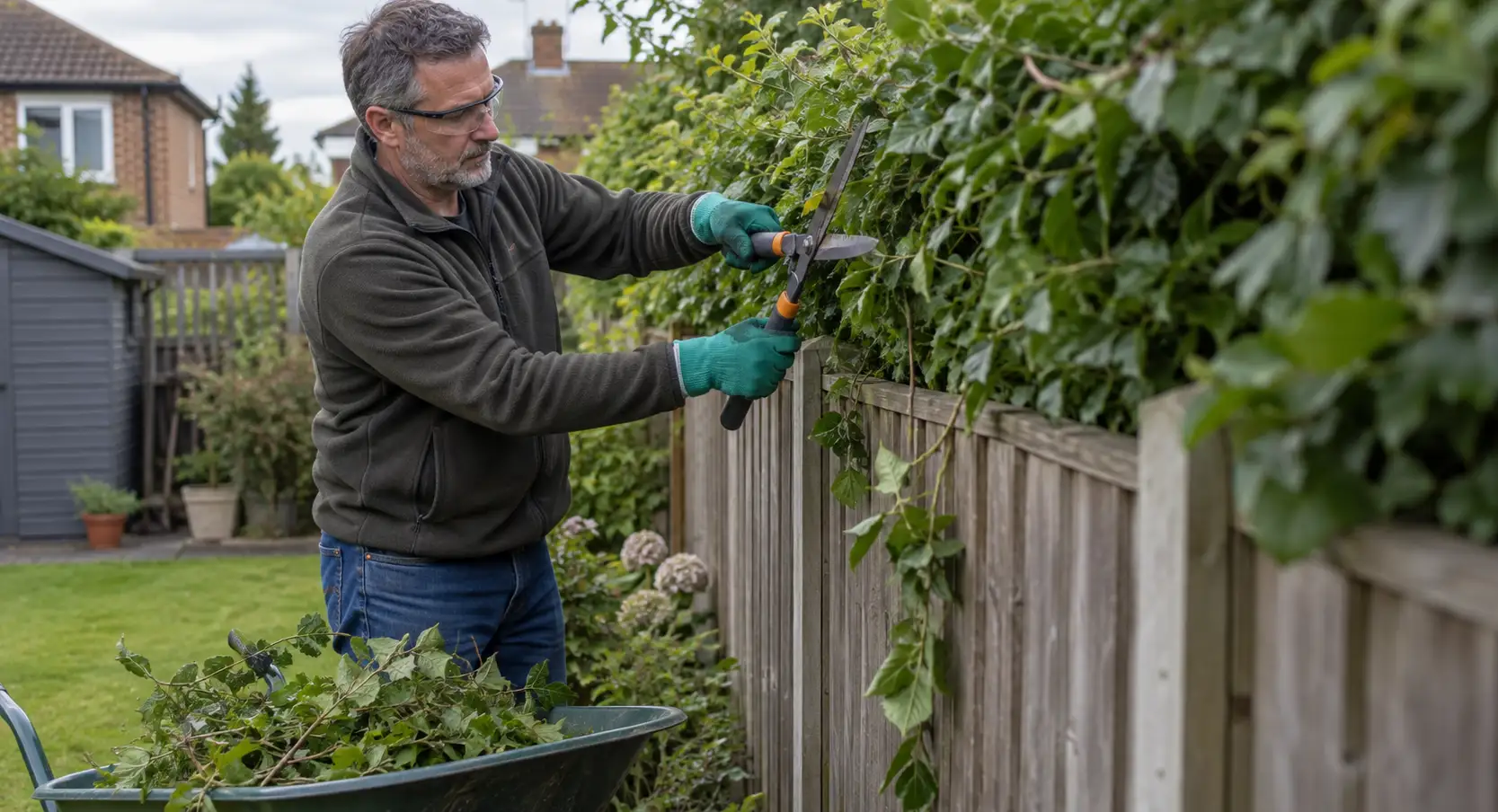
A hedge that’s crept a foot or two over the boundary raises a version of the same question as an overhanging tree branch, and largely gets the same answer — but hedges bring a couple of complications trees generally don’t, and one of them can genuinely leave a permanent mark on the hedge if you get it wrong.
In England and Wales, you’re generally entitled to cut back a neighbour’s hedge where it extends into your garden, without obtaining permission first. The right stops at the legal boundary, however, and doesn’t allow you to reshape the whole hedge or reduce its height simply because you find it too imposing.
The less obvious problem is what happens when a hedge has been left to grow unchecked for years. A light trim of fresh green growth is unlikely to cause much difficulty, but cutting a mature conifer hedge all the way back to the boundary can expose bare wood that may never produce new foliage. You could end up with an unsightly brown strip along the hedge and an angry neighbour, despite having been entitled to remove the encroachment in the first place.
There are also wildlife and tree-protection rules to consider, particularly if the hedge contains nesting birds or mature trees. This article concentrates on England and Wales; Scotland and Northern Ireland recognise broadly similar rights to deal with encroaching vegetation but have their own legal frameworks and statutory protections.
The boundary gives you the right, not control of the hedge
The ordinary common-law right of abatement allows a property owner to cut back branches and roots extending across their boundary. It applies to hedges just as it does to overhanging trees, and the Government’s guidance on neighbouring hedges, trees and boundaries confirms that you can generally remove encroaching growth without the neighbour’s permission, provided you stop at the boundary.
Suppose the hedge next door has spread half a metre into your garden, narrowing the path beside your house. You can ordinarily cut away the growth occupying your space, even if your neighbour would prefer to leave it alone. What you cannot do is carry on cutting into their garden because it would produce a neater shape or prevent the hedge growing back towards you.
The same principle applies to access. You don’t automatically have permission to enter the neighbouring garden, place ladders there or carry out work from their side. If cutting safely requires access to both properties, that is something to arrange with the owner rather than assume.
Finding the boundary can itself be more complicated than it appears. A fence isn’t necessarily positioned exactly on the legal dividing line, and an old hedge may have spread considerably from wherever it was first planted. Where the position is disputed, cutting substantial growth on the assumption that the fence or hedge’s centre marks the boundary can create a disagreement about trespass or property damage.
There is also a distinction between a hedge growing across your boundary and one growing upwards on your neighbour’s land.
A hedge may tower above your fence and cast considerable shade over the garden, but the right to remove encroaching branches doesn’t entitle you to lower its overall height. You can trim growth on your side while having no equivalent right to cut the top or the far side where those parts remain entirely within your neighbour’s property.
Excessive height may fall under the separate statutory high-hedge complaints process. In England and Wales, this can apply to qualifying barriers of predominantly evergreen or semi-evergreen trees or shrubs exceeding two metres and adversely affecting the enjoyment of a home or garden. It isn’t a general law requiring every hedge to stay below two metres, and council intervention depends on particular conditions, including attempts to resolve the matter informally.
The practical distinction is straightforward: cutting back overhang deals with growth entering your property. If the real problem is loss of light from a tall hedge, a different remedy may be needed.
The hedge may never grow back if you cut too deeply
This is where the straightforward legal right becomes considerably less straightforward in practice.
Many garden hedges are maintained through regular light trimming, which encourages dense green foliage along their outer surfaces. When they’re neglected, the green face gradually moves further away from the older stems and branches within. A hedge that originally sat neatly along the boundary can eventually become substantially wider, leaving the original planting line buried inside a mass of woody growth.
What happens when you cut through that outer layer depends heavily on the plant.
The Royal Horticultural Society’s guidance on renovating overgrown hedges explains that most conifers don’t produce new shoots from old, bare wood. Leyland cypress, commonly called leylandii, is a familiar example, along with several other conifers frequently used for garden screening.
A leylandii hedge can look dense and healthy from the outside while containing little green growth within its older interior. Cut off the outer foliage and the exposed brown branches may remain bare indefinitely. Unlike many deciduous hedging plants, the hedge cannot simply be relied upon to grow a fresh green face.
Imagine a hedge that has gradually spread a metre into your garden. A modest trim of the newest growth would be relatively routine, but cutting away the full metre to recover the legal boundary might leave a permanent brown gap along much of its length.
The difference between species is important. Yew is an exception among conifers because it can regenerate from old wood, while many deciduous hedges, including beech, hawthorn and hornbeam, are more tolerant of substantial renovation when pruned appropriately. Even then, the season, condition of the plants and amount removed can influence how well they recover.
With an established conifer hedge, the legal boundary and the sensible horticultural cutting line may therefore be two different places.
That doesn’t remove your right to deal with encroaching growth. But the right isn’t unlimited protection against the consequences of careless or unnecessarily damaging work. If substantial pruning permanently harms the neighbour’s hedge, there could be a dispute about whether the work was carried out reasonably and whether any resulting damage gives rise to liability.
A brown section appearing after pruning isn’t automatically proof that the person cutting the hedge acted unlawfully. The condition of the plants, the extent of the encroachment, the method of cutting and what could reasonably have been avoided may all matter.
Nevertheless, a homeowner who cuts deeply into an established leylandii hedge without first considering what will remain is taking a risk that ordinary light trimming doesn’t present.
Where years of growth would have to be removed to reach the boundary, identifying the hedge species and obtaining competent horticultural advice can prevent a relatively minor inconvenience becoming a much more expensive dispute. Sometimes a carefully planned reduction or an agreed compromise will preserve a healthy screen while making the garden more usable.
The cuttings still belong to your neighbour
Another easily overlooked detail concerns the material you remove.
Where your neighbour owns the hedge, the cut branches and foliage generally remain their property. The conventional approach is to offer the cuttings back and, if they aren’t wanted, dispose of them responsibly yourself.
That doesn’t mean tipping a heap of branches over the fence and leaving the neighbour to clear them away. Having a right to remove overhanging growth isn’t permission to dump garden waste on somebody else’s land without agreement.
For a light trim, the issue is unlikely to cause much difficulty. With a large hedge, however, the amount of waste can be considerable, and arranging its disposal before starting work is more sensible than discovering afterwards that neither household wants several bags of cuttings.
Where ownership of the hedge itself is uncertain, the position deserves additional care. A longstanding boundary hedge may be jointly owned, or the deeds may not establish ownership clearly at all. Routine trimming of growth extending into your garden is one matter; removing or radically altering a potentially shared boundary feature is quite another.
Protected trees can be growing inside an ordinary hedge
Not every hedge is simply a continuous row of shrubs. Older mixed hedges can contain mature trees which have become part of the surrounding growth, sometimes making it difficult to distinguish individual specimens from the hedge itself.
A tree within that hedge may be subject to a Tree Preservation Order, even if the surrounding shrubs aren’t protected. Where a TPO applies, work affecting the tree will generally require consent from the local planning authority unless a statutory exception genuinely permits it. The ordinary right to cut back branches crossing your boundary doesn’t override that protection.
In England, the Government’s guidance on Tree Preservation Orders and trees in conservation areas explains the consent requirements and the rules affecting qualifying trees within conservation areas, where six weeks’ prior notice is normally required unless an exception applies.
Wales operates its own planning procedures, and the Welsh Government’s guidance on protected trees provides information on tree-preservation controls. Where an individual tree within a hedge may be protected, checking with the local planning authority before substantial pruning is the sensible approach.
This isn’t usually a complication when somebody is lightly trimming an ordinary, unprotected garden hedge. It’s more relevant to older mixed hedgerows, large individual stems and properties within conservation areas.
For significant removal or alteration, planning conditions or property covenants can sometimes impose additional restrictions on a particular hedge. Those are separate from the everyday right to remove overhang and are more likely to matter where landscaping has been specifically protected or required as part of a development.
The important thing is to distinguish routine trimming of ordinary shrubs from work that could damage or remove a protected tree.
Nesting birds are a much more common complication
For most garden hedges, wildlife protection is more likely to affect the timing of pruning than a Tree Preservation Order.
Hedges are exactly where many familiar garden birds choose to nest. Dense foliage provides shelter from predators and weather, but it also means an occupied nest can be difficult to spot before somebody starts using a hedge trimmer.
Under section 1 of the Wildlife and Countryside Act 1981, wild birds, their eggs and nests receive legal protection in Great Britain, with some differences in the amended provisions applying to England, Wales and Scotland. In England and Wales, intentionally damaging or destroying a wild bird’s nest while it is being built or used is generally an offence. Northern Ireland has corresponding protections under the Wildlife (Northern Ireland) Order 1985.
These protections apply to an ordinary domestic boundary hedge just as they do to larger hedgerows elsewhere.
There’s a persistent belief that cutting a garden hedge between March and August is automatically illegal. That isn’t the general rule under the Wildlife and Countryside Act for an ordinary residential garden hedge. The protection centres on birds, eggs and nests, particularly those in use or being built, rather than making every act of domestic hedge trimming unlawful throughout a fixed period.
Separate seasonal restrictions do apply to certain hedgerows on or adjoining agricultural land, including a March-to-August cutting restriction for qualifying hedgerows in England. Those rules shouldn’t be confused with the position of an ordinary private garden boundary.
The RHS guidance on trimming hedges identifies early March to early August as the main UK nesting period, while recognising that birds may nest outside those months. Avoiding significant hedge work during the main season is therefore a sensible precaution, but the calendar alone doesn’t establish whether a particular hedge contains an active nest.
A hedge in September may still be occupied, and one in spring may not contain a nest at all.
Before cutting, look carefully for nests and signs of birds repeatedly entering the foliage with nesting material or food. If an active nest is present, work that would damage it should be postponed until it is no longer in use. Where the hedge is so dense that a proper check isn’t possible, delaying substantial pruning is preferable to assuming there is nothing inside.
Regular, appropriately timed maintenance can help avoid this difficulty. Allowing a hedge to become badly overgrown often makes eventual cutting more disruptive, both to the plants themselves and to the wildlife using them.
When it’s better to talk before you cut
For a small amount of fresh growth extending into your garden, there may be very little to discuss. You can generally trim it back to the boundary, take reasonable care of the plants and dispose of the cuttings without turning the job into a neighbour dispute.
The position is less comfortable when the hedge has spread considerably, the boundary isn’t clear or cutting to the legal line would expose a long stretch of bare conifer wood.
Suppose the neighbour wants to preserve the privacy provided by a mature leylandii hedge, while you want to recover the garden space it has gradually occupied. Cutting it back as far as legally possible might leave an unattractive and potentially permanently damaged screen. Neither household benefits from that outcome, particularly if the alternative could have been discussed beforehand.
The neighbour may be willing to arrange professional maintenance, agree a more manageable width or coordinate work on both sides to produce a better result. In some cases, a gradual reduction may be worth considering; in others, the species and extent of overgrowth may leave few satisfactory options without replacing the hedge.
You don’t generally need permission merely to trim ordinary encroaching growth, but a conversation before substantial work can establish where both households believe the boundary lies and what they expect the hedge to look like afterwards. It may also settle responsibility for the cuttings and avoid two separate contractors approaching the same hedge in incompatible ways.
The distinction between overhang and height is worth keeping in mind, too. A hedge can intrude sideways, block light from above or do both, and the legal options aren’t necessarily the same for each problem.
The common-law right exists so you don’t have to accept unlimited vegetation growing across your boundary. With an ordinary leafy shrub, exercising it may be no more complicated than a careful trim.
With a mature conifer hedge whose green face has grown well beyond the original boundary, however, knowing where you may legally cut is only half the decision. The other half is understanding what will be left when you’ve finished.
And that is worth finding out before you start the hedge trimmer.
This article provides general property, gardening and legal information and does not constitute legal, arboricultural, ecological, surveying or other professional advice. Rights to cut back encroaching vegetation depend on the legal boundary, ownership, applicable statutory protections and the nature of the proposed work. Wildlife and planning rules differ across the UK. If substantial pruning could permanently damage a hedge, affect protected trees or wildlife, or create a serious neighbour dispute, obtain appropriate professional advice before carrying out irreversible work.

