

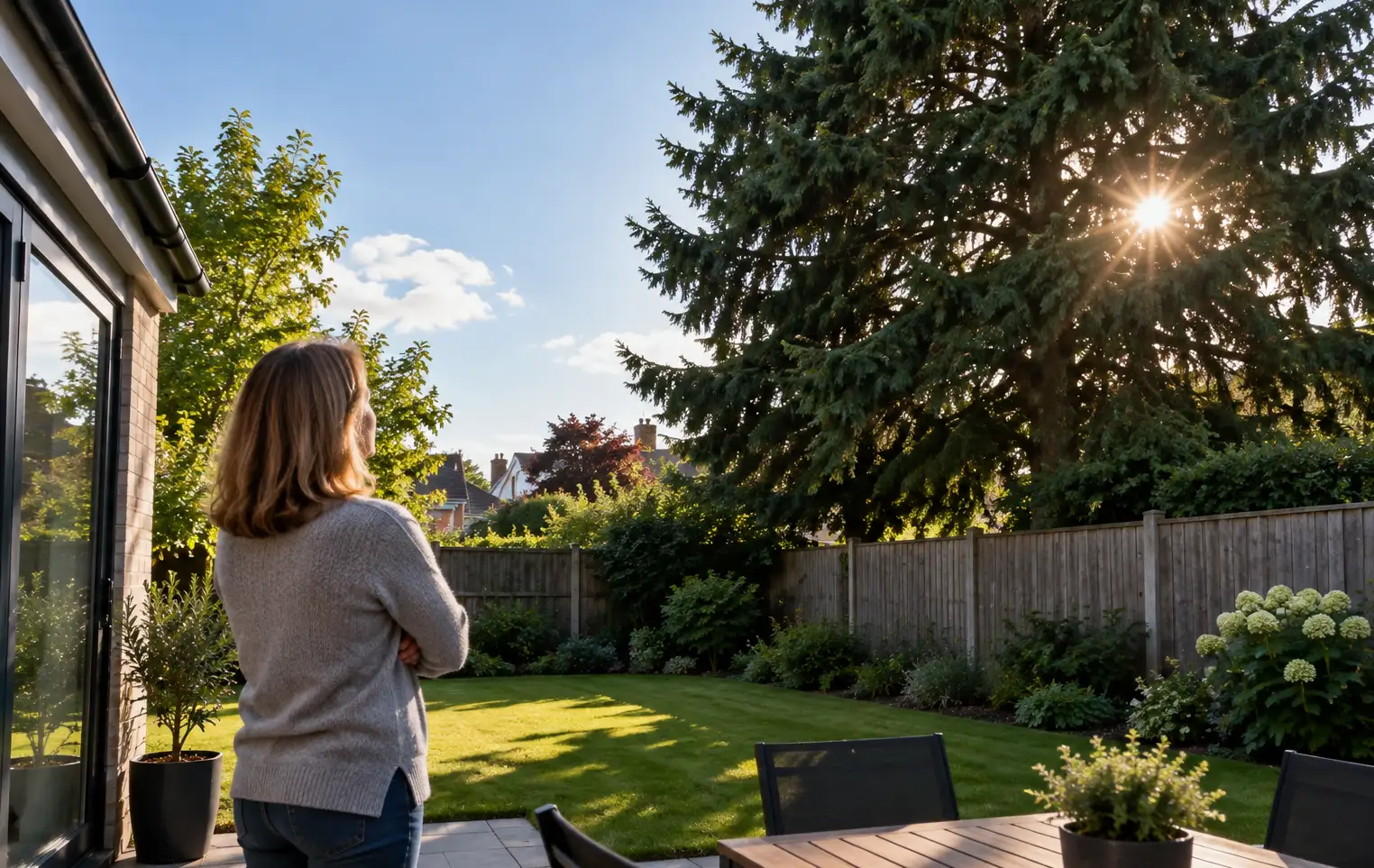
A tall conifer or a spreading sycamore casting an entire garden into shade by mid-afternoon feels, to most people, like exactly the sort of thing the law must have an answer for. It’s one of the more disappointing corners of property law across the UK precisely because, for a single tree affecting a garden, it largely doesn’t.
A neighbour isn’t normally obliged to reduce or remove a healthy tree simply because it’s grown tall enough to block your sunlight. That remains true even where a once-bright patio has become permanently shaded during the afternoon, or a garden that previously supported sun-loving plants has become noticeably darker.
There are exceptions worth understanding, though they don’t all offer the remedy homeowners might expect. The law treats daylight entering a building differently from sunshine falling on a garden, and it draws a firm distinction between a single tree and a line of trees forming a high hedge. You may also have the right to cut branches that extend across your boundary, although that won’t necessarily solve the underlying problem.
For most people dealing with one mature tree, the most productive solution is likely to involve their neighbour rather than a court or council. Knowing which rights genuinely exist, however, can make that conversation considerably easier.
There is no general right to sunlight in your garden
The most important distinction is between the legal right to light that can benefit a building and the ordinary enjoyment of sunshine on open land.
In England and Wales, there is no general legal right to sunlight over a garden, patio or lawn. A neighbouring tree can cast a substantial shadow without its owner being legally required to reduce it, however frustrating the result may be.
Imagine buying a house with a sunny south-facing garden. At the time, the neighbouring tree is relatively small, but over the following fifteen years its crown spreads and its height increases. The lawn receives less afternoon sunshine, the patio becomes chilly earlier in the day and some plants struggle to grow.
The change may genuinely diminish your enjoyment of the property, but it doesn’t ordinarily amount to an actionable legal wrong.
Nor is there a general maximum permitted height for a single tree growing in somebody’s garden. A mature oak, sycamore or conifer may stand well above surrounding houses without its owner being obliged to reduce it simply because it casts a long shadow.
The same broad principle applies elsewhere in the UK. There is no general entitlement to preserve the amount of sunshine reaching open garden space, although particular property deeds or enforceable title conditions can occasionally impose restrictions affecting trees or planting.
It’s worth distinguishing this from other tree-related problems. A tree with dangerous structural defects, roots causing physical damage or branches extending across a boundary may raise separate legal issues. But shade alone doesn’t normally establish any of those circumstances.
That can be a difficult answer where the loss of light has developed gradually and the homeowner remembers how much brighter the garden used to be. The law generally doesn’t protect an expectation that neighbouring vegetation will remain the same size forever.
Windows have a different kind of protection
There is a genuine legal right to light in England and Wales, but it’s much narrower than the expression suggests.
A right to light is a property right, known as an easement, that can protect the natural daylight entering a building through an opening such as a window. It may arise through an express grant or, in certain circumstances, through long-established enjoyment.
Under the Prescription Act 1832, a right can potentially be acquired after 20 years’ continuous enjoyment of light, subject to the relevant legal conditions. HM Land Registry explains the arrangements in its guidance on rights to light.
This doesn’t mean that every window in a house more than twenty years old automatically gives its owner the power to demand that neighbouring obstructions be removed.
Even where a legally protected right exists, the test isn’t whether a room has become noticeably darker or whether its occupants would prefer more sunshine. The question is whether the interference leaves insufficient natural light for the ordinary use of the affected room. Establishing that can require specialist surveying evidence.
The Royal Institution of Chartered Surveyors’ consumer guidance on rights to light explains how these rights work and why professional assessment is important before pursuing a claim.
A single tree can theoretically interfere with an established right to light through a window, but successfully challenging one on that basis is unusual.
Unlike a new building that creates a relatively identifiable obstruction, a tree grows gradually. Establishing the extent of the interference, when it became legally significant and whether an enforceable right has actually been infringed can be difficult.
The Royal Horticultural Society makes this point in its guidance on trees and the law, explaining that trees are rarely the subject of successful rights-to-light challenges because of the difficulty associated with their gradual growth.
If a mature tree is substantially reducing daylight entering a long-established living-room or bedroom window, specialist rights-to-light advice may therefore be worthwhile, particularly where the effect is severe. But a room feeling darker than it did a few years ago isn’t enough, by itself, to establish a claim.
There is another misconception involving the twenty-year period. A tree doesn’t acquire a legal right to continue casting shade merely because it has been growing in the same position for twenty years. The prescription rule concerns the possible acquisition of a right to receive light through a building, not a right belonging to the tree to obstruct it.
Scotland has no direct equivalent of the statutory prescription route under the 1832 Act. Any enforceable protection affecting light needs to be considered under Scots property law and the relevant title arrangements. Northern Ireland has its own property-law context, although the Prescription Act 1832 can also be relevant there. Neither position creates an ordinary right to sunshine across open garden land.
For a homeowner whose principal complaint is a shaded patio or lawn, the distinction remains decisive: a protected window right is not a general right to a sunny garden.
You may be able to cut back the branches on your side
There is one practical remedy that doesn’t depend on proving a right to light.
Where branches from a neighbour’s tree extend across the legal boundary into your property, you can generally cut them back to that boundary without first obtaining the tree owner’s permission.
The Government’s guidance on neighbouring trees and boundaries confirms this common-law right in England and Wales, although statutory protections and the need to avoid damaging the tree still matter.
If a substantial branch extends over your patio, removing the encroaching growth may let more light reach the area beneath it. But your right stops at the boundary, even if cutting further into the crown would make a much greater difference.
You cannot reduce the overall height of a tree rooted on your neighbour’s land, reshape the crown on their side or enter their garden to carry out work without the necessary agreement.
Significant pruning also deserves care. Removing a large limb can affect a tree’s health or stability, and the best arboricultural cutting point may be beyond the legal boundary. Where substantial branches are involved, a professional assessment and cooperation with the owner are preferable to assuming that every overhanging limb can safely be removed.
There is a practical limit to what boundary pruning can achieve anyway. A tall tree may cast most of its shadow because of the height and position of its crown rather than the branches immediately above your garden. Cutting away the overhang might open up some space without materially changing how much afternoon sunlight reaches the ground.
This is particularly noticeable in winter, when the sun sits lower and even a relatively distant tree can cast a long shadow.
The right to cut back encroaching branches is useful, but it isn’t a disguised right to make your neighbour reduce the entire tree.
When several trees form a high hedge, the law changes
The distinction between one tree and a line of trees is particularly important because high-hedge legislation provides a remedy that generally isn’t available for a single specimen.
In England and Wales, Part 8 of the Anti-social Behaviour Act 2003 allows councils to consider complaints about qualifying high hedges that adversely affect the reasonable enjoyment of a home or garden.
The legislation concerns a barrier to light or access formed wholly or predominantly by a line of two or more evergreen or semi-evergreen trees or shrubs, rising above two metres.
A closely planted row of leylandii, for example, may qualify even where individual plants have grown into substantial trees. A single enormous conifer, however much light it blocks, does not.
The Government’s guidance on complaining about high hedges explains the requirements in England, while the Welsh Government provides its own guidance on the complaints process in Wales.
The council route is intended as a last resort after reasonable attempts to resolve the matter with the owner. There is usually a complaint fee, and the council must consider whether the hedge meets the statutory definition and whether its height adversely affects the property.
Even a successful complaint doesn’t automatically mean the hedge must be removed or reduced to two metres. A remedial notice can require proportionate action to address the problem without necessarily destroying the screening altogether.
Scotland operates a separate scheme under the High Hedges (Scotland) Act 2013. Its definition isn’t limited to evergreen or semi-evergreen plants, but a qualifying hedge must still consist of a row of two or more trees or shrubs exceeding two metres and forming a barrier to light. The Scottish Government’s high-hedge guidance explains how to pursue a complaint.
Northern Ireland has its own High Hedges Act (Northern Ireland) 2011, with a similar council process concerning qualifying barriers of predominantly evergreen or semi-evergreen growth. The nidirect guidance on high-hedge disputes provides the relevant information.
The crucial point across all four nations is that a row of trees must genuinely form a qualifying hedge. Two unrelated trees growing separately in a garden don’t necessarily become a high hedge simply because both cast shade.
For the homeowner, this can make an enormous difference. A continuous line of tall screening trees may provide a route to council intervention, while one mature sycamore creating much the same loss of sunlight generally won’t.
What can you realistically ask your neighbour to do?
Where a single healthy tree is responsible for the shade, a reasonable conversation is often more productive than asserting legal rights that don’t apply.
The owner may have little idea how significantly the shadow affects your property, particularly if the tree stands at the far end of their own garden. Explaining that your patio loses sunlight by early afternoon, or that a particular part of the crown now shades a room, is more useful than simply declaring that the tree is too tall.
It may be possible to agree selective pruning or a professionally planned crown reduction that improves the light reaching your property without unnecessarily harming the tree. A competent arboriculturist can help establish what work is appropriate and whether it is likely to make a worthwhile difference.
There may be room for a compromise over cost, especially where the neighbour is willing to permit reasonable work but wouldn’t otherwise have considered it necessary. You could offer to contribute towards suitable professional pruning, although the owner isn’t ordinarily obliged to accept.
It’s worth being realistic about the outcome. Crown reduction doesn’t necessarily create a lasting improvement in sunlight, and severe topping can leave a mature tree damaged, unattractive or prone to problematic regrowth. The aim should be sensible management rather than treating every large tree as something that must be cut down.
Protection can also affect what is possible. In England, a Tree Preservation Order may restrict pruning or crown reduction, while trees within conservation areas can be subject to additional controls. The Government’s guidance on Tree Preservation Orders and conservation-area trees explains the relevant procedures. Scotland, Wales and Northern Ireland have their own arrangements, so the appropriate local planning authority should be consulted before significant work where protection may apply.
A protected tree can still be managed where the necessary permission is obtained, but a neighbour’s loss of garden sunlight doesn’t automatically justify removing or heavily reducing a tree protected for its public amenity value.
If the owner declines to cooperate and there is no actionable damage, dangerous condition, relevant boundary encroachment, qualifying high hedge or serious interference with an established window-light right, the practical options may be limited.
You might decide to move the seating area to a sunnier part of the garden, choose plants better suited to lower light levels or adapt how the outdoor space is used. None is particularly satisfying where a once-bright garden has become shaded through no action of your own, but those changes may achieve more than pursuing a legal dispute with little prospect of success.
A large neighbouring tree can be a genuine inconvenience without its owner having done anything unlawful. That is what makes these disagreements difficult: both neighbours may have understandable interests, yet neither is automatically entitled to impose their preferred outcome.
For a single tree, the strongest approach is usually a specific, reasonable request about what professional pruning might achieve, rather than a demand for removal backed by a legal right that doesn’t generally exist.
You may be able to cut branches crossing your boundary, and a qualifying high hedge may give you access to a council complaints process. But where an otherwise healthy individual tree simply casts shade across your garden, the difficult answer remains that the law rarely gives you the power to make its owner cut it back.
The conversation may achieve what the law cannot.
This article provides general property and legal information and does not constitute legal, surveying, arboricultural, planning or other professional advice. Rights relating to daylight, overhanging trees, protected trees and high hedges depend on the circumstances, property documents and law applying in the relevant UK jurisdiction. If significant property rights, financial consequences or disputes are involved, seek appropriate professional advice before carrying out substantial tree work or commencing legal proceedings.

