

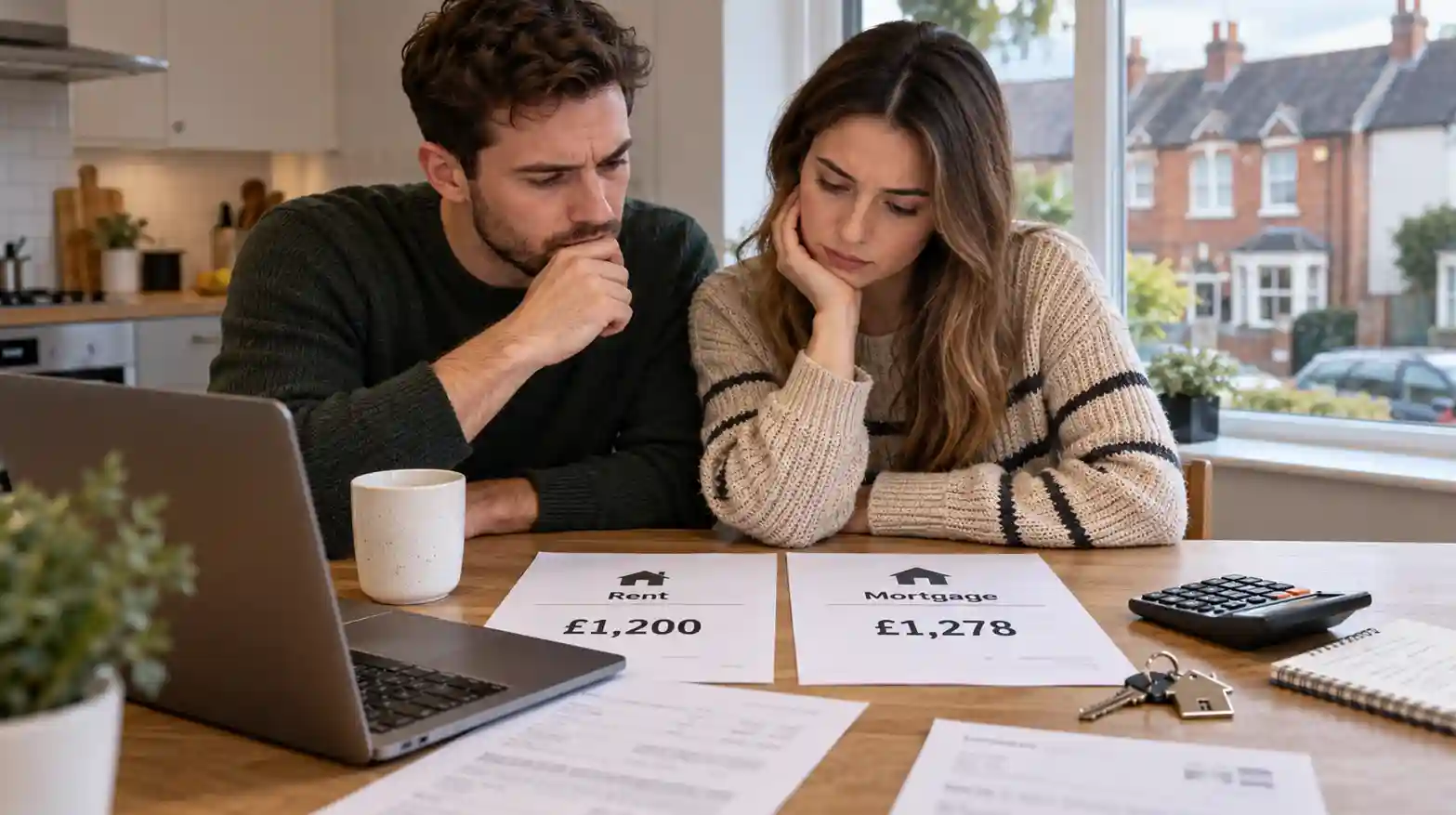
More than half of first-time buyers in a new analysis took on mortgage payments higher than the rent they had been paying. The finding challenges a familiar reason for buying a home, but it does not answer the bigger question of whether owning is financially worthwhile.
For years, one of the strongest arguments for getting on the property ladder was that it could be cheaper than renting. Saving the deposit was the difficult part; once someone bought, the monthly mortgage payment could be lower than the rent they had left behind, while some of that payment reduced a debt rather than paying a landlord. For a growing proportion of buyers, the first part of that argument no longer holds.
New Hamptons research, based on transactions analysed using data from its parent Connells Group, found that 56% of first-time buyers who purchased in September 2026 took on mortgage payments exceeding their previous rent. In September 2022, the proportion was 33%. Hamptons says the latest figure is the highest in at least a decade. Its published analysis does not provide a sample size or sufficient detail to establish how closely the transactions reflect the experience of first-time buyers across the whole market. The finding describes those who completed a purchase, not everyone who considered buying and decided against it.
The shift comes as borrowing has become more expensive again. Rightmove’s October figures put its average two-year fixed mortgage rate at 5.55%, up from 5.29% in September and 4.25% in February. These are figures from Rightmove’s own mortgage tracker, not rates available to every borrower, but they illustrate why a household working out what it can afford may arrive at a different answer from the one it reached earlier in the year. A higher interest rate increases the cost of the same mortgage and, for some buyers, reduces the amount they can borrow within an affordable monthly budget.
The amount of money a buyer brings to the transaction also matters. Hamptons found that those whose new mortgage payments exceeded their old rent had borrowed an average of 91% of the property’s purchase price, equivalent to a 9% deposit. Buyers whose mortgage payment was lower than their former rent had borrowed 83%, equivalent to a 17% deposit. A larger deposit means a smaller loan and may secure a better interest rate, although these comparisons cannot establish that deposits alone caused the difference. The homes bought, mortgage terms and previous rents will not necessarily have been alike.
Age brings another variation. Buyers in their 40s took on mortgage payments averaging 18.2% more than their previous rent, compared with payments 7.5% lower among buyers in their 20s. Hamptons reports an average mortgage term of 27 years for the older group against 34 years for the younger one. Paying back a loan over fewer years increases the monthly commitment, even as it usually reduces interest paid across the mortgage’s lifetime. Older buyers may also be purchasing different sorts of homes. The figures are evidence of varied circumstances, not a universal rule about which age group should buy.
Why the monthly comparison tells only half the story
Rent and a repayment mortgage are different financial commitments. Mortgage interest is a cost of borrowing, but the capital repaid each month reduces the loan and increases the owner’s equity relative to what it would otherwise be. Rent provides a home for the period paid for without creating a stake in the property. That distinction matters, although it is easy to exaggerate: in the early years of a long mortgage at today’s rates, interest takes up much of each payment.
Ownership also brings expenses that do not normally fall directly on tenants. A deposit ties up savings that could have been kept available or earning interest. A purchaser faces legal fees, surveys and moving costs, followed by insurance, maintenance and possibly service charges or major works, as MoneyHelper’s breakdown of buying costs illustrates. Selling again costs money, and a fall in property values can wipe out some or all of the equity built up through repayments. A fixed mortgage rate offers a period of certainty, but the next deal may be more expensive. These costs do not make renting inherently better; they explain why comparing two direct debits cannot tell a household which option leaves it financially stronger.
There is another limitation to Hamptons’ headline. Its comparison follows buyers from the homes they previously rented into the properties they actually purchased. Some may be buying a larger home, moving area or choosing a different standard of accommodation. Their new mortgage therefore need not be compared with the rent for an equivalent property. Rightmove’s September affordability model asked a different question, comparing a mortgage on a modelled first-time buyer home of two bedrooms or fewer with the rent for a similar type of property. It estimated £1,199 a month for the mortgage with a 10% deposit, against £1,297 in rent. Buying appeared cheaper on that narrower monthly comparison. Neither result disproves the other, because the populations, homes and assumptions differ; nor does Rightmove’s comparison include every cost of ownership.
The consequences reach beyond the buyer
Affordability also affects how the wider housing market works. When mortgage payments absorb more of a buyer’s income, there may be less room to increase an offer, pay for repairs after moving or cope with an unexpected change in circumstances. Estate agents and sellers can still encounter strong interest in a property without finding enough purchasers who can finance the asking price. This is a plausible mechanism linking rising borrowing costs with weaker buyer activity, rather than something that Hamptons’ dataset directly measures.
Mortgage brokers and lenders face more finely balanced decisions, particularly for applicants with small deposits or shorter available repayment terms. Changes to the framework for higher loan-to-income lending may give some borrowers more choice, but they do not remove affordability checks or make a higher monthly payment comfortable. Housebuilders have a related incentive to offer deposit contributions or mortgage-cost support to keep new-build sales moving. Those offers may help individual buyers, but they cannot eliminate the longer-term cost of a mortgage and may reduce the amount a developer earns from a sale.
The rental market could feel the consequences too. If some tenants postpone buying, they may remain in rented accommodation longer, sustaining demand in locations with limited supply. But that does not mean this news establishes that rents will rise as a result. The availability of rented homes, household incomes and local conditions remain decisive. Hamptons’ same release recorded annual rent growth of 2.7% on newly agreed tenancies across Great Britain in September, against 1.9% across existing tenancies. That gap matters to prospective purchasers: the rent they currently pay may differ substantially from what they would pay if they needed to find another property today, and rental conditions vary markedly by region.
What five years can reveal
The financial choice becomes clearer when viewed beyond the first monthly payment. Consider a purely illustrative first-time buyer purchasing a £250,000 home in England with a 10% deposit and a £225,000 repayment mortgage over 30 years at 5.5%, assumed fixed for all five years. The monthly mortgage payment would be about £1,278. Of roughly £76,652 paid over five years, £59,688 would be interest and £16,964 would reduce the debt. Assume £2,500 in buying costs, £2,000 a year for upkeep and buildings insurance, and £5,000 to sell. An eligible first-time buyer at this price would pay no Stamp Duty Land Tax under the current relief.
Compare a renter paying £1,200 a month for a broadly similar home. The renter instead keeps the £27,500 that would have funded the deposit and buying costs, earns an illustrative 4% annual return compounded monthly, and saves the difference between rent and the owner’s mortgage and upkeep costs. The table compares the buyer’s equity after selling costs with the renter’s accumulated savings. It excludes tax on savings interest and assumes no unexpected major repairs, service charges or other differing expenses; the interest rates and returns are assumptions, not predictions.
| Five-year scenario | Buyer’s equity | Renter’s savings |
|---|---|---|
| House price unchanged; rent unchanged | £36,964 | £49,767 |
| House price unchanged; rent rises 3% a year | £36,964 | £45,047 |
| House price falls 5%; rent rises 3% a year | £24,464 | £45,047 |
| House price rises 5%; rent rises 3% a year | £49,464 | £45,047 |
Illustrative outcomes, rounded to the nearest pound. Not an indication of likely prices, rents or investment returns.
In this example the renter finishes ahead if house prices stand still, even with rising rent. A 5% increase in the property’s value changes the outcome in the buyer’s favour, while a 5% fall makes ownership considerably less attractive over that short period. The point is not that saving while renting will always outperform buying. It is that repayment of mortgage capital is only one part of the calculation; the length of time someone stays, transaction costs, savings returns and changes in property values can matter just as much. A renter may also find it difficult to save the assumed monthly difference, while ownership brings benefits such as greater control over a home that the table cannot value.
The research therefore describes a genuine change without resolving the decision for any particular buyer. A household expecting to move again within a few years faces a different financial calculation from one planning to stay for decades; a small deposit, substantial service charges or little money left for emergencies can change it again.
For many first-time buyers, homeownership no longer offers the immediate monthly saving they might once have expected. That matters for the homes they can afford, the offers they make and the sales that progress through the market. But paying more each month does not settle whether buying is worthwhile. The test is whether the whole financial commitment is sustainable, and whether the security, control and equity that ownership can bring justify its costs over the years the buyer expects to remain there.
This article provides general news and financial information, including hypothetical illustrations. It does not constitute personalised mortgage, investment, tax or legal advice. Actual costs and outcomes depend on individual circumstances, mortgage terms, property values, savings returns and applicable taxes. Consider obtaining advice from an appropriately regulated mortgage adviser and qualified conveyancer before purchasing. Your home may be repossessed if you do not keep up repayments on your mortgage.

