

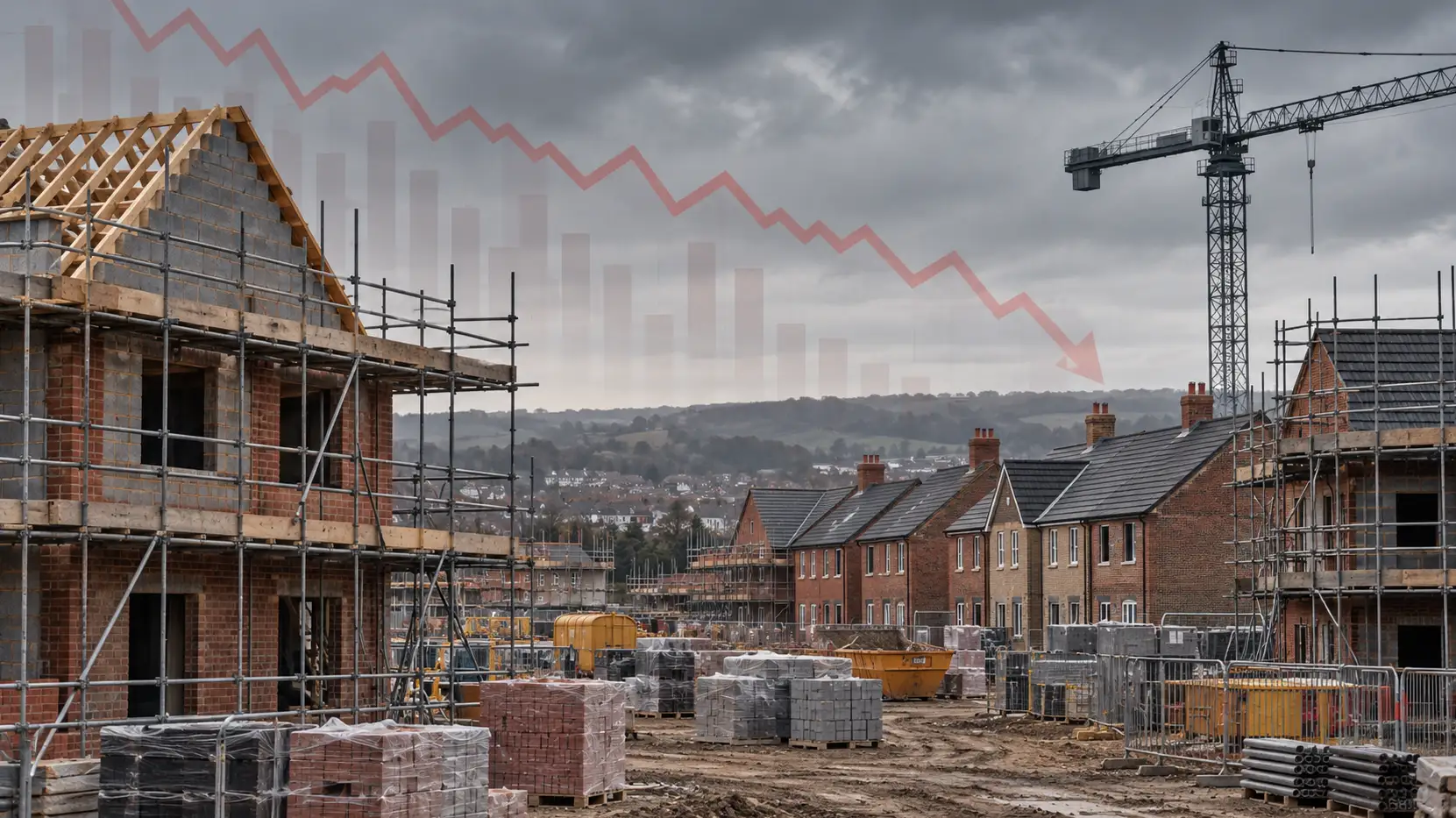
Listed housebuilders have issued more profit warnings in the first nine months of 2026 than throughout the financial crisis year of 2008, according to EY. It is a striking measure of financial pressure in the industry — but the consequences for Britain’s housing supply are more complicated than the headline suggests.
The comparison that will be repeated this week is a striking one. By the end of September, UK-listed housebuilders had issued 14 profit warnings in 2026, according to EY-Parthenon’s latest quarterly analysis. In 2008, when the financial crisis tipped Britain’s housing market into freefall, they issued ten.
Six of this year’s warnings came in the third quarter alone. Across all UK-listed companies, EY counted 65 warnings during the quarter, up from 59 in the second and the highest total since late 2024. Rising costs featured in 35% of warnings across the wider listed market, while policy changes and geopolitical uncertainty were cited in 54%. Claire Gambles, a financial restructuring partner at EY-Parthenon, described housebuilding as having become the centre of cost and interest-rate pressures.
Those figures demand attention, although the comparison with 2008 needs care. A profit warning is a company telling investors that its earnings will fall materially short of expectations. It is not a declaration of insolvency, nor does it necessarily mean that fewer homes are being built. The figures count warnings rather than individual companies, and cover listed businesses rather than the many privately owned and smaller developers operating across Britain. The companies involved, their financial circumstances and the economic conditions surrounding them are not identical to those of the financial crisis.
Yet the latest warnings are not an isolated quarterly setback. EY’s analysis published in July found that listed housebuilders had already issued 47 warnings since the beginning of 2020, compared with 27 in the preceding 13 years combined. The question now is whether sustained pressure on profitability is beginning to change what developers are prepared to build.
Why a profitable-sounding business stops adding up
Every new development is a long financial commitment. A builder buys or secures land, often years before construction begins. It pays for planning, construction, infrastructure and, where required, affordable housing and community contributions. Homes may then be built and sold in phases over several years. The eventual return depends on the difference between selling prices and the costs of delivering the development, but also on how quickly those sales take place. Unsold homes and unfinished sites tie up capital while financing and other expenses continue.
Much of the pressure identified by EY affects both sides of that calculation. Higher energy, labour, materials and borrowing costs increase the expense of building, while weaker consumer confidence and mortgage affordability constrain what purchasers can pay. Housebuilders have increasingly used mortgage contributions, deposit assistance, upgrades and part-exchange arrangements to attract buyers. Such incentives can make a purchase more appealing without an obvious reduction in the advertised price, but their cost still comes out of the money the developer receives.
A simple, purely illustrative example shows how quickly a development’s economics can change. Suppose a builder expects to sell a home for £350,000, with £200,000 in construction costs and another £80,000 covering land, planning, finance and other site expenses. That leaves a projected surplus of £70,000 before any additional company-level costs or tax. If construction costs rise by 5%, adding £10,000, and the builder must offer £10,000 in incentives to secure the sale, that surplus falls to £50,000. The property still sells at a positive return, but the amount left has fallen by almost 29%. A business assessing whether to commit further money to the next development phase may reach a very different decision on those revised figures.
That is why weaker profitability can matter even when there is no immediate danger of a company failing. Developers need sufficient returns to justify the financial risks of acquiring land, securing permissions and constructing homes that may take years to sell. They must also manage cash flow and satisfy lenders. A company can report lower profits while improving its cash position by selling land or slowing construction, just as it can record accounting profits while facing pressure because too much of its money remains tied up in unsold properties.
Crest Nicholson provides a useful contemporary illustration. In its 3 September trading update, the housebuilder revised its full-year expectations from an operating profit of £5 million to £10 million to an operating loss of approximately £10 million. Its net open-market sales rate over the preceding six weeks had fallen to 0.35, compared with 0.55 in the equivalent period a year earlier, and it lowered its expected annual completions from 1,400–1,500 to 1,350–1,400. At the same time, measures including land disposals and cash recovery improved its forecast year-end net debt.
The company was also negotiating changes to its borrowing arrangements. A further announcement on 30 September confirmed that lenders had extended a waiver relating to its interest-cover covenant until 30 November. That should not be mistaken for evidence of impending failure. It does, however, demonstrate how closely a developer’s sales performance, expected earnings, financial flexibility and construction decisions can become connected. For shareholders and lenders, the immediate concern may be profitability and debt. For the wider housing market, the more consequential question is whether those pressures lead to fewer developments being started.
From earnings to homes: the chain that is not yet proven
A slowdown in housebuilding rarely begins with a developer announcing that it intends to produce substantially fewer homes. It can emerge through smaller decisions: opening fewer sales outlets, delaying a later phase, reducing the pace of construction or becoming more selective about buying land. Each may make commercial sense for an individual business. If enough developers respond in this way, however, the cumulative effect can be a smaller pipeline of homes reaching the market.
The latest official figures do not establish that such a contraction is already under way. The government’s housing supply statistics for England, published on 24 September, recorded an estimated 35,910 new-build starts between April and June, 6% higher than the preceding quarter and 20% above the equivalent period in 2025. Completions were estimated at 35,800, down 3% on the quarter but up 1% annually.
Those figures offer some reassurance, but they require careful interpretation. The government has warned that changes in Building Safety Regulator reporting contributed to the recent increase in recorded starts, making comparisons less straightforward. More fundamentally, homes started in the spring may reflect decisions made many months earlier. They cannot establish whether developers responding to weaker summer trading conditions are now reconsidering their plans for later phases or future sites.
There are less encouraging signs further back in the development pipeline. Provisional figures included in the same government release show that planning permission was granted for approximately 212,000 homes in England during the year to June 2026, down from 242,000 the previous year. That is a fall of 12%, although permissions are not the same as homes that will be built: some schemes never proceed, others take years, and the underlying data can include some duplication. The decline does not prove that the latest profit warnings are affecting development decisions, but it adds to the questions surrounding future supply.
For the government, this is an awkward moment. The ambition to deliver substantially more housing depends not only on planning policy and public investment but also on private businesses having sufficient confidence to commit capital. Granting permission for additional homes achieves little if the expected selling prices cannot support construction, infrastructure, financing and an acceptable commercial return.
The problem extends beyond the listed companies highlighted by EY. Large developers often have substantial land holdings and a greater range of financing options, allowing them to defer investment or change construction rates. Smaller builders may be more exposed to delays, costly borrowing or the failure of a particular development to sell as expected. Contractors and materials suppliers can feel the effects before any reduction appears in national completion statistics, as postponed phases translate into less work and potentially more difficult payment conditions.
The consequences could also complicate major programmes intended to increase housing delivery. England’s new towns plans face separate constraints involving construction capacity, infrastructure and skills, all of which depend on businesses being willing to invest ahead of future demand. A prolonged slowdown could make that investment harder to justify, even if the eventual need for additional homes remains considerable.
Affordable housing creates a further difficulty. In England, a substantial part of its delivery is secured through section 106 agreements associated with private residential development. When private sales slow, affordable housing on those sites may also be delayed. Developers facing serious viability problems can seek changes to planning obligations, but reduced profits do not automatically entitle them to relief. The government’s planning viability guidance makes clear that commercial risk is already part of the calculation of developer returns and that its realisation does not, by itself, justify reopening agreed requirements.
That leaves councils and housing providers with a difficult balance. Preserving affordable housing commitments protects an important public benefit, but an unviable scheme may deliver neither the private homes nor the affordable homes originally envisaged. Reducing obligations can sometimes help a development proceed, yet doing so may reduce the housing available to households least able to afford market prices. The appropriate response depends on individual schemes and evidence, rather than a general assumption that developer profitability should always take precedence or that planning obligations can never be reconsidered.
What the pressure could mean for buyers
For prospective purchasers, financial pressure on housebuilders can have an immediate upside. A developer seeking reservations or wanting to sell completed stock may offer more generous incentives, help with mortgage costs or negotiate on price. Buyers may therefore find opportunities that would have been less attractive in a stronger market. But an advertised incentive is not automatically a bargain: its value needs to be considered alongside comparable properties, the actual purchase price and any conditions imposed by the mortgage lender.
The longer-term consequences are less reassuring. A developer that slows construction today may reduce the choice available to purchasers in future years. Nor can the shortage of housing alone guarantee strong demand for new homes. The desire to own a property is different from having the mortgage deposit and income needed to purchase one. Greater flexibility for lenders offering higher loan-to-income mortgages may improve access for some borrowers, but it does not remove affordability checks or ensure that buyers can meet the financial commitments involved.
Financially pressured developers may also make buyers more cautious about purchasing off-plan, where completion can be some distance away. A profit warning is not proof that an individual development is unsafe or that its builder cannot fulfil its contracts, but the financial position of the company, the security of reservation deposits and the protections available if completion is delayed are legitimate considerations. These are reasons for normal conveyancing and financial due diligence, not grounds for assuming that every builder reporting lower profits presents an exceptional risk.
The case for caution — in both directions
There are reasons not to assume that the current pressure will result in substantially fewer homes. Profit warnings can follow forecasts that were simply too optimistic, particularly in an industry sensitive to interest rates and consumer confidence. Some developers may accept lower margins while continuing construction. Others may improve procurement, reduce overheads, standardise designs or find more efficient ways of delivering homes. Stronger businesses may also acquire land or projects from competitors at prices that make future development more attractive.
Yet these possibilities are not guaranteed to offset the financial squeeze. Lower returns reduce the incentive to invest, and lenders may become more cautious as margins and cash reserves weaken. For developers already facing difficult sites, infrastructure costs or demanding planning conditions, a relatively modest deterioration in selling prices or construction expenses may be enough to change whether a project proceeds.
There is a deeper contradiction for the housing market. Weaker demand can encourage developers to offer better terms, making some homes more affordable in the short term. But if the same conditions lead businesses to open fewer sites and reduce future construction commitments, the resulting constraint on housing supply could become apparent when buyers eventually return. What helps some purchasers today could therefore contribute to a tighter market later. That is an economic risk worth examining, not a forecast established by EY’s figures.
The distinction matters because Britain’s housing shortage is not simply a question of how many people want a home. It is also a question of how many can afford to buy, at prices that allow builders to cover their costs and justify further investment. Where those conditions cease to align, substantial underlying housing need can coexist with disappointing sales and developers reluctant to build.
What would show whether homes are at risk
The coming months should provide a clearer picture of whether this is primarily a period of weaker earnings or the beginning of a more serious constraint on construction. Builders’ trading statements will reveal whether reservation rates recover, how many sales outlets remain active and whether completion forecasts are being reduced further. Land purchases and development starts will be particularly important because they reflect decisions about future activity rather than homes already approaching completion. Changes in subcontractor workloads and manufacturers’ order books may provide additional evidence of weakening investment.
Official housing-start figures and planning-permission trends will help test that picture, although their limitations and reporting delays need to be recognised. A sustained fall in development starts, alongside weaker reservations and declining investment in new sites, would provide much stronger grounds for concern about future housing supply than profit warnings alone.
If demand improves and developers continue investing, the warnings may ultimately prove more significant for shareholders than for the number of homes built. If instead financial pressure persists and development decisions are repeatedly postponed, the consequences will reach further than the companies reporting disappointing results.
The 2008 comparison deserves attention because it reveals how difficult trading conditions have become for some of Britain’s largest housebuilders. But the measure that will matter most is not whether the warning count rises further. It is whether the companies expected to provide the country’s next generation of homes still see enough commercial reason to build them.
This article provides general news and analysis of the housebuilding industry and does not constitute investment, mortgage or legal advice. Financial and housing-market figures relate to the sources and reporting periods identified and may be revised. Buyers considering new-build properties should obtain independent conveyancing and financial advice appropriate to their circumstances.

