

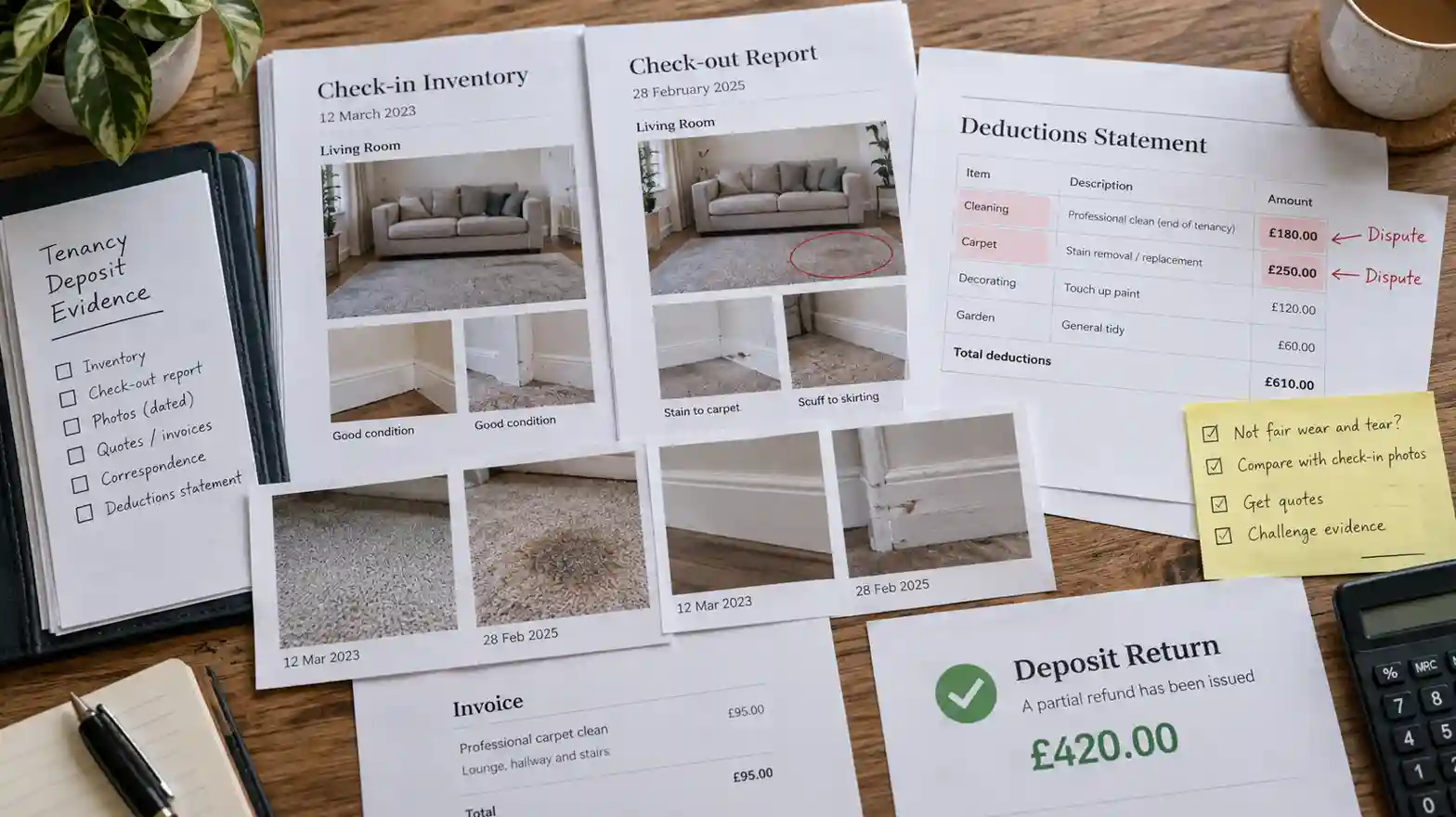
A long, indignant message to a former landlord explaining why a deduction feels unfair rarely moves the needle. An adjudicator reading a dated check-in photograph beside a dated check-out photograph, with the inventory and the evidence behind the landlord’s claimed cost in front of them, is dealing with something much more useful. The difference between those two responses — how you feel about a deduction and what an independent person can actually verify — is the entire subject of this article.
There is one principle worth understanding from the outset. In a protected-deposit dispute, the money does not begin as the landlord’s money which you then have to win back. The landlord or agent is normally the party making a claim against your deposit, and it is for them to provide evidence showing why the deduction is justified. That does not mean a tenant should sit back where strong contrary evidence exists, but it does change how the dispute should be approached: you are testing the landlord’s claim, not applying for permission to recover money that was already yours.
Work out what’s genuinely disputed before you do anything else
Start with the landlord’s or agent’s proposed deductions line by line, but before writing a detailed response ask to see the evidence behind any charge that has not already been properly supported. That might mean the check-out report, photographs, contractor quotations, invoices, receipts or the calculation used to arrive at a particular figure. MyDeposits’ current tenant guide to deposit disputes recommends obtaining the landlord’s breakdown and supporting evidence before deciding how to challenge it, and the logic is straightforward: it is difficult to answer a £600 cleaning or replacement claim properly if you do not yet know what condition is being alleged, what work is said to be necessary or where the £600 figure came from.
Once you have that information, separate what you accept from what you genuinely dispute. Some deductions may be obviously wrong; others may be partly justified but too high. You might accept that you damaged a door while disagreeing that £450 represents the landlord’s actual loss, or accept that one room needed additional cleaning without accepting the cost of cleaning the entire property. Accepting one fair deduction does not mean conceding the rest.
Most disputes become clearer when three questions are kept separate: did something happen for which you were responsible, did that cause the landlord a financial loss, and is the amount being claimed a reasonable reflection of that loss? An adjudicator can accept the landlord’s case on the first question and still reduce or reject the figure claimed on the third.
Where part of the deposit is genuinely undisputed, ask for that amount to be released rather than allowing an argument over one deduction to hold up everything else. The exact mechanism varies with the protection scheme and whether the deposit is held on a custodial or insured basis, but a disputed £150 does not necessarily justify leaving the rest of a much larger deposit tied up.
The evidence hierarchy: what an adjudicator can actually verify
Deposit adjudication is different from arguing directly with the landlord because the person deciding the case has never seen the property. They are not conducting their own investigation and are not deciding who sounds more believable. They are working from the material both sides submit.
The Tenancy Deposit Scheme’s current tenant guidance on adjudication evidence puts the starting point clearly: the deposit is treated as the tenant’s money, so the party seeking a deduction has to produce evidence supporting that claim. Relevant evidence from the tenant can then undermine, qualify or explain what the landlord has submitted.
For condition disputes, the check-in inventory or schedule of condition and the check-out evidence are usually central because together they establish the before and after. A detailed check-in report recording that a cream bedroom carpet was already worn beside the doorway is considerably more useful than an inventory saying merely “carpet — good”, particularly if a later photograph can be compared from roughly the same position. Four clearly dated photographs tied to four disputed items can therefore tell an adjudicator considerably more than fifty undated images with no obvious relationship to the inventory.
Other evidence earns its place according to the issue being argued. The tenancy agreement may establish what standard the tenant was required to maintain or restore. Rent statements matter where arrears are claimed. Emails and messages can show that a defect existed earlier, that damage followed an unrepaired problem, that the landlord knew about something before check-out, or that permission had been given for an alteration now being challenged.
Invoices, receipts, quotations and estimates answer a different question: what is the alleged loss worth? A landlord does not necessarily have to have bought a replacement or already paid a contractor before an adjudicator can recognise a loss, so “they haven’t actually replaced it” is not automatically a winning argument. A genuine estimate or quotation can be evidence. But typing “new carpet £900” onto a deductions statement does not establish that £900 is the amount properly chargeable to the tenant either. The figure still has to be connected to the condition of the item, the tenant’s responsibility and the loss the landlord actually suffered.
That matters because deposit adjudication is not simply an exercise in reimbursing whatever a replacement happens to cost. In many cases, compensation for the reduction in value is more appropriate than the price of something new.
Where your case actually needs to focus
Cleaning disputes normally begin with the standard recorded at check-in. A landlord can expect the property back to an equivalent level of cleanliness, subject to the tenancy obligations, but cannot use the deposit to upgrade the property from the condition in which it was originally handed over.
The phrase “professional cleaning” causes particular confusion. In England, the important distinction is between requiring a tenant to buy a professional cleaning service and holding them responsible for returning the property to the appropriate standard. TDS’s current guidance on professional cleaning explains that the tenant cannot simply be required to use a professional cleaning company; what matters is whether the property was returned to the same standard of cleanliness as at the beginning.
If it was professionally cleaned before you moved in, you may therefore need to achieve an equivalent standard when you leave. That does not automatically mean paying a professional cleaner. Equally, if the check-out evidence genuinely shows the property was returned substantially less clean than it started, the landlord can still seek the reasonable cost of rectifying that difference, including professional cleaning where the work required justifies it. The useful argument is not merely “I didn’t have to hire a cleaner”, but whether additional cleaning was actually necessary and whether the amount claimed reflects the work required.
Damage claims involve the same before-and-after comparison but add fair wear and tear. A carpet becoming flatter or more faded over several years is not automatically tenant damage; a new burn mark is a different matter. Even then, proving damage does not necessarily entitle the landlord to the entire cost of a brand-new replacement.
This is where betterment becomes important. A deposit deduction is supposed to compensate for loss, not leave the landlord in a better position than if the damage had never happened. If an already-used carpet had several years of its useful life behind it before being damaged, charging the tenant the full price of a new replacement may overstate the landlord’s loss. Age, original quality, condition at check-in, length of tenancy and likely remaining lifespan can all change the calculation. TDS’s current decision-making guidance expressly recognises fair wear and tear and betterment, including situations where compensation rather than full replacement is the appropriate outcome.
Evidence of age can therefore matter much more than tenants expect. A purchase receipt, an invoice for previous decoration, an inventory describing an item as already used, or correspondence establishing when something was installed may all affect what a fair deduction looks like.
Missing items, damaged furniture and lost keys can be more straightforward where the inventory clearly proves what was provided. Garden disputes are often harder because the same garden can look dramatically different between a summer check-in and a winter check-out without having been neglected. Correspondence becomes particularly valuable where the argument is really about cause: a stain following a leak you repeatedly reported, a cupboard door already known to be damaged, or redecoration carried out with the agent’s permission all change what the check-out photograph means.
The strongest challenge is therefore rarely “this charge is ridiculous”. It is a specific comparison between what existed at the beginning, what existed at the end, what part of that change is actually attributable to the tenant and whether the amount claimed properly reflects age, condition and loss.
How the dispute process actually runs
In England and Wales, protected deposits sit within one of the approved tenancy-deposit schemes, and those schemes provide a free dispute-resolution route for disagreements over deductions. The current GOV.UK guidance on tenancy-deposit disputes explains the broad framework, but the precise route into adjudication varies according to the scheme and whether protection is custodial or insured.
That distinction is worth taking seriously rather than relying on a generic description of “ADR”. In a custodial arrangement, the scheme itself already holds the deposit; under an insured model, the landlord or agent may still physically hold the money while the scheme provides the protection and dispute mechanism. Referral stages, response requirements, evidence deadlines and the consequences of somebody failing to engage can therefore differ. Once agreement with the landlord looks unlikely, identify the scheme protecting your deposit and follow that scheme’s current process rather than assuming the landlord’s description of how adjudication works is necessarily complete.
What does remain consistent is the adjudicator’s role. They decide the deposit dispute from the evidence put before them. They do not visit the property, conduct an independent investigation or negotiate a compromise. That makes scheme adjudication particularly well suited to ordinary end-of-tenancy disagreements about cleaning, damage, missing items, rent or the amount reasonably attributable to one of those claims.
It is not designed to decide every legal dispute that may exist between landlord and tenant. Where the scheme route is unavailable or inappropriate, or where the claim involves wider losses or remedies beyond the deposit itself, court proceedings may remain available. It is better to describe that simply as a court claim rather than assume automatically that every deposit dispute belongs on the small-claims track, because the correct procedure depends on what is being claimed.
An unprotected deposit is a different issue again. In England, a landlord who should have protected a deposit but failed to do so can face a separate county-court claim, with the court able to order repayment or protection of the deposit and award the tenant compensation of up to three times its value. The GOV.UK guidance on unprotected deposits explains that remedy.
Wales also operates statutory deposit protection for standard occupation contracts under its own Renting Homes framework. Welsh Government’s deposit guidance for tenants directs contract-holders back to the relevant protection scheme where proposed deductions are disputed, while failure to protect a deposit can create a separate court issue.
Whichever scheme applies, do not allow an informal argument with the landlord or agent to continue indefinitely without checking the dispute deadline. Different providers and protection models can operate different procedural windows, so the scheme actually protecting your money is the place to confirm how long you have.
Scotland and Northern Ireland work differently
In Scotland, an ordinary disagreement about cleaning, damage or another proposed deduction does not go directly to the First-tier Tribunal simply because the tenant and landlord cannot agree. Scottish deposits are held within one of the approved tenancy-deposit schemes, and where deductions remain disputed the scheme’s free dispute-resolution service allows an independent adjudicator to decide how the money should be divided.
The current mygov.scot guidance on getting a tenancy deposit back is particularly useful from the tenant’s side: you do not need to wait indefinitely for the landlord to initiate matters, you have 30 working days to respond to proposed deductions once contacted by the scheme, and where the landlord cannot prove the deduction the money should be returned to you.
The First-tier Tribunal has a different role, including cases where the landlord failed to comply with Scotland’s tenancy-deposit protection requirements. That is separate from an ordinary adjudication deciding whether part of an otherwise protected deposit should be retained for cleaning or damage.
Northern Ireland also uses approved deposit schemes but operates its own dispute mechanics. The official nidirect guidance on sorting out deposit disputes contains an important protection for tenants: where the tenant requests referral to the scheme’s dispute-resolution mechanism, the case can proceed even if the landlord does not agree. The adjudicator normally has 20 working days after receiving the case from the scheme administrator to make a decision, with only a limited review route for matters such as legal error or failure to consider relevant evidence rather than simply because one party dislikes the outcome.
The practical lesson across the UK is not that every deposit scheme operates identically. It is that the jurisdiction and the scheme protecting the money need to be established before deciding what process and deadline applies.
Building your submission
Once you know which items are genuinely disputed, organise the submission around those items rather than retelling the tenancy from beginning to end. An adjudicator does not need every email exchanged over three years if only three messages explain the damaged wall being argued about, and more evidence is not automatically better evidence.
For each deduction, make the comparison easy to follow. Identify what the landlord is claiming, the obligation they say was breached, what the check-in evidence shows, what the check-out evidence shows and why the amount claimed does or does not follow from that change. If age matters, identify it. If the condition existed before you moved in, point to the inventory. If the problem arose from an unrepaired defect, attach the message in which you reported it. If replacement is being claimed where cleaning or repair would have dealt with the loss, explain why.
The landlord’s cost evidence should be treated in the same way. A £600 quotation proves that somebody is prepared to carry out certain work for £600; it does not automatically prove that £600 is the loss properly chargeable against your deposit. The adjudicator still has to consider the starting condition, fair wear and tear, betterment and whether repair, cleaning or partial compensation would be proportionate.
The written explanation should be concise enough that the evidence remains visible. “The check-in report dated 3 June 2023 records the lounge carpet as used with existing wear at the doorway. The landlord is claiming the full £780 replacement cost in 2026. The carpet was therefore not new at the beginning of the tenancy, and the claim makes no allowance for its existing age or condition” gives the adjudicator a clear question to decide. A page explaining generally why the landlord has behaved badly may be completely sincere and still do less work.
What a stronger position actually looks like
The useful test before submitting a dispute is close to the one the landlord should be applying before claiming against the deposit: could somebody who has never entered the property look at the material and understand what changed, who was responsible for that change and what the resulting loss was actually worth?
A strong case does not require perfect paperwork. Tenants often do not have receipts showing when the landlord bought a carpet, photographs of every wall from the day they moved in or access to every contractor report. Missing landlord evidence can itself matter because the party claiming the deduction bears the burden of establishing it.
Where evidence does exist, however, make each piece do a specific job. Use the inventory to establish the baseline, comparable photographs to show the change, correspondence to explain what the pictures cannot and cost evidence to test whether the amount claimed reflects the real loss. Raise fair wear and tear where ordinary ageing is being charged to you and betterment where an old item is effectively being renewed at your expense.
Then use the protection scheme’s dispute process before the relevant deadline rather than allowing the argument to drift indefinitely through emails between you and the landlord.
The strongest deposit challenge is not necessarily the longest or angriest one. It is the one in which each disputed pound can be traced back to a claim the landlord has either proved — or has not.
This article provides general property information, not legal, financial, surveying or other professional advice for your individual circumstances. Property disputes and regulatory issues can depend on the facts, documents, location and applicable law. If significant money, property or legal rights are at risk, or you are considering an irreversible course of action, take appropriate professional advice before proceeding.

