

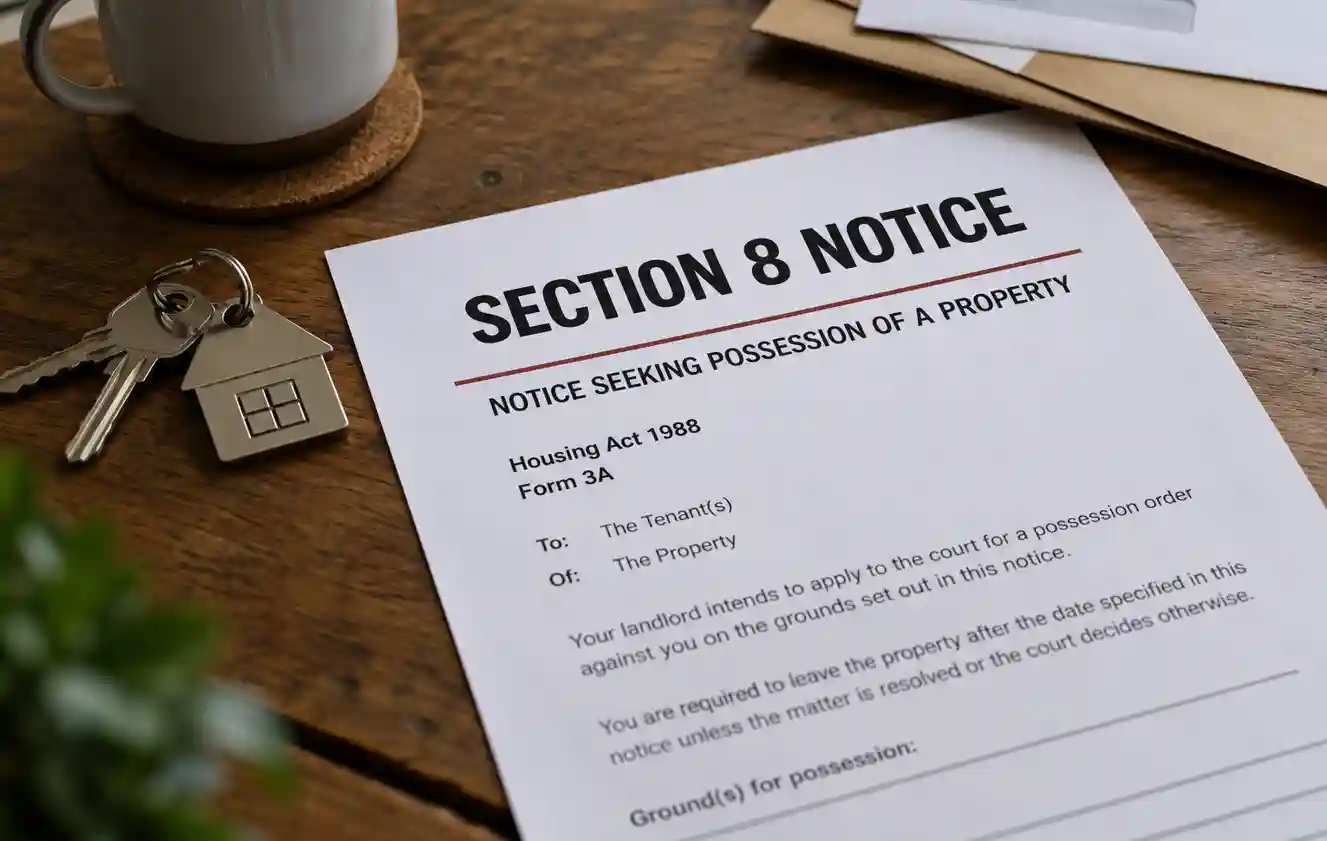
A Section 8 notice landing on the doormat reads like an ending. It isn’t one — it’s the opening move in a process that still has several stages left to run, and the landlord still has to prove the legal ground on which they are relying.
Working through what’s actually in front of you, methodically, does more to reduce the fear of the moment than any reassurance that “it’ll probably be fine” ever could. The useful questions are concrete: is this the right notice, when was it served, what ground is being alleged, does the evidence support it, has the correct notice period been given, and is there anything else that prevents the court from making a possession order?
Most importantly, a Section 8 notice does not itself end the tenancy. If you stay after the notice period expires, the landlord normally has to apply to court, obtain a possession order and, if necessary, obtain a warrant before bailiffs or authorised enforcement officers can lawfully evict you.
This article covers private assured periodic tenancies in England where notice was served on or after 1 May 2026. Wales should not be folded into the same explanation: most Welsh private tenancies became standard occupation contracts under the Renting Homes (Wales) Act 2016 in December 2022 and use a different possession framework.
What the notice is actually claiming, and what it isn’t
A Section 8 notice says that your landlord intends to seek possession of the property using one or more statutory grounds. It is not a possession order, it does not itself terminate the tenancy on the date printed in the form, and it does not give the landlord a right to change the locks or physically remove you when that date arrives.
If you remain after the relevant notice period and the dispute has not been resolved, the landlord’s next step is normally a possession claim in the county court. They then have to prove the ground or grounds being relied upon.
That distinction is worth holding onto because the language used around possession can make several very different stages sound interchangeable. “Notice served”, “court claim issued”, “possession order made” and “bailiff appointment booked” do not mean the same thing. The government’s current guide for private tenants who receive a possession notice after 1 May 2026 sets out those stages and confirms that a landlord cannot simply take possession without the court process.
That does not mean the notice should be ignored. Staying after it expires can lead to court proceedings, costs and, where rent is owed, a money judgment as well as possession. It means the notice is the point to understand the case being made against you rather than assuming the result has already been decided.
Start with the form itself
For a private assured tenancy in England where notice is given on or after 1 May 2026, the prescribed notice is Form 3A.
The older Form 3 continues to have a role in the separate social-housing assured-tenancy framework during its transitional period, but it is not the standard post-May-2026 form for ordinary private landlords.
There is an important nuance here. The law allows a landlord to use Form 3A or a form substantially to the same effect, so a notice is not automatically invalid merely because its layout differs from the downloadable government PDF or because it contains an insignificant formatting or spelling mistake.
The substance matters. A post-reform notice needs to give the correct amount of notice, set out fully the substance of the ground or grounds being relied upon and explain why the landlord says they apply. Using an obsolete form, omitting a ground, giving the wrong notice period or failing properly to explain the case can therefore be much more significant than a cosmetic error.
The government’s assured tenancy forms page contains the current Form 3A, tenant guidance and the statutory wording of the possession grounds. Comparing what you have received with the current official material is a sensible first check.
Check when it was served, not just the date typed at the top
The minimum notice period runs from service of the notice, which means the date printed on the form and the date on which it was legally served are not necessarily the same thing.
A landlord may hand the notice to you, put it through the letterbox, send it electronically where that method is legally effective, or use post. The tenancy agreement and the method of service can affect how the service date is established. Keep the envelope if it arrived by post, retain the email or message if it was sent electronically, and if it was handed to you or delivered through the door make a note of when that happened.
The point is not to manufacture a dispute over a day where none exists. It is to establish the correct starting date before deciding whether the landlord actually allowed the statutory notice period attached to the ground being used.
This matters particularly where the dates are close. The court will want to know that the landlord served the notice correctly and waited for the required period before beginning proceedings.
Identify every ground being relied on, and compare it with what actually happened
The notice should tell you which statutory ground or grounds the landlord intends to prove and why they say each applies. Do not stop at the ground number.
Form 3A requires the substance of the statutory ground to be set out and the landlord to explain the facts on which they rely. That gives you something much more useful to check than a reference such as “Ground 8” or “Ground 12” on its own.
If the notice says you owe three months’ rent, compare that with your rent statement, bank records, benefit records and any payments the landlord may not have credited correctly. If it says you breached a tenancy term, identify the actual term and what conduct is being alleged. If the landlord says they intend to sell or move into the property, the relevant ground has its own statutory requirements rather than becoming valid merely because that intention has been written on the form.
Ground-specific restrictions can matter just as much as the wording. The new moving-in and selling grounds, Grounds 1 and 1A, cannot normally require possession during the first 12 months of a new tenancy. A landlord can serve notice during that protected period, but the notice cannot require possession in a way that cuts across the statutory protection.
The useful exercise is therefore not simply “is Form 3A filled in?” It is whether the ground written on Form 3A actually fits your tenancy and the facts.
Mandatory and discretionary grounds change what happens in court
The distinction between a mandatory ground and a discretionary one matters considerably.
With a mandatory ground, the court must make a possession order if the landlord establishes all the legal requirements. With a discretionary ground, proving the underlying facts is not enough on its own: the court must also decide whether making a possession order is reasonable.
Ground 8, the mandatory serious-rent-arrears ground, is one of the most important examples under the post-2026 system. For a tenant paying monthly, the qualifying threshold is at least three months’ rent outstanding; for weekly or fortnightly rent it is at least 13 weeks. The threshold has to be satisfied both when the notice is served and at the possession hearing.
That second date matters. If the arrears have fallen below the mandatory threshold by the hearing, Ground 8 is no longer made out. The landlord may still rely on another ground — such as discretionary Ground 10 for rent arrears or Ground 11 for persistent late payment — if it was properly included in the notice and the facts support it, but the legal test is then different.
There is also a specific protection where the qualifying Ground 8 arrears have arisen because Universal Credit that should contribute towards the rent has not been received. Current government guidance says the landlord cannot use Ground 8 to obtain possession on arrears attributable to that missing benefit payment.
If serious debt is part of the problem, it is also worth telling an adviser if you are in, or may qualify for, a formal Breathing Space. Where a rent debt is protected by the debt-respite scheme, that can affect when the landlord is able to start rent-arrears possession proceedings and can extend the period for which the Section 8 notice remains usable.
For discretionary grounds, evidence about what has happened since the notice was served can be particularly important. Repayments made, agreements kept, benefit problems resolved and changes in circumstances can all matter to the court’s decision on reasonableness.
This is why reading the ground matters more than simply reading the date by which the landlord wants you to leave.
Multiple grounds can change the notice period
Different Section 8 grounds carry different minimum notice periods under the 2026 system. Some require four months, some two months, some four weeks and some two weeks.
Where several ordinary grounds are combined, the landlord generally has to wait for the longest notice period among them before starting proceedings. If one ground requires four weeks and another requires two months, a four-week date will not normally be enough.
There is, however, an important exception. If Ground 7A or Ground 14 is relied upon — grounds dealing with specified serious antisocial or criminal behaviour and antisocial behaviour — proceedings can begin immediately after service even where other grounds appear on the same notice, although the court cannot necessarily make the possession order immediately.
This is one reason not to judge a multi-ground notice simply by finding the shortest or longest period in a general guide. Every ground listed needs to be checked.
A defective notice can matter — but “valid or invalid” is not the only question
Some mistakes can stop the landlord’s case or force them to begin the process again. An incorrect form, insufficient notice period, missing ground or inadequate explanation of why the ground applies can therefore be significant.
But not every imperfection destroys a notice. The law allows a form substantially to the same effect as Form 3A, and a trivial spelling or formatting error is a very different problem from failing to state the possession ground properly.
There is another distinction tenants can easily miss: some problems do not necessarily invalidate the notice itself but can still prevent the landlord obtaining a possession order.
Tenancy-deposit protection is a good example under the post-2026 system. For most possession grounds, the court will not make a possession order while the landlord remains in breach of the applicable deposit-protection requirements. The position can be remedied in certain ways, including proper protection or return of the deposit, and the restriction does not apply to the serious antisocial-behaviour Grounds 7A and 14.
So asking only “is my Section 8 notice valid?” can be too narrow. The fuller question is whether the notice is valid, whether the ground is legally available, whether the landlord can prove it, and whether there are any other requirements that must be satisfied before the court can actually order possession.
A defective notice can buy time and sometimes defeat the current claim, but it should not be treated as a guarantee that the tenancy is safe indefinitely. A landlord may be able to correct the problem and start again.
What happens once the notice period expires
If the notice period expires and you remain in the property, the tenancy does not simply disappear.
The landlord can apply to the county court for possession. You should then receive court papers including the landlord’s claim and a defence form. The defence form is your opportunity to explain why the landlord should not obtain possession, raise changes that have occurred since the notice was served and, where appropriate, bring a counterclaim.
Do not leave it until the day of the hearing. Current government guidance gives tenants 14 days to return the defence form, and says a short written statement can be sent if completing the full form is difficult. Free help with the defence is available through the Housing Loss Prevention Advice Service, which can provide advice from the point at which you first receive written notice that possession is being sought and can also provide representation at court.
The landlord cannot keep an unused Section 8 notice indefinitely either. Under the current system, proceedings normally have to be started within 12 months beginning with the date the notice was served. That period can be extended in particular circumstances, including where rent-arrears proceedings were prevented by a Breathing Space.
At the hearing, the outcome depends heavily on the ground. The judge can dismiss or adjourn the claim, make an outright possession order or, where the law permits, make a suspended order subject to conditions.
For a mandatory ground that has genuinely been proved, the court has much less discretion about whether possession is granted. For a discretionary ground, the court can consider whether eviction is reasonable even though the underlying conduct has been established.
Rent-arrears cases can therefore change significantly between notice and hearing. Paying down arrears may take Ground 8 below its mandatory threshold. A repayment arrangement may matter to reasonableness under a discretionary ground. Evidence that the landlord’s figures are wrong can affect whether the ground exists at all.
If the court makes an outright possession order and you remain beyond the date in that order, the landlord normally still has to obtain a warrant or, where permitted, a writ before lawful physical eviction takes place. You will usually receive a further notice telling you when enforcement is due.
Changing the locks or physically removing an assured tenant without following the lawful process is not an alternative available to a landlord simply because the Section 8 notice period has expired.
The fact that you do not legally have to leave on the notice date does not mean there is never a reason to move before court. Leaving earlier may avoid some court costs or suit your circumstances, particularly where the landlord’s ground is strong and you have secured another home. But if you may struggle to find somewhere else, get housing advice before surrendering the tenancy. The government’s tenant guidance specifically recommends contacting the local council about your housing options and, where there is a risk of homelessness, speaking to the council’s homelessness-prevention team before agreeing to leave.
That is an important distinction: the notice date is not an automatic eviction date, but the decision whether to stay or leave can have practical consequences and deserves advice rather than guesswork.
The shift this article is trying to produce
A Section 8 notice is designed to communicate something serious, and it should be taken seriously. But serious does not mean final.
It is the landlord’s statement of the case they intend to bring: on a prescribed form or something substantially equivalent, relying on particular statutory grounds, after particular notice periods, with facts they will eventually have to prove to a court.
Some notices will withstand every check. Others will contain errors. Sometimes the form itself is the problem; sometimes the ground is not made out; sometimes the notice is valid but another legal obstacle prevents a possession order; and sometimes the tenant’s position changes materially between service and the hearing.
What the notice does not do is decide any of those questions by itself.
So the useful response is not simply to worry about the date printed on the front page. Establish what document you have, when it was served, what grounds it relies on, whether those grounds match the facts, whether the notice period is right and what needs to happen next. If court papers arrive, respond to them rather than waiting for the hearing; if rent arrears are involved, deal with the debt position as early as possible; and if leaving could put you at risk of homelessness, get advice before giving up the home.
A Section 8 notice is the beginning of the landlord’s possession case. It is not the court’s decision on it.
This article provides general property information, not legal, financial, surveying or other professional advice for your individual circumstances. Property disputes and regulatory issues can depend on the facts, documents, location and applicable law. If significant money, property or legal rights are at risk, or you are considering an irreversible course of action, take appropriate professional advice before proceeding.

