

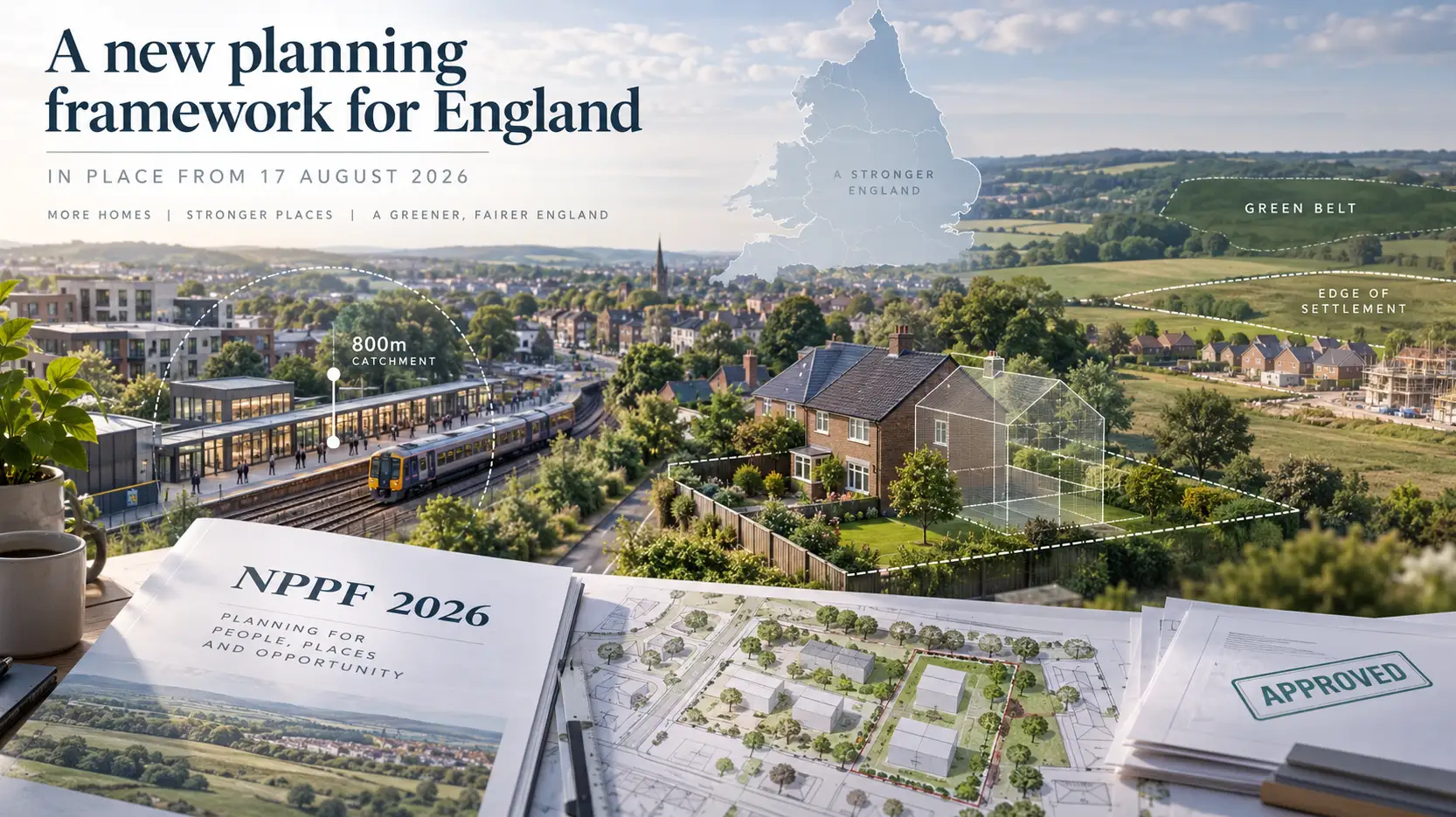
A planning application judged today is not being judged against the same national policy that applied before 17 August. Nothing about the site has changed, but the yardstick has. That is the practical reality behind the replacement National Planning Policy Framework the government published on 17 August 2026 — and it matters most where a proposal touches a handful of specific things: a plot within walking distance of a well-connected station, a house with room in the garden, land just outside a settlement boundary, or an application still waiting for advice from a statutory consultee whose formal role the government has decided to change but has not yet changed in law. The government set out the wider reasoning behind the reforms in its Creating a clear, rules-based planning system publication.
None of this means permission has become automatic anywhere. It means the balance being struck by planning officers, committees and inspectors has moved, in some places significantly, and anyone with an application in the system — or a site they are weighing up — needs to understand where.
A different starting point for decisions, not a different law
The new Framework is a wholesale restructuring of the NPPF, with policies now separated much more clearly between plan-making and decision-making. The national decision-making policies took effect as material considerations from the date of publication, replacing the December 2024 Framework for that purpose. Plan-making is more complicated: Annex A contains transitional arrangements, meaning not every plan already in preparation switched to the new policy regime overnight. The government explains the implementation approach in its policy paper accompanying the new Framework.
It is worth being precise about what that means. The NPPF is national planning policy, not primary legislation, and it does not suspend the statutory requirement to determine applications in accordance with the development plan unless material considerations indicate otherwise. What has changed is the weight the new Framework tells decision-makers to give to conflicting local policy. Under Annex A, existing development plan policies found to be materially inconsistent with the new national decision-making policies should be given very limited weight, except where they have been examined and adopted or made against the new Framework. Older policies do not lose weight simply because of their age.
That distinction matters. A local plan has not suddenly disappeared because it predates 17 August, but where a genuine material inconsistency exists, the new national policy may now alter the planning balance substantially.
Where the presumption now runs by default
The Framework replaces the previous form of the presumption with a restructured approach across policies S3 to S6. Inside defined settlement boundaries, Policy S4 establishes what the government has described as a “default yes”: development should be approved unless its benefits would be substantially outweighed by adverse effects when assessed against the national decision-making policies.
That is a more approval-oriented national starting point, but it is not an absence of planning control. Design, heritage, flood risk, protected landscapes, biodiversity and other considerations continue to matter, and several national policies are expressly written so that proposals should be refused in specified circumstances.
Outside settlement boundaries, Policy S5 applies a similar planning balance only to particular categories of development. They include the reuse, extension, alteration or replacement of certain existing lawful buildings; redevelopment of previously developed land; limited infilling within groups of houses; qualifying development within reasonable walking distance of a well-connected station; and development addressing an evidenced unmet need. For housing, the Framework specifically identifies the absence of a five-year supply of deliverable housing sites or a Housing Delivery Test result below 75% as circumstances capable of establishing that unmet need, subject to the other requirements of the policy.
Proposals outside settlements which do not fall within one of the S5 categories face a different test and should only be approved in exceptional circumstances where the benefits substantially outweigh the adverse effects. Green Belt and Local Green Space are dealt with separately rather than through S5.
Why station catchments have become a live planning question
This is likely to be one of the changes with the sharpest practical consequences for landowners, developers and agents. The Framework defines a “well-connected station” as a railway station or Underground, tram or light-rail stop within one of the top 80 Travel to Work Areas in England ranked by Gross Value Added, combined with minimum weekday service-frequency requirements. The draft had proposed the top 60 areas; the final Framework expanded that to 80.
Reasonable walking distance is defined as around 800 metres, or around a 10-minute walk where topography, route availability, route quality or physical barriers mean that an 800-metre measurement would not reflect a reasonable walking journey.
Outside settlements, qualifying residential and mixed-use development within that distance can fall within Policy S5 where it is also physically well related to the station or settlement, can be accommodated by existing or proposed infrastructure and would not prejudice comprehensive development of the wider area. Within the Green Belt, a separate route now exists under Policy GB7. An 800-metre circle on a map is therefore a starting point for the planning analysis, not a guarantee of permission.
The Green Belt dimension needs particular care because it is easy to overstate. Policy GB3 provides that, where a development plan’s spatial strategy has identified suitable land around a well-connected station for development, exceptional circumstances do not have to be demonstrated to justify altering Green Belt boundaries. That operates through plan-making; it does not mean Green Belt boundaries automatically disappear around qualifying stations.
There is also a separate and important decision-making change. Policy GB7 now includes residential or mixed-use development within reasonable walking distance of a well-connected station among the categories capable of being treated as not inappropriate development in the Green Belt, provided the policy’s relationship, infrastructure and comprehensive-development tests are met. Major schemes involving housing must also comply with the Golden Rules in Policy GB8.
For major housing development subject to those Golden Rules, the affordable-housing requirement can come from a development plan policy produced under the new Framework. Until such policies are in place, the national fallback is 15 percentage points above the highest existing affordable-housing requirement that would otherwise apply, capped at 50%. Where there is no pre-existing requirement, 50% applies by default. The Green Belt changes are therefore material, but they are a long way from a general licence to build near any station.
The density floor near stations — and its limits
Policy L3 sets national minimum densities for qualifying residential and mixed-use development within reasonable walking distance of a well-connected station. The minimum is 35 dwellings per hectare of net developable area, rising to at least 45 dwellings per hectare where the station’s service frequency is at least twice the minimum required for a well-connected station. The draft Framework had proposed higher figures of 40 and 50 dwellings per hectare.
Stations outside the top 80 Travel to Work Areas do not meet the Framework’s definition of a well-connected station and are therefore outside these national station-density minimums. There is also a limited exception for sites below the threshold for major development where meeting the standard can be shown to be inappropriate or impossible, as well as an exception for traveller sites.
These are floors, not ceilings, and the Framework expects them to be exceeded where possible, particularly in highly connected locations. Net developable area is a narrower measure than the gross site boundary, so density figures quoted for a site are only meaningful once that distinction is clear.
There is also a significant consequence for schemes that fail the test. Policy L3(4) says development proposals that do not make efficient use of land in accordance with the policy should be refused. A site’s proximity to a qualifying station is therefore not, by itself, evidence that the land is more valuable or readily developable. Density, design, infrastructure capacity and the economics of the scheme still matter.
The garden question: stronger support, not a blank cheque
This is the part of the Framework most likely to interest individual homeowners and small developers, and the part most easily overstated in coverage that reduces it to “you can build in your garden now”.
Policy L1 requires development plans to identify where there is scope for intensification, including redevelopment of low-density residential plots and infill within residential curtilages. Policy L2 then gives substantial weight to the benefits of proposals within settlements that create additional homes or floorspace through sensitive redevelopment or additional development within existing plots.
A separate draft Policy L4 had proposed national criteria specifically for residential extensions, but it was dropped from the final Framework. The December 2025 draft NPPF shows how the proposal developed before publication of the final version. The curtilage provisions that remain are therefore particularly important when understanding what the August changes actually do.
For development within residential curtilages, Policy L2 says that new development should not occupy more than twice the footprint of all the existing buildings on the site and should leave at least 50% of the non-developed area within the curtilage undeveloped after construction. The existing buildings are assessed as they stood on the date the Framework was published. The policy expressly allows those figures to be exceeded where additional development can be accommodated without harm to the overall character of the area, taking infrastructure and the sustainability of the location into account.
None of this converts a residential garden into previously developed land, and none of it removes the other planning questions that can decide an application: safe access, daylight and sunlight, privacy, usable external amenity space, design and the effect on the wider street scene. The honest description of the change is that national policy now gives suitable intensification within residential plots a clearer and more favourable starting point — not that permission follows automatically.
Density is rising everywhere within settlements, not just near stations
The push towards higher density is not confined to station catchments. Policy L3 says residential and mixed-use proposals within settlements should contribute to an increase in the density of the area unless there is clear justification that doing so would be inappropriate or impossible. Existing character remains relevant, but the Framework says it should not prevent development which makes the most of an area’s potential.
That can mean infill, redevelopment, additional storeys, corner development or simply more efficient layouts rather than uniformly taller buildings. It is nevertheless a significant change in the national starting point that applicants, homeowners, agents and local authorities will now have to work through against the circumstances of individual sites.
Two consultee changes — but only one took effect on 17 August
One distinction is easy to blur and worth stating precisely, because the reforms announced on the same day operate on different legal footings.
Policy DM3 is part of the new national decision-making policy and therefore took effect immediately. It says councils should consult statutory or internal consultees only where necessary and should not delay a planning decision beyond a consultee’s statutory deadline merely to obtain advice, unless there is insufficient information to make the decision, proceeding without the advice would create public-safety risks, or more detailed advice may enable approval rather than refusal.
Separately, the government published its response on reforming the statutory consultee system. It confirmed that The Gardens Trust and Theatres Trust are to lose statutory consultee status and move to notification arrangements; Sport England will remain a statutory consultee but with a narrower remit; and the government will also change the referral or notification criteria applying to bodies including National Highways, Active Travel England, Historic England and the Mining Remediation Authority.
Those changes did not themselves come into force on 17 August. The government response states that regulations will follow to bring the reforms into force. As at 22 September 2026, GOV.UK continues to describe those implementing regulations as forthcoming, so current statutory consultation requirements should continue to be checked rather than assuming the announced narrower regime already applies.
| Change | Position as at 22 September 2026 | Why it matters |
|---|---|---|
| New NPPF national decision-making policies | In effect from 17 August 2026 | They are material considerations for live planning decisions |
| New NPPF plan-making policies | Subject to Annex A implementation and transitional arrangements | The applicable Framework can depend on the type and stage of the plan |
| Statutory consultee reforms | Government policy confirmed, but implementing regulations still to come | Existing legal consultation requirements should not be treated as already replaced |
Applicants and agents relying on the announced narrower consultee regime to argue that a referral is no longer required should therefore check the position immediately before acting.
What the new Framework does not do
It is worth being clear about the limits because several easy misconceptions follow from the headline changes. The new NPPF does not mean every site within 800 metres of a station will get permission, that every garden can be built on, that local plans or the development plan system have disappeared, or that Green Belt protection has generally gone.
Nor have the statutory consultee reforms announced in August all taken effect. Historic England, for example, is not being stripped of its role altogether; the government intends to narrow some of its notification criteria while retaining requirements for the most significant heritage cases.
Planning permission is still required for the great majority of the development discussed here. National policy support is not the same thing as a grant of permission, and it never has been.
The practical significance of the August 2026 Framework will not be settled by the document itself. It will be settled site by site, as local planning authorities update their plans, as inspectors apply the new policies to live appeals, and as the interaction between national policy, individual development plans and genuine constraints on individual sites plays out in decisions over the coming months.
What is already true is that the national policy against which those decisions are being measured is materially different from the one that applied before 17 August — and anyone with an application in the system, or a site under consideration, has good reason to understand exactly how.
This article provides general information about planning policy in England and does not constitute planning or legal advice. Planning decisions depend on the circumstances of individual sites and proposals, and policy, legislation and guidance can change.

